Visto n' Visa
Blog
Notícias e artigos
Destinations
Careers
Immigrants

Want to live and work in Wheaton?

Personalized immigration plan with eligible visas, costs, and next steps for your goal!

If you are not eligible, you will know exactly why and what to do to improve your approval chances.

Save up to 12 hours in meetings

No pointless assessments.

Save up to 90%

Save money on vague or unfocused consultations

Avoid Fraud and Mistakes

One mistake can cost you your visa

Total Impartiality

Zero commercial bias

Decide with peace of mind

No toxic urgency

Fast and Accurate

Answers in minutes, no guesswork

Mosaic of immigrant communities in Montgomery County

Wheaton is one of the most diverse points in the Washington metropolitan area, with a strong presence of Latin American, Asian and African immigrants. More than half of residents speak a language other than English at home.

Wheaton has around fifty thousand residents and is among the most multicultural areas in the state of Maryland. The population is predominantly composed of Hispanic, Asian and non-Hispanic white residents, with a significant Black community and a growing presence of families from East Africa. Finding three or four generations of the same family living near one another is common.

Spanish is widely spoken in commerce, mainly in Salvadoran, Guatemalan and Mexican varieties. Asian languages such as Vietnamese, Korean, Mandarin Chinese and Tagalog also appear in schools, churches and supermarkets. The Montgomery County Public Schools system serves students who speak dozens of languages at home and offers well-structured ESOL programs.

Religiously, the neighborhood reflects this mix: Catholic parishes with Spanish-language Masses, Latin evangelical churches, Buddhist temples, mosques and Ethiopian Orthodox congregations coexist within a few kilometers. The age profile is balanced, with a strong presence of young families with school-age children.

Languages spoken
  • English
  • Spanish
  • Vietnamese
  • Korean
  • Mandarin Chinese
  • +2 more
Main religions
  • Catholicism
  • Evangelical Protestantism
  • Ethiopian Orthodox Christianity
  • Buddhism
  • Islam
  • +1 more

Lower cost than Bethesda, but still driven up by Metro access

The cost of living in Wheaton is high by national U.S. standards, but moderate for the Washington area. Housing is the biggest expense, and proximity to the Metro pushes rents up in newer buildings.

Compared to downtown Washington, Bethesda or Chevy Chase, Wheaton is one of the more affordable options in Montgomery County for those who need direct Metro access. Even so, the cost of living is clearly above the U.S. national average, particularly for housing, car transportation and private childcare. Salary, health insurance and local taxes tend to weigh on the budget.

Groceries and daily food can be cheaper than in neighboring areas because the supply of ethnic markets is vast. Stores such as H Mart, Grand Mart and Latin markets compete with Giant and Safeway, and those who cook at home save considerably. Eating out is also more affordable than downtown: many restaurants offer complete meals at prices well below those in Dupont Circle or Adams Morgan.

Other significant expenses include property tax, which is high in Montgomery County, and car insurance, which rises due to being within the metropolitan area. Public transportation via WMATA reduces that cost for those who work in D.C., but parking and toll fees in the region continue to weigh on those who depend on a car.

105Cost index (US = 100)5% above US average
CategorySingleCoupleFamily (2 + 2)
iHousing$1,363$1,572$1,992
iFood$398$797$1,447
iTransport$524$891$1,153
iHealthcare$294$588$1,101
iChildcare$1,908
iOther$891$1,604$2,254
Monthly total$3,470$5,452$9,855

Source: U.S. BLS Consumer Expenditure Survey 2023 + BEA Regional Price Parities 2023 · Estimates in USD, monthly.

Row houses, new buildings near the Metro, and residential pockets

Wheaton's housing stock combines suburban single-family homes, townhouses, older apartment buildings and new mixed-use towers built around the Metro station. Prices vary considerably based on proximity to the rail line.

The heart of Wheaton, around Veirs Mill Road, Georgia Avenue and the Metro station, concentrates apartment buildings and new mixed-use developments, such as the Wheaton Triangle and buildings above retail stores. These are practical options for those who work in D.C. and want to walk to the Metro. Studios and one-bedroom apartments tend to appear most frequently in this range.

Moving away from the commercial core, residential streets such as those in Glenmont, Wheaton Hills, Kemp Mill and Connecticut Avenue Estates offer row houses and single-family homes built between the 1950s and 1980s. This is the most common option for families with children. Homes have yards, garages and are near Montgomery County public schools.

The rental market is competitive, especially near the station. It is worth considering older buildings a few blocks in, which tend to have lower rents and larger units. Roommate culture works well in Glenmont and Kemp Mill houses, popular among young professionals and students from the University of Maryland College Park.

Recommended neighborhoods
  • Wheaton Hills
  • Kemp Mill
  • Glenmont
  • Connecticut Avenue Estates
  • Wheaton Triangle
  • +1 more

Job market driven by the federal government and Montgomery County healthcare

A large share of Wheaton residents work for the federal government in D.C. or in health and research institutions within Montgomery County. Commerce, hospitality and local services also employ many people, especially within the immigrant population.

The main driver of employment for Wheaton residents is the federal government. Being just a few Metro stops from downtown Washington, it is common to work at agencies such as the Department of Health and Human Services, Department of Agriculture, EPA, NIH or contractors that serve the government. Jobs in county and state agencies are also frequent, given the size of Montgomery County's administrative structure.

Healthcare and biomedical research are strong due to proximity to the National Institutes of Health campus in Bethesda, Walter Reed in Silver Spring and hospitals such as Holy Cross in Silver Spring and Adventist HealthCare in White Oak. Nearby universities, such as the University of Maryland College Park and Montgomery College, offer positions in education, research and administration.

For immigrants who are just starting out, the service sector absorbs a great deal of labor: ethnic restaurants, markets, construction, landscaping, cleaning, elder care and childcare. The commercial avenues of Wheaton are a common path for opening small businesses, such as family restaurants, salons and repair shops.

Dominant sectors
  • Federal government
  • Healthcare and biomedical research
  • Education
  • Hospitality and food service
  • Construction
  • +1 more
Major employers
  • Montgomery County Government
  • Holy Cross Hospital
  • Adventist HealthCare
  • Montgomery College
  • Westfield Wheaton
  • +1 more

Large, diverse public schools and universities just minutes away

Wheaton is served by the Montgomery County Public Schools network, one of the largest and most multicultural in the United States. For higher education, Montgomery College is located within the neighborhood and research universities are a short distance away.

The Montgomery County Public Schools network, MCPS, serves students in the area and is recognized for its linguistic diversity and ESOL programs for students learning English. Schools such as Wheaton High School, Northwood High School and Albert Einstein High School welcome recently arrived immigrant families and offer specific support for translation and cultural adaptation.

For community and technical education, Montgomery College maintains campuses in Takoma Park and Rockville, with English courses, professional certifications and associate degrees that serve as a bridge to universities. Evening and weekend programs assist those who work full time. County resident scholarships are an important gateway for immigrants.

For traditional higher education, the University of Maryland College Park is approximately fifteen minutes by car and offers the full range of undergraduate and graduate programs. Other nearby options include Johns Hopkins University in Baltimore and its D.C. campuses, Catholic University of America and American University, all reachable by Metro or bus.

Notable universities
  • Montgomery College
  • University of Maryland, College Park
  • Johns Hopkins University (D.C. campuses)
  • Catholic University of America
  • American University

Large nearby hospitals and community clinics for immigrants

The area has large hospitals in Silver Spring, Bethesda and Takoma Park, plus specific community clinics to serve low-income and immigrant populations, with translators and sliding-scale fees.

For emergencies and hospital stays, the most commonly used hospitals are Holy Cross Hospital in Silver Spring, Adventist HealthCare White Oak Medical Center, Suburban Hospital in Bethesda and the MedStar and Johns Hopkins complex in the region. The National Institutes of Health, in Bethesda, is a world reference in biomedical research, though it does not function as a general hospital.

For routine care, there are several community clinics affiliated with the county's Department of Health and Human Services. Mary's Center, Mercy Health Clinic and Community Clinic Inc. serve immigrants regardless of documentation status, with a sliding scale of payment, bilingual physicians and assistance obtaining coverage via Medicaid and state programs.

Health insurance is practically essential in the United States. Those with formal employment receive coverage through their employer. Those who work in services or are self-employed can purchase coverage through Maryland Health Connection, with federal subsidies based on income. Pharmacies such as CVS, Walgreens and Giant Pharmacy operate throughout the neighborhood, several with Spanish-language service.

Wheaton

Generally safe residential neighborhood, with attention needed in specific corridors

Wheaton is considered safe by Washington metropolitan area standards, with crime rates comparable to other Montgomery County suburbs. Most incidents involve theft in parking lots and from vehicles.

Residential areas such as Wheaton Hills, Kemp Mill, Connecticut Avenue Estates and Forest Glen are quiet, with active neighborhoods and a low crime rate. Families walk to parks, schools and markets without major concerns. As in any American suburb, it is advisable to lock the car, avoid leaving valuables visible and pay attention in shopping center parking lots at night.

The central commercial corridor, around the Metro station and Georgia Avenue, sees more foot traffic and consequently more incidents of theft and minor altercations, particularly at bar closing time. Montgomery County Police maintains a regular presence in the area and lighting is reasonable. Women generally report feeling comfortable moving around during the day, with normal caution at night.

For emergencies, the number is 911. For non-emergency services and civil matters, MC311 is the county channel. Montgomery County Police has specific units for crimes against immigrants and assists victims regardless of immigration status, a policy reaffirmed multiple times by local authorities.

Safer neighborhoods
  • Wheaton Hills
  • Kemp Mill
  • Forest Glen
  • Connecticut Avenue Estates
  • Glenmont (residential area)
Areas to avoid
  • Westfield Wheaton parking lots at night
  • Vicinity of the Metro station after bars close
  • Industrial corridor along Veirs Mill Road late at night

Red Line Metro, buses and cycling for the more adventurous

Wheaton has a rare advantage for an American suburb: its own Metro station, connecting directly to downtown Washington via the Red Line. WMATA bus service and the county's Ride On complete the public transit network.

The Wheaton station of the Washington Metro is located at the neighborhood's central axis on the Red Line, and runs to stations such as Silver Spring, Union Station, Metro Center and Bethesda. It is possible to reach downtown D.C. in approximately 30 to 40 minutes without changing lines. The station also features one of the longest escalators in the Western Hemisphere, making it a local landmark.

Metrobus (WMATA) and Ride On (Montgomery County) bus lines cover areas where the Metro does not reach, connecting Wheaton to Aspen Hill, Olney, Rockville, Takoma Park and the University of Maryland campus in College Park. Those who need a car find public parking in several commercial center buildings, though it is metered and paid during business hours.

The neighborhood has some bike lanes and shared trails, but cycling infrastructure remains uneven outside the parks. The Sligo Creek Trail and Rock Creek Trail pass nearby and allow cycling into D.C. through the forest. For those leaving the area, the most commonly used airports are Reagan National (DCA), Dulles (IAD) and Baltimore-Washington (BWI).

Airports
  • DCA — Ronald Reagan Washington National (approximately 25 km)
  • IAD — Washington Dulles International (approximately 50 km)
  • BWI — Baltimore/Washington International Thurgood Marshall (approximately 50 km)
  • Bike infrastructure

Climate

Wheaton

Informal gastronomic capital of greater Washington

Wheaton is best known for its food rather than its museums. It has a well-earned reputation as one of the best places to eat authentic ethnic food throughout the Washington metropolitan area, with small, family-run restaurants from dozens of countries.

Local culture is built around the street and the table. The streets around Georgia Avenue and University Boulevard concentrate award-winning Salvadoran pupuserias, Peruvian barbecue, Vietnamese pho, Ethiopian food with injera, Korean barbecue restaurants, authentic Mexican taquerias and Asian bakeries. Food critics in the region regularly cite Wheaton as a destination for those seeking flavor without the tourist crowds.

The neighborhood has annual festivals tied to immigrant communities, featuring live music, dance and cuisine. Events such as Taste of Wheaton bring residents together around local restaurants. In Silver Spring, just minutes away, larger festivals take place, such as the AFI Silver Theatre screenings and Independence Day parades, which draw residents from Wheaton.

For art and history, most of the cultural weight is found in downtown Washington, with Smithsonian museums available for free just one Metro ride away. Locally, there are small galleries, active public libraries (Wheaton Library and Recreation Center) and community theaters. The combination of a short Metro ride to D.C. and a vibrant neighborhood life defines the culture of those who live here.

Notable dishes
  • Salvadoran pupusas
  • Peruvian pollo a la brasa
  • Vietnamese pho
  • Ethiopian injera with tibs
  • Korean bulgogi and banchan
  • +1 more
Annual events
  • Taste of Wheaton
  • Wheaton Arts Parade and Festival
  • Montgomery County Agricultural Fair
  • Silver Spring Jazz Festival

Large parks, ethnic markets and easy access to D.C. museums

Wheaton's attractions are divided between the regional parks surrounding the neighborhood, the gastronomic scene and proximity to downtown Washington, which puts Smithsonian museums just one Metro ride away.

Wheaton Regional Park is the local highlight. It has trails, a fishing lake, an antique carousel, a miniature train, picnic areas and the famous Brookside Gardens, the county's botanical garden with greenhouses, a Japanese garden and light festivals in winter. It is one of the most visited parks in Montgomery County and draws families from across the region on weekends.

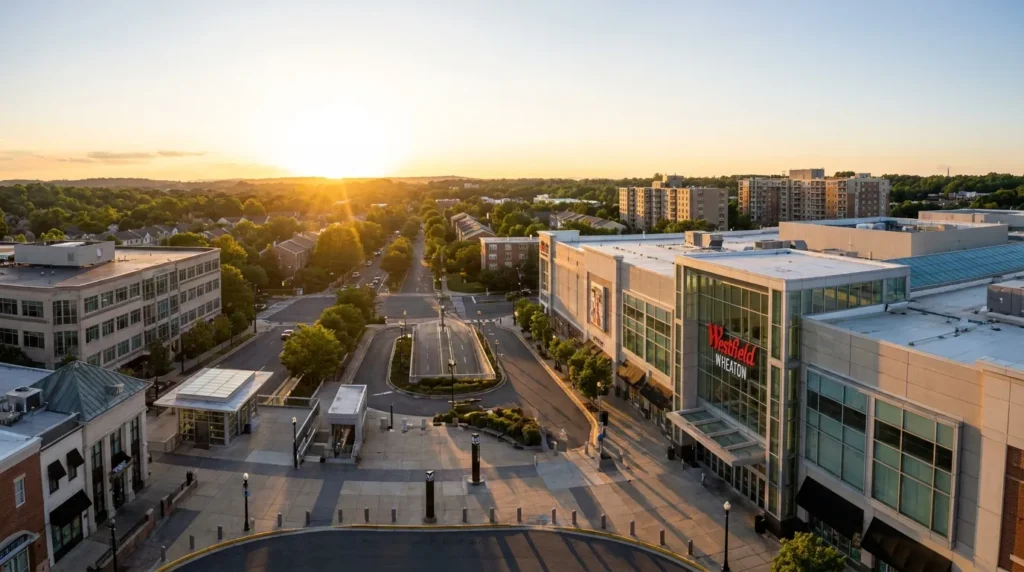
Another highlight is Westfield Wheaton, a shopping center with a cinema, restaurants and large stores, which serves as a neighborhood meeting point. The Asian markets H Mart and Grand Mart, along with Latin and African markets, have become attractions in their own right, with vast sections of food, baked goods and products from around the world.

Thanks to proximity to Washington, D.C., residents take advantage of Smithsonian museums, all free of charge, National Mall monuments, national parks such as Rock Creek Park and seasonal events like the Cherry Blossom Festival, all accessible via the Red Line Metro. In just a few hours, it is possible to combine a morning at Brookside Gardens and an afternoon at the Smithsonian without needing a car.

  1. 1Wheaton Regional Park
  2. 2Brookside Gardens
  3. 3Wheaton Park Carousel and Train
  4. 4Westfield Wheaton
  5. 5Sligo Creek Trail
  6. 6Georgia Avenue ethnic markets
Parks & green spaces
  • Wheaton Regional Park
  • Brookside Gardens
  • Sligo Creek Park
  • Rock Creek Park (nearby access)
  • Glenmont Local Park
  • +1 more

One of the most multicultural neighborhoods on the U.S. East Coast

Wheaton and the surrounding area are home to immigrant communities from Central America, South America, Southeast Asia, Korea, China, Ethiopia and West Africa. Diversity is evident in schools, churches, commerce and daily life.

The most visible groups include Salvadorans, Guatemalans, Hondurans, Mexicans, Peruvians and Bolivians, with a strong presence in commerce, construction and restaurants. The Salvadoran community is particularly large throughout Montgomery County and has had cultural associations, churches and Spanish-language media established for decades.

Asian communities are equally strong. Vietnamese, Korean, Chinese, Filipino and Indian residents have well-established temples, churches, markets and commercial areas in Wheaton and Rockville. The Ethiopian and Eritrean presence is a hallmark of the Washington metropolitan area in general, with restaurants, Orthodox churches and community organizations very active along the Silver Spring-Wheaton corridor.

For newly arrived immigrants, there is an organized support network. Organizations offer English classes, documentation assistance, legal referrals and support for children in schools. Montgomery County has explicit inclusion policies, with multilingual service in schools, public hospitals and local government agencies.

17,000
Foreign-born residents
estimated
Top countries of origin
  • El Salvador
  • Vietnam
  • Ethiopia
  • China
  • South Korea
  • Mexico
  • Guatemala
  • Philippines
Foreign consulates
  • El Salvador Consulate General (Washington, D.C.)
  • Mexico Consulate General (Washington, D.C.)
  • Guatemala Consulate General (Washington, D.C.)
  • Peru Consulate General (Washington, D.C.)
  • Brazil Consulate General (Washington, D.C.)
  • +3 more
Community organizations
  • CASA de Maryland
  • Identity Inc.
  • Mary's Center
  • Ethiopian Community Center in Washington D.C.
  • Asian American LEAD
  • Montgomery County Office of Community Partnerships

Latest posts

Posts about Maryland

Coverage and updates related to this destination.

Showing content from Maryland, as there is no specific data for Wheaton yet.