Visto n' Visa
Blog
Notícias e artigos
Destinations
Careers
Immigrants

Want to live and work in Frederick?

Personalized immigration plan with eligible visas, costs, and next steps for your goal!

If you are not eligible, you will know exactly why and what to do to improve your approval chances.

Save up to 12 hours in meetings

No pointless assessments.

Save up to 90%

Save money on vague or unfocused consultations

Avoid Fraud and Mistakes

One mistake can cost you your visa

Total Impartiality

Zero commercial bias

Decide with peace of mind

No toxic urgency

Fast and Accurate

Answers in minutes, no guesswork

Predominantly white population with growing diversity

Frederick has a predominantly white population, but with growing diversity: expanding Latin, Asian, and African communities, reflecting recent urban growth and economic attraction.

Compared to southern Montgomery County, Frederick has a more traditional ethnic composition, with a non-Hispanic white majority. Over the past two decades, however, the city has become considerably more diverse. Latinos, particularly Salvadorans, Mexicans, and Guatemalans, form the largest minority, followed by African Americans, Asians, primarily Indians and Chinese, and African immigrants.

This diversity is visible in schools, commerce, and corridors such as East Patrick Street, with several Latin restaurants and markets. Frederick County has invested in ESL programs and bilingual services as the immigrant community has grown. The Brazilian presence is small but expanding, tied to professionals working in DC or at Fort Detrick who reside in Frederick.

English dominates in the public sphere, with Spanish as a common second language in some neighborhoods and establishments. Religiously, Protestant churches of various denominations, historic Catholic parishes, synagogues, mosques, Hindu temples, and Latin evangelical congregations coexist. Trinity Chapel, Evangelical Lutheran Church, and All Saints Episcopal are part of the downtown historic heritage.

Languages spoken
  • English
  • Spanish
  • Mandarin
  • Hindi
  • Korean
Main religions
  • Catholic
  • Protestant
  • Evangelical
  • Jewish
  • Hindu

Less expensive than Washington and Montgomery County, but rising

Frederick has a significantly lower cost of living than Washington or southern Montgomery County, with affordable rents and reasonably priced homes, though city growth has been pushing prices up.

Frederick has historically been one of the most affordable options in the broader Washington metropolitan area. Apartment and townhouse rents, home sale prices, and basic service costs are clearly below what is paid in Rockville, Gaithersburg, or central DC. For a family, buying a home in Frederick has become a viable alternative where Bethesda was already out of reach.

The city's recent success has pushed prices upward. More sought-after neighborhoods, such as areas near downtown and around Worman's Mill, have become considerably more expensive in recent years. Even so, the overall cost-of-living index remains below the mid-Atlantic average, and property taxes in Frederick County are lower than in Montgomery County, a decisive factor in home purchases.

For everyday needs, supermarkets such as Wegmans, Giant, Aldi, and Walmart cover most shopping. Downtown restaurants range from cuisine by award-winning chefs to casual Latin and Asian options. A car is practically required, and insurance costs are at a moderate level. For those commuting to DC, the MARC train factors into the monthly budget.

105Cost index (US = 100)5% above US average
CategorySingleCoupleFamily (2 + 2)
iHousing$1,363$1,572$1,992
iFood$398$797$1,447
iTransport$524$891$1,153
iHealthcare$294$588$1,101
iChildcare$1,908
iOther$891$1,604$2,254
Monthly total$3,470$5,452$9,855

Source: U.S. BLS Consumer Expenditure Survey 2023 + BEA Regional Price Parities 2023 · Estimates in USD, monthly.

Historic homes, new subdivisions, and surrounding townhouses

Housing in Frederick ranges from historic homes in the downtown area to new subdivisions with townhouses and detached homes nearby, in a market still more accessible than southern Maryland.

The historic core, with late 18th- and 19th-century brick homes on streets such as Court, Church, and Patrick, attracts buyers seeking character and walkability. These properties are expensive and competitive, but offer a near-urban lifestyle. Around downtown, neighborhoods such as North End, West Side, and Baker Park combine older homes, parks, and a family-friendly pace.

In newer subdivisions such as Worman's Mill, Spring Ridge, Urbana, and Whittier, two- and three-story townhouses and detached homes predominate, generally with HOA fees. These neighborhoods attract families and professionals seeking new construction at prices affordable by regional standards. Oakdale and Linganore-Bartonsville, in the surrounding area, offer even more space, with an almost rural feel.

For renters, apartment complexes near Route 26, Spring Ridge, and downtown list units on Apartments.com and Zillow. Move-in specials are common. For buyers, it is important to check school district boundaries and commute times to I-270, which can become heavy for those working in DC. A home inspection, particularly for historic properties, is an essential step.

Recommended neighborhoods
  • Downtown Historic District
  • Baker Park
  • Worman's Mill
  • Spring Ridge
  • Urbana
  • +1 more

Fort Detrick, biotech, healthcare, and proximity to greater Washington

Frederick's job market revolves around Fort Detrick, biotech, healthcare, and the federal government, complemented by commerce, services, and access to the I-270 and Washington employment corridor.

Fort Detrick is the heart of Frederick's economy. The U.S. Army base is home to the United States Army Medical Research Institute of Infectious Diseases, a portion of the National Cancer Institute, and several government biomedical research units. It employs thousands of civilians, military personnel, and contractors, with strong demand in life sciences, security, and technology.

Around Fort Detrick, a biotechnology ecosystem has grown, including companies such as AstraZeneca in Frederick, Leidos Biomedical Research, Charles River Laboratories, and bioscience startups. Frederick Health Hospital, formerly Frederick Memorial, is the largest civilian healthcare employer, and the county school system is also a major employer. Commerce, hotels, and restaurants round out the picture.

Many Frederick residents commute to DC, Rockville, or Bethesda. The drive along I-270 is taxing during peak hours, and the MARC train helps partially. For immigrant professionals in biosciences, IT, healthcare, and engineering, Frederick is an appealing base: it combines local employment with access to Maryland's research corridor, which includes some of the world's most respected centers.

Dominant sectors
  • Biotechnology
  • Biomedical research and defense
  • Healthcare
  • Federal government
  • Education
  • +1 more
Major employers
  • Fort Detrick
  • Frederick Health Hospital
  • AstraZeneca Frederick
  • Leidos Biomedical Research
  • Frederick County Public Schools
  • +1 more

Well-rated public district, community college, and nearby universities

Frederick is served by the well-rated Frederick County Public Schools, has Frederick Community College, Hood College within the city, and the University of Maryland just over an hour away.

Frederick County Public Schools is one of the better-performing districts in the mid-Atlantic, with schools such as Urbana High School and Linganore High School appearing in state rankings. There is a broad offering of Advanced Placement courses, technical programs at the Career and Technology Center, and ESL support for immigrant students. The school community reflects the city's growing diversity.

Frederick Community College, on the west side of the city, offers professional, technical, ESL, and transfer-preparatory courses. It is a common option for immigrant adults who need to validate credentials or refine academic English. Programs such as nursing and cybersecurity have a strong regional reputation, and partnerships with state universities facilitate transfers.

Hood College, a private liberal arts institution founded in 1893, is located in the center of the city and offers undergraduate and graduate programs in areas such as computer science, biotechnology, business, and education. Mount St. Mary's University, in Emmitsburg to the north, is another nearby option. The University of Maryland College Park, Johns Hopkins, and UMBC are approximately an hour away.

Notable universities
  • Hood College
  • Frederick Community College
  • Mount St. Mary's University
  • University of Maryland College Park
  • Johns Hopkins University

Robust local hospital and proximity to DC's medical corridor

Frederick has Frederick Health Hospital as its main center, with several clinics and medical offices, and quick access to reference hospitals in Bethesda, Baltimore, and Washington for complex cases.

Frederick Health Hospital, in the north-central part of the city, is Frederick's primary hospital. It offers emergency care, maternity services, surgery, oncology, orthopedics, and various specialties. It has a strong regional reputation, and its clinic network, Frederick Health Medical Group, covers primary care and specialties at multiple locations throughout the city and county.

For outpatient care and minor urgent needs, clinics such as Patient First, CVS MinuteClinic, and MedExpress are distributed throughout the city. Primary care is available through private practices affiliated with Frederick Health Medical Group, Adventist HealthCare, and national networks. For immigrants, Mission of Mercy and community clinics offer services on an income-based sliding scale.

For highly complex cases, hospitals such as Johns Hopkins in Baltimore, the NIH Clinical Center in Bethesda, Holy Cross in Silver Spring, and MedStar Washington handle referrals. The roughly one-hour distance makes this practical for consultations and specialized procedures. Maryland Health Connection enables individual plan purchases, with income-based subsidies, and Maryland Medicaid covers low-income families.

Healthcare index74.0 / 100
  • Life expectancyyears at birth
    78.4yrs
  • Doctors per 1kpracticing physicians
    3.7
  • Health spendper capita, per year
    $13,473
  • Public systemoverall quality rating
    Good

Safe city by metropolitan standards, with very quiet neighborhoods

Frederick has crime rates below the greater Washington average, with most of the city operating as a quiet environment and a few specific areas requiring some attention at night.

In terms of safety, Frederick is considered one of the most peaceful cities in greater Washington. Violence rates fall below the national average, and serious crimes against ordinary residents are rare. The city and county police maintain a visible presence, with community outreach programs and bilingual services as the city becomes more diverse.

The most common crimes involve thefts in parking lots, break-ins to vehicles for visible items, and minor shoplifting. Some areas near East Patrick Street and around certain shopping centers may see more incidents, though most do not represent a risk during normal movement. Downtown at night is typically busy, with bars and restaurants, and is perceived as safe.

For newcomers, the practical advice is the usual for American suburbs: basic precautions with vehicles and homes, and awareness when moving through isolated parking lots at night. Families report a calm routine, with children riding bikes in parks such as Baker Park and Worman's Mill. Community-police relations have evolved as demographics shift, with outreach efforts directed at immigrant communities.

5.8
Homicides per 100k
per year
Safety index
72.0
Crime index
28.0
Safer neighborhoods
  • Downtown Historic District
  • Worman's Mill
  • Whittier
  • Spring Ridge
  • Linton at Ballenger
  • Tuscarora
Areas to avoid
  • portions of West Patrick Street near industrial areas at night
  • isolated stretches along Highway 40 East after dark

MARC train, local buses, and strong car dependency

Frederick has a MARC station with service to Washington, the TransIT bus network, access to I-270 and I-70, and high car dependency, with heavy traffic along the DC corridor during peak hours.

The Frederick station, on the Brunswick Line of MARC, offers direct trains to Union Station in Washington in just over an hour. Schedules are oriented toward DC commuters, with morning departures and late-afternoon returns. For those needing off-peak times, the car remains the primary option.

TransIT Services of Frederick County operates a local bus network covering downtown, residential neighborhoods, Frederick Health Hospital, Fort Detrick, and shopping centers. There is no subway. The nearest Metro station is Bethesda, on the Red Line, reachable by car or express bus in about an hour. The Purple Line, under construction, does not reach Frederick.

By road, I-270 leads to the Capital Beltway 495 and Washington, and I-70 connects the city to Hagerstown and western Maryland. Route 15 runs north to south, linking to Pennsylvania. BWI Airport is about an hour to the east, Dulles approximately an hour to the south, and Reagan National in Arlington a little over an hour away. A car remains practically indispensable.

32 min
Avg commute
41
Walkability
Airports
  • IAD — Washington Dulles International
  • BWI — Baltimore/Washington International Thurgood Marshall
  • FDK — Frederick Municipal Airport
  • Bike infrastructure

What the climate is like living in Frederick

A city at the foot of the Catoctin Mountains with a humid subtropical climate: hot summers around 30 degrees Celsius, cold winters with regular snowfall, and four distinct seasons.

Summer in Frederick is hot and humid, with highs between 28 and 31 degrees Celsius from June through August. Proximity to the mountains brings cooler nights than Baltimore or Washington, though air conditioning is necessary.

Winter brings regular snowfall, accumulating between 55 and 70 cm per season. January lows range from -5 to 0 degrees Celsius, and the gentle topography can cause ice to build up on higher roads.

Spring brings cherry blossoms and tulips through the historic downtown, and autumn lights up the Catoctin forests in red and gold. Annual rainfall totals around 1,100 mm, well distributed throughout the year, with strong thunderstorms occurring in summer.

Sunny days / year207 days
Avg high (°F)
  • 56°J
  • 62°F
  • 73°M
  • 79°A
  • 85°M
  • 93°J
  • 98°J
  • 96°A
  • 92°S
  • 84°O
  • 71°N
  • 61°D
Avg low (°F)
  • 10°J
  • 12°F
  • 19°M
  • 27°A
  • 36°M
  • 47°J
  • 61°J
  • 58°A
  • 46°S
  • 35°O
  • 23°N
  • 13°D
Rainfall (")
  • 3"J
  • 3"F
  • 3"M
  • 3"A
  • 4"M
  • 3"J
  • 4"J
  • 4"A
  • 4"S
  • 3"O
  • 3"N
  • 4"D

Living historic core, strong dining scene, and outdoor life

Frederick has one of the best-preserved historic cores in the mid-Atlantic, a rising dining scene, regular festivals, and easy access to Maryland's mountains, wineries, and trails.

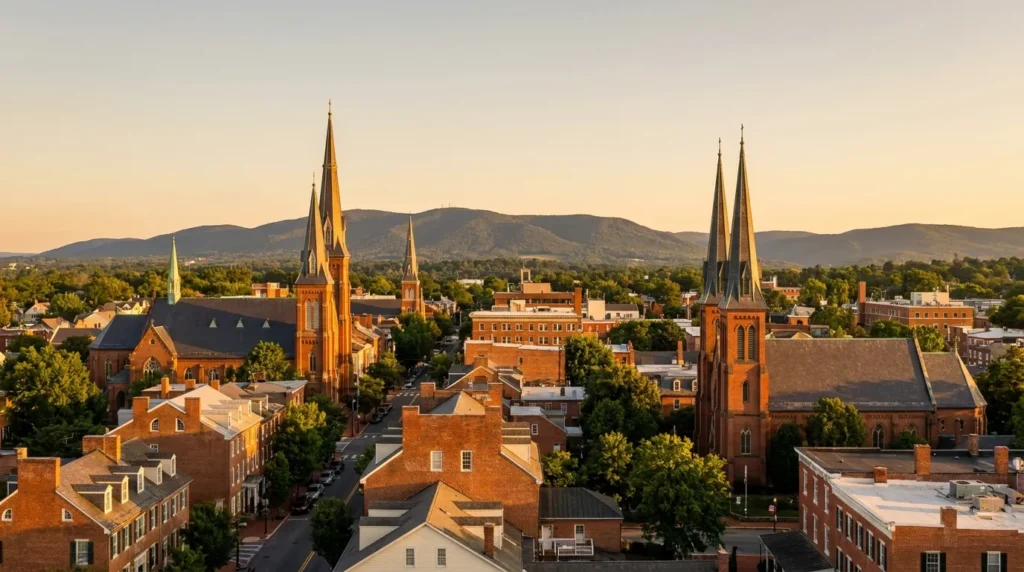
The historic downtown is the cultural heart of the city. 19th-century buildings house award-winning restaurants, craft breweries, galleries, and independent shops. Carroll Creek Park, with its canal and murals depicting local history, serves as the backdrop for the Frederick Festival of the Arts, the In the Streets Festival, and summer evening events with live music.

The dining scene has gained a reputation. Restaurants such as Volt, once helmed by chef Bryan Voltaggio, gave momentum to a scene that now includes bistros, Latin steakhouses, Ethiopian and Indian restaurants, and breweries such as Flying Dog, with a tasting room. Frederick Coffee Company and Cafe Bueno are classic downtown spots. Farmers markets operate on weekends.

Outdoor life is strong. The Catoctin Mountains, with Cunningham Falls and Catoctin Mountain Park, are a short drive away. Sugarloaf Mountain offers short hiking trails. Wineries and cideries occupy the rural surroundings. For sports, the Frederick Keys, a minor league baseball team, plays at Nymeo Field. Cinema, theater at the Weinberg Center for the Arts, and concerts round out the calendar.

Frederick

What to do in Frederick, the historic city between DC and Pennsylvania

Frederick sits in western Maryland, an hour from Washington, DC and Baltimore. It features a restored historic downtown, deep ties to the Civil War, and an active dining and craft brewery scene.

Downtown Frederick defines the city: Federal and Victorian architecture, dozens of restaurants, independent cinemas (Weinberg Center for the Arts), galleries, and Carroll Creek Linear Park, an urban canal lined with murals and pedestrian bridges. The National Museum of Civil War Medicine documents medical advances during the Civil War, and Monocacy National Battlefield, to the south, marks the 1864 battle.

For everyday life, Frederick Fairgrounds hosts the Great Frederick Fair in September and events throughout the year. Frederick Community College serves as an accessible educational hub, and the Frederick Visitor Center coordinates guided tours. Award-winning breweries include Flying Dog Brewery and Olde Mother Brewing, alongside distilleries such as McClintock Distilling.

On weekends, Catoctin Mountain Park (neighbor to Camp David), Cunningham Falls State Park (Maryland's tallest waterfall), and Antietam National Battlefield (30 minutes away) are all within easy reach. Washington, DC, with its Smithsonian museums, is 50 minutes via I-270, and Gettysburg, Pennsylvania, is 40 minutes via US-15.

  1. 1["Downtown Frederick Historic District"
  2. 2"National Museum of Civil War Medicine"
  3. 3"Monocacy National Battlefield"
  4. 4"Catoctin Mountain Park (nearby)"
  5. 5"Schifferstadt Architectural Museum"
  6. 6"Carroll Creek Linear Park"
Nightlife5.0 / 10
Parks & green spaces
  • ["Baker Park"
  • "Carroll Creek Linear Park"
  • "Cunningham Falls State Park (nearby)"
  • "Catoctin Mountain Park"
  • "Mount Olivet Cemetery (historic)"
  • +1 more

Latest posts

Posts about Maryland

Coverage and updates related to this destination.

Showing content from Maryland, as there is no specific data for Frederick yet.