Visto n' Visa
Blog
Notícias e artigos
Destinations
Careers
Immigrants

Want to live and work in Dundalk?

Personalized immigration plan with eligible visas, costs, and next steps for your goal!

If you are not eligible, you will know exactly why and what to do to improve your approval chances.

Save up to 12 hours in meetings

No pointless assessments.

Save up to 90%

Save money on vague or unfocused consultations

Avoid Fraud and Mistakes

One mistake can cost you your visa

Total Impartiality

Zero commercial bias

Decide with peace of mind

No toxic urgency

Fast and Accurate

Answers in minutes, no guesswork

Who lives in Dundalk today

A historically white working-class community that has diversified over the past two decades, with notable growth in Latino and Black populations and longstanding pockets of Eastern European descendants.

Dundalk has about 66,000 residents and was long known as a neighborhood of Polish, Ukrainian, German, and Irish families who came to work in the shipyards and at Bethlehem Steel. That heritage is still visible in the churches, ethnic clubs, and neighborhood bakeries. Over the past two decades, the profile has shifted: Black families from Baltimore and Latino immigrants now make up a growing share of the population.

English is the dominant language in nearly all public settings. Spanish is increasingly present in businesses along Eastpoint and Merritt Boulevard, and schools such as Dundalk Elementary offer support programs for English language learners. Other languages spoken at home include Polish among older residents, along with smaller groups speaking Tagalog, Russian, and Haitian Creole.

Religion plays a significant role in neighborhood life. Catholic parishes such as St. Rita, Our Lady of Hope, and Sacred Heart of Mary maintain roots in the Polish and Irish communities. Baptist, Methodist, and Pentecostal evangelical churches are common throughout the area, and synagogues are located nearby in eastern Baltimore. Mosques serve the Muslim community in the broader metro region, particularly toward Catonsville and the northern parts of the county.

Languages spoken
  • English
  • Spanish
  • Polish
  • Tagalog
  • Haitian Creole
  • +1 more
Main religions
  • Catholicism
  • Evangelical Protestantism
  • Baptist
  • Methodist
  • No religion / Unaffiliated
  • +1 more

Cost of living below the Baltimore area average

Dundalk ranks among the most affordable suburbs in the Baltimore metropolitan area, with rents and home prices well below those in the northern county suburbs and central Baltimore.

Housing is Dundalk's main draw for newcomers. One-bedroom apartments and two-bedroom rowhouses are priced far lower than comparable units in Towson, Catonsville, or central Baltimore. Modest homes with a small yard and garage can be found at prices that would be uncommon in other parts of the metro area.

Everyday food and services are also accessible. Chains such as Aldi, Food Lion, Save A Lot, and the Giant on Merritt Boulevard serve households on tighter budgets, and Latin grocery stores offer fresh produce at lower prices. Neighborhood restaurants, diners, and crab houses still serve inexpensive meals, far from the price levels found in Fells Point or Harbor East.

The costs that weigh most are transportation, car insurance, and utilities. Auto insurance in Maryland is expensive, particularly in Baltimore County. Heating in winter and air conditioning in summer add up in older homes with poor insulation. Property taxes are moderate but vary by neighborhood and assessment year.

105Cost index (US = 100)5% above US average
CategorySingleCoupleFamily (2 + 2)
iHousing$1,363$1,572$1,992
iFood$398$797$1,447
iTransport$524$891$1,153
iHealthcare$294$588$1,101
iChildcare$1,908
iOther$891$1,604$2,254
Monthly total$3,470$5,452$9,855

Source: U.S. BLS Consumer Expenditure Survey 2023 + BEA Regional Price Parities 2023 · Estimates in USD, monthly.

Brick rowhouses and waterfront neighborhoods

The housing stock is dominated by brick rowhouses and detached homes from the mid-20th century, with pockets of marina properties and waterfront homes in Edgemere and Turners Station.

Buyers will find in Dundalk one of the most affordable brick rowhouse markets in the entire Baltimore region. Neighborhoods such as Dundalk Village, planned in the 1910s with curving streets and tree-lined squares, carry historic character and are listed on the National Register of Historic Places. St. Helena and Eastpoint are denser and more practical, close to commercial strips.

Rental options include garden apartment complexes spread along Merritt Boulevard, Dundalk Avenue, and North Point Road. Much of this stock sits at the lower end of the price and quality range, with variable maintenance standards. Larger families tend to look for full houses on residential streets, where monthly costs still fall below many suburban markets.

Those seeking waterfront living look toward Edgemere, at the tip of the peninsula, and Turners Station, a historic African American community on the banks of Bear Creek. There are marinas, homes with views of the Patapsco, and a limited supply of newer units in coastal developments. The tradeoff is that these areas are more isolated and fully car-dependent.

Recommended neighborhoods
  • Dundalk Village
  • St. Helena
  • Eastpoint
  • Edgemere
  • Turners Station
  • +2 more

From steelmaking to port logistics

The closure of Bethlehem Steel reshaped the local economy, which is now driven by logistics, ports, healthcare, and retail, with Tradepoint Atlantic emerging as the major new industrial hub.

For nearly a century, Dundalk was synonymous with steel. Bethlehem Steel at Sparrows Point employed more than 30,000 workers at its peak and closed in stages through 2012, leaving a deep mark on the local economy. The former mill site has since been redeveloped as Tradepoint Atlantic, an industrial and logistics complex spanning more than 1,000 acres, with distribution centers operated by Amazon, Under Armour, FedEx, Volkswagen, and light manufacturing firms.

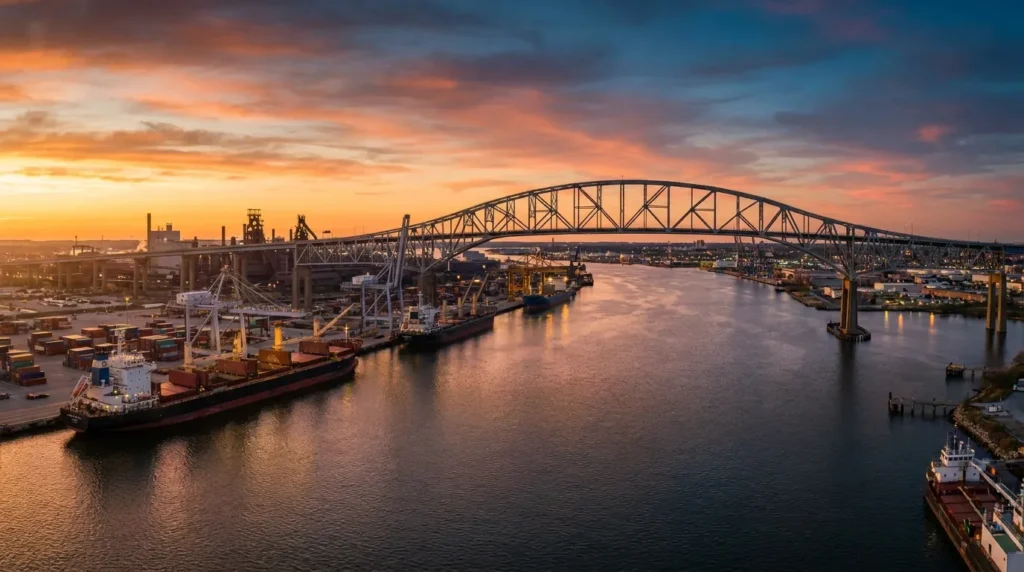
The port is the other major driver. Dundalk Marine Terminal, operated by the Maryland Port Administration, handles vehicles, containers, and general cargo and generates thousands of direct jobs in stevedoring, trucking, and logistics operations. The automotive sector maintains a strong presence through vehicle import and export yards.

Beyond industry, Dundalk relies on healthcare, retail, and construction. MedStar Franklin Square Medical Center, on the border with Rosedale, is a major regional employer, and CCBC Dundalk trains technicians in nursing, mechanics, and logistics. Positions in retail, restaurants, public schools, and county agencies round out the employment picture.

Dominant sectors
  • Logistics and ports
  • Light manufacturing
  • Healthcare
  • Retail
  • Construction
  • +1 more
Major employers
  • Tradepoint Atlantic
  • Amazon
  • Under Armour
  • FedEx Ground
  • Dundalk Marine Terminal
  • +3 more

County public schools and a local community college

Elementary and secondary education is managed by Baltimore County Public Schools, and local technical and higher education is centered at CCBC Dundalk, with Baltimore-area universities accessible by car.

Public schools in Dundalk fall under Baltimore County Public Schools, one of the largest districts in the state. Schools serving the area include Dundalk Elementary, Sandalwood Elementary, Holabird Middle School, and Dundalk High School. Results vary by school, and many families research attendance boundaries before deciding where to settle.

Traditional Catholic schools tied to parishes, such as Our Lady of Hope/St. Luke School and St. Rita School, are smaller options that charge tuition. For specific academic profiles, neighboring districts offer magnet schools, and some families enroll students at technical schools such as Sollers Point Technical High School, which focuses on construction, automotive, and nursing programs.

At the postsecondary level, the main local option is CCBC Dundalk, a campus of the Community College of Baltimore County, offering programs in nursing, mechanics, welding, logistics, and transfer courses for four-year colleges. Universities such as Johns Hopkins, University of Maryland Baltimore County, and Towson University are 20 to 40 minutes away by car and enroll many students from Dundalk.

Notable universities
  • Community College of Baltimore County (CCBC) - Dundalk
  • Sollers Point Technical High School
  • Johns Hopkins University (25 min away)
  • University of Maryland Baltimore County (30 min away)
  • Towson University (30 min away)

Care anchored at MedStar Franklin Square and Baltimore's hospital network

Dundalk relies on neighboring hospitals and clinics, with MedStar Franklin Square as the regional reference and easy access to Baltimore's major hospital complexes.

Dundalk has no large hospital within its boundaries, but MedStar Franklin Square Medical Center, in Rosedale, is a few minutes away via I-695. It is a large general hospital with an emergency department, maternity, oncology, and cardiology services, and is where most residents end up for more serious emergencies.

A short distance away are Johns Hopkins Bayview Medical Center, in Highlandtown, and the main Johns Hopkins Hospital complex in eastern Baltimore. For more complex treatments, both hospitals are nationally recognized references. The University of Maryland Medical Center, in downtown Baltimore, also serves patients from the region.

For primary care, neighborhood clinics, urgent care facilities such as Patient First and MedStar PromptCare, and community health centers such as Total Health Care handle day-to-day needs. Residents covered by Maryland Medicaid primarily use the metro area's network of Federally Qualified Health Centers. CVS, Walgreens, and Rite Aid pharmacies are easy to find throughout the area.

Dundalk

Generally quiet suburb, with more sensitive stretches near commercial corridors

Most of Dundalk is residential and calm; concerns are concentrated along certain stretches of Merritt Boulevard, Dundalk Avenue, and industrial edges at night.

The sense of safety in Dundalk varies considerably from one block to the next. Established neighborhoods such as Dundalk Village, Gray Manor, and parts of St. Helena are quiet, with long-term residents, tree-lined streets, and low turnover. The most common crimes are vehicle theft, break-ins, and drug-related incidents.

The areas that appear most frequently in crime statistics are stretches of Merritt Boulevard and Dundalk Avenue at night, particularly around older motels, 24-hour gas stations, and some poorly maintained apartment buildings. Industrial edges near Sparrows Point and Holabird also warrant caution after work hours, more due to isolation than to high violent crime rates.

Policing is handled by the Baltimore County Police Department, based at Precinct 12 (Dundalk). Community policing programs, cameras on commercial corridors, and partnerships with resident associations such as the Dundalk Renaissance Corporation have contributed to revitalization efforts. For newcomers, visiting the neighborhood at different times of day and speaking with neighbors before signing a lease is advisable.

Safer neighborhoods
  • Dundalk Village
  • Gray Manor
  • Eastfield-Stanbrook
  • Norwood-Holabird
  • Edgemere
  • Bear Creek
Areas to avoid
  • Parts of Merritt Boulevard at night
  • Areas along Dundalk Avenue near older motels
  • Industrial edges near Holabird Avenue after business hours

Car-dependent with some key bus routes

Dundalk is primarily a car-dependent area, with bus connections to downtown Baltimore, easy access to I-695, and proximity to BWI and Martin State Airport.

Most residents depend on a car. The main arteries are Merritt Boulevard, Dundalk Avenue, North Point Boulevard, and Holabird Avenue, all connecting to I-695 (Baltimore Beltway) and I-95. From central Dundalk to downtown Baltimore takes about 20 to 25 minutes without traffic, and the drive to Washington D.C. can be completed in just over an hour.

Public transit exists but is limited. MTA Maryland CityLink Navy, CityLink Brown, and LocalLink 67 serve the main neighborhoods and connect to Patterson Park, Johns Hopkins Hospital, and downtown Baltimore. Connections to BWI Marshall Airport are available via bus and MARC train with a transfer. Martin State Airport, in Middle River, is 20 minutes away and serves general aviation.

There is no metro system in Dundalk, and dedicated bike lanes remain scarce, though sections of the Patapsco Regional Greenway are being expanded. Water access makes occasional maritime transport a curiosity: marinas on Bear Creek and the Patapsco are oriented toward recreation rather than commuting. Workers at Sparrows Point can use an internal shuttle that Tradepoint Atlantic operates on select schedules.

Airports
  • BWI — Baltimore/Washington International Thurgood Marshall (25 min away)
  • MTN — Martin State Airport (general aviation, 20 min away)
  • DCA — Ronald Reagan Washington National (1 hour away)

Climate

Dundalk

Working-class heritage, seafood, and Eastern European traditions

Cultural life centers on working-class identity, community festivals, Chesapeake Bay food, and Polish, Ukrainian, and Irish traditions preserved in clubs and parishes.

Dundalk takes pride in its working-class roots and celebrates them at events such as the Dundalk Heritage Fair, held every summer at Heritage Park with music, a parade, food trucks, and Fourth of July festivities. The Independence Day Parade is one of the largest community parades in the Baltimore region and has traveled down Dundalk Avenue since the 1930s.

Local cuisine mixes Chesapeake Bay traditions with immigrant heritage. Blue crab steamed with Old Bay seasoning, Maryland crab soup, oysters, and pit beef sandwiches are served at crab houses such as Schultz's Crab House and at neighborhood bars. Bakeries and delis still offer pierogi, Polish kielbasa, sauerkraut, and traditional Ukrainian pastries at church festivals such as St. Michael the Archangel.

Ethnic and fraternal clubs remain active, and the American Legion, VFW, and Polish Home Club anchor part of local social life. The Patapsco Arts Council and Dundalk Renaissance Corporation promote local artist fairs, street murals, and neighborhood programming. Dundalk has no UNESCO heritage of its own, but Dundalk Village is listed on the National Register of Historic Places.

Notable dishes
  • Blue crab steamed with Old Bay
  • Maryland crab soup
  • Pit beef sandwich
  • Pierogi
  • Polish kielbasa
  • +2 more
Annual events
  • Dundalk Heritage Fair
  • Dundalk Independence Day Parade
  • St. Rita's Carnival
  • Polish Festival at St. Michael the Archangel
  • Turners Station Heritage Day

Historic landmarks, waterfront access, and regional parks

Attractions include community museums, marinas, state parks along the Chesapeake Bay shoreline, and the distinctive historic district of Dundalk Village.

The tourism centerpiece of Dundalk is Dundalk Village itself, with its central square, church, and rowhouses designed in a Garden City style. The Dundalk-Patapsco Neck Historical Society and Museum tells the story of the neighborhood, the steel industry, and the immigrant families who shaped the region. It is a brief visit, but it provides context for those considering a move to the area.

The waterfront is a major asset. North Point State Park, in Edgemere, has trails, a fishing pier, and the ruins of the former Bay Shore Park amusement park, with views of the Chesapeake Bay. Fort Howard Park, at the tip of the peninsula, was a military installation and is now a community park with views of the shipping channel. Hart-Miller Island, accessible only by boat, is a popular weekend destination.

For everyday recreation, Heritage Park hosts the Dundalk Heritage Fair, and Patapsco Valley State Park to the west offers waterfalls, trails, and picnic areas. For shopping and movies, Eastpoint Mall is nearby, and the Beltway leads to Baltimore's entertainment options, including the Inner Harbor, National Aquarium, and Orioles games at Camden Yards.

  1. 1Dundalk Village Historic District
  2. 2North Point State Park
  3. 3Fort Howard Park
  4. 4Dundalk-Patapsco Neck Historical Society and Museum
  5. 5Heritage Park
  6. 6Eastpoint Mall
Parks & green spaces
  • North Point State Park
  • Fort Howard Park
  • Heritage Park
  • Merritt Point Park
  • Stansbury Park
  • +1 more

New diversity layered over old working-class roots

To the descendants of Poles, Ukrainians, Irish, and Germans who came to the shipyards, recent decades have added Latinos, Caribbeans, Asians, and Africans drawn by affordable housing.

Dundalk's immigrant history begins with Eastern and Southern Europeans who arrived from the late 19th century through the mid-20th century to work at Bethlehem Steel and the shipyards. Polish, Ukrainian, Italian, German, and Irish communities formed parishes, clubs, and bakeries that still exist today. African American families settled largely in Turners Station, a historic community founded by steel workers.

Over the past two decades, the profile has changed. Latino immigrants, primarily from Mexico, El Salvador, Guatemala, Honduras, and the Dominican Republic, have opened restaurants, grocery stores, and auto shops along Merritt Boulevard and Dundalk Avenue. There is a growing presence of families from Nigeria, Ethiopia, the Philippines, India, China, and Vietnam, many of them working in the area's hospitals and logistics sector.

Practical support tends to come from Baltimore-area organizations. Catholic Charities' Esperanza Center serves Latino immigrants with English classes, legal assistance, and health services; the International Rescue Committee of Baltimore resettles refugees; and CASA Maryland provides labor support, rights advocacy, and job training. Consulates are concentrated in Baltimore and Washington D.C., about an hour away by car.

6,500
Foreign-born residents
estimated
Top countries of origin
  • Mexico
  • El Salvador
  • Guatemala
  • Honduras
  • Dominican Republic
  • Philippines
  • Nigeria
  • India
Foreign consulates
  • Consulate General of Mexico in Washington D.C.
  • Consulate General of El Salvador in Washington D.C.
  • Consulate General of Guatemala in Washington D.C.
  • Consulate General of the Philippines in Washington D.C.
  • Consulate General of India in Washington D.C.
  • +2 more
Community organizations
  • Esperanza Center (Catholic Charities of Baltimore)
  • CASA Maryland
  • International Rescue Committee - Baltimore
  • Baltimore City Community College - ESL programs
  • Dundalk Renaissance Corporation
  • Turners Station Heritage Foundation

Latest posts

Posts about Maryland

Coverage and updates related to this destination.

Showing content from Maryland, as there is no specific data for Dundalk yet.