Visto n' Visa
Blog
Notícias e artigos
Destinations
Careers
Immigrants

Want to live and work in Columbia?

Personalized immigration plan with eligible visas, costs, and next steps for your goal!

If you are not eligible, you will know exactly why and what to do to improve your approval chances.

Save up to 12 hours in meetings

No pointless assessments.

Save up to 90%

Save money on vague or unfocused consultations

Avoid Fraud and Mistakes

One mistake can cost you your visa

Total Impartiality

Zero commercial bias

Decide with peace of mind

No toxic urgency

Fast and Accurate

Answers in minutes, no guesswork

High racial diversity and household income well above average

Columbia has a balanced ethnic composition, with a strong Asian and African American presence, a significant Indian community, household income above the Maryland average, and schools that reflect this diversity.

Columbia's demographics are unusual for the United States. Non-Hispanic whites make up just over half the population, African Americans form about a quarter, Asians represent a robust share driven by Indian, Chinese, and Korean residents, and Latinos account for a growing segment. This reflects the original design of an integrated city and the appeal that Howard County schools and employment opportunities hold for professional families.

The Indian community is especially visible, with dedicated markets, temples, and weekend schools focused on cultural traditions and language. There are African communities, particularly Nigerian and Ethiopian, along with growing numbers of Korean families. The Brazilian community is small, largely connected to research, technology, and healthcare professionals at surrounding hospitals.

English dominates, with strong ESL offerings in public schools. Religious diversity is notable: mainline and evangelical Protestant churches, Catholic parishes, synagogues, Hindu temples, Sikh gurdwaras, mosques, and Buddhist centers. The Interfaith Center in Town Center houses several congregations under one roof, a symbol of this pluralism.

Languages spoken
  • English
  • Spanish
  • Mandarin
  • Korean
  • Hindi
  • +1 more
Main religions
  • Catholic
  • Protestant
  • Hindu
  • Jewish
  • Muslim
  • +1 more

Cost of living above the state average, with expensive housing

Columbia has a cost of living above the Maryland average, driven by housing and high property taxes in Howard County, though typical salaries in the region are also elevated.

Living in Columbia is not inexpensive. Rents and sale prices are clearly above the state average, especially in the most sought-after villages such as River Hill and Clemens Crossing. For a family, a three- or four-bedroom home in a neighborhood with a good public school carries a high price tag, reflecting strong demand from skilled professionals competing for the area.

Property taxes in Howard County rank among the highest in the state, compounded by state and local income taxes. In return, residents receive public schools among the best in the United States, high safety, and well-maintained infrastructure. For many families, that trade-off is worthwhile compared to paying for expensive private schooling in other metro areas.

For everyday needs, markets such as Wegmans, Whole Foods, Giant, and H Mart cover everything from basics to Asian specialty products. Services, restaurants, and gyms are priced near Greater Washington levels. A car is practically essential, and insurance rates are moderate, aided by low local crime rates.

109Cost index (US = 100)9% above US average
CategorySingleCoupleFamily (2 + 2)
iHousing$1,420$1,638$2,075
iFood$415$830$1,507
iTransport$546$928$1,201
iHealthcare$306$612$1,147
iChildcare$1,987
iOther$928$1,671$2,348
Monthly total$3,615$5,679$10,265

Source: U.S. BLS Consumer Expenditure Survey 2023 + BEA Regional Price Parities 2023 · Estimates in USD, monthly.

Organized residential villages, with suburban single-family homes predominating

Columbia is organized into ten villages, each with schools, parks, and community centers, with a predominance of single-family homes, townhouses, and low-rise buildings in a green, well-maintained environment.

Columbia's urban design is the starting point for understanding housing. The city is divided into ten villages: Wilde Lake, Harper's Choice, Long Reach, Owen Brown, Oakland Mills, Hickory Ridge, Kings Contrivance, Dorsey's Search, River Hill, and the Town Center. Each village has a neighborhood center, schools, community pools, and trails, all partially managed by the Columbia Association.

The housing stock is dominated by detached single-family homes with yards, townhouses, low-rise condominiums, and some taller buildings in Town Center near the shopping center. Neighborhoods like River Hill attract families because of River Hill High School, considered one of the best in the state. Wilde Lake and Harper's Choice have older homes with good value and a diverse family profile.

For rentals, platforms such as Zillow and Apartments.com list complexes managed by large companies, with pools, fitness centers, and monthly rents that vary by village. Around Town Center, newer buildings offer a more urban lifestyle. The Columbia Association charges an annual maintenance fee, part of the cost of living there, in exchange for all shared infrastructure.

Recommended neighborhoods
  • River Hill
  • Town Center
  • Hickory Ridge
  • Dorsey's Search
  • Clemens Crossing
  • +1 more

Technology, defense, healthcare, and proximity to DC and Baltimore

Columbia benefits from its proximity to Fort Meade, the NSA, and defense and technology companies, with strong demand in cybersecurity, healthcare, and professional services, along with easy access to jobs in DC and Baltimore.

Columbia is just a few miles from Fort Meade, headquarters of the NSA and U.S. Cyber Command, which has transformed the region into one of the country's largest cybersecurity and defense hubs. Companies such as Northrop Grumman, Leidos, Booz Allen, and hundreds of contractors maintain offices in Columbia and nearby business parks, with strong demand for engineers, analysts, and professionals holding security clearances.

Howard County General Hospital, affiliated with Johns Hopkins, and affiliated clinics concentrate healthcare employment. Howard Community College, the Loyola Graduate Center, and companies such as Tenable and MICROS Systems compose the local ecosystem. Banks, law firms, and medical technology companies round out the picture.

The key advantage of living in Columbia is access. In under an hour, almost any office in Baltimore or Washington is within reach, including federal agencies, embassies, and the university ecosystem. For skilled foreign professionals, particularly in IT, healthcare, and research, it is an ideal base for combining employment in DC with a quieter and more affordable residential lifestyle.

Dominant sectors
  • Technology
  • Cybersecurity and defense
  • Healthcare
  • Federal government and contractors
  • Professional services
Major employers
  • Northrop Grumman
  • Leidos
  • Howard County General Hospital
  • Howard County Public Schools
  • Tenable
  • +1 more

Top public schools, a strong community college, and accessible universities

Columbia is part of Howard County Public Schools, one of the best public districts in the United States, with a local community college and several prestigious universities a short distance away.

Howard County Public School System consistently ranks among the best public school districts in the United States. Schools such as River Hill High School, Marriotts Ridge, Atholton, and Wilde Lake post strong standardized test results, extensive Advanced Placement offerings, and International Baccalaureate programs at select campuses. Immigrant families find structured ESL support at all schools.

Howard Community College, with a campus inside Columbia, offers vocational, technical, and transfer-track programs for four-year colleges. It is a common choice for adults seeking retraining, students looking to save on the first two years before transferring to the University of Maryland, and immigrants needing to strengthen academic English.

Higher education options include local programs from Loyola, the Johns Hopkins University Education Center, and UMBC Training Centers. The University of Maryland in College Park, Johns Hopkins in Baltimore, and UMBC in Catonsville are all within an hour, dramatically expanding the available options. Prestigious private schools in the region round out the landscape for those seeking alternatives.

Notable universities
  • Howard Community College
  • Johns Hopkins University Education Center
  • Loyola University Maryland Columbia Campus
  • University of Maryland College Park
  • UMBC

Local general hospital affiliated with Johns Hopkins, with easy access to referral centers

Howard County General Hospital, part of the Johns Hopkins network, handles most local healthcare needs, supported by a dense network of offices, clinics, and easy access to referral centers in Baltimore.

Howard County General Hospital in Columbia is the city's primary hospital. It is part of the Johns Hopkins Medicine network and offers emergency care, maternity services, surgery, oncology, and various specialties. Its integration with Hopkins facilitates referrals for complex cases to Baltimore, particularly in cancer, transplants, and advanced cardiology.

Primary care and specialists are spread across medical centers such as the Howard County Center on Cedar Lane Avenue and offices throughout the villages. Networks such as Kaiser Permanente, MedStar, Patient First, and One Medical maintain a strong presence in Columbia, with urgent care clinics open on weekends as well, a common option for treating flu, infections, and minor injuries.

Most residents are covered by employer-sponsored insurance, particularly at the surrounding technology and defense companies, or Maryland Medicaid for lower-income families. The Maryland Health Connection is the state marketplace for purchasing individual plans, with income-based subsidies. Newly arrived immigrants often use community clinics at Healthy Howard and Chase Brexton as a first point of entry.

Healthcare index76.0 / 100
  • Life expectancyyears at birth
    78.4yrs
  • Doctors per 1kpracticing physicians
    3.7
  • Health spendper capita, per year
    $13,473
  • Public systemoverall quality rating
    Good

City with low crime rates and a calm residential environment

Columbia has crime rates among the lowest in the Baltimore metro area, with a calm residential atmosphere, though opportunistic thefts in parking lots and shopping centers still occur.

In terms of safety, Columbia is considered one of the most peaceful cities in the Mid-Atlantic, with violent crime rates far below the national average and well below those of neighboring Baltimore. Howard County maintains a well-staffed police force, and the urban design, featuring ample green space, good lighting, and well-maintained villages, contributes to the overall sense of security.

The most common everyday incidents are opportunistic thefts in shopping center parking lots such as The Mall in Columbia, car break-ins targeting visible items, minor altercations at bars, and online fraud. Violent crimes against ordinary residents are rare, though isolated incidents do occur, generally tied to personal conflicts or isolated events.

For newcomers, the practical advice is the standard for an American suburb: avoid leaving anything visible in the car, keep homes and garages properly secured, and use the local police reporting app to monitor neighborhood incidents. Families let children ride bikes on the trails, and community life at the pools and neighborhood centers reinforces the perception of a calm city.

5.8
Homicides per 100k
per year
Safety index
78.0
Crime index
22.0
Safer neighborhoods
  • Hickory Ridge
  • River Hill
  • Wilde Lake (residential sections)
  • King's Contrivance
  • Harper's Choice (south)
  • Dorsey Search
Areas to avoid
  • parts of Long Reach near commercial centers at night
  • isolated stretches of Owen Brown after dark

Car-oriented city with local bus service and nearby rail

Columbia is strongly car-oriented, with some regional bus lines and no rail within the municipality, but Amtrak and MARC stations are a short distance away in Baltimore and DC.

The city was designed around the car, and a vehicle remains practically indispensable for daily life. The villages are connected by quiet streets, and main arterials such as Route 29 and Route 175 tie into the road network. Interstates 95 and 70 run through the surrounding area, placing Baltimore and Washington between forty minutes and an hour away, depending on traffic.

For public transit, Howard Transit offers a few local routes serving workers and students, along with regional Maryland Transit Administration lines. There is no subway in Columbia, and the MARC train has stations in nearby Savage and Dorsey, reached by car, allowing daily commutes to Baltimore or to Washington, particularly Union Station.

BWI Airport is approximately half an hour away, served by the MARC train and light rail. Dulles and Reagan are roughly an hour away in the DC area. For those working at Fort Meade or other nearby defense hubs, commutes tend to be short, which supports the residential lifestyle of local residents.

30 min
Avg commute
40
Walkability
Airports
  • BWI — Baltimore/Washington International Thurgood Marshall
  • IAD — Washington Dulles International
  • DCA — Ronald Reagan Washington National
  • Bike infrastructure

What the climate is like living in Columbia

A planned suburb between Baltimore and Washington with a humid subtropical climate: hot and muggy summers, moderately cold winters, and four well-defined seasons.

Summer in Columbia brings highs between 84 and 88 degrees Fahrenheit, with the high humidity typical of the Mid-Atlantic region. Afternoon thunderstorms are common, and air conditioning is standard in all homes.

Winters are cold without extremes, with lows between 27 and 34 degrees Fahrenheit in January and modest snowfall, around 18 inches per season. A winter coat is sufficient, and the climate allows for walking outdoors through much of the year.

Spring with cherry blossoms and fall with red and yellow foliage are the most pleasant seasons. Rainfall is well distributed at around 43 inches annually, and the city's planned lakes provide a refreshing effect during summer.

Sunny days / year210 days
Avg high (°F)
  • 43°J
  • 47°F
  • 55°M
  • 65°A
  • 73°M
  • 82°J
  • 88°J
  • 85°A
  • 78°S
  • 68°O
  • 55°N
  • 48°D
Avg low (°F)
  • 29°J
  • 31°F
  • 36°M
  • 45°A
  • 53°M
  • 63°J
  • 69°J
  • 68°A
  • 61°S
  • 52°O
  • 39°N
  • 33°D
Rainfall (")
  • 3"J
  • 4"F
  • 4"M
  • 4"A
  • 5"M
  • 5"J
  • 6"J
  • 7"A
  • 5"S
  • 5"O
  • 3"N
  • 5"D

Community culture, outdoor life, and a multicultural scene

Columbia has a strong community culture, with ethnic festivals, outdoor activities on its lakes and trails, an award-winning music venue at Merriweather Post Pavilion, and a dining scene that reflects the city's diversity.

Cultural life is organized around the villages and Merriweather Post Pavilion, an outdoor amphitheater that hosts international pop, rock, and hip-hop artists throughout the season. Toby's Dinner Theatre in Town Center combines dining and live theater. The Columbia Festival of the Arts brings an annual season of music, dance, and theater, and Wine in the Woods is a classic on the local calendar.

Outdoor life centers on Lake Kittamaqundi, Lake Elkhorn, and Wilde Lake, with connected trails, bike paths, and community centers with pools. Symphony Woods, next to the shopping center, gained Merriweather Park at Symphony Woods, an open space with art installations. Columbia Association recreation centers offer gyms and activities at subsidized rates.

The dining scene mirrors the demographics. Indian, Korean, Chinese, Ethiopian, Vietnamese, and Middle Eastern restaurants coexist with Latin American and American cuisine. H Mart, the Korean supermarket in Ellicott City, is nearby and draws Asian families. Cultural celebrations such as the Festival of India, Lunar New Year events, and Juneteenth have a significant presence.

Columbia

Life in Columbia, MD, a planned city between DC and Baltimore

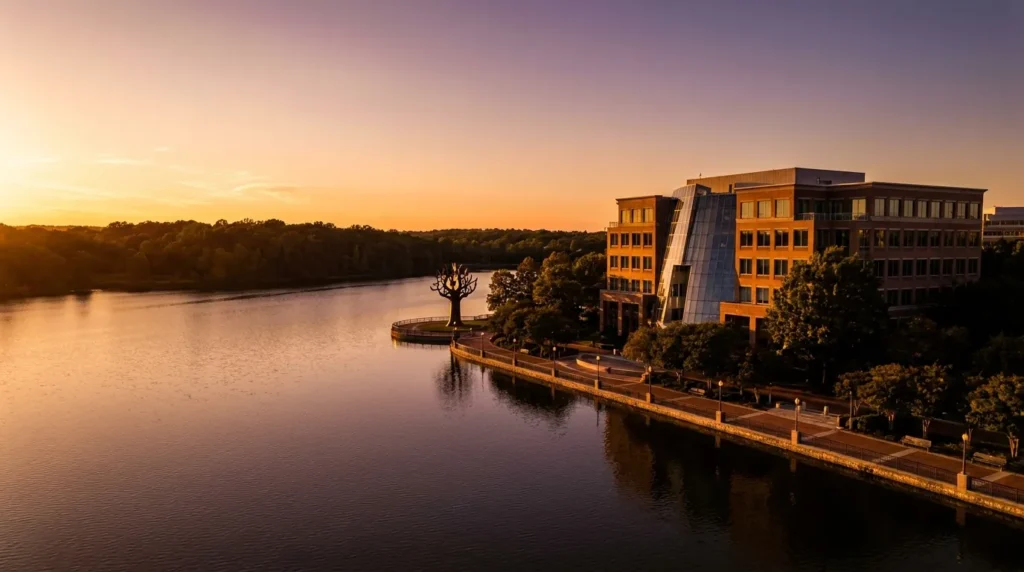
A planned community designed by James Rouse in the 1960s between Washington and Baltimore, organized into villages with artificial lakes, abundant recreation, and an intentional tradition of racial and religious diversity.

Columbia was designed as a model community in 1967 and grew around Lake Kittamaqundi and Lake Elkhorn. The Merriweather Post Pavilion, an outdoor amphitheater designed by Frank Gehry, serves as a national concert venue and anchors the Merriweather District, a new pedestrian-oriented town center.

Columbia Mall is the main commercial hub, alongside the Symphony of Lights and the Columbia Festival of the Arts. The Robinson Nature Center and the Howard County Conservancy offer ongoing environmental programming. Neighboring Ellicott City's historic Main Street is a destination for bars and antique shops.

For outdoor recreation, more than 90 miles of trails connect villages including Wilde Lake, Harper's Choice, Long Reach, Owen Brown, Hickory Ridge, Kings Contrivance, River Hill, and Town Center. Centennial Park, with its lake and 2.4-mile path, is the city's primary running and rowing hub.

  1. 1["Merriweather Post Pavilion"
  2. 2"Columbia Mall"
  3. 3"Lake Kittamaqundi"
  4. 4"Columbia Art Center"
  5. 5"Toby's Dinner Theatre"
  6. 6"Robinson Nature Center"
Nightlife4.0 / 10
Parks & green spaces
  • ["Centennial Park"
  • "Lake Kittamaqundi"
  • "Lake Elkhorn"
  • "Wilde Lake"
  • "Patuxent Branch Trail"
  • +1 more

Latest posts

Posts about Maryland

Coverage and updates related to this destination.

Showing content from Maryland, as there is no specific data for Columbia yet.