Visto n' Visa
Blog
Notícias e artigos
Destinations
Careers
Immigrants

Want to live and work in Baltimore?

Personalized immigration plan with eligible visas, costs, and next steps for your goal!

If you are not eligible, you will know exactly why and what to do to improve your approval chances.

Save up to 12 hours in meetings

No pointless assessments.

Save up to 90%

Save money on vague or unfocused consultations

Avoid Fraud and Mistakes

One mistake can cost you your visa

Total Impartiality

Zero commercial bias

Decide with peace of mind

No toxic urgency

Fast and Accurate

Answers in minutes, no guesswork

Majority Black city with growing diversity

Baltimore has an African American majority, a significant white population in certain neighborhoods, an expanding Latino community, and Asian and African immigrant clusters connected to its universities, with English as the primary language.

About six in ten Baltimore residents are African American, making the city one of the Blackest in the United States by proportion. Non-Hispanic whites make up another significant share, concentrated in areas such as Canton, Federal Hill, Roland Park, and Mount Vernon. Latinos, primarily from El Salvador, Honduras, and Mexico, are growing in neighborhoods such as Highlandtown and Upper Fells Point.

There are also smaller but significant communities of African immigrants from Nigeria, Senegal, and Ethiopia, drawn by universities, hospitals, and employment opportunities. Asians are present around Johns Hopkins and the University of Maryland, with Korean, Chinese, Indian, and Filipino communities. The Brazilian presence is small, largely tied to students and researchers.

English is dominant, but Spanish appears in commerce, schools, and clinics in Latino neighborhoods. Religiously, Baltimore has a strong Catholic tradition inherited from Maryland's colonial period, African American Baptist and Methodist churches, a historic Jewish community in Park Heights and Pikesville, and evangelical congregations tied to immigrant communities.

Languages spoken
  • English
  • Spanish
  • Mandarin
  • Amharic
  • Korean
Main religions
  • Catholic
  • Baptist
  • Methodist
  • Jewish
  • Unaffiliated

Significantly cheaper than Washington, with affordable rent but high taxes

Baltimore costs less than Washington, Philadelphia, or New York, especially in rent and home ownership, but carries high municipal and state taxes and above-average car insurance rates.

Compared to neighboring Washington, Baltimore offers a clear discount on almost everything related to housing. Apartments in desirable neighborhoods such as Mount Vernon, Hampden, or Charles Village rent for significantly less than comparable units in DC or Arlington. Owned properties, especially the row houses common to the city, carry prices that surprise newcomers accustomed to heated markets.

The other side is the tax burden. Maryland has a progressive state income tax, and Baltimore adds a city-level rate. Property taxes within city limits are among the highest in the state, a decisive factor when purchasing. It is therefore common for people to work in Baltimore while living in Baltimore County or Howard County, even if that means slightly higher rent.

Day to day, groceries at Giant or Wegmans, gasoline, and basic services are priced close to the national average. Car insurance is expensive, with city-specific risk pushing rates upward. For an immigrant family, the overall calculation still tends to be favorable, especially when weighed against salaries in healthcare, research, and federal government roles accessible by Amtrak or MARC train.

93Cost index (US = 100)7% below US average
CategorySingleCoupleFamily (2 + 2)
iHousing$1,207$1,392$1,764
iFood$353$706$1,281
iTransport$464$789$1,021
iHealthcare$260$520$975
iChildcare$1,689
iOther$789$1,420$1,996
Monthly total$3,073$4,827$8,726

Source: U.S. BLS Consumer Expenditure Survey 2023 + BEA Regional Price Parities 2023 · Estimates in USD, monthly.

Historic row houses, sharply unequal neighborhoods, and abundant supply

Baltimore is a city of brick row houses, with neighborhoods that vary sharply in condition and safety, plentiful rental inventory, and purchase prices that are attractive compared to the broader East Coast.

The classic Baltimore image is the row house block: narrow attached homes, typically three stories, with brick facades and a front stoop. This housing stock defines much of the city. In established neighborhoods, these homes have been restored into residences for professionals. In declining areas, some remain vacant and deteriorated, a condition that helps explain the inequality visible within just a few blocks.

For safe rentals, areas such as Canton, Fells Point, Federal Hill, Mount Vernon, Hampden, Charles Village, Roland Park, and Mount Washington consistently top searches. Each has a distinct profile, ranging from younger and lively, like Canton, to more residential and tree-lined, like Roland Park. Near Johns Hopkins and Bayview, supply is oriented toward healthcare professionals.

Buying in Baltimore stands out for its low price points. Full houses are available at figures that would purchase only studios in other major metros. The caution required is high, however. Inspecting structure, roof, mold, and flood history is essential, and neighborhood selection strongly determines investment outcomes. Working with a local real estate agent who knows the market is standard practice.

Recommended neighborhoods
  • Canton
  • Federal Hill
  • Mount Vernon
  • Hampden
  • Charles Village
  • +3 more

Hopkins, the port, federal government, and growing biotechnology

Baltimore's labor market rests on healthcare and research centered on Johns Hopkins, the port, logistics, nearby federal government, biotechnology, and services, with strong opportunities for skilled professionals.

Johns Hopkins, combining hospital and university, is Maryland's largest private employer and functions as the city's economic engine. Physicians, nurses, researchers, laboratory technicians, and support teams concentrate there and at partners such as the University of Maryland Medical Center and MedStar. The biotechnology sector, with companies clustered around these institutions, has grown with federal and private investment.

The Port of Baltimore is the East Coast's second largest for automobiles and roll-on/roll-off cargo, sustaining thousands of direct and indirect jobs in logistics, shipping, and trucking. Federal and state government employs a substantial workforce, particularly in agencies such as CMS, FDA, and NSA, the latter two within a short distance. Banks, law firms, and insurance companies round out the picture.

For skilled immigrants, opportunities appear in hospitals, universities, medical technology companies, and Inner Harbor startups. Regulated professions require credential validation or examinations, but the presence of major institutions facilitates transition programs. Operational roles in logistics, construction, hospitality, and services see steady demand, with positions that frequently do not require advanced English proficiency.

Dominant sectors
  • Healthcare and research
  • Higher education
  • Port logistics
  • Federal and state government
  • Biotechnology
  • +1 more
Major employers
  • Johns Hopkins University and Hospital
  • University of Maryland Medical System
  • MedStar Health
  • Northrop Grumman
  • T. Rowe Price
  • +1 more

Prestigious universities, challenging public schools, and a strong private network

Baltimore concentrates prestigious universities, accessible community colleges, and numerous private and charter schools, but the municipal public school system faces uneven funding and fragile average performance.

For higher education, Baltimore is a significant destination. Johns Hopkins University, the University of Maryland Baltimore, with its strong focus on law, medicine, and pharmacy, Loyola, Towson, Morgan State, a historically Black institution, and the Maryland Institute College of Art together enroll tens of thousands of students. The city is also home to prestigious music schools such as the Peabody Institute, affiliated with Hopkins.

Baltimore City Community College and the Community College of Baltimore County offer technical, vocational, and transfer pathways. These are a common choice for adult immigrants who need to validate credentials, improve English through ESL programs, or begin a degree without committing to expensive tuition right away.

The municipal public school system delivers mixed results, with some schools of excellence, such as Baltimore Polytechnic Institute and Western High School, alongside others with chronic challenges. Families who have the option tend to seek charter, magnet, or private schools, such as Gilman, Bryn Mawr, and Friends School. Neighborhood selection is often made with school boundaries in mind.

Notable universities
  • Johns Hopkins University
  • University of Maryland Baltimore
  • Loyola University Maryland
  • Towson University
  • Morgan State University
  • Maryland Institute College of Art

World-class medical hub with hospital and research leadership

Baltimore has one of the most recognized hospital systems in the world, led by Johns Hopkins, with an extensive network of community clinics and coverage through Maryland Medicaid and marketplace insurance plans.

Johns Hopkins Hospital is a global reference in nearly every specialty, and healthcare in Baltimore is organized largely around it and the University of Maryland Medical Center. For common cases and urgent care, hospitals such as Mercy, Sinai, MedStar Union Memorial, and GBMC cover different parts of the city and nearby suburbs well.

Primary care is delivered through community clinic networks such as Total Health Care and Chase Brexton Health Care, which serve low-income and LGBTQ+ populations, and through private practices affiliated with the major systems. For immigrants, there are state programs for pregnant women and children, and the Esperanza Center, connected to Catholic Charities, offers a clinic oriented toward Spanish speakers.

Those who are employed generally have health insurance through their employer, especially at Hopkins and large health networks. Those without coverage can access plans through Maryland Health Connection, the state marketplace under the Affordable Care Act, with income-based subsidies. For those without documentation, community clinics and public emergency rooms serve as entry points, with sliding-scale billing.

Healthcare index76.0 / 100
  • Life expectancyyears at birth
    78.4yrs
  • Doctors per 1kpracticing physicians
    3.7
  • Health spendper capita, per year
    $13,473
  • Public systemoverall quality rating
    Good

Safety varies sharply by neighborhood, with specific precautions required

Baltimore appears in negative national violence rankings, but the most serious crimes are concentrated in specific areas, while many neighborhoods function as ordinary urban zones with standard precautions.

Discussing safety in Baltimore as a single category is difficult. The city has a high homicide rate compared to the national average, concentrated in areas with structural poverty and drug trafficking, particularly in the west and parts of the east. Neighborhoods such as Canton, Federal Hill, Mount Vernon, Hampden, Charles Village, and Roland Park have a very different reality, comparable to other major American cities.

The crimes most commonly affecting ordinary residents are car theft, vehicle break-ins, and opportunistic robbery. Basic precautions address most of the risk: avoid leaving anything visible in a vehicle, avoid parking on isolated dark streets, use additional locks, and exercise heightened awareness when walking at night in unfamiliar areas.

When choosing where to live, the most useful approach is to walk through neighborhoods at different times of day, consult the city's official Crime Map, and speak with current residents. The city invests in violence interruption programs, and the historically tense relationship with the police is undergoing reform. Those living in stabilized areas tend to report a calm daily routine.

5.8
Homicides per 100k
per year
Safety index
28.0
Crime index
72.0
Safer neighborhoods
  • Federal Hill
  • Canton
  • Fells Point
  • Mount Washington
  • Roland Park
  • Hampden
  • Locust Point
Areas to avoid
  • Sandtown-Winchester
  • West Baltimore stretches after dark
  • Cherry Hill during off-hours
  • Berea/Broadway East
  • portions of East Baltimore

Rail, buses, light rail, and quick access to Washington

Baltimore has light rail, buses, a subway line, and Penn Station served by Amtrak, with MARC and Acela trains connecting DC, Philadelphia, and New York, but the city still revolves largely around the car.

Local public transit is managed primarily by MTA Maryland, with buses covering much of the city, a subway line running between Owings Mills and Johns Hopkins Hospital, and light rail extending from the northern county to BWI Airport. Service handles specific routes adequately but rarely replaces the car for those living far from downtown or working non-standard hours.

Baltimore's major transit asset is Penn Station, served by Amtrak. Regional trains reach Washington in about forty minutes and Philadelphia in just over an hour. The Acela puts New York at roughly two and a half hours. The MARC train, a more affordable option, makes the daily Washington commute practical for those working in the federal government while living in Baltimore.

BWI Airport, south of the city, is served by light rail and MARC and offers domestic and international flights at competitive fares. By road, Interstate 95 runs along the coastal corridor, and the Beltway 695 rings the city. Traffic is heavy during peak hours, especially at the tunnels beneath the harbor.

1
Metro lines
14
Metro stations
30 min
Avg commute
69
Walkability
Airports
  • BWI — Baltimore/Washington International Thurgood Marshall
  • DCA — Ronald Reagan Washington National
  • IAD — Washington Dulles International
  • International airport
  • Bike infrastructure

What the Climate Is Like Living in Baltimore

Humid subtropical on the mid-Atlantic coast, with long, muggy summers around 31 degrees Celsius and moderate winters with occasional snow.

Baltimore summers are hot and quite humid, with highs between 30 and 32 degrees Celsius from June through August. The proximity to Chesapeake Bay keeps the heat index elevated, and air conditioning is essentially a necessity.

Winters are cold without being extreme, with lows between -3 and 2 degrees Celsius in January. Average seasonal snowfall is around 50 cm, with occasional larger storms. A mid-weight coat handles most of the winter comfortably.

Spring and fall are the most pleasant seasons, with temperatures ranging from 15 to 22 degrees Celsius and clear skies. Rainfall is fairly evenly distributed throughout the year, totaling around 1,100 mm annually, and strong thunderstorms can occur in summer.

Sunny days / year211 days
Avg high (°F)
  • 44°J
  • 48°F
  • 56°M
  • 65°A
  • 73°M
  • 82°J
  • 87°J
  • 85°A
  • 79°S
  • 68°O
  • 56°N
  • 48°D
Avg low (°F)
  • 30°J
  • 31°F
  • 37°M
  • 46°A
  • 55°M
  • 64°J
  • 70°J
  • 69°A
  • 63°S
  • 53°O
  • 40°N
  • 33°D
Rainfall (")
  • 3"J
  • 4"F
  • 4"M
  • 5"A
  • 5"M
  • 6"J
  • 7"J
  • 8"A
  • 5"S
  • 5"O
  • 3"N
  • 5"D

A city of music, seafood, and a strong cultural identity

Baltimore has a dense cultural scene: jazz, hip-hop, locally rooted house music, notable museums, the tourist-friendly Inner Harbor, a seafood-centered culinary tradition with the blue crab as its icon, and neighborhoods with distinct personalities.

Baltimore's cultural identity is strong and somewhat anti-glamorous, the opposite of neighboring Washington. It comes through in films such as those of John Waters, in series like The Wire, and in music ranging from the historic jazz of Billie Holiday to Baltimore Club. Neighborhoods like Hampden cultivate their own sense of humor, with eccentric festivals such as Hampdenfest and HonFest, which celebrates the local accent.

Outdoor life centers heavily on the waterfront. The Inner Harbor concentrates the National Aquarium, maritime museums, and boat tours. Federal Hill and Fort McHenry, where the national anthem was written, are popular weekend destinations. Museums such as the Baltimore Museum of Art, with its extensive Matisse collection, and the Walters Art Museum offer free admission.

In food, Chesapeake blue crab reigns, served steamed with Old Bay seasoning and in the form of the famous crab cake. Markets such as Lexington Market and Cross Street Market bring together local food stalls. Bars in Fells Point and Federal Hill animate weekends, and the Orioles baseball team at Camden Yards tends to become part of the routine for new residents.

What to See and Do While Living in Baltimore

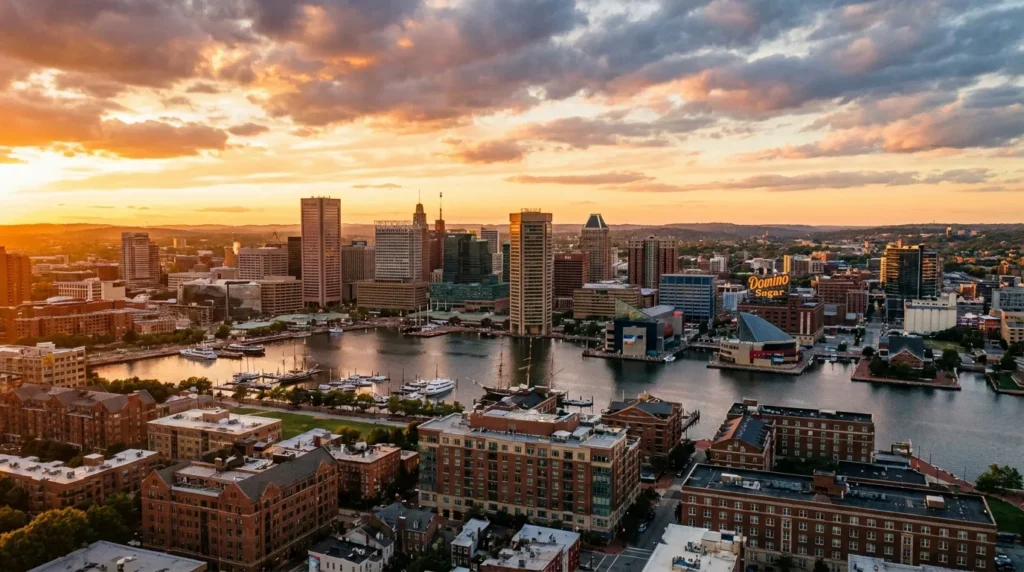
Baltimore blends a revitalized Inner Harbor, historic neighborhoods like Fells Point and Federal Hill, world-class museums, and a food scene celebrated for Chesapeake Bay crab cakes.

The Inner Harbor is home to the National Aquarium, Maryland Science Center, and the USS Constellation, a 19th-century frigate. Federal Hill, Fells Point, and Canton, with their exposed brick rowhouses and waterfront bars, are the go-to neighborhoods for young professionals. The American Visionary Art Museum showcases outsider art, and the Baltimore Museum of Art holds the largest Matisse collection in the world.

Johns Hopkins University and Johns Hopkins Hospital serve as economic anchors, drawing health professionals from around the globe. Camden Yards, home of the Baltimore Orioles, is a landmark in baseball stadium design. The Hippodrome Theatre hosts Broadway productions, and the Lyric Opera House maintains an active opera program. Mount Vernon, with the Walters Art Museum and the original Washington Monument, forms the cultural heart of the city.

For outdoor space, Druid Hill Park houses the Maryland Zoo and Victorian-era gardens. Patterson Park, Federal Hill Park, and the Gwynns Falls Trail offer urban hiking options. Chesapeake Bay and Annapolis are 45 minutes away, with Ego Alley and the US Naval Academy. Washington, D.C. is one hour away via MARC Train.

  1. 1["Inner Harbor"
  2. 2"National Aquarium"
  3. 3"Fort McHenry National Monument"
  4. 4"Baltimore Museum of Art"
  5. 5"American Visionary Art Museum"
  6. 6"Camden Yards (Orioles)"
Nightlife7.0 / 10
Parks & green spaces
  • ["Patterson Park"
  • "Druid Hill Park"
  • "Federal Hill Park"
  • "Cylburn Arboretum"
  • "Gwynns Falls\/Leakin Park"
  • +1 more

Latest posts

Posts about Maryland

Coverage and updates related to this destination.

Showing content from Maryland, as there is no specific data for Baltimore yet.