Visto n' Visa
Blog
Notícias e artigos
Destinations
Careers
Immigrants

Want to live and work in Portland?

Personalized immigration plan with eligible visas, costs, and next steps for your goal!

If you are not eligible, you will know exactly why and what to do to improve your approval chances.

Save up to 12 hours in meetings

No pointless assessments.

Save up to 90%

Save money on vague or unfocused consultations

Avoid Fraud and Mistakes

One mistake can cost you your visa

Total Impartiality

Zero commercial bias

Decide with peace of mind

No toxic urgency

Fast and Accurate

Answers in minutes, no guesswork

A small city with strong growth in African and Latin American communities

Portland has approximately 68,000 residents. The majority are white residents of Irish, Italian, and Franco-Canadian descent, but over the past two decades the city has gained substantial communities from sub-Saharan Africa and the Middle East.

The traditional profile remains strong: descendants of Irish, Italian, Franco-Canadian ("Acadians" and "Québécois"), and English settlers form the historical base. The city has its own distinct accent and a cultural identity tied to the North Atlantic.

Since the 2000s, Portland has become a refugee resettlement destination. Somali, Sudanese, Congolese, Angolan, Rwandan, Iraqi, and Syrian communities have established themselves along with churches, mosques, and markets, primarily in East Bayside, now known as "Little Mogadishu." More recently, families from Haiti, Venezuela, and Angola have arrived.

Brazilians are a small minority, but the city has solid infrastructure for Portuguese speakers due to the Angolan community. Religious life includes historic Catholicism, various Protestant denominations, synagogues (Temple Beth El), mosques, and African Pentecostal churches.

Languages spoken
  • English
  • Spanish
  • Somali
  • Arabic
  • French
  • +3 more
Main religions
  • Catholicism
  • Protestantism (various denominations)
  • Islam
  • Judaism
  • No religion

Expensive by Maine standards, still cheaper than Boston, with rising rent pressure

Portland is Maine's most expensive city. Rents have risen sharply since 2020 as people have relocated from Boston and New York. Groceries, winter heating, and health insurance are the main expenses.

Rent is the biggest challenge. One-bedroom apartments in the downtown or West End area are priced comparably to mid-sized East Coast cities. Home prices surged after the pandemic, and supply remains low. More affordable neighborhoods include Riverton, North Deering, and parts of East Deering.

Winter raises the cost of living: oil or natural gas heating weighs heavily from December to March, and car insurance also rises due to snowy roads. Supermarkets like Hannaford, Shaw's, and Whole Foods cover everyday needs. For better prices and ethnic products, Bayside Market, Boqueh Market (African foods), and Micucci Grocery (Italian) are go-to options.

Living without a car keeps costs down, since downtown is walkable and bus service is reasonable. However, Maine salaries are generally lower than in metropolitan New England, so budgets can be tight for those in service industries.

93Cost index (US = 100)7% below US average
CategorySingleCoupleFamily (2 + 2)
iHousing$1,205$1,390$1,761
iFood$352$704$1,279
iTransport$464$787$1,020
iHealthcare$259$518$972
iChildcare$1,686
iOther$787$1,417$1,992
Monthly total$3,067$4,816$8,710

Source: U.S. BLS Consumer Expenditure Survey 2023 + BEA Regional Price Parities 2023 · Estimates in USD, monthly.

Victorian homes, triple-deckers, and new condos near the harbor

Portland offers an interesting mix of historic homes, three-story apartment buildings (triple-deckers), and new developments near the harbor. Supply is limited and the market is competitive.

West End and Western Promenade have the finest Victorian homes, tree-lined streets, and harbor views. Munjoy Hill, in Eastern Promenade, has become one of the most sought-after neighborhoods, with cafes, bakeries, and the best sunsets in the city. East Bayside is more modest, with affordable rents and a strong immigrant presence.

Parkside and Bayside have condos and smaller buildings close to downtown. Deering Center is more residential, with single-family homes and a solid school network. North Deering, Riverton, and Rosemont are farther out, with larger homes and yards, better suited for families with a car.

The rental market is tight: the best listings circulate by word of mouth, especially in central neighborhoods. Those arriving without a local network often start outside the center and move closer as they get to know the city. Buying is expensive and requires patience.

Recommended neighborhoods
  • West End
  • Munjoy Hill
  • East Bayside
  • Parkside
  • Deering Center
  • +2 more

Healthcare, tourism, food, and financial services lead the economy

Portland concentrates Maine's largest employers. MaineHealth, Unum, L.L.Bean (in nearby Freeport), and an expanding culinary scene create jobs in healthcare, office work, hospitality, and construction.

MaineHealth, owner of Maine Medical Center, is the region's largest employer. The insurer Unum is headquartered here and hires in technology, actuarial services, and customer support. Idexx Laboratories (veterinary diagnostics, in neighboring Westbrook) is a major force in laboratory and technology. WEX, a payments fintech, also has its headquarters locally.

The celebrated culinary scene creates many positions in kitchens, front of house, and management. Restaurants like Fore Street, Eventide Oyster, and Duckfat have brought national recognition to the city. In summer, tourism employs thousands in hotels, ferries, souvenir shops, and fishing boats.

For newly arrived immigrants, openings exist in fish and lobster processing, cleaning, construction, elder care, and food service. The local office of Catholic Charities Maine and the New Mainers Resource Center assist refugees and immigrants with retraining and credential recognition.

Dominant sectors
  • Healthcare
  • Insurance and Financial Services
  • Tourism and Hospitality
  • Food and Culinary
  • Fishing and Seafood Processing
  • +1 more
Major employers
  • MaineHealth
  • Maine Medical Center
  • Unum
  • WEX
  • Idexx Laboratories
  • +3 more

Local public universities and proximity to New England campuses

Portland is home to the main campus of the University of Southern Maine and has a solid public school network. For broader university options, Boston is two hours away with dozens of institutions.

The University of Southern Maine (USM) has campuses in Portland and Gorham, with programs in education, nursing, computer science, business administration, and law (Maine Law). Southern Maine Community College, in South Portland, offers associate degrees and technical programs at more accessible prices.

Bowdoin College, in Brunswick (40 minutes away), is one of the finest liberal arts colleges in the United States. Bates College, in Lewiston, is also highly regarded. The University of New England has campuses in Biddeford and Portland, with a strong health sciences program. Maine Medical Center offers medical residencies.

Portland Public Schools provide strong ESL services for refugee and immigrant children. Charter schools and private schools such as Waynflete are also options. The city invests in adult English programs through Portland Adult Education.

Notable universities
  • University of Southern Maine
  • Maine College of Art & Design
  • University of New England (Portland Campus)
  • Southern Maine Community College
  • Maine Law

Maine Medical Center is the largest medical center in the state

Maine Medical Center, in Portland, is the state's primary tertiary hospital. The MaineHealth system connects regional hospitals, and community clinics serve immigrants on a sliding payment scale.

Maine Medical Center, part of MaineHealth, is the state's referral hospital for complex cases, with a Level 1 trauma program and residencies in multiple specialties. Mercy Hospital, downtown, is a smaller Catholic alternative. Both handle emergencies.

For those arriving without insurance, Greater Portland Health (a federally qualified community health center) operates on a sliding payment scale and has interpreters in multiple languages. Portland Community Free Clinic offers free care to those without coverage. Mental health remains a weak point in the network, with long waits for psychiatrists.

CVS, Walgreens, Hannaford, and Rite Aid pharmacies serve the city. Private dentists are expensive without insurance; USM has a low-cost dental hygiene clinic. The large immigrant communities have driven the network to expand interpreter services in Somali, Arabic, French, Spanish, and Portuguese.

Healthcare index72.0 / 100
  • Life expectancyyears at birth
    78.4yrs
  • Doctors per 1kpracticing physicians
    3.7
  • Health spendper capita, per year
    $13,473
  • Public systemoverall quality rating
    Good

City considered safe, with isolated issues tied to drugs and homelessness

Portland has low crime rates compared to other American cities. Violent crimes are rare. The most pressing concerns involve the opioid crisis, homelessness, and theft.

The Portland Police Department maintains a visible presence, and most neighborhoods are safe to walk at night, including Munjoy Hill and West End. Violent crime is below the national average and tends to be linked to personal disputes or drug trafficking.

The opioid crisis in Maine has affected Portland, and visible drug use and homelessness are concentrated around Bayside and parts of downtown. Car break-ins, bike theft, and petty theft are the most common incidents. Residential neighborhoods and islands like Peaks Island are virtually crime-free.

For immigrants, the city has a reputation for being welcoming. The police department has cultural mediation programs, and organizations such as the Immigrant Legal Advocacy Project offer free legal guidance. There is no automatic cooperation between local police and ICE in routine situations.

5.8
Homicides per 100k
per year
Safety index
72.0
Crime index
28.0
Safer neighborhoods
  • West End
  • East End
  • Munjoy Hill
  • Old Port
  • Deering Center
  • Rosemont
Areas to avoid
  • sections of Bayside near shelters at night
  • Kennedy Park area during late hours
  • industrial parking lots along Marginal Way after business hours

Walkable downtown, Greater Portland Metro bus, and island ferries

Portland is one of the most walkable cities in the American Northeast. The entire downtown can be navigated on foot, and the Greater Portland Metro bus system covers the main neighborhoods. For travel out of state, there is an airport and train service.

Downtown, including Old Port, the Arts District, and Eastern Promenade, is entirely walkable. The Greater Portland Metro system operates routes connecting Portland to Westbrook, Falmouth, South Portland, and the airport. Casco Bay Lines ferries depart several times daily for Peaks Island, Long Island, and other islands where some residents live year-round.

Portland International Jetport (PWM) offers direct flights to Boston, New York, Philadelphia, Washington, Orlando, and other American destinations. The Amtrak Downeaster train connects Portland to Boston in just over two hours, with several departures daily. Greyhound and Concord Coach serve interstate bus routes.

Cycling infrastructure is expanding, and Eastern Promenade has one of the best urban bike paths in New England. In winter, snow complicates travel, and most families keep a car. Living without driving is nonetheless feasible in the downtown area.

20 min
Avg commute
72
Walkability
Airports
  • PWM — Portland International Jetport
  • International airport
  • Bike infrastructure

What the climate is like living in Portland

A port city in Maine with a humid continental climate: short, mild summers around 26 degrees Celsius, long winters with heavy snowfall, and maritime influence.

Summer in Portland is pleasant and short, with highs between 25 and 27 degrees Celsius in July and cool breezes from Casco Bay. Air conditioning is unnecessary in most homes, and the tourism season takes full advantage of the weather.

Winter is cold and long, with lows between -10 and -5 degrees Celsius from December through February and snowstorms that accumulate roughly 160 cm per season. The maritime influence makes the cold less extreme than in the interior, though coastal winds worsen the wind chill.

Spring arrives late, generally in mid-April, and a spectacular fall brings foliage from September through October. Annual rainfall totals around 1,200 mm, and coastal fog is common in spring.

Sunny days / year201 days
Avg high (°F)
  • 35°J
  • 36°F
  • 44°M
  • 53°A
  • 64°M
  • 72°J
  • 79°J
  • 78°A
  • 71°S
  • 61°O
  • 48°N
  • 40°D
Avg low (°F)
  • 20°J
  • 19°F
  • 27°M
  • 38°A
  • 47°M
  • 57°J
  • 64°J
  • 64°A
  • 57°S
  • 47°O
  • 35°N
  • 27°D
Rainfall (")
  • 4"J
  • 3"F
  • 3"M
  • 5"A
  • 3"M
  • 4"J
  • 6"J
  • 4"A
  • 4"S
  • 5"O
  • 4"N
  • 6"D

National culinary scene, indie arts, and maritime culture

Portland is a national reference for cuisine and craft beverages. It has theaters, festivals, a strong art museum, and an identity tied to the harbor, summer on Casco Bay, and harsh winters.

Old Port concentrates restaurants, pubs, and shops along cobblestone streets. The Portland Museum of Art holds an important collection of Winslow Homer and American art. The Maine Historical Society, the State Theatre, Merrill Auditorium, and Portland Stage Company sustain cultural programming throughout the year.

Local cuisine revolves around lobster, oysters, white fish, sourdough bread, craft beer, and cocktails. Allagash, Bissell Brothers, and Foundation are anchor breweries. Festivals such as the Old Port Festival, Portland Pride, and the Maine Lobster Festival (in nearby Rockland) draw visitors during the season.

In summer, life happens on Eastern Promenade, on ferries to the islands, and at Crescent Beach. In winter, the focus shifts to theaters, cafes, bookstores (Print, Longfellow Books), and the tradition of skiing at nearby mountains such as Sunday River and Sugarloaf.

Portland

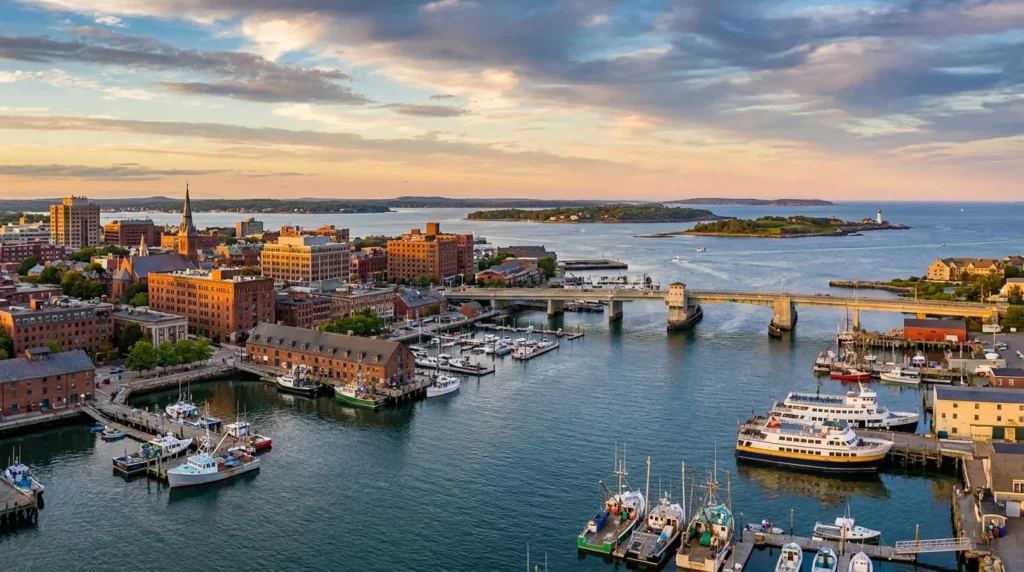
Portland, Maine's largest city between the sea and the old harbor

Portland combines the historic Old Port, iconic lighthouses, nationally recognized dining, and easy access to Maine's islands and national parks.

The Old Port, with its cobblestone streets and 19th-century brick buildings, is the heart of the city, home to restaurants, independent bookstores, and cafes. The Portland Museum of Art houses works by Winslow Homer and Andrew Wyeth. The Victoria Mansion, a Victorian-era estate, and the Wadsworth-Longfellow House tell the story of the city's past.

Portland Head Light, in Cape Elizabeth, is one of the most photographed lighthouses in the United States. The Casco Bay Lines ferry connects residents and visitors to islands such as Peaks Island, Great Diamond, and Chebeague. The Eastern Promenade Trail, along the bay, is one of the most used paths by the local population.

Within an hour, it is possible to reach Acadia National Park, the Mount Washington Valley in New Hampshire, and the beaches of Old Orchard Beach. Festivals such as the Maine Lobster Festival and the Old Port Festival draw crowds in summer. Portland's dining scene has earned James Beard Awards and attracts chefs from across the country.

  1. 1["Old Port"
  2. 2"Portland Head Light in Cape Elizabeth"
  3. 3"Portland Museum of Art"
  4. 4"Eastern Promenade"
  5. 5"Casco Bay Lines ferries"
  6. 6"Victoria Mansion"
Nightlife6.0 / 10
Parks & green spaces
  • ["Eastern Promenade"
  • "Western Promenade"
  • "Deering Oaks Park"
  • "Back Cove Trail"
  • "Baxter Woods"
  • +1 more

Latest posts

Posts about Maine

Coverage and updates related to this destination.

Showing content from Maine, as there is no specific data for Portland yet.