Visto n' Visa
Blog
Notícias e artigos
Destinations
Careers
Immigrants

Want to live and work in Kennebunk?

Personalized immigration plan with eligible visas, costs, and next steps for your goal!

If you are not eligible, you will know exactly why and what to do to improve your approval chances.

Save up to 12 hours in meetings

No pointless assessments.

Save up to 90%

Save money on vague or unfocused consultations

Avoid Fraud and Mistakes

One mistake can cost you your visa

Total Impartiality

Zero commercial bias

Decide with peace of mind

No toxic urgency

Fast and Accurate

Answers in minutes, no guesswork

Who lives in Kennebunk and how the city is changing

Kennebunk is predominantly white and upper-middle class, with an aging population. Diversity has been growing through Portland, which has received refugees from Africa, the Middle East, and Latin America over the past 15 years.

Kennebunk has about 11,000 permanent residents, a number that nearly doubles in summer. Most were born in the United States, with English, Irish, and French-Canadian ancestry, a legacy of the historical immigration that shaped Maine. The median age exceeds 50, reflecting a statewide trend: Maine is the oldest state in the US.

The immigrant presence in Kennebunk is small, but the greater Portland metro area has been receiving new groups. The most numerous today include Iraqis, Somalis, Angolans, Rwandans, Congolese, Syrians, Brazilians, and Venezuelans, generally resettled through federal programs or family chain migration. In Kennebunk specifically, seasonal Latino and Jamaican workers can be found in hospitality and restaurants during summer.

English is the dominant language in all settings: public services, schools, and commerce. Spanish appears in hospitality workplaces. The religions reflect New England heritage, with a strong Congregational, Catholic, and Unitarian presence. The village has churches more than 200 years old in the historic center.

Languages spoken
  • English
  • Spanish
  • French
  • Arabic
  • Portuguese
Main religions
  • Congregational Christianity
  • Catholicism
  • Unitarian Universalism
  • Episcopal Christianity
  • No declared religion

Cost of living in Kennebunk: above the Maine standard, mid-range for New England

Living in Kennebunk costs more than the rest of Maine due to coastal tourism. Year-round rental is the main bottleneck, with a chronic shortage of units due to homes converted to Airbnb.

The cost of living in Kennebunk is above the Maine average and above the US national average, primarily because of housing. A one-bedroom apartment is difficult to find for less than the equivalent of several months of local minimum wage, and small houses in the historic center exceed prices seen in mid-size inland US cities.

Food at Hannaford or Shaw's carries typical New England prices: fresh vegetables cost more in winter, while local seafood (lobster, scallops, mussels) is more accessible in summer, bought directly from fishmongers. Fuel, electricity, and heating oil are significant in the winter budget: most homes use fuel oil, and filling the tank in winter is a major fixed expense.

Areas where costs are lower: state sales tax is 5.5% and relatively low, there is no tax on grocery food, and municipal parks and beaches are accessible to residents. Remote workers can achieve a comfortable standard of living; those relying on local hospitality or retail wages face real financial pressure.

Kennebunk

Housing in Kennebunk: tight supply and seasonal market dynamics

The real estate market is dominated by historic houses in the center, beach houses, and new condominiums along Route 1. Year-round rental is scarce; many properties have been converted to short-term rentals.

The historic center (Kennebunk Village) has 19th-century wood-frame houses, tree-lined streets, and sidewalks that allow walking to shops. It is the most valued area and the first choice for those who prioritize a walkable lifestyle. The Lower Village, near the bridge to Kennebunkport, is more tourist-oriented and also expensive, ideal for those who want to be close to the beaches.

West Kennebunk, further inland, offers houses with larger lots, somewhat more accessible prices, and a more family-oriented character. Along Route 1 and near turnpike exit 25 (Maine Turnpike, I-95) there are newer condominiums and rental apartments, more functional than charming. The Beach Districts (Mother's Beach, Gooch's Beach, Middle Beach, Kennebunk Beach) have many seasonal vacation homes.

The main bottleneck is year-round rental. The town has few apartment buildings, and much of the housing stock has been converted to short-term rentals. Newcomers often live first in Sanford, Biddeford, or Wells, which are 15 to 25 minutes away by car and have more accessible rents, until a unit opens up in Kennebunk.

Recommended neighborhoods
  • Kennebunk Village
  • Lower Village
  • West Kennebunk
  • Beach District (Gooch's Beach)
  • Cat Mousam Road area

Job market in Kennebunk: tourism, healthcare, and commutes to Portland

The local economy depends on hospitality, restaurants, and construction. Skilled professionals typically commute to Portland, where qualified jobs in healthcare and technology are concentrated.

Kennebunk has no large industrial employer. Most local jobs are in hotels, inns, restaurants, construction, landscaping, and maintenance services, with a seasonal peak from May through October. Regional hospitals and clinics affiliated with Southern Maine Health Care employ nurses, technicians, and administrative staff year-round.

Those working in office, technology, finance, or specialized healthcare typically commute to Portland (40 to 50 minutes via I-95) or Portsmouth, New Hampshire (35 minutes to the south). The hybrid work model became common after 2020, and many residents live in Kennebunk precisely to combine quality of life with two or three commute days per week.

For newly arrived immigrants, the most common entry points are hospitality (kitchen work, housekeeping), construction, landscaping, and elder care. Intermediate English helps significantly; a Social Security number or work authorization are basic requirements. Adult English programs run in Sanford and in Biddeford through Adult Education.

Dominant sectors
  • Tourism and hospitality
  • Healthcare and elder care
  • Construction
  • Retail trade
  • Landscaping and residential services
  • +1 more
Major employers
  • Southern Maine Health Care
  • Kennebunk School District (RSU 21)
  • Hannaford Supermarkets
  • Kennebunk Savings Bank
  • The Nonantum Resort
  • +1 more

Education in Kennebunk: well-rated public schools and universities in Portland

The RSU 21 public school network serves Kennebunk, Kennebunkport, and Arundel, with schools ranked among the best in the region. Higher education is located in Portland, Biddeford, and New Hampshire.

The school system is Regional School Unit 21 (RSU 21), serving Kennebunk, Kennebunkport, and Arundel. It has five schools from pre-K through high school, with Kennebunk High School as the only secondary school. Public ratings (Niche, GreatSchools) consistently rank the district among the best in Maine, and the high school graduation rate is high.

For immigrant families with children, enrollment is free regardless of immigration status, with proof of residency required. Schools have English as a Second Language programs, though classes are small given the town's demographic profile. Families needing more ESL support often prefer Biddeford or Sanford.

There is no local higher education. Nearby options include University of New England (UNE) in Biddeford (15 minutes), University of Southern Maine (USM) in Portland (40 minutes), Southern Maine Community College in South Portland, and York County Community College in Wells. Bowdoin, Bates, and Colby are about an hour and a half to the north.

Notable universities
  • University of New England (UNE) — Biddeford
  • University of Southern Maine (USM) — Portland
  • York County Community College — Wells
  • Southern Maine Community College — South Portland

Healthcare in Kennebunk: solid regional network, specialists in Portland

Southern Maine Health Care serves the area with a hospital in Biddeford and clinics in Kennebunk. For specialties, the path leads to Portland (Maine Medical Center) or Boston.

Primary care in Kennebunk is covered by Southern Maine Health Care (SMHC) clinics and private practices downtown. The reference hospital is SMHC Medical Center in Biddeford, 15 minutes away, with a 24-hour emergency room, maternity ward, and general surgery. For serious emergencies, medical helicopters transfer patients to Portland.

Maine Medical Center in Portland is the largest hospital in the state, concentrating oncology, cardiology, neurology, and specialized intensive care. It is the reference for complex cases. Boston (MGH, Brigham, Dana-Farber) is within reach for highly specialized treatments, with referral.

The American healthcare system is insurance-based: employed immigrants typically have employer-sponsored coverage, and those with low incomes can apply for MaineCare (state Medicaid) or federal Marketplace subsidies. Without insurance, a basic appointment is expensive, and emergency rooms bill high. Community clinics in Biddeford offer care on a sliding scale.

Kennebunk

Safety in Kennebunk: low crime rates, a town considered peaceful

Kennebunk has crime rates well below the US national average. Violent crimes are rare; seasonal thefts in closed vacation homes during winter are the most common complaint.

Kennebunk is considered one of the safest towns in Maine, which is itself one of the safest states in the US. Violent crimes are rare, and daily life in the village has a familiar tone: houses where front doors remain unlocked, children riding bikes unaccompanied, neighbors who know each other by name. Minor thefts from garages and unlocked cars do occur, especially in summer as visitors arrive.

Beach areas (Gooch's Beach, Mother's Beach) and the historic center have active patrols by the Kennebunk Police Department, especially on peak-season weekends. Empty vacation homes in winter are occasional targets for theft, and residents often hire weekly check-in services or ask neighbors to keep watch.

Common points of attention: poorly lit stretches of Route 1 at night, isolated areas near the turnpike, and empty parking lots in the off-season. There are no established drug trafficking or violence zones. For immigrants coming from large cities, the adjustment is typically to the quiet and isolation, not to safety risks.

Safer neighborhoods
  • Kennebunk Village (historic center)
  • Lower Village
  • West Kennebunk (residential)
  • Beach District (residential)
Areas to avoid
  • Isolated stretches of Route 1 at night
  • Deserted beach parking lots in winter
  • Industrial areas near turnpike exit 25

Getting around Kennebunk: a personal vehicle is the rule, not the exception

There is no public transit within the city. A car is required for any daily routine. The Amtrak Downeaster train connects the area to Portland and Boston via the local station.

Kennebunk has no municipal bus service. To reach a grocery store, a medical office, or a workplace, all residents need a personal vehicle or ridesharing. I-95 (Maine Turnpike) runs through the town at exit 25, providing quick access to Portland (north) and Portsmouth/Boston (south). Route 1 is the scenic alternative, slower but parallel.

The major asset is the Amtrak Downeaster: the train station is in central Kennebunk and has several daily departures to Portland, Old Orchard Beach, Wells, Dover, Durham, Exeter, Haverhill, and Boston North Station. For occasional trips to Boston, it is comfortable and avoids turnpike traffic.

The nearest commercial airport is Portland International Jetport (PWM), about 25 miles away. For international flights with more options, Boston Logan (BOS) is about 1 hour 45 minutes under normal conditions. Manchester (MHT), in New Hampshire, is an alternative about 1 hour away. Bike lanes within the city are limited, but segments exist along the Bridle Path and on some downtown streets.

Airports
  • PWM — Portland International Jetport (40 min)
  • BOS — Boston Logan International (1h45)
  • MHT — Manchester-Boston Regional (1h)
  • Bike infrastructure

Climate

Kennebunk

Culture in Kennebunk: New England maritime tradition and a festival calendar

The city embodies the classic culture of the Maine coast: lobster, colonial mansions, summer festivals, and an illuminated Christmas celebration. The Brick Store Museum preserves the region's history.

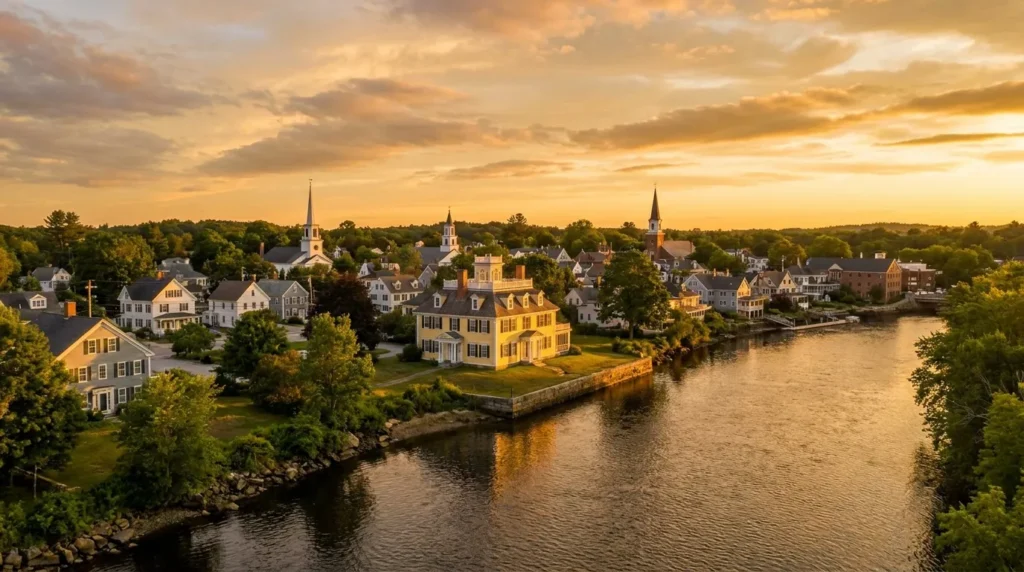
Kennebunk's cultural identity comes from the sea and colonial architecture. Downtown streets feature 19th-century sea captains' houses, white churches with tall steeples, and the famous Wedding Cake House, with its ornate white plaster facade. The Brick Store Museum on Main Street tells the history of the shipbuilding industry, fishing, and the arrival of the first families.

Food is a central element. Butter-steamed lobster, lobster rolls on Frankfurter-style buns, clam chowder, grilled scallops, and blueberry pie appear at any local restaurant. Establishments such as Mabel's Lobster Claw and The Clam Shack have become local landmarks. For breakfast, Maine blueberry pancakes are nearly obligatory.

The cultural calendar is strong in summer (concerts at Lafayette Park, Fourth of July fireworks, fish festival) and reaches a high point at year's end with the Christmas Prelude in December, which fills the center with lights, carriages, choral singing, and parades. It is one of the best-known attractions in southern Maine in winter.

Notable dishes
  • Lobster roll
  • New England clam chowder
  • Grilled sea scallops
  • Butter-steamed lobster
  • Blueberry pie
  • +1 more
Annual events
  • Christmas Prelude (December)
  • Kennebunk River Day
  • Fourth of July Parade
  • Concerts in the Park (Lafayette Park)
  • Lobsterfest Maine
  • +1 more

What to see in Kennebunk: beaches, historic center, and an iconic lighthouse

Attractions are divided among the coastline (beaches and Walker's Point), the historic center (Wedding Cake House, Brick Store Museum), and woodlands. Neighboring Kennebunkport complements the itinerary.

Kennebunk's historic center concentrates its architectural landmarks. The Wedding Cake House on Summer Street is the yellow house with an ornate white facade that has become a postcard cover. The Brick Store Museum brings together four 19th-century buildings transformed into a museum of local history, maritime heritage, and art. The Louis T. Graves Memorial Library next door is a fine example of a small New England library.

On the shore, Gooch's Beach is the best-known, wide with firm sand good for walking. Mother's Beach is smaller, sheltered, and family-friendly. Middle Beach is rockier. Heading from Kennebunk toward Kennebunkport, Walker's Point (the Bush family estate) and Cape Porpoise Light are worth visiting, the latter appearing in classic Maine photographs.

For green spaces, Rachel Carson National Wildlife Refuge has short trails through the estuary, excellent for birdwatching. Wonderbrook Park and the Sea Road School Trail offer short woodland walks. In winter, a visit can be combined with at least one of the Kennebunkport villages, just a few minutes away.

  1. 1Wedding Cake House
  2. 2Brick Store Museum
  3. 3Gooch's Beach
  4. 4Walker's Point (neighboring Kennebunkport)
  5. 5Cape Porpoise Light
  6. 6Mother's Beach
Parks & green spaces
  • Rachel Carson National Wildlife Refuge
  • Wonderbrook Park
  • Lafayette Park
  • Bridle Path Trail
  • Kennebunk Plains Wildlife Management Area
  • +1 more

Immigrant communities in Kennebunk and the greater Portland metro area

Kennebunk itself has few immigrant residents, but the greater Portland metro area concentrates diverse groups: Iraqis, Somalis, Angolans, Rwandans, Congolese, Syrians, Brazilians, Venezuelans, and Jamaicans.

Kennebunk's migration profile reflects that of southern Maine: small in absolute numbers but growing each year. Seasonal Latino and Jamaican workers arrive for summer hospitality work, and Indian, Filipino, and Eastern European healthcare professionals work in regional hospitals. For immigrants seeking an active community, Portland is the reference, about 40 minutes away.

Since the 2000s, Portland has received waves of refugees and migrants from Iraq, Somalia, South Sudan, Angola, the Democratic Republic of Congo, Rwanda, Syria, Venezuela, and El Salvador. There is also a longstanding presence of Irish, Italian, and French-Canadian communities and, more recently, Brazilians who relocated from Massachusetts. Lewiston, about an hour to the north, has the largest Somali community in the state.

Institutional support is concentrated in Portland: organizations such as Catholic Charities Maine, Immigrant Welcome Center, Maine Immigrant and Refugee Services, and ProsperityME offer assistance with documentation, English, and employment. In Kennebunk specifically, libraries and some churches maintain conversation groups and targeted support for newly arrived families.

450
Foreign-born residents
estimated
Top countries of origin
  • Canada
  • Jamaica
  • Iraq
  • Philippines
  • India
  • Brazil
  • Mexico
  • United Kingdom
Foreign consulates
  • Honorary Consulate of France — Portland
  • Honorary Consulate of Italy — Portland
  • Honorary Consulate of Canada — Portland
  • Consulate General of Mexico — Boston (jurisdiction)
  • Consulate General of Brazil — Boston (jurisdiction)
Community organizations
  • Catholic Charities Maine — Refugee and Immigration Services
  • Immigrant Welcome Center — Portland
  • Maine Immigrant and Refugee Services (MEIRS)
  • ProsperityME
  • Greater Portland Immigrant Welcome Center
  • Adult Education — Sanford/Biddeford

Latest posts

Posts about Maine

Coverage and updates related to this destination.

Showing content from Maine, as there is no specific data for Kennebunk yet.