Visto n' Visa
Blog
Notícias e artigos
Destinations
Careers
Immigrants

Want to live and work in Monroe?

Personalized immigration plan with eligible visas, costs, and next steps for your goal!

If you are not eligible, you will know exactly why and what to do to improve your approval chances.

Save up to 12 hours in meetings

No pointless assessments.

Save up to 90%

Save money on vague or unfocused consultations

Avoid Fraud and Mistakes

One mistake can cost you your visa

Total Impartiality

Zero commercial bias

Decide with peace of mind

No toxic urgency

Fast and Accurate

Answers in minutes, no guesswork

Monroe's population: Black majority with a strong Southern tradition

A city with a Black majority, a significant white community, and a growing Hispanic presence. ULM students and healthcare professionals add age and cultural diversity.

Monroe has a Black majority, a historical legacy of the Mississippi Delta and northeast Louisiana. The white community is large and concentrated in specific neighborhoods and suburbs, particularly in West Monroe, the neighboring city across the river. This division follows longstanding patterns common to the Deep South.

The Hispanic population is smaller than in other Louisiana cities, but growing, with Mexican and Central American families drawn by work in agriculture, construction, and restaurants. Latin grocery stores and taquerias are emerging, especially along commercial corridors such as Louisville Avenue.

ULM and the major hospitals add diversity, with students and professionals coming from across the United States and abroad. Asian and South Asian communities are small but present, connected to healthcare and higher education.

Languages spoken
  • English
  • Spanish
Main religions
  • Protestant Christianity (Southern Baptist)
  • Evangelical Christianity
  • Catholicism
  • Non-religious

Cost of living in Monroe: among the lowest in the United States

Overall costs well below the national average. Housing, groceries, and gas are affordable. Auto insurance is a notable expense due to Louisiana's statewide rates. Property taxes are low.

Monroe consistently ranks among the most affordable cities in the United States. Purchasing a three-bedroom home in a decent neighborhood is achievable on a modest salary. Two-bedroom apartment rents in reasonable areas are among the lowest in the country, particularly near ULM and in the older residential districts.

Groceries, gas, and everyday services follow the pattern of a mid-size Southern city, with comfortable prices for consumers. Dining out is inexpensive, with diners, fried seafood, soul food, and regional barbecue covering the everyday menu. Major grocery chains (Walmart, Brookshire's, Albertsons) compete on price.

The main expense is auto insurance, one of the worst in the United States due to Louisiana's statewide conditions. Homeowner's insurance is better than in the southern part of the state, as Monroe is not in a hurricane zone, but storm risk remains. Property taxes are low, which benefits homebuyers considerably.

Monroe

Housing in Monroe: traditional neighborhoods and new developments to the south

A highly affordable real estate market, with traditional neighborhoods near ULM, new developments to the south and west, and more modest areas to the north. Neighboring West Monroe is a popular alternative.

Traditional neighborhoods are found around ULM and Bayou DeSiard, featuring older homes, tree-lined streets, and a university atmosphere. South Grand, Old Garden District, and Forsythe Park are notable examples. For younger families, newer developments such as Bayou DeSiard Country Club and southern neighborhoods offer modern homes.

West Monroe, across the river, attracts families who prefer a suburban setting with schools that tend to receive stronger ratings. It is a separate municipality with its own identity, but functions as part of the metropolitan area. Neighborhoods such as Frenchman's Bend are sought after by professionals.

For apartments, the supply runs along Louisville Avenue, near ULM, and in newer complexes to the south. Low prices mean that even early-career professionals can secure good-quality housing. Checking the storm history and FEMA flood zone maps before signing a lease or purchase agreement is advisable.

Recommended neighborhoods
  • South Grand
  • Old Garden District
  • Forsythe Park
  • Bayou DeSiard Country Club
  • Frenchman's Bend (West Monroe)
  • +2 more

Job market: healthcare, telecommunications, education, and agribusiness

An economy anchored by healthcare (St. Francis, Ochsner LSU), telecom (Lumen Technologies), ULM as an academic employer, and delta agribusiness. Light manufacturing and retail round out the picture.

Healthcare is the largest employer, with St. Francis Medical Center and Ochsner LSU Health Monroe serving as major regional hospitals. Physicians, nurses, technicians, and administrative staff find solid opportunities, as Monroe acts as the medical reference point for all of northeast Louisiana and parts of Mississippi.

Lumen Technologies, formerly CenturyLink, maintains its headquarters in Monroe, with positions in technology, networking, sales, and corporate administration. Despite workforce reductions over the years, it still employs hundreds of professionals and keeps the city on the corporate map of the United States.

ULM and Louisiana Delta Community College are significant academic employers. Delta agribusiness (cotton, soybeans, corn) and food processing have a regional presence. For workers without fluent English, construction, agriculture, food processing, and restaurants offer accessible entry points.

Dominant sectors
  • Healthcare
  • Telecommunications
  • Higher education
  • Agribusiness
  • Light manufacturing
  • +1 more
Major employers
  • St. Francis Medical Center
  • Ochsner LSU Health Monroe
  • Lumen Technologies (CenturyLink)
  • University of Louisiana Monroe
  • Monroe City Schools
  • +2 more

Education: ULM, a pharmacy school, and a challenging public school system

Monroe City Schools faces structural challenges; many families opt for Christian private schools or relocate to Ouachita Parish and West Monroe districts. ULM and Louisiana Delta Community College are the higher education anchors.

Monroe City Schools administers the public schools and faces structural challenges. Families with more resources often choose Christian private schools such as River Oaks School, Saint Frederick High School, and Ouachita Christian School. Neighborhoods within Ouachita Parish, including Sterlington and West Monroe, have public schools with stronger ratings.

In higher education, the University of Louisiana Monroe (ULM) is the standout institution, with its College of Pharmacy being one of the only pharmacy programs in Louisiana and attracting students from across the state. Other strong areas include health sciences, biology, business management, and education.

Louisiana Delta Community College offers technical and associate degree programs at very accessible prices, with courses in healthcare, technology, and industry. For adult learners, LDCC and community organizations provide ESL, GED preparation, and vocational certifications for entry into the local job market.

Notable universities
  • University of Louisiana Monroe (ULM)
  • Louisiana Delta Community College
  • Grambling State University (Grambling, nearby)
  • Louisiana Tech University (Ruston, nearby)

Healthcare: regional medical hub for northeast Louisiana

Monroe serves as the regional medical hub for the northeast of the state and parts of Mississippi. St. Francis Medical Center and Ochsner LSU Health Monroe are the primary hospitals.

St. Francis Medical Center, a Catholic institution, is Monroe's largest hospital, offering emergency care, surgery, obstetrics, oncology, cardiology, and pediatrics. It serves patients from across the delta region. Ochsner LSU Health Monroe, formerly University Health Conway, is the second major system, affiliated with LSU.

For highly complex cases, transplants, advanced oncology, and intricate neurosurgery, patients may be referred to Shreveport (about an hour and a half away, Willis-Knighton, LSU Health) or New Orleans (Ochsner). The majority of care, however, is handled within Monroe.

Those arriving without employer-sponsored insurance should look into Louisiana's expanded Medicaid program and community clinics such as DeltaCare. In serious emergencies, any hospital provides treatment regardless of coverage; billing is negotiated afterward, typically through installment plans.

Healthcare index56.0 / 100
  • Life expectancyyears at birth
    78.4yrs
  • Doctors per 1kpracticing physicians
    3.7
  • Health spendper capita, per year
    $13,473
  • Public systemoverall quality rating
    Fair

Safety: safe areas alongside neighborhoods to avoid

Monroe has crime rates above the national average, concentrated in certain neighborhoods. Residential areas near ULM, Bayou DeSiard, and family-oriented districts are considered safe.

Monroe's crime statistics are higher than the United States average, with problems concentrated in specific neighborhoods in the northern and east-central parts of the city. Areas near ULM, Bayou DeSiard, Forsythe Park, and family neighborhoods to the south are considered safe.

The most common day-to-day crimes involve car theft, vehicle break-ins, and residential burglaries when security is lax. Locking vehicles, installing a basic home camera, and researching neighborhoods before signing a lease or purchase agreement address most common concerns.

Those prioritizing maximum safety often choose suburbs such as West Monroe, Sterlington, and neighborhoods within Ouachita Parish, which have better statistics and a more positive family perception. The Monroe Police Department and the Ouachita Parish Sheriff's Office cover the region, with reasonable response times.

5.8
Homicides per 100k
per year
Safety index
35.0
Crime index
65.0
Safer neighborhoods
  • Garden District (Monroe Historic District)
  • University area (ULM)
  • Frenchmen's Bend
  • Lakeshore
  • Forsythe Park area
  • Bayou DeSiard
Areas to avoid
  • South Monroe at night
  • Isolated stretches near DeSiard Street after dark
  • Industrial areas along the Ouachita River outside business hours

Transportation: a car-dependent city with its own regional airport

Monroe is a car-dependent city, with I-20 running east-west and US-165 running north-south. Public transit is minimal. The regional airport serves domestic flights with connections to major hubs.

A car is essentially required. Interstate 20 runs through Monroe connecting it to Shreveport, Vicksburg, and points east. US-165 cuts north-south through the city, serving as the route toward Alexandria and Arkansas. Traffic is light by American standards, with brief peaks during morning and evening commutes.

Local public transportation is very limited. The Monroe Transit System operates a small number of routes with low frequency, insufficient for most daily needs. Cycling has some users on the ULM campus and downtown, but heat and humidity limit broader adoption.

Monroe Regional Airport (MLU) serves domestic flights with daily connections to Atlanta (Delta), Dallas (American), and Houston (United). For international flights or more options, many travelers drive to Shreveport (SHV), about an hour and a half away, or Dallas, roughly five hours via I-20.

16 min
Avg commute
32
Walkability
Airports
  • MLU — Monroe Regional Airport
  • Bike infrastructure

What the climate is like living in Monroe

Monroe, in northeastern Louisiana, has a humid subtropical climate with very hot and muggy summers, short mild winters, and high humidity year-round.

Summer in Monroe runs from May through October, with highs between 32 and 35 degrees Celsius and very high humidity. Daily thunderstorms are common in July and August. Overnight temperatures drop to around 22 to 24 degrees Celsius. Air conditioning is essential and runs nearly year-round. Mosquitoes are present throughout the warm months.

Winter is short and mild. Lows range from 3 to 8 degrees Celsius from December through February, with occasional frost. Snow is rare. Heating costs are modest. Spring brings severe weather, with a real tornado risk in April and May.

Day-to-day life calls for reliable air conditioning, mosquito repellent, and a plan for urban flooding and severe weather. Monroe is a mid-size Delta city with a very low cost of living and an unhurried pace. Fall is the most comfortable season, with stable conditions. The city sits inland but can still feel indirect effects from Gulf hurricanes.

Sunny days / year216 days
Avg high (°F)
  • 59°J
  • 61°F
  • 70°M
  • 74°A
  • 83°M
  • 91°J
  • 93°J
  • 94°A
  • 90°S
  • 79°O
  • 67°N
  • 63°D
Avg low (°F)
  • 41°J
  • 43°F
  • 51°M
  • 56°A
  • 65°M
  • 72°J
  • 76°J
  • 76°A
  • 71°S
  • 60°O
  • 48°N
  • 45°D
Rainfall (")
  • 5"J
  • 6"F
  • 6"M
  • 6"A
  • 5"M
  • 3"J
  • 3"J
  • 5"A
  • 2"S
  • 4"O
  • 3"N
  • 4"D

Culture: Southern tradition, college sports, and a small but authentic scene

Culture rooted in Southern tradition, ULM Warhawks athletics, gospel and country music, and regional festivals. Monroe's scene is small but authentic, with delta cuisine at the center.

Monroe's culture is traditionally Southern, with Baptist and Methodist churches serving as important social centers, especially within the Black community. Gospel, country, and delta blues define the local soundscape. The Robertson family of Duck Dynasty fame, known for the Duck Commander brand, is from West Monroe.

Sports revolve around the ULM Warhawks, with football and basketball drawing local crowds. Bayou DeSiard, winding through the city, is the backdrop for festivals such as BayouFest and the Downtown Gallery Crawl. The Twin City Art Foundation and the Masur Museum of Art sustain a modest visual arts scene.

Food is delta-rooted: fried catfish, simple gumbo, soul food (collard greens, mac and cheese, fried chicken), regional barbecue, and plenty of homemade sweets. Local restaurants such as Genusa's and Warehouse No. 1 blend tradition with more refined settings at competitive prices.

Monroe

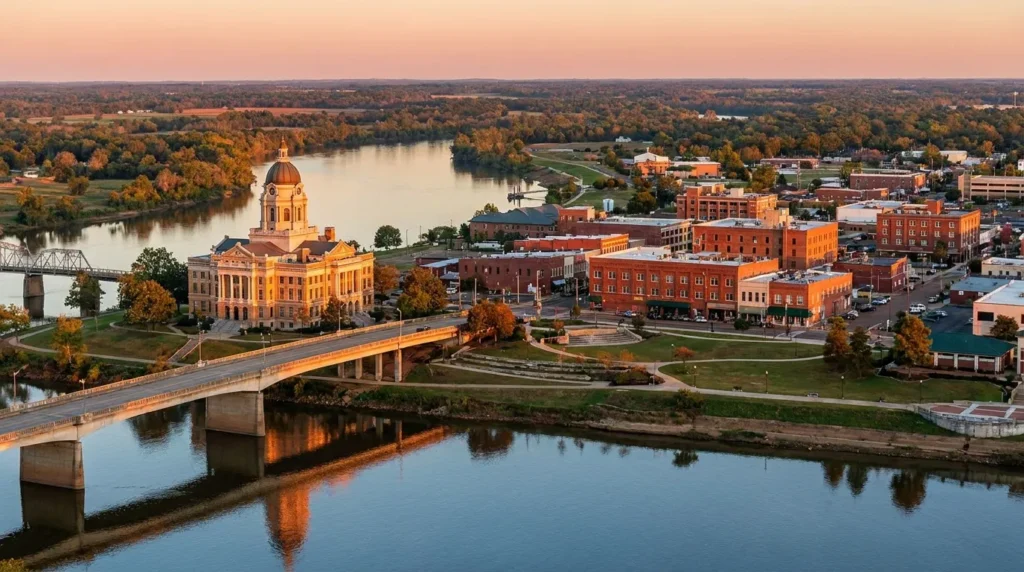
Monroe, northern Louisiana's hub on the Ouachita River

Seat of Ouachita Parish and regional center of northeastern Louisiana. Life moves at a Southern pace, shaped by Delta heritage, natural gas history, and the economic presence of CenturyLink/Lumen.

Downtown Monroe stretches along both banks of the Ouachita River, with neighboring West Monroe forming a single urban area. Antique Alley in West Monroe is a regional destination for collectors, and the Riverwalk along the river leads to the restored Forsythe Park. The Biedenharn Museum and Gardens, former home of the family who pioneered Coca-Cola bottling, stands as a cultural landmark.

Louisiana Purchase Gardens and Zoo houses more than 800 animals, from local anacondas to Siberian tigers. The Masur Museum of Art holds a collection of regional work. The Monroe Symphony Orchestra and Strauss Theatre Center anchor the cultural calendar. Louisiana Delta Community College and the University of Louisiana at Monroe (ULM) bring student life to the Sterlington Road corridor.

Black Bayou Lake National Wildlife Refuge, with boardwalks over cypress swamps and alligators, is the most sought-after nature outing in the area. The Chennault Aviation and Military Museum honors General Claire Chennault of the Flying Tigers. Annual events such as the Bayou Cuisine Festival and Delta Jubilee mark the local calendar. For day trips, Vicksburg, Mississippi, is about an hour away.

  1. 1["Biedenharn Museum & Gardens (home of the family that bottled Coca-Cola)"
  2. 2"Masur Museum of Art"
  3. 3"Northeast Louisiana Children's Museum"
  4. 4"Louisiana Purchase Gardens & Zoo"
  5. 5"Chennault Aviation and Military Museum"
  6. 6"Black Bayou Lake National Wildlife Refuge"
Nightlife3.0 / 10
Parks & green spaces
  • ["Forsythe Park (along the Ouachita)"
  • "Kiroli Park (in West Monroe
  • nearby)"
  • "Black Bayou Lake National Wildlife Refuge"
  • "Restoration Park"
  • +2 more

Latest posts

Straight from the blog

There are no posts specifically about Monroe yet. In the meantime, check out our latest posts.