Visto n' Visa
Blog
Notícias e artigos
Destinations
Careers
Immigrants

Want to live and work in Houma?

Personalized immigration plan with eligible visas, costs, and next steps for your goal!

If you are not eligible, you will know exactly why and what to do to improve your approval chances.

Save up to 12 hours in meetings

No pointless assessments.

Save up to 90%

Save money on vague or unfocused consultations

Avoid Fraud and Mistakes

One mistake can cost you your visa

Total Impartiality

Zero commercial bias

Decide with peace of mind

No toxic urgency

Fast and Accurate

Answers in minutes, no guesswork

Small city, Cajun-Creole mix, and a growing Latino presence

A majority-white population of Cajun and French heritage, with a historic Black community, Houma and Chitimacha Indigenous peoples, and growing Latin American immigration tied to construction and fishing.

Houma has around 33,000 residents in the city proper and approximately 110,000 when including the greater Terrebonne metropolitan area. Most of the population identifies as white with Cajun, French, and Acadian ancestry, with a significant African American community concentrated in historic neighborhoods such as Mechanicville and East Houma.

Indigenous presence is a central part of local identity: the United Houma Nation, headquartered here, brings together thousands of members spread across the coastal parishes. Chitimacha families from nearby communities are also part of the fabric. This Native layer coexists with French, English, and, more recently, Hispanic surnames.

Latin American immigration accelerated after Hurricane Katrina and continues to be driven by demand in construction, fishing, and landscaping. Mexicans, Hondurans, and Cubans make up the largest recent group. There are smaller communities of Filipinos tied to the boat industry and Vietnamese who came through shrimping. English dominates, but Cajun French and Spanish appear in everyday life.

Languages spoken
  • English
  • Cajun French
  • Spanish
  • Louisiana Creole
  • Vietnamese
Main religions
  • Roman Catholic
  • Baptist
  • Methodist
  • Pentecostal
  • No religion

One of the lowest costs of living in the American South

Affordable rent, cheap food, and low taxes, but high homeowner's insurance due to hurricanes and flooding adds considerable weight to the monthly budget.

Houma is one of the most affordable cities in the South. Three-bedroom homes with yards are priced well below the national average, and supermarkets such as Rouses Market and Walmart Supercenter keep weekly grocery costs accessible. Local restaurants serve generous Cajun meals at modest prices, and gas tends to stay below the national average.

The major burden on the budget is homeowner's insurance. Because the area sits in a hurricane and flood zone, policies can cost several times more than in inland cities. Those who purchase a financed home are required to carry flood insurance through the federal program (NFIP), which adds several hundred dollars per month.

Electricity is provided by Entergy at a moderate rate, but air conditioning runs nearly year-round, so summer utility bills climb. Healthcare, public schools, and car transportation are affordable. In the end, a working family can live comfortably here on salaries that would barely cover rent in New Orleans or Baton Rouge.

Houma

Homes with yards, bayou in the backyard, and few high-rises

A market dominated by single-story homes with garages and yards; affordable rent, but flood history and insurance must be checked before signing any lease.

The standard in Houma is a single-family one-story home, many in Creole cottage or ranch style from the 1960s to 1980s. Neighborhoods such as Broadmoor, Bayou Cane, and Southdown concentrate middle-class families and offer good schools. Apartments exist but are a minority, generally in low-rise complexes near Martin Luther King Boulevard.

For newcomers, it is worth prioritizing higher-ground areas outside FEMA AE flood zones. Neighborhoods such as Summerfield, Sugar Mill, and parts of Bayou Cane sit on higher ground. Trailers and mobile homes are still common on the rural outskirts of the parish, a cheaper option but vulnerable to hurricanes.

Rentals are largely handled through local real estate agencies and Facebook groups. Relying solely on large platforms like Zillow is not practical here, as coverage is limited. Always request the property's flood history (Elevation Certificate) and an insurance quote before signing, as these can change the financial calculation entirely.

Recommended neighborhoods
  • Broadmoor
  • Bayou Cane
  • Southdown
  • Summerfield
  • Sugar Mill
  • +1 more

Offshore oil, shipyards, and fishing drive the economy

A market heavily tied to the Gulf of Mexico: oil and gas, shipbuilding, commercial fishing, and healthcare dominate; the economy fluctuates with the price of a barrel.

Houma is one of the main hubs of the U.S. offshore oil and gas sector. Maritime services companies, platform maintenance firms, offshore support vessel operators, and Gulf helicopter services all base their operations here. Edison Chouest Offshore and Danos are major names, and dozens of mid-size suppliers hire technicians, mechanics, welders, and mariners.

Shipbuilding and vessel repair come close behind, with Bollinger Shipyards leading the field. Commercial fishing, especially shrimp and oysters, sustains dozens of small family fleets, though under pressure from imports and hurricanes. Healthcare is a growing segment, with Terrebonne General Health System and Ochsner St. Anne employing nurses, technicians, and physicians.

For immigrants without fluent English, the most common entry points are construction, post-hurricane reconstruction, landscaping, restaurants, and seafood processing. Hourly wages are good by local standards, but the work is physically demanding and season-dependent. Connections through churches, the Hispanic community, and groups such as Houma Latino Inc. are very helpful for a first placement.

Dominant sectors
  • Offshore oil and gas
  • Shipbuilding
  • Commercial fishing
  • Healthcare
  • Construction
  • +1 more
Major employers
  • Edison Chouest Offshore
  • Bollinger Shipyards
  • Danos
  • Terrebonne General Health System
  • Ochsner St. Anne Hospital
  • +1 more

Parish public schools, community college, and strong technical training

Public education managed by Terrebonne Parish School District, a traditional Catholic school option, and a focus on technical training tied to oil, gas, and nursing.

Elementary and secondary education in Houma is centralized under the Terrebonne Parish School District, which operates dozens of public schools. For those seeking alternatives, there are well-regarded Catholic schools such as Vandebilt Catholic High School and Maria Immacolata. The charter school offering is small, and most families choose based on neighborhood.

At the postsecondary level, Fletcher Technical Community College is the primary reference, training technicians in welding, instrumentation, practical nursing, industrial safety, and maritime operations, fields with direct placement in the local market. Nicholls State University, in Thibodaux 30 minutes away, is the nearest public university and offers full degree programs.

Those seeking graduate study or research typically relocate to New Orleans (Tulane, Loyola, UNO) or Baton Rouge (LSU). For immigrants needing to learn English, ESL classes are available at Fletcher, local churches, and organizations such as Catholic Charities Diocese of Houma-Thibodaux. Public libraries offer free support.

Notable universities
  • Fletcher Technical Community College
  • Nicholls State University (Thibodaux, 30 min)
  • L. E. Fletcher Center for Workforce Training

Two main hospitals and specialized care in New Orleans

The local network covers emergencies and basic specialties; complex cases are typically referred to university hospitals in New Orleans.

Houma is primarily served by two hospitals: Terrebonne General Health System, a nonprofit community hospital, and Ochsner St. Anne Hospital, part of the state's largest private network. Both offer 24-hour emergency care, maternity, general surgery, oncology, and cardiology, at a level appropriate for a city of this size.

The American system runs on private health insurance and requires careful plan selection. Those employed by large companies in the oil sector typically receive robust coverage. For self-employed individuals and newly arrived immigrants, community health centers such as Start Corporation and federally qualified health centers (FQHCs) charge on a sliding scale based on income.

For high-complexity care (transplants, rare pediatric surgeries, advanced oncology), patients are referred to centers in New Orleans, such as Ochsner Medical Center and Tulane Medical Center. Travel time and driving distance matter when treatment requires frequent visits, so those with serious chronic conditions should evaluate the logistics before relocating.

Houma

Reasonable safety by Louisiana standards, with areas to avoid

Violent crime below the state average, with theft and break-ins concentrated in certain areas; the main real risk is hurricanes, not crime.

Houma has a lower crime rate than large Louisiana cities such as New Orleans and Baton Rouge, but still above the national average, particularly for property crime. Vehicle theft, garage break-ins, and isolated robberies occur, mainly in older central neighborhoods. Violent crime is rarer and localized.

Established residential areas such as Broadmoor, Southdown, Summerfield, and most of Bayou Cane are quiet, with regular policing by the Houma Police Department and Terrebonne Parish Sheriff. Commercial areas such as Southland Mall and the Martin Luther King Boulevard corridor are busy and safe during the day.

The most serious risk here is not crime but weather. Hurricanes such as Ida (2021) caused severe destruction, and parts of the parish sit in mandatory evacuation zones. Newcomers should develop a family evacuation plan, keep documents digitized, and consider living in an elevated home or a neighborhood further north in the city.

Safer neighborhoods
  • Broadmoor
  • Southdown
  • Summerfield
  • Sugar Mill
  • Bayou Cane (northern portion)
  • Schriever
Areas to avoid
  • Older central areas after dark
  • Isolated industrial areas near the Houma Navigation Canal
  • Mandatory evacuation zones during hurricane alerts

Everything revolves around the car and elevated highways

With no urban rail and minimal public transit, living in Houma requires a personal vehicle; U.S. 90 connects to New Orleans in just over an hour.

Houma is a car-oriented city. Main thoroughfares such as Martin Luther King Boulevard, West Park Avenue, and Tunnel Boulevard concentrate commerce, offices, and restaurants. U.S. Highway 90 runs east-west through the region, linking the city to New Orleans in just over an hour by car and gradually merging into future Interstate 49 South.

Local public transit is provided by Good Earth Transit, with a few bus routes covering central neighborhoods during business hours. It is useful for occasional trips but does not replace a car for shift workers or those living in the rural parts of the parish. There are no significant bike lanes, and cycling on main thoroughfares is not advisable.

Houma-Terrebonne Airport (HUM) handles executive flights and offshore charter operations, primarily helicopters to Gulf platforms. For commercial flights, the nearest airport is Louis Armstrong New Orleans International (MSY), about 90 minutes away. The Port of Terrebonne also serves industrial cargo through the Houma Navigation Canal.

Airports
  • HUM — Houma-Terrebonne Airport
  • MSY — Louis Armstrong New Orleans International (reference, 90 min)

Climate

Houma

Roots-level Cajun: zydeco, gumbo, and the Wednesday French Table

A city proud of its Cajun and Creole heritage, with live music, seafood festivals, and living French traditions in everyday life.

Houma is one of those places where Cajun culture is still lived, not just celebrated. Zydeco and Cajun bands play at venues like the Jolly Inn, and on Wednesday afternoons the city maintains the Cajun French Table, gatherings where elders and curious visitors speak only Cajun French. Local radio stations alternate country, swamp pop, and French.

Food is the best entry point. Chicken and andouille gumbo, crawfish étouffée, jambalaya, boiled crawfish in season, and shrimp po-boys are part of everyday life, not just the tourist menu. Restaurants such as A-Bear's Cafe, Big Mike's BBQ Smokehouse, and Boudreau and Thibodeau's are classic stops.

The festival calendar is full. Houma Mardi Gras features family-friendly parades less crowded than those in New Orleans. The Bayou Country Superfest, Rougarou Fest (based on Cajun werewolf legends), and Voice of the Wetlands Festival reinforce local identity. Everything typically brings together food, music, family, and the swamp as a backdrop.

Notable dishes
  • Seafood gumbo
  • Crawfish étouffée
  • Cajun jambalaya
  • Boiled crawfish
  • Shrimp po-boy
  • +2 more
Annual events
  • Houma Mardi Gras
  • Rougarou Fest
  • Voice of the Wetlands Festival
  • Bayou Country Superfest
  • Downtown Live After Five
  • +1 more

Bayous, Cajun museums, and swamp tours

Attractions revolve around swamp nature, Cajun heritage, and oil history; it is a destination for immersion rather than mass tourism.

To truly get to know Houma, the path leads through swamp tours on Bayous Black, Petit Caillou, and Pointe-aux-Chenes, where alligators, herons, eagle nests, and coastal Indigenous villages can be seen. Local operators such as Annie Miller's Son's Swamp Tours and Munson's Swamp Tours are traditional and family-run.

The Bayou Terrebonne Waterlife Museum tells the story of fishing and the oil industry. The Southdown Plantation House and Museum preserves the memory of the sugarcane era, with care given to including the history of enslaved people. The Regional Military Museum holds collections from local veterans, and Downtown Houma features historic buildings and Cajun art murals.

Outdoor life takes place at parks such as Bayou Country Sports Park, Mandalay National Wildlife Refuge for birdwatching, and Pointe-aux-Chenes Wildlife Management Area for fishing and canoeing. A trip to Grand Isle on the Gulf, about 90 minutes away, offers rustic beaches and sport fishing.

  1. 1Annie Miller's Son's Swamp Tours
  2. 2Bayou Terrebonne Waterlife Museum
  3. 3Southdown Plantation House and Museum
  4. 4Regional Military Museum
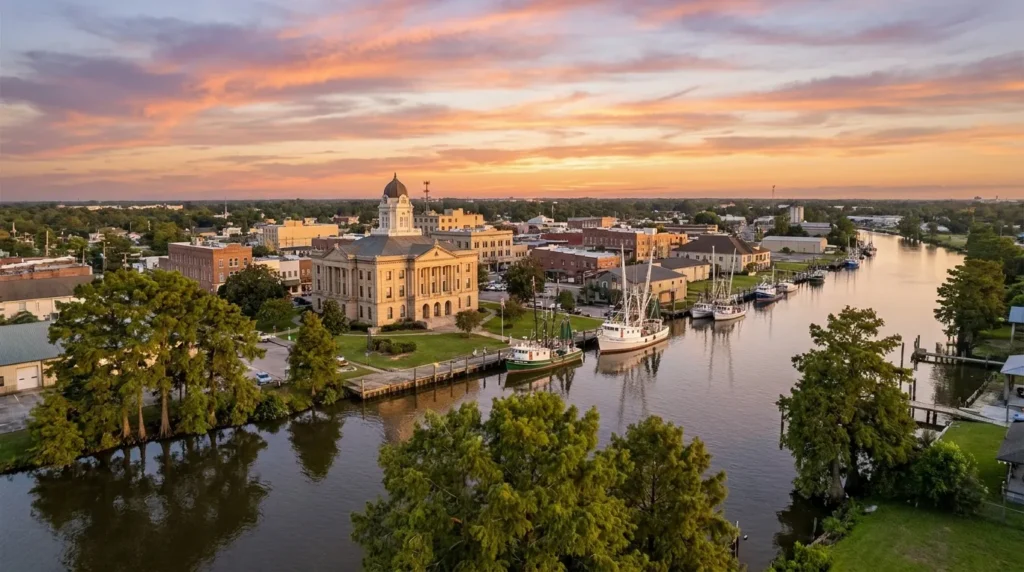
  5. 5Downtown Houma Historic District
  6. 6Mandalay National Wildlife Refuge
Parks & green spaces
  • Bayou Country Sports Park
  • Southdown Park
  • Bayou Black Park
  • Mandalay National Wildlife Refuge
  • Pointe-aux-Chenes Wildlife Management Area

Growing Hispanic community and historic Filipino roots

Most recent immigrants come from Mexico, Honduras, and Cuba; Filipinos have a historic presence tied to the boat industry, and Vietnamese are established in shrimping.

Contemporary immigration to Houma accelerated after Hurricane Katrina (2005), when reconstruction labor arrived in large numbers. Mexicans and Hondurans now form the largest contingent, concentrated in construction, landscaping, restaurants, and seafood processing. Cubans and Venezuelans arrive in smaller numbers, many tied to healthcare and small businesses.

There is a historic Filipino community linked to offshore support vessel crews whose presence dates back decades. Vietnamese immigrants arrived from the 1970s and 1980s onward and established themselves in shrimping and commerce in neighboring parishes. Brazilians are few, generally in construction, offshore welding, or through marriage with locals.

Institutional support is still modest but exists: Catholic Charities Diocese of Houma-Thibodaux serves immigrants with English assistance, food, and basic legal matters; Start Corporation runs community programs; and groups such as Houma Latino Inc. organize celebrations and document assistance drives. For consular services, the nearest consulate for many countries is in New Orleans, or Houston for Brazil.

4,500
Foreign-born residents
estimated
Top countries of origin
  • Mexico
  • Honduras
  • Philippines
  • Cuba
  • Vietnam
  • Venezuela
  • Guatemala
  • Brazil
Foreign consulates
  • Mexican Consulate General in New Orleans (90 min)
  • Honduran Consulate in New Orleans
  • Philippine Consulate General in Houston
  • Vietnamese Consulate General in Houston
  • Brazilian Consulate General in Houston
  • +1 more
Community organizations
  • Catholic Charities Diocese of Houma-Thibodaux
  • Houma Latino Inc.
  • Start Corporation
  • United Houma Nation Community Services
  • Bayou Community Foundation

Latest posts

Straight from the blog

There are no posts specifically about Houma yet. In the meantime, check out our latest posts.