Visto n' Visa
Blog
Notícias e artigos
Destinations
Careers
Immigrants

Want to live and work in Baton Rouge?

Personalized immigration plan with eligible visas, costs, and next steps for your goal!

If you are not eligible, you will know exactly why and what to do to improve your approval chances.

Save up to 12 hours in meetings

No pointless assessments.

Save up to 90%

Save money on vague or unfocused consultations

Avoid Fraud and Mistakes

One mistake can cost you your visa

Total Impartiality

Zero commercial bias

Decide with peace of mind

No toxic urgency

Fast and Accurate

Answers in minutes, no guesswork

Baton Rouge Population: African American Majority and Strong University Presence

A predominantly African American city, with a significant white population and growing Vietnamese, Hispanic, and Indian communities. LSU's student population keeps the demographic profile young.

Baton Rouge has a majority African American population, a historical legacy of the American South. The white population is large and concentrated in certain neighborhoods and suburbs. This geographic divide is visible and influences the real estate market, schools, and daily life.

LSU brings tens of thousands of college students, many from other states and countries, keeping part of the city young and in motion. There is a historic Vietnamese community, primarily connected to fishing and restaurants, along with growing Hispanic and South Asian families.

The Brazilian community is small but present, with families connected to engineering, petrochemicals, and graduate programs at LSU. Evangelical and Catholic churches tend to be meeting points. Spanish is increasingly heard in neighborhoods like Sherwood Forest and along Florida Boulevard.

Languages spoken
  • English
  • Spanish
  • Vietnamese
  • Cajun French
Main religions
  • Catholicism
  • Protestant Christianity (Southern Baptist)
  • Evangelical Christianity
  • Non-religious
  • Other Christian religions

Cost of Living in Baton Rouge: Below the American Average

Overall low cost by U.S. standards, with housing, groceries, and dining out quite affordable. State taxes are moderate, but car and homeowner's insurance are notoriously expensive.

Baton Rouge is one of the most affordable state capitals in the South. Rent for a two-bedroom apartment in a decent neighborhood is well below what is paid in Houston, Dallas, or Atlanta. Buying a home is also accessible, especially outside the most desirable neighborhoods like Bocage and Country Club of Louisiana.

Groceries are inexpensive, especially for local seafood, rice, vegetables, and meats. Dining out is part of the culture and is affordable, with Cajun diners, Vietnamese restaurants, and Texas-style steakhouses spread throughout the city. Gasoline follows Southern norms, generally reasonable.

Where newcomers are often caught off guard is insurance. Louisiana has some of the most expensive auto insurance in the U.S., and homeowner's insurance is also significant due to hurricane and flood risk. State income tax exists but is moderate, and property tax is low.

84Cost index (US = 100)16% below US average
CategorySingleCoupleFamily (2 + 2)
iHousing$1,092$1,260$1,596
iFood$319$638$1,159
iTransport$420$714$924
iHealthcare$236$470$882
iChildcare$1,529
iOther$714$1,285$1,806
Monthly total$2,781$4,367$7,896

Source: U.S. BLS Consumer Expenditure Survey 2023 + BEA Regional Price Parities 2023 · Estimates in USD, monthly.

Housing in Baton Rouge: Neighborhoods With Very Different Profiles

A city of distinct neighborhoods, ranging from luxury subdivisions to simpler areas. Southern suburbs concentrate families with children. Rentals near LSU are more expensive and noisier.

The most desirable neighborhoods are in the south, such as Bocage, Country Club of Louisiana, Highland Road, and Garden District. These are tree-lined areas with well-rated schools and large homes. Mid City, more centrally located, has been revitalizing with restaurants and middle-class housing.

Near LSU, the housing stock is dominated by student apartments, with high turnover, parties, and prices inflated by the university population. Those who work but want a quieter setting might consider Southdowns or Inniswold. Young families often look at Central, Zachary, and Prairieville, already in the suburbs.

Newly arrived immigrants often start in large apartment complexes with more flexible credit history requirements. It is worth considering areas with lower flood risk; hurricanes and severe storms are a real concern, and insurance costs can vary considerably from ZIP code to ZIP code.

Recommended neighborhoods
  • Garden District
  • Mid City
  • Southdowns
  • Bocage
  • Highland Road
  • +3 more

Job Market: Petrochemicals, Government, University, and Healthcare

Economy anchored in petrochemicals along the Mississippi, state government, LSU, and major hospitals. Engineering, chemistry, technology, and construction offer solid opportunities.

The petrochemical complex between Baton Rouge and New Orleans concentrates refineries and chemical plants from major companies such as ExxonMobil, Shell, and Dow. Chemical, mechanical, and electrical engineers, as well as maintenance professionals, find solid opportunities with competitive salaries relative to local costs.

State government is the second-largest employer, headquartered in Baton Rouge. LSU contributes with research and teaching, along with the Our Lady of the Lake and Baton Rouge General hospital systems. Technology is growing slowly, with software development hubs tied to the IBM Center and LSU.

For those arriving without fluent English, restaurants, construction, landscaping, and the seafood processing industry offer entry points. Skilled workers in welding, instrumentation, and industrial electrical trades often find positions quickly through petrochemical contracts.

Dominant sectors
  • Petrochemicals
  • State Government
  • Higher Education
  • Healthcare
  • Industrial Construction
  • +1 more
Major employers
  • ExxonMobil
  • Louisiana State University
  • Our Lady of the Lake Health
  • State of Louisiana
  • Dow Chemical
  • +3 more

Education: LSU as Anchor and a Divided School System

The city's public school system is challenging, with families seeking magnet, charter, and private schools. LSU and Southern University form the university core, with recognized programs.

The East Baton Rouge Parish School System administers public schools with uneven quality. Families with more resources seek magnet, charter, or private schools such as Episcopal, Catholic High, and University Lab. Suburbs like Zachary, Central, and Ascension Parish have significantly higher-rated public schools.

In higher education, Louisiana State University (LSU) is a giant, covering undergraduate through advanced research in engineering, agronomy, computer science, and oceanography. Southern University, a historically Black institution, is another academic pillar. Baton Rouge Community College offers technical training and associate degrees at accessible prices.

For adult immigrants, ESL, GED, and technical qualification programs are available at Baton Rouge Community College and through community organizations. East Baton Rouge Parish libraries offer free English classes and support for immigrant families adjusting to life in the area.

Notable universities
  • Louisiana State University (LSU)
  • Southern University and A&M College
  • Baton Rouge Community College
  • Franciscan University of Steubenville at Baton Rouge

Healthcare: Robust Hospital Network for the City's Size

A regional healthcare hub with major hospitals (Our Lady of the Lake, Baton Rouge General, Ochsner) and specialized centers. Serves not only the city but several surrounding parishes.

Baton Rouge is home to three main hospital systems: Our Lady of the Lake Regional Medical Center, Baton Rouge General, and Ochsner Medical Complex. Together they cover trauma, cardiology, oncology, neurology, and pediatrics, drawing patients from other Louisiana parishes.

Mary Bird Perkins Cancer Center is a regional reference in oncology, offering advanced treatments. The LSU Health Sciences Center trains physicians and research professionals, strengthening the healthcare ecosystem. Private clinics and urgent care centers are widespread, with a strong presence in the southern and eastern suburbs.

Those arriving without employer-sponsored insurance need to navigate the system. Community clinics such as Baton Rouge Primary Care Collaborative and expanded Medicaid qualifications are available. Serious emergencies are treated at any hospital regardless of insurance coverage; billing follows afterward and typically requires negotiation.

Healthcare index60.0 / 100
  • Life expectancyyears at birth
    78.4yrs
  • Doctors per 1kpracticing physicians
    3.7
  • Health spendper capita, per year
    $13,473
  • Public systemoverall quality rating
    Fair

Safety: A City With Quiet Areas and Higher-Risk Zones

Crime statistics in Baton Rouge show concentration in specific northern neighborhoods. Southern areas, suburbs, and the LSU surroundings are considered safe with normal precautions.

Like many mid-sized Southern cities, Baton Rouge has very uneven safety by neighborhood. Areas in the northern part of the city, particularly certain ZIP codes north of Florida Boulevard, have high rates of violent crime. The south, including Garden District, Southdowns, Bocage, and the LSU area, is considered safe.

The most common everyday crimes involve car theft, theft of items from vehicles, and residential break-ins when no alarm system is present. Common sense addresses most risks: locking the car, not leaving bags visible, knowing the route before going out at night.

Suburbs like Prairieville, Zachary, Central, and Ascension Parish are the choices for those who prioritize maximum safety, usually at the cost of longer commutes. In emergencies, the Baton Rouge Police and parish sheriffs respond quickly, and major hospitals have high-level trauma centers.

5.8
Homicides per 100k
per year
Safety index
35.0
Crime index
65.0
Safer neighborhoods
  • LSU area
  • Garden District (historic neighborhood)
  • Bocage
  • Southdowns
  • Highland Park
  • University Acres
Areas to avoid
  • Northern areas near Scotland neighborhood after dark
  • Stretches along Florida Boulevard at night
  • Industrial areas near the port
  • Old South Baton Rouge during nighttime hours

Transportation: Spread-Out City, Total Car Dependence

Baton Rouge is a car-dependent city. Traffic on the Mississippi bridges is the main pain point. Bus service exists but is limited. The local airport serves domestic flights with connections to major hubs.

The city was designed for the automobile, with wide roads, large parking lots, and neighborhoods far from downtown. I-10 and I-12 cut through Baton Rouge and carry most of the daily commutes. The bridges over the Mississippi connecting West Baton Rouge experience chronic congestion during peak hours.

CATS (Capital Area Transit System) operates bus lines covering central areas and the LSU campus, but low frequency and limited coverage make living without a car impractical outside the city center. Cycling works in specific areas, such as around LSU, but is not a citywide solution.

Baton Rouge Metropolitan Airport (BTR) serves domestic flights with connections to Atlanta, Dallas, Houston, Charlotte, and Denver. For direct international flights, many travelers prefer New Orleans (MSY), about an hour and fifteen minutes away via I-10.

23 min
Avg commute
34
Walkability
Airports
  • BTR — Baton Rouge Metropolitan Airport
  • Bike infrastructure

What the Climate Is Like While Living in Baton Rouge

Baton Rouge, the capital of Louisiana, has a humid subtropical climate with very hot and muggy summers, short and mild winters, and a real risk of hurricanes in late summer.

Summer in Baton Rouge runs from May through October, with highs between 90°F and 95°F and very high humidity. Daily thunderstorms occur in July and August. Nighttime temperatures drop to around 73°F to 77°F, though conditions still feel warm. Air conditioning is essential and runs virtually year-round.

Winter is short and mild. Lows range from 39°F to 48°F from December through February, with occasional frost and extremely rare snowfall. Heating costs remain relatively low. Spring brings severe weather, including thunderstorms and tornadoes, and hurricane season begins in June.

For residents, a robust central air conditioning system is a necessity, along with mosquito repellent given the presence of tropical vectors. A hurricane evacuation plan is also advisable. As a state capital with a strong university presence (LSU), the city maintains an active cultural life. Urban flooding is a real risk, and checking flood zone maps before purchasing property is recommended.

Sunny days / year218 days
Avg high (°F)
  • 63°J
  • 66°F
  • 73°M
  • 77°A
  • 84°M
  • 89°J
  • 90°J
  • 91°A
  • 88°S
  • 80°O
  • 70°N
  • 66°D
Avg low (°F)
  • 46°J
  • 49°F
  • 56°M
  • 60°A
  • 68°M
  • 74°J
  • 76°J
  • 76°A
  • 72°S
  • 63°O
  • 52°N
  • 50°D
Rainfall (")
  • 5"J
  • 5"F
  • 4"M
  • 6"A
  • 6"M
  • 6"J
  • 7"J
  • 6"A
  • 4"S
  • 4"O
  • 4"N
  • 5"D

Culture: Cajun Food, LSU Football, and Year-Round Festivals

Cajun and Creole culture permeates the city, with gumbo, jambalaya, music festivals, and LSU games as social pillars. The arts scene is growing around the Shaw Center and Mid City.

Eating in Baton Rouge is serious business. Gumbo, jambalaya, étouffée, po-boys, boudin, and fried seafood make up the everyday menu. Places like Parrain's, Mansur's, and the food truck scene show how central cuisine is to local identity. Markets like the Red Stick Farmers Market draw crowds on Saturday mornings.

College sports, especially LSU Tigers football at Tiger Stadium, is a citywide event. On game days, traffic shifts, bars fill up, and even those who do not follow sports feel the atmosphere. LSU baseball also has a loyal following.

The calendar features Mardi Gras (less intense than in New Orleans, but with its own parades), Bayou Country Superfest, Fête Rouge, and Cajun festivals in the metropolitan area. Museums like LASM and the Capitol Park Museum cover science, art, and Louisiana history.

Baton Rouge

What to See and Do While Living in Baton Rouge

Baton Rouge is the capital of Louisiana, home to LSU and Southern University, with a vibrant Cajun and Creole cultural scene, music festivals, and historic landmarks along the Mississippi River.

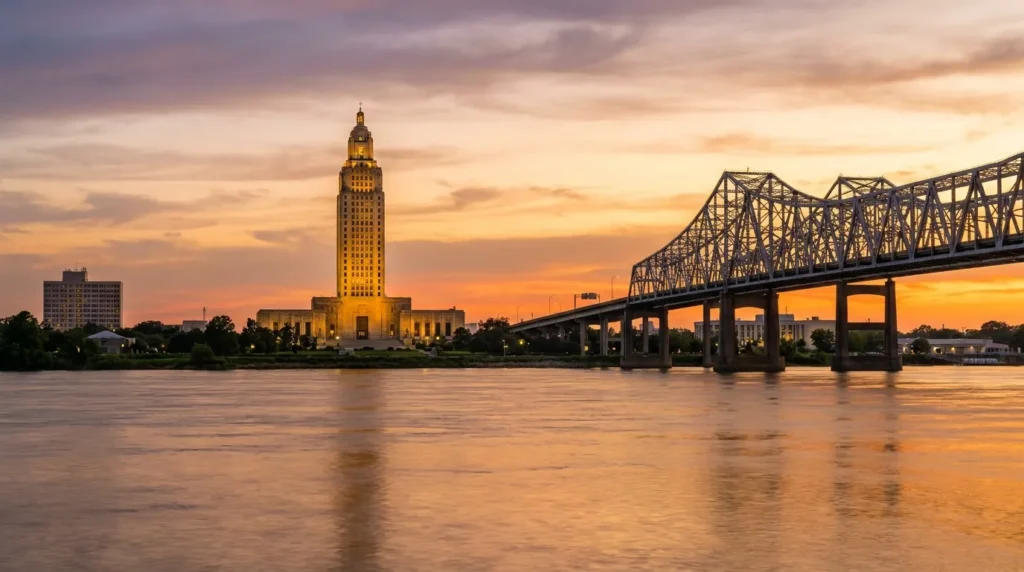
The Louisiana State Capitol, the tallest in the United States at 137 meters and designed in Art Deco style, features an observation deck on the 27th floor. The Old State Capitol, built in Neo-Gothic style, has been converted into a museum of political history. The LSU Museum of Art at the Shaw Center for the Arts and the LSU Rural Life Museum cover the history of the state.

The LSU Tigers dominate fall weekends, with games held at Tiger Stadium (Death Valley). The Downtown district, centered around Third Street, concentrates restaurants, jazz venues, and BREC's Bluebonnet Swamp Nature Center for wetland trails. The USS Kidd, a World War II museum ship, is anchored on the river.

For outdoor activities, City Park and BREC's Highland Road Park offer trails, golf, and tennis. Tickfaw State Park and the Atchafalaya Basin are 30 to 45 minutes away. For Cajun-Creole culture, New Orleans is 1 hour and 20 minutes away via Interstate 10, and Lafayette, the cultural capital of Acadiana, is 1 hour away.

  1. 1["Louisiana State Capitol (tallest in the US)"
  2. 2"Old State Capitol"
  3. 3"LSU Rural Life Museum"
  4. 4"USS Kidd Veterans Museum"
  5. 5"Louisiana Art & Science Museum"
  6. 6"Magnolia Mound Plantation"
Nightlife6.0 / 10
Parks & green spaces
  • ["Baton Rouge Lakes (LSU Lakes)"
  • "BREC's City-Brooks Community Park"
  • "Bluebonnet Swamp Nature Center"
  • "Greenwood Community Park"
  • "Forest Community Park"
  • +1 more

Latest posts

Straight from the blog

There are no posts specifically about Baton Rouge yet. In the meantime, check out our latest posts.