Visto n' Visa
Blog
Notícias e artigos
Destinations
Careers
Immigrants

Want to live and work in Paducah?

Personalized immigration plan with eligible visas, costs, and next steps for your goal!

If you are not eligible, you will know exactly why and what to do to improve your approval chances.

Save up to 12 hours in meetings

No pointless assessments.

Save up to 90%

Save money on vague or unfocused consultations

Avoid Fraud and Mistakes

One mistake can cost you your visa

Total Impartiality

Zero commercial bias

Decide with peace of mind

No toxic urgency

Fast and Accurate

Answers in minutes, no guesswork

Paducah Demographics: small city, predominantly white, with growing immigrant communities

Population around 27,000, predominantly non-Hispanic white, with a significant African American minority and a growing presence of Latino and Asian immigrants attracted by industrial and agricultural work in the region.

Paducah has about 27,000 residents within city limits, and the Paducah-Mayfield metropolitan area surpasses ninety thousand. The racial composition is predominantly non-Hispanic white, with about twenty percent African American population, historically concentrated in neighborhoods such as Fountain Avenue and parts of the southern city.

Immigrant groups are still small in absolute numbers, but are growing. Mexicans and Central Americans are the most visible presence, working in construction, restaurants, and regional agribusiness. There are also smaller communities from the Philippines, India, and China, linked primarily to the healthcare sector at Mercy Health-Lourdes and Baptist Health Paducah.

The median age is higher than the national average, with a strong presence of retirees. Families with young children tend to concentrate in neighborhoods such as Reidland, Lone Oak, and western Paducah. Christianity is dominant, with diversity among Baptist, Methodist, Catholic, and traditional African American church denominations.

Languages spoken
  • English
  • Spanish
  • Tagalog
  • Mandarin
  • Vietnamese
Main religions
  • Southern Baptist
  • Methodist
  • Catholic
  • Traditional African American churches
  • Pentecostal
  • +1 more

Cost of Living in Paducah: one of the most affordable cities in the United States

Paducah consistently ranks among the most affordable American cities. Rent, homeownership, groceries, and services are well below the national average.

The cost of living in Paducah is among the lowest in the United States. Renting a two- or three-bedroom home in a quiet neighborhood typically costs a fraction of what similar housing runs in mid-size northeastern or western cities. Apartments downtown or near the hospital are still in an accessible range by American standards.

Buying a home is one of the biggest advantages. Restored Victorian properties in LowerTown, suburban homes in Lone Oak and Reidland, or simpler houses in West Paducah fall in price ranges that in other parts of the United States would not cover even a studio apartment.

Grocery stores such as Kroger, Walmart Supercenter, and Aldi make a small dent in the budget. Local restaurants charge modest prices, and gas tends to be below the national average. The weak point is health insurance, which remains expensive as in any part of the United States, and the need for a personal vehicle, since public transportation is minimal.

Paducah

Housing in Paducah: spacious homes with yards at prices that shock those coming from big cities

Affordable real estate market with spacious homes, yards, and family neighborhoods. LowerTown attracts artists and creatives; Lone Oak and Reidland draw families; the historic downtown has Victorian charm.

Paducah's real estate market is one of the central draws for immigrants and those relocating from expensive cities. Independent houses with four bedrooms, a garage, and a large yard are standard. Those arriving from São Paulo, Mexico City, Manila, or Mumbai are often pleasantly shocked by what fits within a budget.

LowerTown is the best-known neighborhood, with restored Victorian homes occupied by artists and creative professionals. The historic downtown has loft and apartment options in older buildings. Lone Oak, to the south, is the classic suburban neighborhood for families with children in public school. Reidland attracts those who want even more space and quiet.

Renting is also inexpensive compared to virtually any large American city. New apartments near Lourdes hospital and complexes in West Paducah are common options for those arriving to work. One thing to note is that inventory is smaller, and desirable homes in sought-after neighborhoods go quickly.

Recommended neighborhoods
  • LowerTown Arts District
  • Lone Oak
  • Reidland
  • Historic Downtown
  • West Paducah
  • +1 more

Job Market in Paducah: healthcare, nuclear industry, and river logistics

Regional economy driven by hospitals, the uranium enrichment plant in West Paducah, heavy industry, river transportation, and commerce. Small market but with stable openings in specific sectors.

Paducah's job market is dominated by healthcare, industry, and river logistics. The two major hospitals, Baptist Health Paducah and Mercy Health-Lourdes, are major employers for the region, hiring from physicians and nurses to administrative and support roles. Healthcare professionals with American credentials will find real demand.

The industrial sector has historically been anchored by the former uranium enrichment plant in West Paducah, today in decommissioning but still generating jobs in environmental remediation and closure work. Chemical industries, foundries, and companies such as CSI (Computer Services Inc) and the Paducah Gaseous Diffusion Plant also have a notable presence.

The Ohio River is a frequently overlooked source of employment. River transport companies, shipyards, and port logistics hire barge pilots, mechanics, and operators. For those arriving without fluent English, positions in restaurants, construction, cleaning, and regional agribusiness are the most common entry points.

Dominant sectors
  • Healthcare and hospitals
  • Nuclear and chemical industry
  • River transport and logistics
  • Education
  • Retail
  • +1 more
Major employers
  • Baptist Health Paducah
  • Mercy Health-Lourdes Hospital
  • Paducah Gaseous Diffusion Plant (decommissioning)
  • West Kentucky Community and Technical College
  • McCracken County Public Schools
  • +2 more

Education in Paducah: public schools, technical college, and a Murray State extension campus

School system divided between Paducah Public Schools and McCracken County Schools. West Kentucky Community and Technical College provides technical training. Murray State University has an extension campus in the city.

The public school system is divided between Paducah Public Schools, which serves the municipality, and McCracken County Public Schools, which covers the metropolitan region. Schools such as Paducah Tilghman High and McCracken County High have a good regional reputation, with Advanced Placement programs and traditional athletic activities.

For technical higher education and the first two years of college, West Kentucky Community and Technical College (WKCTC) is central. It is consistently recognized among the best community colleges in the United States, with a strong focus on nursing, technology, and technical trades for the local industry.

Those seeking bachelor's and graduate degrees will find the Murray State University Paducah Regional Campus, with courses in engineering, business, and education. For more complete programs, students travel to the main campus in Murray, about an hour by car, or to universities in Nashville, Carbondale, and St. Louis.

Notable universities
  • West Kentucky Community and Technical College (WKCTC)
  • Murray State University — Paducah Regional Campus
  • Mid-Continent University (historical)
  • Paducah School of Art and Design (part of WKCTC)

Healthcare in Paducah: two major regional hospitals cover all of western Kentucky

Baptist Health Paducah and Mercy Health-Lourdes Hospital are regional care hubs, serving patients from the entire Jackson Purchase region, southern Illinois, and western Tennessee. Strong coverage for the city's size.

Paducah's healthcare infrastructure is disproportionately strong for the city's size, precisely because it functions as a regional hub. The two large hospitals, Baptist Health Paducah and Mercy Health-Lourdes Hospital, offer services in cardiology, oncology, orthopedics, maternity, and full emergency care, along with intensive care units.

For newly arrived immigrants, the American healthcare system remains the main challenge. Without employer-sponsored health insurance, even basic treatments can be expensive. Eligible patients can seek Kentucky Medicaid and community health centers such as Four Rivers Behavioral Health and subsidized FQHC clinics.

Rare specialties often require travel to Nashville, St. Louis, or Memphis. For common urgent care needs, urgent care clinics such as Mercy Health Urgent Care and Baptist Health Urgent Care accept walk-ins, with more predictable costs than hospital emergency rooms.

Paducah

Safety in Paducah: a small city with quiet neighborhoods and isolated pockets of crime

Paducah has crime rates above the national average in some indicators, concentrated in specific areas. Most suburban neighborhoods and the restored downtown are quiet for everyday life.

Like many small American cities, Paducah has crime statistics above the national average in some indicators, especially theft and drug-related crimes. But the real perception for those living there depends heavily on which neighborhood one chooses. Suburban areas and the revitalized historic downtown are quite safe.

Neighborhoods such as Lone Oak, Reidland, and most of western Paducah have a consistent reputation for safety, with neighbors who know each other and low turnover. LowerTown, after revitalization, is also safe during the day and at night, with a constant presence of residents and visitors.

Areas to avoid for living or walking alone at night tend to be certain parts of southern Paducah near Fountain Avenue and the industrial east side. As in any city in the United States, basic precautions apply: do not leave cars unlocked, keep homes alarmed, and stay alert in deserted areas after dark.

Safer neighborhoods
  • Lone Oak
  • Reidland
  • LowerTown Arts District
  • Revitalized historic downtown
  • Residential West Paducah
  • Massac Creek
Areas to avoid
  • Southern Paducah near Fountain Avenue at night
  • Eastern industrial areas after working hours
  • Isolated stretches of the floodwall after dark

Transportation in Paducah: a car-dependent city with a regional airport and river barges

Paducah relies almost entirely on the automobile. Public transportation exists but is limited. Barkley Regional Airport connects to Chicago via commuter flights; larger airports are 2-3 hours away by car.

Paducah is a car city. Almost no one lives without a personal vehicle, and the urban layout reflects this: ample parking, drive-throughs almost everywhere, and spread-out suburban neighborhoods. For those coming from cities with dense metro systems, it is one of the most immediate cultural adjustments.

The Paducah Area Transit System (PATS) operates a few bus lines within the city, but frequency and coverage are limited, mainly serving those who have no other option. Uber and Lyft are available, though with fewer drivers than in metropolitan areas. Interstate I-24 cuts through the region, connecting quickly to Nashville (2h30) and St. Louis (3h).

Barkley Regional Airport offers commuter flights to Chicago O'Hare via Contour Airlines, sufficient for international connections. For more options, many residents drive to Nashville (BNA) or St. Louis (STL). The Ohio River is the main route for cargo transport: barges and towboats are part of the daily landscape.

Airports
  • PAH — Barkley Regional Airport (commuter flights to Chicago O'Hare)
  • BNA — Nashville International (2h30 by car)
  • STL — St. Louis Lambert International (3h by car)

Climate

Paducah

Culture in Paducah: UNESCO Creative City of Folk Art, quilts, and river blues

Paducah was designated a UNESCO Creative City of Folk Art and Craft (quilting). It has a vibrant arts scene for its size, riverside festivals, and traditional Southern cuisine with a Kentucky touch.

Paducah surprises with its cultural density for a small city. In 2013 it was designated a UNESCO Creative City of Folk Art and Craft, primarily because of the National Quilt Museum and the strong quilting tradition that attracts collectors and artists from around the world during AQS QuiltWeek. The LowerTown Arts District concentrates studios, galleries, and monthly events.

Local cuisine is Southern with strong Kentucky and lower Mississippi influences: western Kentucky-style rib and pork shoulder barbecue with black Worcestershire-based sauce, hot brown, fried catfish, hush puppies, and bourbon. Historic restaurants such as Doe's Eat Place and the food truck scene during Quilt Show enliven the downtown.

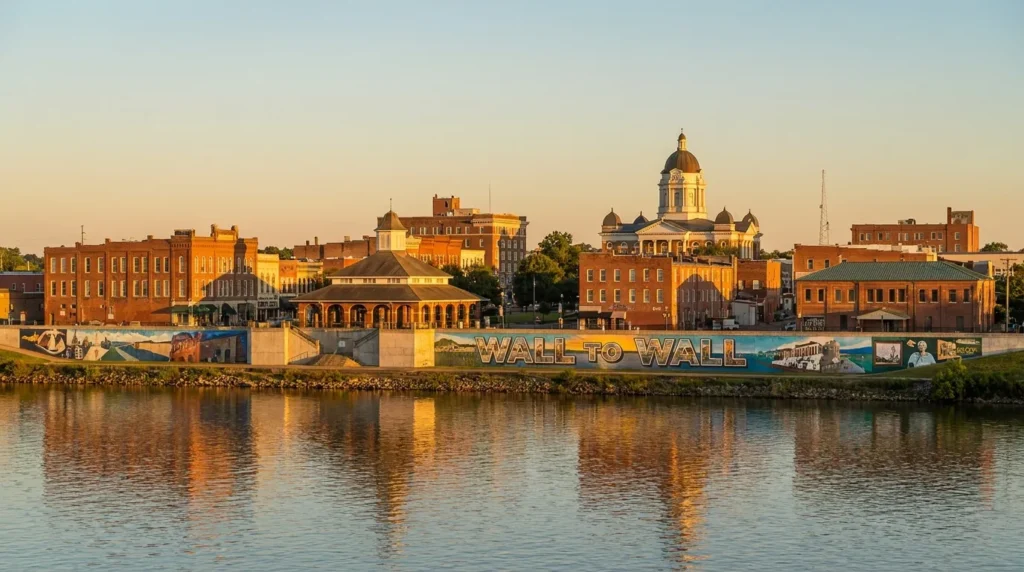
Major annual events include AQS QuiltWeek, which fills the city with visitors in April, Barbecue on the River in September, and the Lower Town Arts & Music Festival. The floodwall mural along the river, with more than fifty painted panels, is a must-see for understanding local history.

Notable dishes
  • Western Kentucky barbecue (pork with black sauce)
  • Hot brown sandwich
  • Mississippi fried catfish
  • Hush puppies
  • Burgoo (meat stew)
  • +2 more
Annual events
  • AQS QuiltWeek Paducah
  • Barbecue on the River
  • Lower Town Arts & Music Festival
  • Paducah Summer Festival
  • Dogwood Trail Celebration
  • +1 more
UNESCO sites
  • Paducah — UNESCO Creative City of Folk Art and Craft (designated in 2013)

Attractions in Paducah: museums, riverside murals, and river nature

The National Quilt Museum, floodwall murals, the LowerTown arts district, local museums, and easy access to Kentucky and Barkley lakes round out the offerings. A small city with consistent cultural programming.

For its size, Paducah delivers well on attractions. The National Quilt Museum is the cultural landmark, with a world collection of artistic quilts and rotating exhibitions that draw visitors from around the globe during AQS QuiltWeek. The Paducah Floodwall Mural Project, with large panels painted along the river levee, tells the city's history.

The LowerTown Arts District concentrates galleries, open studios, and cafes. The River Discovery Center focuses on the Mississippi and Ohio river culture. The Lloyd Tilghman House & Civil War Museum and the William Clark Market House Museum cover local and regional history. Maiden Alley Cinema screens independent films and documentaries.

The large green space within the city is Noble Park, with a lake, playground, and trails. For greater nature, Land Between the Lakes National Recreation Area, Kentucky and Barkley lakes, and Clarks River National Wildlife Refuge are less than an hour away, offering fishing, canoeing, camping, and wildlife watching.

  1. 1National Quilt Museum
  2. 2Paducah Floodwall Murals (Wall to Wall)
  3. 3LowerTown Arts District
  4. 4River Discovery Center
  5. 5Lloyd Tilghman House & Civil War Museum
  6. 6Maiden Alley Cinema
Parks & green spaces
  • Noble Park
  • Bob Noble Park Lake
  • Stuart Nelson Park
  • Atomic City Family Aquatic Park (seasonal)
  • Land Between the Lakes NRA (nearby)
  • +1 more

Immigrant communities in Paducah: small but growing groups in healthcare and industry

Paducah is not a traditional immigrant destination, but has small and growing communities from Mexico, the Philippines, India, and Central America, mainly linked to hospital work, agribusiness, and construction.

Paducah is not on the traditional radar of major immigration flows to the United States, but it has small, active communities that have grown over the past two decades. Mexicans and Central Americans form the most visible group, concentrated in construction, restaurants, agribusiness, and food processing in the surrounding rural areas.

Healthcare professionals from the Philippines, India, and to a lesser extent the Caribbean and West Africa work at Baptist Health and Mercy Health-Lourdes hospitals, often recruited through H-1B and EB-3 visas. There is also a Vietnamese and Chinese presence tied to commerce and restaurants, and a recent flow of Venezuelans and Cubans seeking an affordable cost of living.

As a small city, Paducah does not host consulates, but communities organize around churches (St. Francis de Sales for Hispanic communities, Filipino parishes, South Asian temples in Nashville). For consular services, residents travel to Nashville, St. Louis, or Chicago, depending on the jurisdiction of their home country.

800
Foreign-born residents
estimated
Top countries of origin
  • Mexico
  • Philippines
  • India
  • Honduras
  • Guatemala
  • Vietnam
  • China
  • Venezuela
Foreign consulates
  • Mexican Consulate General in Little Rock (jurisdiction)
  • Philippine Consulate General in Chicago (jurisdiction)
  • Indian Consulate General in Houston (jurisdiction)
  • Guatemalan Consulate General in Nashville (jurisdiction)
  • Honduran Consulate General in Atlanta (jurisdiction)
Community organizations
  • Catholic Charities of Western Kentucky
  • Hispanic American Coalition of Paducah (informal)
  • St. Francis de Sales Hispanic Ministry
  • Four Rivers Behavioral Health (multilingual support)
  • Paducah Cooperative Ministry
  • WKCTC ESL Program

Latest posts

Posts about Kentucky

Coverage and updates related to this destination.

Showing content from Kentucky, as there is no specific data for Paducah yet.