Visto n' Visa
Blog
Notícias e artigos
Destinations
Careers
Immigrants

Want to live and work in Georgetown?

Personalized immigration plan with eligible visas, costs, and next steps for your goal!

If you are not eligible, you will know exactly why and what to do to improve your approval chances.

Save up to 12 hours in meetings

No pointless assessments.

Save up to 90%

Save money on vague or unfocused consultations

Avoid Fraud and Mistakes

One mistake can cost you your visa

Total Impartiality

Zero commercial bias

Decide with peace of mind

No toxic urgency

Fast and Accurate

Answers in minutes, no guesswork

Who Lives in Georgetown: Local Tradition and the Japanese Community

Georgetown is predominantly white, with a small Black population and a notable Japanese community brought by Toyota. Hispanics are growing rapidly. Christianity dominates, with strong Baptist and Catholic presences.

About 80 percent of the population is white, with primarily English, Scots-Irish, and German heritage. The Black population is around 6 to 8 percent, historically present since the 19th century (Georgetown was home to Georgetown College, a Baptist institution). Hispanics are growing rapidly, with Mexicans forming the largest share.

The Japanese community is notable for a city of this size. Toyota's presence since 1986 brought rotating expatriate families, executives, and technicians who stay for years. There is a Japanese market (Sayuri Asian Market), a church, a weekend supplementary school for children, authentic restaurants, and cultural events such as the Festival of Cultures.

Religiously, Protestantism dominates (Southern Baptists are the majority), with Georgetown College (a historic Baptist institution) being influential. Catholic parishes (St. Pius X), Methodist, Presbyterian, and evangelical churches are also present. A small Buddhist temple serves the Japanese and Asian community. The median age is close to the national figure, with a family-oriented profile and a growing number of young professionals.

Languages spoken
  • English
  • Spanish
  • Japanese
  • Korean
  • Mandarin
Main religions
  • Protestantism (Southern Baptist, Methodist)
  • Catholicism
  • Evangelical churches
  • Buddhism
  • No religion

Cost of Living in Georgetown: Affordable and Growing

Georgetown is affordable, cheaper than Lexington and well below Cincinnati or Nashville. Rents and home prices are reasonable, with an upward trend driven by growth. Groceries and services are inexpensive.

Housing is the biggest advantage. Homes in established neighborhoods are priced comfortably by American standards, and new homes in expanding suburbs such as Cherry Blossom and Lanes Run are accessible for families with median incomes. Apartments rent for less than in neighboring Lexington, and new complexes are being built to accommodate growth.

Groceries are straightforward: Kroger, Walmart, Aldi, and smaller markets cover everyday needs. International markets such as Sayuri Asian Market carry Japanese, Asian, and specialty ingredients. Mexican tiendas serve the Hispanic community. Local restaurants are inexpensive, and variety is good thanks to the Japanese presence (Sushi Kashin, Ginger Sushi Bar).

Kentucky levies a state income tax and Georgetown applies Scott County's occupational tax. Property taxes are moderate. Energy costs are reasonable. For those employed at Toyota or its suppliers, with employer health coverage and benefits, the cost of living is very favorable and saving on a median income is realistic.

Georgetown

Where to Live in Georgetown: Traditional Neighborhoods and New Developments

Georgetown has historic homes downtown, traditional suburbs to the west and east, and rapidly expanding areas on the outskirts. Newcomers often start by renting in modern complexes near Toyota.

The historic downtown has Federal and Victorian-style homes, many listed on the historic register, surrounding Main Street and South Broadway. It is a charming neighborhood close to several institutions (Georgetown College is just to the north). Lemons Mill Road and the northern part of the city have established suburbs with traditional homes, medium-sized lots, and good schools.

Cherry Blossom Way and new neighborhoods east of the city (near U.S. 25 and I-75) are expanding rapidly, with modern homes, medium lots, new apartment complexes, and proximity to Toyota. Lanes Run, Springwood, Suffolk Park, and Cane Run are examples. Young families and professionals from Toyota and its suppliers are concentrated in these areas.

For renters, complexes such as The Pointe at Georgetown and Magnolia Park are popular choices. Those seeking rural space can find homes on small farms minutes from the city center, surrounded by Bluegrass pastures and horses. Local real estate agencies including Bluegrass Sotheby's, Keller Williams, and Coldwell Banker McMahan are active in the market.

Recommended neighborhoods
  • Downtown Georgetown (historic)
  • Lemons Mill Road
  • Cherry Blossom
  • Lanes Run
  • Suffolk Park
  • +2 more

Jobs in Georgetown: Toyota and the Supplier Chain

The economy revolves around Toyota Motor Manufacturing Kentucky, Toyota's largest plant in the world (Camry, Lexus). Dozens of suppliers generate direct and indirect employment, alongside healthcare and retail.

Toyota Motor Manufacturing Kentucky (TMMK), headquartered in Georgetown, is Toyota's largest manufacturing plant outside Japan and the company's largest car plant in the world, producing the Camry, Lexus ES, Avalon, and hybrids. It employs around 9,000 people directly, with above-average regional wages and strong benefits (the plant is not represented by the UAW, but the package is competitive).

The supplier network settled nearby from the 1980s onward: companies such as Toyota Boshoku, Toyotetsu, Daiwa Plastics, DENSO, Aisin, and Toyota Tsusho operate plants in the city and surrounding region. This network employs thousands more. For those newly arriving, these suppliers offer parallel pathways into the automotive supply chain.

Other major employers include Georgetown College (the largest academic employer in the area), Georgetown Community Hospital (part of CHI Saint Joseph Health), Scott County Government, and the retail and hospitality sector. Proximity to Lexington (20 minutes) opens access to the University of Kentucky job market, larger hospitals, and specialized positions.

Dominant sectors
  • Automotive manufacturing
  • Higher education
  • Healthcare
  • Logistics
  • Retail
Major employers
  • Toyota Motor Manufacturing Kentucky
  • Toyota Boshoku America
  • Toyotetsu Mid America
  • DENSO Manufacturing
  • Georgetown College
  • +2 more

Education in Georgetown: Growing Schools and a Traditional University

Scott County Public Schools serves the city, with generally well-rated schools. Georgetown College is a Baptist institution founded in 1829. ELL programs are growing with the arrival of immigrant families.

Scott County Public Schools serves the city and county, with Scott County High School (among the largest in the state in some years) and Great Crossing High School as flagship campuses. The system is considered one of the best in central Kentucky, with AP programs, strong athletics, and newer facilities. ESL programs serve the growing immigrant student population.

Private options include Anderson Christian School and several smaller Catholic schools. Georgetown College, a Baptist institution founded in 1829, is one of the oldest colleges west of the Appalachians. Enrollment is around 1,000 students in programs covering liberal arts, business, education, science, and nursing. The Tigers compete in the NAIA Mid-South Conference.

For technical education, BCTC (Bluegrass Community and Technical College) has campuses in the area (Georgetown and nearby Lexington), offering two-year programs in manufacturing, healthcare, and technology. Toyota partners with BCTC for the Advanced Manufacturing Technician Program, which combines factory work with coursework in a German-style apprenticeship model.

Notable universities
  • Georgetown College
  • Bluegrass Community and Technical College (Georgetown campus)

Healthcare in Georgetown: Local Hospital and Access to Lexington

Georgetown has a community hospital (Georgetown Community Hospital) and direct access to Lexington's major hospital networks (UK HealthCare, Baptist Health). Good coverage for a city this size.

Georgetown Community Hospital, part of CHI Saint Joseph Health, is the main local hospital, with around 75 beds, a 24-hour emergency department, maternity services, a surgical center, and outpatient services. It serves the city and Scott County for routine care and emergencies. Complex cases are transferred to Lexington (UK HealthCare, Baptist Health Lexington, Saint Joseph Hospital).

Several community clinics and private practices operate throughout the city, including Baptist Health Medical Group and Saint Joseph Medical Group. For uninsured patients, HealthFirst Bluegrass (a Federally Qualified Health Center) serves nearby areas, and sliding-scale fee clinics are available. Toyota provides robust health benefits to employees, in line with company standards.

For tertiary care, transplants, complex oncology, and specialized pediatrics, Lexington's major centers are available (UK Albert B. Chandler Hospital, Kentucky Children's Hospital). Dentists and specialists in Georgetown are adequate; larger options are 20 minutes away. Japanese and Spanish interpreters are available at larger hospitals. Emergency response via 911 is rapid.

Healthcare index60.0 / 100
  • Life expectancyyears at birth
    78.4yrs
  • Doctors per 1kpracticing physicians
    3.7
  • Health spendper capita, per year
    $13,473
  • Public systemoverall quality rating
    Good

Safety in Georgetown: A Very Quiet City

Georgetown is considered one of the safest cities in Kentucky for its size. Violent crime is rare and property crime is low. Excellent for families and those seeking peace and quiet.

Crime rates in Georgetown are well below the national average for violent crime. Indexes rank among the best in Kentucky for mid-sized cities, comparable to the safer suburbs of major metropolitan areas. Most incidents involve minor property crime (theft, vehicle break-ins), concentrated in certain commercial areas.

Residential neighborhoods are quiet day and night, and the historic downtown has a good police presence and adequate lighting. The Georgetown Police Department maintains active community engagement, and the Scott County Sheriff covers rural areas. Emergency response via 911 is fast. Families walk with children downtown, and the general sense of community safety is strong.

Natural hazards include tornadoes (the region sits on the northern edge of the Southern Tornado Alley, with the main season in April and May), flooding in low-lying areas near Royal Spring and Elkhorn Creek, and ice storms in winter. Schools and businesses have sirens and protocols in place. There is no significant seismic risk. National Weather Service and local meteorological response are reliable.

5.8
Homicides per 100k
per year
Safety index
75.0
Crime index
25.0
Safer neighborhoods
  • Cherry Blossom (planned residential area)
  • Lanes Run Estates
  • The Homestead
  • Suburban area near Georgetown College
  • Lakeland Hills
Areas to avoid
  • Isolated stretches along US-25 north of downtown at night
  • Industrial areas near the Toyota plant outside business hours

Getting Around Georgetown: I-75 and Proximity to Lexington

Georgetown is a car-dependent city. I-75 runs through the city and connects quickly to Lexington and Cincinnati. There is no meaningful local public transit; Blue Grass Airport in Lexington is about 30 minutes away.

A car is necessary. The city is compact, with I-75 running along the eastern edge of the downtown (exits 125 and 126). US-25 (Lexington Road / Frankfort Road) is the main internal artery. US-460 crosses the city east to west. Internal distances are short and traffic is light, except at Toyota shift changes. Parking is easy and free.

Georgetown has no meaningful public bus system of its own. Some community services cover elderly residents and people with disabilities. Residents who commute to Lexington generally drive via I-75 or US-25, with a trip of 25 to 40 minutes depending on the time of day. Cycling works in some areas, with trails at Cardome Centre and local parks.

I-75 reaches Cincinnati Northern Kentucky International Airport (CVG) in about one hour and 15 minutes, and Blue Grass Airport (LEX) in Lexington is about 30 minutes away via US-25 or I-75/I-64. For international flights, CVG (Delta to Paris) or connecting flights through Atlanta and Charlotte are the main options. Greyhound serves nearby Lexington.

20 min
Avg commute
32
Walkability
Airports
  • LEX — Blue Grass Airport (in Lexington, about 12 miles away)
  • Bike infrastructure

What the climate is like living in Georgetown

Georgetown, in north-central Kentucky, has a humid subtropical climate with hot, muggy summers, mild winters with occasional snow, and four distinct seasons.

Summer in Georgetown runs from June through September, with highs between 84°F and 90°F and high humidity. Frequent thunderstorms occur in July and August. Nights drop to around 66°F to 70°F. Air conditioning is essential, and the characteristic Bluegrass lawns define the landscape.

Winter is cold but short. Lows range from 23°F to 34°F from December through February, with severe cold snaps reaching 10°F. Annual snowfall accumulates between 10 and 16 inches, melting quickly. Heating is standard, though utility costs remain moderate.

For daily living, plan for strong air conditioning in summer and warm layers for the brief winter. Georgetown is home to the largest Toyota plant in the United States — Toyota Motor Manufacturing Kentucky — and forms part of the greater Lexington metro area. Fall is the most scenic season, with foliage color peaking in October across the horse farms.

Sunny days / year192 days
Avg high (°F)
  • 44°J
  • 49°F
  • 57°M
  • 64°A
  • 74°M
  • 83°J
  • 87°J
  • 85°A
  • 81°S
  • 69°O
  • 55°N
  • 49°D
Avg low (°F)
  • 29°J
  • 31°F
  • 38°M
  • 44°A
  • 55°M
  • 63°J
  • 68°J
  • 66°A
  • 61°S
  • 50°O
  • 37°N
  • 34°D
Rainfall (")
  • 5"J
  • 5"F
  • 4"M
  • 4"A
  • 4"M
  • 5"J
  • 5"J
  • 4"A
  • 2"S
  • 4"O
  • 3"N
  • 4"D

Culture in Georgetown: History, Horse Farms, and Festivals

Georgetown has a mixed culture of historic Kentucky city and modern industrial identity. Events include the Festival of the Horse, Cardome Centre gatherings, and thoroughbred horse farms throughout the surrounding area.

The Georgetown and Scott County Museum, located downtown, documents local history from the city's founding. Yuko-En on the Elkhorn is a formal Japanese garden, a symbol of friendship between Kentucky and Toyota City, Japan. Cardome Centre, a former convent, hosts events, festivals, and markets. The Festival of the Horse, held in July, celebrates the region's equestrian tradition with parades, music, and food.

The historic downtown has restaurants including Galvin's on Main and Slainte Public House, along with several coffee options. Local breweries such as Country Boy Brewing serve the community. For authentic Japanese cuisine, restaurants like Sushi Kashin and Ginger Sushi Bar serve both locals and visitors. Buffalo Trace Distillery (bourbon) is located in nearby Frankfort.

The surrounding Bluegrass Region has dozens of thoroughbred horse farms, with tours available at select properties (including Old Friends Thoroughbred Retirement in Georgetown, a sanctuary for retired racehorses). Georgetown College Tigers athletics and nearby University of Kentucky events draw local interest. Royal Spring Park, in the downtown, features the original spring that supplied water when the city was founded.

Georgetown

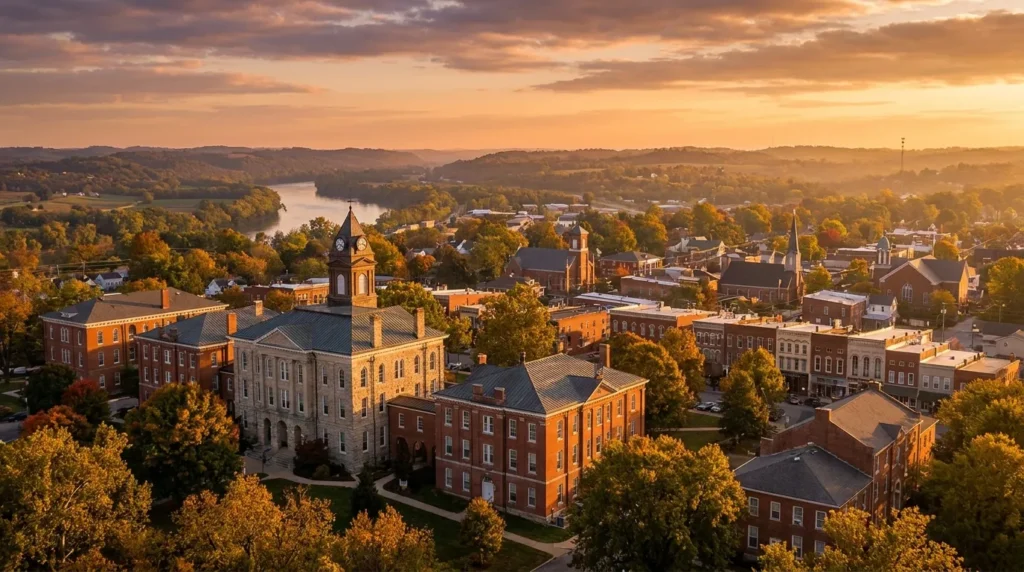
Attractions in Georgetown, seat of Scott County in Kentucky's Bluegrass region

Georgetown blends a restored historic downtown, the Toyota Motor Manufacturing Kentucky plant, Thoroughbred horse farms, and Georgetown College campus as anchors of daily life.

The downtown area around Main Street features 19th-century brick buildings, local shops, restaurants, and the Cardome Centre (a former seminary now used as a community venue). The Georgetown/Scott County Museum, housed in a former post office, documents local history. Royal Spring Park preserves the water source that gave rise to the city and where Elijah Craig is said to have distilled the first bourbon, according to local tradition.

Toyota Motor Manufacturing Kentucky is the largest Toyota plant outside Japan and the region's top employer. A guided factory tour and the Toyota Visitor Center showcase production of the Camry, Avalon, and RAV4 Hybrid. The Japanese presence has also shaped the dining scene and supports a Japanese Saturday School. Georgetown College, founded in 1829, serves as a sports and cultural hub with programming open to the public.

The surrounding area is classic Bluegrass: roughly 70 Thoroughbred horse farms, with Old Friends Thoroughbred Retirement Farm as a popular visitor destination. For outdoor recreation, Yuko-En on the Elkhorn (the official state Japanese garden), Royal Spring Park, and Suffoletta Family Aquatic Center are key spots. Each October, the Festival of the Horse closes the downtown with a parade, equestrian events, and local food.

  1. 1["Toyota Motor Manufacturing Kentucky Visitor Center (factory tour)"
  2. 2"Yuko-En on the Elkhorn (official state Japanese garden)"
  3. 3"Georgetown & Scott County Museum"
  4. 4"Old Friends Thoroughbred Retirement Farm"
  5. 5"Cardome Renaissance Centre"
  6. 6"Historic Downtown Georgetown"
Nightlife3.0 / 10
Parks & green spaces
  • ["Yuko-En on the Elkhorn"
  • "Royal Spring Park"
  • "Suffoletta Family Park"
  • "Cardome Park"
  • "Brooking Park"
  • +1 more

Latest posts

Posts about Kentucky

Coverage and updates related to this destination.

Showing content from Kentucky, as there is no specific data for Georgetown yet.