Visto n' Visa
Blog
Notícias e artigos
Destinations
Careers
Immigrants

Want to live and work in Bowling Green?

Personalized immigration plan with eligible visas, costs, and next steps for your goal!

If you are not eligible, you will know exactly why and what to do to improve your approval chances.

Save up to 12 hours in meetings

No pointless assessments.

Save up to 90%

Save money on vague or unfocused consultations

Avoid Fraud and Mistakes

One mistake can cost you your visa

Total Impartiality

Zero commercial bias

Decide with peace of mind

No toxic urgency

Fast and Accurate

Answers in minutes, no guesswork

Who Lives in Bowling Green: Surprising Diversity for a Mid-Size City

Bowling Green is majority white but has one of the most diverse refugee communities in the American interior. Significant Bosnian, Burmese, Somali, Congolese, Hispanic, and Indian populations are present.

About three-quarters of the population is white, with ancestry primarily English, Scots-Irish, and German. The Black population is around 13 percent, with a historical presence predating recent arrivals and growth from African refugee communities. Hispanics make up around 8 percent, with Mexicans forming the largest group.

The defining demographic feature of Bowling Green is its refugee resettlement program, active since the 1980s through the International Center of Kentucky. Established communities include Bosnians (who arrived in the 1990s), Karen and Chin Burmese, Somalis, Congolese, Iraqis, Syrians, and Cubans. Dozens of languages are spoken at home throughout the city.

Religiously, Christianity predominates, with Southern Baptists forming the largest group, alongside strong Catholic, Methodist, and evangelical presences. An active mosque (Islamic Center of Bowling Green), a Burmese Buddhist temple, Orthodox churches, and multiple evangelical congregations in other languages serve the diverse population. WKU brings approximately 17,000 students, keeping the city relatively young.

Languages spoken
  • English
  • Spanish
  • Bosnian / Serbo-Croatian
  • Burmese / Karen / Chin
  • Somali
  • +2 more
Main religions
  • Protestantism (Southern Baptist, Methodist)
  • Catholicism
  • Islam
  • Buddhism
  • Orthodox Christianity
  • +1 more

Cost of Living in Bowling Green: Affordable by American Standards

Bowling Green is less expensive than the national average. Rent, groceries, services, and gas are accessible. Homeownership is within reach for those with a stable median income.

Housing is a clear advantage. One-bedroom apartments near WKU or in complexes on the south side of the city cost considerably less than in Nashville, just one hour away. Homes for purchase are in an affordable range, especially in established neighborhoods such as Cumberland Hills, Plano, and areas west of Russellville Road. Prices have been rising but remain competitive.

Grocery options are plentiful: Kroger, Walmart, Aldi, Sam's Club, and Meijer. For international foods, markets such as International Foods (Bosnian and Eastern European), Mediterranean Grocery, Halal Market, and several Latin markets along Scottsville Road are available. Local restaurants are inexpensive, with lunch options at low prices. Gas prices fall below the national average.

Kentucky levies a state income tax; Bowling Green has an occupational license tax at both the city and county level. Property taxes are moderate. Utilities (Warren Rural Electric or municipal) are reasonable. Car insurance runs below the state average. Employer-sponsored health insurance is the most practical way to keep healthcare costs manageable.

85Cost index (US = 100)15% below US average
CategorySingleCoupleFamily (2 + 2)
iHousing$1,115$1,286$1,629
iFood$325$652$1,183
iTransport$429$729$943
iHealthcare$240$480$900
iChildcare$1,560
iOther$729$1,311$1,843
Monthly total$2,838$4,458$8,058

Source: U.S. BLS Consumer Expenditure Survey 2023 + BEA Regional Price Parities 2023 · Estimates in USD, monthly.

Where to Live in Bowling Green: Established Neighborhoods and New Developments

Bowling Green offers a range of housing options, from the historic downtown to new suburbs along Cave Mill Road. Immigrants often begin by renting in complexes or houses near Scottsville Road and Russellville Road.

Established neighborhoods such as Cumberland Hills, College Hill (near WKU), Magnolia Gardens, and the Old Louisville Road area offer traditional housing stock. Streets around Cave Mill Road to the south feature newer suburbs with larger homes, spacious lots, and good schools, popular with established families and healthcare and management professionals.

Near WKU, especially around State Street and College Street, there are lofts, apartments, and small houses suited to students and young professionals. Downtown Bowling Green is undergoing revitalization, with historic buildings being converted to loft units. Russellville Road and Scottsville Road concentrate apartment complexes popular with immigrants, close to manufacturing jobs.

Those seeking more space will find semi-rural areas to the east and north of the county with large-lot homes at accessible prices. Plano and Smiths Grove (neighboring communities) offer small-town living. Local real estate firms such as Crye-Leike, Coldwell Banker Legacy, and Keller Williams First Choice cover the market.

Recommended neighborhoods
  • Cumberland Hills
  • Cave Mill Road area
  • College Hill
  • Magnolia Gardens
  • Plano
  • +2 more

Work in Bowling Green: Strong Manufacturing and WKU

The economy centers on General Motors (Corvette plant), Western Kentucky University, diverse manufacturing, healthcare, and logistics. Manufacturing positions are regularly available for immigrants with basic English.

The General Motors Bowling Green Assembly Plant is the world's only Chevrolet Corvette factory, with around one thousand direct jobs. Beyond that, the region has a large cluster of automotive and diversified manufacturing: Magna International, Halton Company (HVAC), Bowling Green Metalforming, Camping World (headquarters), and Houchens Industries (supermarket chain).

Western Kentucky University is the second-largest employer, encompassing the main campus, a teaching hospital, a regional library, and a research center. It attracts faculty, researchers, and administrative staff and generates many support-service positions. Med Center Health is the major local healthcare network, with The Medical Center at Bowling Green serving as the principal regional hospital.

Logistics takes advantage of the I-65 corridor, with warehouses and trucking operations throughout the area. An Amazon Fulfillment Center operates in the region. For immigrants with basic English, manufacturing plants such as Halton, GM, and their suppliers offer training and bilingual supervision in some cases. Wages are lower than in metropolitan areas, but the cost of living provides a meaningful offset.

Dominant sectors
  • Automotive manufacturing
  • Higher education
  • Healthcare
  • Logistics
  • Retail and wholesale
Major employers
  • General Motors Bowling Green Assembly (Corvette)
  • Western Kentucky University
  • Med Center Health
  • Houchens Industries
  • Camping World
  • +3 more

Education in Bowling Green: Schools and a Strong Regional University

Bowling Green has two public school systems (Bowling Green Independent and Warren County), Western Kentucky University, and several private options. The ELL system is strong because of the refugee population.

Bowling Green Independent School District serves schools within city limits, with Bowling Green High School as its flagship. Warren County Public Schools covers the rest of the county, with schools including Greenwood High, Warren Central High, and South Warren High. Both systems have robust English Language Learner (ELL) programs for recently arrived refugee and immigrant children.

Private options include Bowling Green Christian Academy, St. Joseph Catholic School, and Christian Heritage Academy. Religious diversity also appears in informal education: Bible schools operate in multiple languages, and Islamic and Buddhist weekend schools are available. The International Center of Kentucky helps refugee children adjust to local schools.

Western Kentucky University is the main public higher education institution, with strong programs in journalism, business, education, science, and health. SKYCTC (Southcentral Kentucky Community and Technical College) offers two-year and vocational programs. WKU has an intensive English program (English as a Second Language Institute) for international students.

Notable universities
  • Western Kentucky University
  • Southcentral Kentucky Community and Technical College (SKYCTC)

Healthcare in Bowling Green: Regional Hospital and Clinics

Bowling Green is a regional healthcare hub for southern Kentucky, with The Medical Center at Bowling Green, multiple clinics, and dedicated services for refugees. Complex cases are referred to Nashville or Louisville.

The Medical Center at Bowling Green, part of Med Center Health, is the primary hospital, with a 24-hour emergency room, maternity ward, oncology (Med Center Health Cancer Center), cardiology, and a surgical center. It is affiliated with larger networks and refers tertiary cases to Vanderbilt in Nashville or to Louisville facilities. The hospital has approximately 350 beds.

Greenview Regional Hospital, at Exit 22, is a second option with a 24-hour ER and general services. Several community clinics are available, including Family Health Services Bowling Green, which operates on a sliding-scale fee for uninsured patients. For refugees, the International Center of Kentucky runs health programs and helps connect individuals with available services.

WKU also operates academic health centers. Dozens of dentists, ophthalmologists, and specialty clinics are available throughout the city. For complex pediatric cases, many families travel to Vanderbilt in Nashville. Interpreters are available at the main hospital in multiple languages, given the city's demographic profile. Emergency care via 911 is efficient.

Healthcare index60.0 / 100
  • Life expectancyyears at birth
    78.4yrs
  • Doctors per 1kpracticing physicians
    3.7
  • Health spendper capita, per year
    $13,473
  • Public systemoverall quality rating
    Fair

Safety in Bowling Green: Quiet with Areas to Watch

Bowling Green is considered safe by American standards, with moderate violent crime rates and more common property crime. Family and residential neighborhoods are quiet day and night.

Crime rates in Bowling Green fall below the national average for violent crime, with most reports involving property crime (theft, vehicle break-ins). Certain central areas near sections of Old Morgantown Road and around downtown at night warrant attention, but residential neighborhoods are generally quiet.

Neighborhoods such as Cumberland Hills, Cave Mill, Plano, and the WKU area are considered safe. The Bowling Green Police Department has community units and multilingual teams, an important partnership with the refugee communities. The Warren County Sheriff covers rural areas. Emergency response via 911 is fast.

Natural hazards include tornadoes (the region sits in the southern Tornado Alley, with active seasons in March-May and October-November). The city suffered a devastating tornado in December 2021. Sirens and protocols are in place at schools, businesses, and community shelters. Flooding can occur near the Barren River. Winter brings occasional ice storms.

5.8
Homicides per 100k
per year
Safety index
65.0
Crime index
35.0
Safer neighborhoods
  • Western Kentucky University campus area
  • Plano
  • Cherry Creek
  • Crestmoor
  • Hartland
  • Greystone
Areas to avoid
  • Isolated stretches around US-31W at night
  • Industrial areas near the Barren River after dark

Getting Around Bowling Green: A Car-Dependent City Near I-65

Bowling Green is a car-dependent city. There is modest public transit (GO bg) and cycling works in flat areas. I-65 connects quickly to Nashville and Louisville. A small airport serves charters.

A car is necessary in Bowling Green. The city is spread out, with main corridors such as Scottsville Road, Russellville Road, Nashville Road, US-31W, and Veterans Memorial Lane (KY-880) linking different areas. Traffic is light, distances are short, and parking is plentiful and free almost everywhere. I-65 runs through the city with multiple exits.

GO bg Transit operates buses throughout the city, with some useful lines in the WKU area, downtown, and along major corridors. Service frequency is limited. Students use the university's internal transportation system. Cycling is practical in flat areas, and trails are available at Lover's Lane Soccer Complex and various parks.

For longer trips, most residents drive: Nashville (BNA) is one hour away via I-65 and offers direct international flights, making it the most common departure airport. Louisville (SDF) is two hours away. Bowling Green-Warren County Regional Airport (BWG) serves general aviation and charters. Greyhound and Megabus also serve the city.

17 min
Avg commute
38
Walkability
Airports
  • BWG — Bowling Green-Warren County Regional Airport
  • Bike infrastructure

What the climate is like living in Bowling Green

Bowling Green has a humid subtropical climate typical of southern Kentucky, with hot and humid summers, mild winters with occasional snow, and well-defined seasons.

Summer in Bowling Green runs from June through September, with highs between 86°F and 91°F and very high humidity. Frequent thunderstorms occur in July and August. Nights cool to around 68°F to 72°F, though humidity lingers. Air conditioning is essential and runs for much of the summer.

Winters are cold but short. Lows range from 25°F to 36°F from December through February, with temperatures dropping below 14°F only rarely. Snow accumulates between 8 and 12 inches per year and often melts within days. Heating is standard, though utility costs are modest compared to the northern part of the country.

For residents, plan on strong air conditioning through summer and heavy clothing needed for only a few weeks. Spring brings severe storms with tornado risk, as southern Kentucky falls within the extended Tornado Alley. Bowling Green has a vibrant university atmosphere thanks to Western Kentucky University. Fall foliage peaks in October.

Sunny days / year196 days
Avg high (°F)
  • 48°J
  • 52°F
  • 61°M
  • 68°A
  • 77°M
  • 86°J
  • 89°J
  • 87°A
  • 83°S
  • 71°O
  • 58°N
  • 53°D
Avg low (°F)
  • 32°J
  • 34°F
  • 41°M
  • 47°A
  • 58°M
  • 65°J
  • 70°J
  • 69°A
  • 63°S
  • 52°O
  • 39°N
  • 37°D
Rainfall (")
  • 5"J
  • 7"F
  • 5"M
  • 5"A
  • 4"M
  • 6"J
  • 6"J
  • 5"A
  • 3"S
  • 4"O
  • 3"N
  • 4"D

Culture in Bowling Green: Corvettes, Basketball, and Culinary Diversity

Bowling Green has a local culture centered on Western Kentucky University, the National Corvette Museum, and festivals celebrating its diversity. The dining scene is diverse for a city of its size.

The National Corvette Museum, at Exit 28 on I-65, is the best-known attraction, with a comprehensive exhibit on the iconic sports car and tours of the adjacent factory. WKU and its Big Red mascot drive the sports calendar, with basketball (E.A. Diddle Arena), football (Houchens Industries-L.T. Smith Stadium), and the Hilltoppers name present throughout the city.

The dining scene reflects the cultural mix: Bosnian restaurants such as Sabah's Mediterranean Grill, Burmese, Somali, Mexican, and Central American spots along Scottsville Road, plus Japanese and Indian options. At spaces like Fountain Square Park downtown, events such as Friday Night Live run through the summer. Mammoth Cave National Park is 40 minutes away, an option for weekend outings.

Southern rural culture is also present: country and bluegrass music at venues like Tidball's, classic Southern food (BBQ, hot brown), and a strong religious tradition. The annual International Festival celebrates the refugee communities. Lost River Cave, on the south side of the city, offers underground boat tours popular with families.

Bowling Green

Bowling Green, home of the Corvette and Western Kentucky University

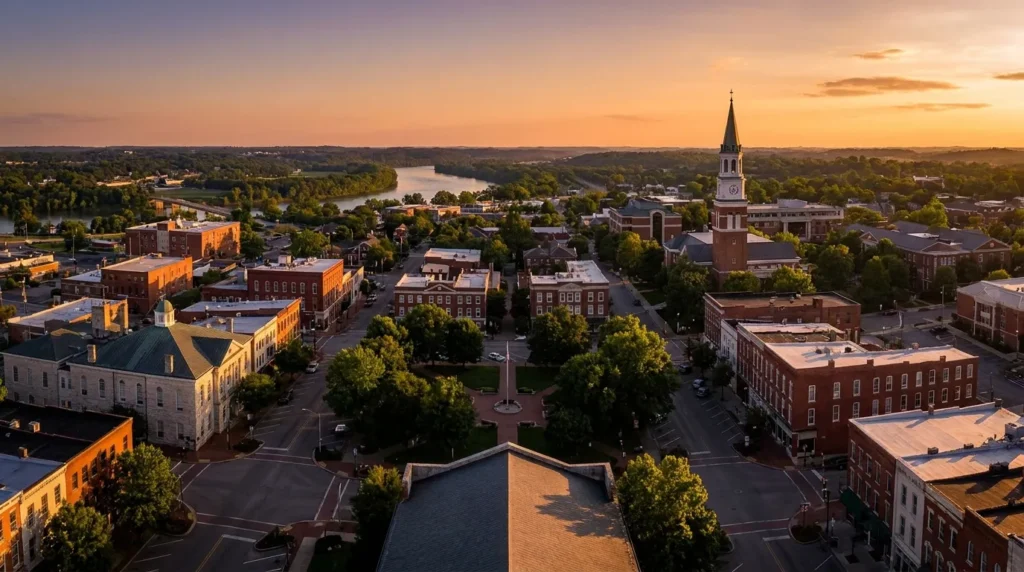
Kentucky's third-largest city, Bowling Green is home to the sole Chevrolet Corvette assembly plant, Western Kentucky University, and the nearby UNESCO World Heritage site Mammoth Cave National Park.

The National Corvette Museum chronicles the history of America's most iconic sports car and sits directly across from GM's Bowling Green Assembly plant, the only factory in the world that builds the Corvette, which offers guided tours by appointment. The adjacent NCM Motorsports Park hosts track day events, and Aviation Heritage Park displays historic aircraft.

Western Kentucky University (WKU) brings energy to the city center, with the Kentucky Museum, Hardin Planetarium, and the Guthrie Bell Tower among its landmarks. The Historic RailPark and Train Museum, housed in the former L&N Station, and Aviation Heritage Park round out the cultural circuit. Fountain Square Park anchors the historic downtown with shops and the Bowling Green Ballpark, home of the Hot Rods, an affiliate of the Tampa Bay Rays.

About half an hour away lies Mammoth Cave National Park, the world's longest known cave system and a UNESCO World Heritage site. Lost River Cave, located within the city itself, offers underground boat tours. Beech Bend Park combines a water park, drag racing strip, and campground.

  1. 1["National Corvette Museum"
  2. 2"Lost River Cave (underground boat tour)"
  3. 3"Beech Bend Park (amusement park)"
  4. 4"Aviation Heritage Park"
  5. 5"Historic RailPark and Train Museum"
  6. 6"Kentucky Museum (WKU)"
Nightlife5.0 / 10
Parks & green spaces
  • ["Lost River Cave Nature Preserve"
  • "Preston Miller Park"
  • "Kereiakes Park"
  • "Hobson Grove Park"
  • "Phil Moore Park"
  • +1 more

Latest posts

Posts about Kentucky

Coverage and updates related to this destination.

Showing content from Kentucky, as there is no specific data for Bowling Green yet.