Visto n' Visa
Blog
Notícias e artigos
Destinations
Careers
Immigrants

Want to live and work in Ashland?

Personalized immigration plan with eligible visas, costs, and next steps for your goal!

If you are not eligible, you will know exactly why and what to do to improve your approval chances.

Save up to 12 hours in meetings

No pointless assessments.

Save up to 90%

Save money on vague or unfocused consultations

Avoid Fraud and Mistakes

One mistake can cost you your visa

Total Impartiality

Zero commercial bias

Decide with peace of mind

No toxic urgency

Fast and Accurate

Answers in minutes, no guesswork

Who Lives in Ashland

The population is predominantly white with Appalachian roots, with a small but growing presence of Latin American and South Asian immigrants connected to the healthcare and services sectors.

Ashland has a demographic profile typical of eastern Kentucky: a white majority of English, Irish, and German descent, with a strong Appalachian identity. The population is around 20,000 residents in the city and approximately 350,000 in the Huntington-Ashland metropolitan area spanning three states.

The immigrant presence is modest compared to larger cities, but it exists and grows slowly. Doctors and nurses from India and the Philippines work at King's Daughters Medical Center, and Mexican and Central American families are employed in restaurants, construction, and services. Small clusters from Eastern Europe are also present.

English dominates daily life entirely, with a distinctive Southern Appalachian accent. Spanish appears in some shops and religious services. The predominant religion is Protestant Christianity, with Baptists, Methodists, and Pentecostals forming the majority, and a Catholic minority serving much of the Hispanic community.

Languages spoken
  • English
  • Spanish
Main religions
  • Protestantism (Baptist, Methodist, Pentecostal)
  • Catholicism
  • No religion

Low Cost of Living by American Standards

Ashland ranks among the most affordable cities in the United States. Rent, food, and basic utilities place little strain on the budget, compensating for wages lower than those in urban centers.

The cost of living in Ashland is well below the American average. Renting a two- or three-bedroom house costs a fraction of what one would pay in large cities, and buying property is accessible even on a median income. Electricity, gas, and water bills are also low.

Groceries and restaurants follow the pattern of a small city: national chains such as Kroger and Walmart, some independent markets, chain restaurants, and limited ethnic options. Dining out is inexpensive. Used cars, gasoline, and auto insurance cost less than the national average.

The weak point lies in specialized services: dental care, private physicians, attorneys, and some retail categories are limited, and many residents cross the bridge to Huntington (WV) or drive to Lexington for broader options. Fiber internet availability remains uneven across neighborhoods.

Ashland

Historic Homes and Quiet Residential Neighborhoods

Ashland has a large stock of well-maintained older homes in historic neighborhoods and newer options in hillside subdivisions. Low prices attract those looking to buy their first home.

The historic residential core is in the Bath Avenue Historic District and surrounding areas, with Victorian, Colonial Revival, and exposed brick homes from the early twentieth century. Many have been restored and still cost less than small apartments in large cities. These neighborhoods feature wide sidewalks, mature trees, and an established community feel.

For those who prefer newer construction, hillside subdivisions such as Pollard, Westwood, and the Summit area offer suburban homes from the 1970s onward, with garages, yards, and quiet streets. Apartment rentals exist mainly near downtown and along 13th Street.

Newcomers typically rent during the first months to get to know the city, then buy. Local real estate agencies and the FSBO (For Sale By Owner) market are active. When evaluating historic homes, it is worth inspecting the roof, wiring, and foundation, as deferred maintenance is common in older housing stock.

Recommended neighborhoods
  • Bath Avenue Historic District
  • Pollard
  • Westwood
  • Summit
  • Central Park area

Healthcare, Logistics, and Industry Sustain the Economy

The largest employer is the regional hospital. Refining, chemicals, steel, and logistics complete the economic base, with stable openings for those with technical or clinical training.

King's Daughters Medical Center is the city's largest single employer, with thousands of positions in medicine, nursing, technical roles, administration, and services. Foreign healthcare professionals find a genuine employment path in Ashland, particularly in nursing and radiology.

The industrial heritage remains alive. The Marathon Petroleum refinery in neighboring Catlettsburg employs hundreds, and chemical and industrial gas companies operate in the region. AK Steel (now Cleveland-Cliffs) was historically a major local presence, reduced today but still active. Road and rail logistics in the Ohio basin keeps truck drivers and operators employed.

For administrative, technology, or creative positions, opportunities are limited, and those in these fields generally work remotely or commute to Huntington. Average wages reflect the low cost of living, so real purchasing power is reasonable for skilled workers.

Dominant sectors
  • Healthcare
  • Refining and petrochemicals
  • Metal industry
  • Logistics and transportation
  • Retail
Major employers
  • King's Daughters Medical Center
  • Marathon Petroleum (Catlettsburg refinery)
  • Cleveland-Cliffs (formerly AK Steel)
  • Calgon Carbon
  • Ashland Independent Schools

Community Colleges and Regional Universities

Ashland has a community college within the city and is close to universities in West Virginia and other Kentucky cities, with easy access to bachelor's degrees and technical training.

Ashland Community and Technical College (ACTC), part of the KCTCS system, offers technical, vocational, and the first two years of undergraduate education at low cost. It is the entry point for many immigrants in the region seeking certification in healthcare, welding, mechanics, or administrative fields.

For bachelor's degrees, Marshall University in Huntington (WV) is about 20 minutes away and offers a wide range of programs, including medicine, engineering, and graduate studies. Morehead State University in Kentucky is approximately one hour away via I-64. For more advanced master's and doctoral programs, the University of Kentucky in Lexington attracts serious research.

The city's public school system (Ashland Independent Schools) is considered one of the best in eastern Kentucky, with Ashland Paul G. Blazer High School as its flagship. Families relocating for the schools typically seek properties within the Blazer district.

Notable universities
  • Ashland Community and Technical College
  • Marshall University (Huntington, WV)
  • Morehead State University
  • University of Kentucky (Lexington)

Regional Healthcare Hub with a Major Hospital

King's Daughters Medical Center transforms Ashland into a medical reference point for eastern Kentucky and neighboring regions of Ohio and West Virginia, with a broad network of specialties.

King's Daughters Medical Center (KDMC) is the pillar of the tri-state healthcare system, with hundreds of beds and specialties ranging from cardiology and oncology to trauma and neurosurgery. It serves patients from three states and is the central reason Ashland carries medical significance disproportionate to its size.

Bon Secours Mercy Health also operates units in the region, and independent clinics, urgent care centers, and physician offices are scattered throughout downtown and Westwood. For immigrants, finding a family doctor who accepts new insurance is generally a matter of calling a few options; wait times are shorter than in major metropolitan areas.

Those without insurance find options at FamilyCare and community clinics that charge on a sliding income scale. For highly complex procedures, some patients still travel to Lexington or Columbus (OH), but most moderate- to high-complexity care is handled at KDMC.

Ashland

Generally Safe City with Pockets to Avoid

Ashland has crime rates below the average for similarly sized American cities. Residential neighborhoods are quiet. Like much of the Appalachian region, some areas are affected by the opioid crisis.

Most of Ashland is safe for living and daytime walking. Established residential neighborhoods such as Bath Avenue, Pollard, and Westwood have low rates of violent crime and are considered comfortable for families. The historic downtown is safe during business hours and at events.

The real concern for the region is the opioid crisis, which has affected eastern Kentucky for more than a decade. This manifests in petty theft, a visible homeless population in some central areas at night, and drug-related incidents. It does not make the city dangerous, but calls for the standard caution appropriate to any location.

Local police are accessible and the community is cohesive, with a strong culture of knowing one's neighbors. More deteriorated areas east of downtown and some old industrial zones warrant caution at night, but there are no large no-go zones as found in larger metropolitan areas.

Safer neighborhoods
  • Bath Avenue Historic District
  • Pollard
  • Westwood
  • Summit
  • Central Park area
Areas to avoid
  • Parts of downtown at night
  • Old industrial areas along the river
  • Pockets east of downtown

Car-Dependent City with River and Rail Access

Ashland is heavily car-dependent. It has a small regional airport, access to a larger airport in Huntington, and lies along a historic CSX rail route.

Getting around Ashland requires a car in practice. The city is compact, but distances between neighborhoods, stores, and workplaces do not favor pedestrians. The Ashland Bus System (ABS) serves basic routes, useful for those who do not drive but with infrequent schedules.

The main regional airport is Tri-State Airport (HTS) in Huntington, about 20 minutes by car, with commercial flights to hubs such as Atlanta and Charlotte. For international flights, most travelers drive to Lexington (LEX), Cincinnati (CVG), or Columbus (CMH), all two to three hours away.

The CSX rail line runs through the city and was central to its industrial history, but today it carries only freight. Interstate 64 passes to the south, connecting quickly to Lexington, Louisville, and eastward to Charleston (WV). Dedicated cycling infrastructure is limited, though the waterfront has stretches suitable for walking and cycling.

Airports
  • HTS — Tri-State Airport (Huntington, WV)
  • LEX — Blue Grass Airport (Lexington)
  • CVG — Cincinnati/Northern Kentucky International

Climate

Ashland

Appalachian Culture with Live Music and Seasonal Festivals

Ashland breathes Appalachian heritage: bluegrass, country, traditional churches, and summer and Christmas festivals. The Paramount Arts Center is the cultural heart of the city.

The Paramount Arts Center, a restored 1931 Art Deco theater, is the most important cultural venue, hosting country, bluegrass, comedy, and theatrical productions throughout the year. Naomi and Wynonna Judd, both Ashland natives, launched their careers there, and the venue carries that local pride.

Local cuisine is that of the southern Appalachians: rib and brisket barbecue, soup beans with cornbread, biscuit and gravy for breakfast, and fried chicken on nearly every menu. Hispanic, Asian, and Italian restaurants have been gradually appearing. The craft brewery scene has grown over the past decade with regional establishments including Country Boy.

The calendar includes Summer Motion on the July 4 weekend by the river, Poage Landing Days celebrating the city's founding, and the well-known Winter Wonderland of Lights in Central Park from November through January, drawing visitors from across the tri-state region.

Notable dishes
  • Rib and brisket barbecue
  • Soup beans with cornbread
  • Biscuit and gravy
  • Southern fried chicken
  • Apple stack cake
Annual events
  • Winter Wonderland of Lights (Nov-Jan)
  • Summer Motion (July 4)
  • Poage Landing Days (September)
  • Festival of Trees (December)
  • Concerts at Paramount Arts Center

Parks, Riverside, and Historic Landmarks

The main attractions combine nature, industrial heritage, and culture. Central Park, the Ohio River waterfront, and the Paramount Arts Center are the central highlights.

Central Park is the city's green heart, with 47 acres of wooded land, trails, a playground, and the well-known pavilion used for events. At year's end, the Winter Wonderland of Lights transforms the entire park into an illuminated route attracting families from across the tri-state region.

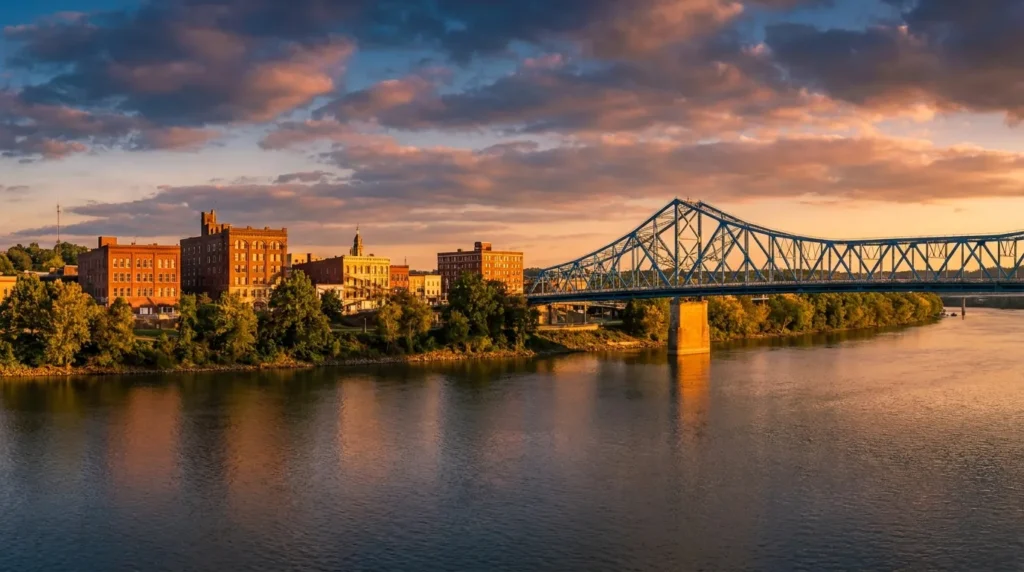
The waterfront along the Ohio River features Ashland Riverfront Park and a walking promenade with views of West Virginia across the water. The Highlands Museum and Discovery Center offers regional history, interactive science for children, and exhibits on country and bluegrass music.

A short drive from the city are Carter Caves State Resort Park, with explorable caves and trails, and Greenbo Lake State Resort Park, ideal for fishing and camping. Quick access to the Appalachian Mountains opens year-round options for hiking, ATVs, and rural tourism.

  1. 1Central Park
  2. 2Paramount Arts Center
  3. 3Highlands Museum & Discovery Center
  4. 4Ashland Riverfront Park
  5. 5Bath Avenue Historic District
  6. 6Winter Wonderland of Lights
Parks & green spaces
  • Central Park
  • Ashland Riverfront Park
  • Armco Park
  • Carter Caves State Resort Park (nearby)
  • Greenbo Lake State Resort Park (nearby)

Small Immigrant Community Centered on Healthcare and Services

The immigrant presence in Ashland is small but diverse, with doctors and nurses from South Asia and the Philippines, Hispanic families in services and construction, and a few European clusters.

Ashland is not a traditional destination for large-scale immigration, but King's Daughters Medical Center has been bringing physicians, nurses, and technicians from India and the Philippines for decades, forming a stable professional community. Many have settled with their families in Westwood and Summit.

The Hispanic community is the second most visible, with Mexicans, Guatemalans, and Hondurans working in restaurants, construction, landscaping, and food processing in the region. Small Latin markets have appeared over the past decade, and Spanish-language masses are held at local Catholic parishes. There is also a small presence of families from Eastern Europe and the Middle East connected to the medical sector.

As a modestly sized city, Ashland has no consulates of its own; those needing consular services travel to Cincinnati, Columbus, Pittsburgh, or Atlanta depending on nationality. Local immigrant support organizations are scarce, with Catholic Charities of Louisville covering the state and regional NGOs serving individual cases.

400
Foreign-born residents
estimated
Top countries of origin
  • Mexico
  • India
  • Philippines
  • Guatemala
  • Honduras
  • China
  • Germany
Foreign consulates
  • Consulate General of Mexico (Indianapolis)
  • Consulate General of India (Atlanta)
  • Consulate of the Philippines (Washington DC)
  • Consulate General of Germany (Atlanta)
  • Consulate General of the United Kingdom (Atlanta)
Community organizations
  • Catholic Charities of Louisville
  • Kentucky Refugee Ministries (Lexington)
  • Maysville Community Resource Center
  • Hispanic-Latino Coalition of Eastern Kentucky
  • Tri-State Literacy Council

Latest posts

Posts about Kentucky

Coverage and updates related to this destination.

Showing content from Kentucky, as there is no specific data for Ashland yet.