Visto n' Visa
Blog
Notícias e artigos
Destinations
Careers
Immigrants

Want to live and work in Emporia?

Personalized immigration plan with eligible visas, costs, and next steps for your goal!

If you are not eligible, you will know exactly why and what to do to improve your approval chances.

Save up to 12 hours in meetings

No pointless assessments.

Save up to 90%

Save money on vague or unfocused consultations

Avoid Fraud and Mistakes

One mistake can cost you your visa

Total Impartiality

Zero commercial bias

Decide with peace of mind

No toxic urgency

Fast and Accurate

Answers in minutes, no guesswork

Diverse population driven by university and meat processing industry

A mix of Anglo-American families, a significant Hispanic community linked to Tyson Foods, university students, and smaller groups of immigrants from Southeast Asia and East Africa.

Emporia has around 24,000 residents and one of the highest Hispanic proportions among small Kansas cities, at around one-third of the population. The presence stems mainly from Mexican and Central American families who came to work at the Tyson Foods plant over the past thirty years, and who today support their own businesses along Commercial Street and around the Mercado Hispano.

Emporia State University, with around five thousand students, brings a constant flow of young people from other parts of Kansas, the United States, and international programs, with a small but stable presence of Chinese, Indian, Saudi, and African students. There is also a Somali community connected to work at the processing plant and a long-established Vietnamese minority.

The religious majority is Christian, with a strong Catholic presence (partly due to Hispanic families) and several historic Protestant churches downtown. The city also has a historic Black Methodist congregation and smaller places of worship serving the university community.

Languages spoken
  • English
  • Spanish
  • Somali
  • Vietnamese
  • Mandarin
Main religions
  • Catholicism
  • Protestantism (Methodist, Baptist, Lutheran)
  • Evangelical Christianity
  • Islam (Somali community)
  • No religion

Low cost even by rural Kansas standards

Rent, groceries, and services fall well below the US national average, with costs pulled down by the university market and modest median income.

Emporia is one of the most affordable cities in Kansas to live in. Rent for a one-bedroom apartment near the university typically ranges from six hundred to eight hundred dollars per month, and entire two- or three-bedroom homes appear between nine hundred and fourteen hundred. Buying a modest home downtown or in older neighborhoods is still possible for under two hundred thousand dollars.

Supermarkets such as Walmart, Aldi, and the local HyVee cover the basics, with Hispanic grocery stores selling imported products at competitive prices. Electricity and gas bills vary considerably with the seasons: summer weighs on air conditioning and winter on gas heating, with an annual average of around two hundred dollars per month for a house.

Private transportation is practically mandatory, so a used car and insurance factor into the budget. On the other hand, gas prices tend to be among the lowest in the US. Eating out is affordable, with Mexican diners, American barbecue spots, and national chains all charging small-city prices.

Emporia

Affordable single-story homes, with rentals concentrated near the university

Market dominated by single-family homes from the 1920s through the 1970s, with student rentals near campus and newer developments to the west and north.

Emporia's housing stock consists mainly of older single-story homes and bungalows, many from the early twentieth century, spread across a grid of tree-lined streets. The most sought-after neighborhoods are around Emporia State University, the historic downtown, and Peter Pan Park, with renovated houses and large yards.

For rentals near the university, the Market Street and Merchant Street area offers shared houses for students and small apartments. Families tend to look for more residential neighborhoods such as West Side, near Walnut and Riverside schools, or the newer subdivisions west of Highway 99, where more modern homes appear in the two-hundred-fifty-thousand-dollar range.

Those prioritizing price find options in neighborhoods south of the rail line, with simpler construction and proximity to the Tyson plant. The city is compact, so getting from one side to the other rarely takes more than ten minutes by car.

Recommended neighborhoods
  • Westside
  • Historic downtown (Commercial Street)
  • Emporia State University area
  • Peter Pan Park
  • Northwest Emporia

University, meatpacking plant, and logistics sustain the local economy

A small, stable market dominated by higher education, animal protein processing, logistics distribution, and county public services.

The city's largest employer is Emporia State University, which sustains faculty, administrative staff, and a service chain around campus. Close behind is the Tyson Foods plant, which processes beef and employs thousands of people, with a strong presence of Hispanic and African workers.

Hospitals such as Newman Regional Health and the network of local clinics form another employment hub, with positions for nurses, technicians, and administrators. The logistics sector has grown with the proximity of I-35: distribution centers for Hostess Brands (Dolly Madison) and Detroit Diesel Allison are among the most visible.

For newcomers without fluent English, the most accessible paths tend to be Tyson, restaurants, hotels at the I-35 exits, and cleaning services. Those with technical qualifications find openings in industrial maintenance, transportation, and construction.

Dominant sectors
  • Higher education
  • Meat processing
  • Logistics and distribution
  • Healthcare
  • Commerce and services
Major employers
  • Emporia State University
  • Tyson Foods
  • Newman Regional Health
  • Hopkins Manufacturing
  • Detroit Diesel Allison
  • +1 more

Public state university and bilingual school network

A university city anchored by Emporia State, with a nearby community college and public schools featuring strong bilingual programs.

Emporia State University is the city's educational heart. Founded in 1863 as a normal school, it now offers undergraduate and graduate programs in education, business, library science, and sciences, with one of the most respected teacher training programs in the American Midwest. Hornets team games, especially football and basketball, animate the city on weekends.

For those seeking technical training or English as a second language courses, Flint Hills Technical College is located in Emporia and offers short programs in healthcare, welding, mechanics, and technology. Allen Community College has a campus in Burlington, about half an hour away by car.

The USD 253 public school district has schools with Spanish-English bilingual programs to serve the Hispanic community and maintains the historic Emporia High School. There are also Catholic schools (Sacred Heart) and small private Christian schools.

Notable universities
  • Emporia State University
  • Flint Hills Technical College
  • Newman Divinity School (extension)

Regional hospital covers the basics; complex cases go to Topeka or Wichita

Healthcare system organized around Newman Regional Health, with local clinics and referrals to larger hospitals for specialized cases.

Newman Regional Health is Emporia's general hospital and covers emergencies, deliveries, medium-complexity surgeries, orthopedics, and basic cardiology. It serves the entire Flint Hills region, with around one hundred beds and its own specialist team. There is also a network of family clinics and outpatient care at several points throughout the city.

For complex cases, advanced oncology, neurosurgery, or high-level trauma, patients are generally referred to Topeka (Stormont Vail and University of Kansas Health) or Wichita (Wesley Medical Center), both about one and a half hours away by car. Medical helicopters serve urgent cases.

Immigrants find clinics with Spanish interpreters at Newman and at Flint Hills Community Health Center, which accepts uninsured patients on an income-based sliding scale. Twenty-four-hour pharmacies operate at Walmart and Walgreens on US-50.

Emporia

Generally calm city, with busier spots near the highway

Violence rates low by American standards, with theft and minor property crimes concentrated near I-35 and central commercial areas.

Emporia is a calm city by US standards, with crime dominated by residential burglaries, vandalism, and alcohol- and drug-related incidents. Serious violence is uncommon, and residential neighborhoods are quiet at night, with neighbors who know one another.

The most active areas are along Industrial Road and at the I-35 exits, where gas stations, hotels, and fast food attract traveler traffic and occasional late-night activity. Hotel and shopping center parking lots account for the majority of vehicle break-ins.

Newcomers are advised not to leave valuables visible in their cars, particularly near the university and at event parking lots. The municipal police and Lyon County sheriff maintain a constant presence and respond to calls with the speed typical of a small city.

Safer neighborhoods
  • Westside
  • Peter Pan Park area
  • New subdivisions to the northwest
  • Residential neighborhoods west of Merchant Street
Areas to avoid
  • Immediate vicinity of Industrial Road at night
  • I-35 exits (hotel parking lots late at night)
  • Industrial areas south of the rail line after business hours

Car-dependent city with no commercial airport of its own

Quick access via I-35 and US-50, minimal public transit, and commercial flights through Kansas City, Wichita, or Manhattan.

In Emporia, having a car is practically mandatory. The city is compact and flat, but public transit is limited to a demand-responsive paratransit service and Lyon County Transportation, aimed primarily at seniors and people with reduced mobility. There are no fixed-route urban bus lines.

The logistics location is one of the advantages: I-35 cuts through the city and connects Kansas City to the north (about two hours) and Wichita to the south (one and a half hours), while US-50 leads west toward Newton and Dodge City. Interstate bus services from Greyhound and Jefferson Lines stop in the city.

For air travel, options include Kansas City International (MCI), Wichita Eisenhower (ICT), and Manhattan Regional (MHK), the last being closest but with limited flights. For freight and cargo transport, BNSF Railway maintains active operations in the city.

Airports
  • EMP — Emporia Municipal Airport (general aviation)
  • MHK — Manhattan Regional (regional, ~120 km)
  • ICT — Wichita Dwight D. Eisenhower National (~150 km)
  • MCI — Kansas City International (~180 km)
  • Bike infrastructure

Climate

Emporia

Rural tradition, Hispanic identity, and the history of Veterans Day

A cultural blend of Anglo-rural Kansas roots, Mexican influence visible in food and celebrations, and civic pride tied to the origin of Veterans Day.

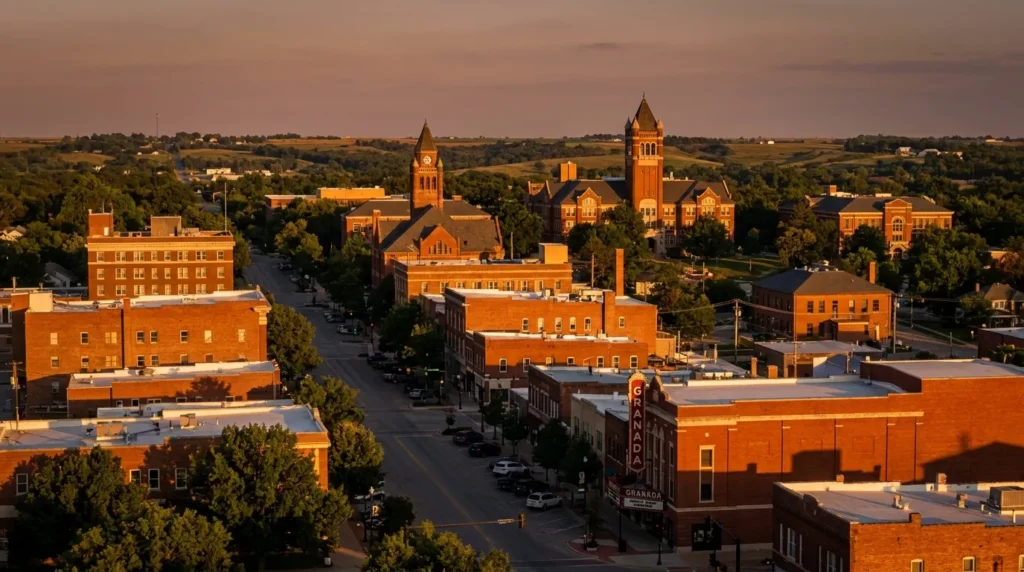
Emporia's culture is shaped by the encounter between rural Kansas traditions, including rodeos, country music, and agricultural festivals, and a strong Hispanic presence that has taken root over recent decades. Commercial Street has Mexican bakeries, taquerias, and markets selling imported products that have become part of the city's identity.

The great civic occasion is the Veterans Day Parade, held every November 11 and drawing veterans and bands from across the state, honoring the local origin of the holiday. Other celebrations that animate the year include the Great American Market downtown, Emporia State Hornets games, and Symphony in the Flint Hills, an outdoor festival on the nearby prairies.

The city is also home to the Flint Hills Review literary magazine, the historic Emporia Gazette (founded by William Allen White), and a modest circuit of independent cinema and university theater on the ESU campus.

Notable dishes
  • Carne asada and barbacoa tacos at Commercial Street taquerias
  • Homemade tamales sold at Hispanic markets
  • Chicken fried steak with white gravy
  • Flint Hills-style Kansas barbecue
  • Chorizo breakfast burrito
Annual events
  • Veterans Day Parade (November)
  • Great American Market
  • Symphony in the Flint Hills (June, on the prairies)
  • Dirty Kanza / Unbound Gravel (gravel cycling race, June)
  • Independence Day celebration at Soden's Grove Park

Parks, firefighters museum, and gateways to the Flint Hills

Attractions centered on urban parks, small historical museums, the ESU campus, and the open landscape of the Flint Hills in the surrounding area.

The city's recreational heart is Soden's Grove Park, with a lake, barbecue areas, a small municipal zoo, and the National Teachers Hall of Fame, a museum dedicated to American educators. Peter Pan Park is another favorite, with a playground, a memorial garden to William Allen White, and a fishing pond.

In the historic downtown, the Emporia Gazette Museum, the Lyon County Historical Society, and the Granada Theatre (a renovated art deco cinema) preserve the city's legacy. The Emporia State campus, with its William Allen White Library and Plumb Hall, is worth visiting for the architectural ensemble.

Outside the city, the unmissable destination is the Flint Hills, one of the last great stretches of native prairie in the world, with the Tallgrass Prairie National Preserve about half an hour south, in Strong City. The region is also the base for Symphony in the Flint Hills and the Unbound gravel race.

  1. 1Soden's Grove Park
  2. 2National Teachers Hall of Fame
  3. 3Emporia Gazette Building (William Allen White)
  4. 4Granada Theatre
  5. 5Lyon County Historical Society Museum
  6. 6Tallgrass Prairie National Preserve (Strong City, nearby)
Parks & green spaces
  • Soden's Grove Park
  • Peter Pan Park
  • Jones Park
  • David Traylor Zoo of Emporia
  • Flint Hills Nature Trail

Established Hispanic community and new African and Asian flows

Immigration concentrated at the Tyson plant and the university, with a dominant Hispanic community and smaller groups from Somalia, Vietnam, China, India, and the Philippines.

Emporia has one of the highest proportions of immigrants among small Kansas cities. By far the largest community is Mexican and Central American, present for decades and visible along Commercial Street, with markets, taquerias, Spanish-language church services, and community organizations. The second, more recent wave is Somali, which came to work at Tyson and maintains a small network of businesses and a mosque.

Through the university, there is a constant flow of international students from China, India, Saudi Arabia, Nigeria, and Vietnam, some of whom remain in the city after graduating. Small, long-established Vietnamese and Filipino communities complete the mosaic, sustained by modest Asian restaurants and grocery stores.

Newcomers find support through organizations such as Hispanic Faith and Family Connection, the Refugee Assistance Program linked to the Catholic diocese, and the ESU English as a Second Language center. Consulates are not located in Emporia; those needing consular services travel to Kansas City or Wichita.

3,500
Foreign-born residents
estimated
Top countries of origin
  • Mexico
  • El Salvador
  • Guatemala
  • Somalia
  • Vietnam
  • China
  • India
  • Philippines
Foreign consulates
  • Mexican Consulate in Kansas City (MO)
  • Mexican Consulate General in Omaha
  • El Salvador Consulate in Kansas City
  • Guatemalan Consulate General in Kansas City
  • Vietnamese Consulate General in Houston (jurisdiction)
  • +1 more
Community organizations
  • Hispanic Faith and Family Connection
  • Catholic Charities of Northeast Kansas
  • Flint Hills Community Health Center
  • Emporia Multicultural Coalition
  • International Student Office (Emporia State University)
  • Newman Regional Health Language Services

Latest posts

Posts about Kansas

Coverage and updates related to this destination.

Showing content from Kansas, as there is no specific data for Emporia yet.