Visto n' Visa
Blog
Notícias e artigos
Destinations
Careers
Immigrants

Want to live and work in Muncie?

Personalized immigration plan with eligible visas, costs, and next steps for your goal!

If you are not eligible, you will know exactly why and what to do to improve your approval chances.

Save up to 12 hours in meetings

No pointless assessments.

Save up to 90%

Save money on vague or unfocused consultations

Avoid Fraud and Mistakes

One mistake can cost you your visa

Total Impartiality

Zero commercial bias

Decide with peace of mind

No toxic urgency

Fast and Accurate

Answers in minutes, no guesswork

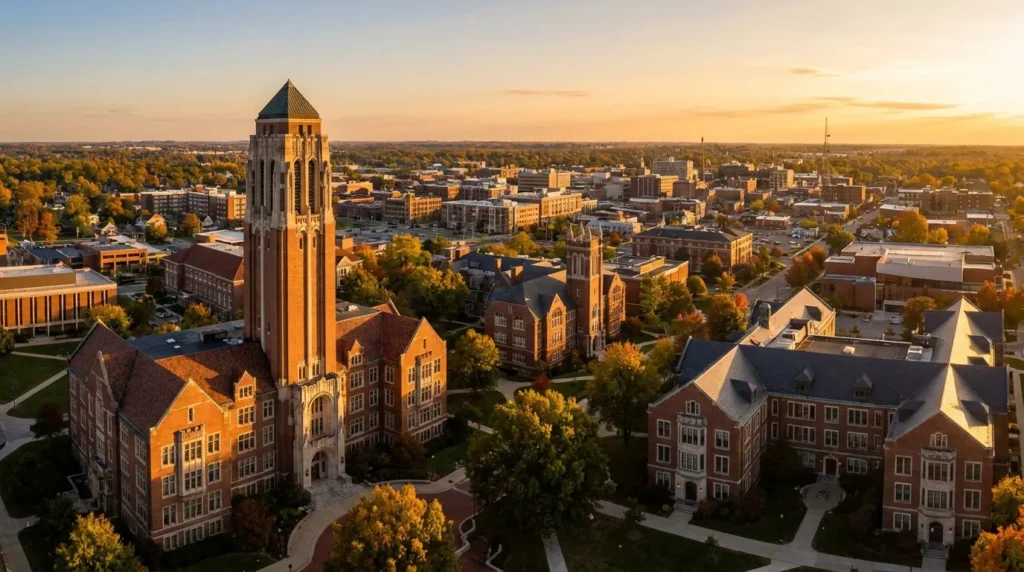
University population in a small Midwest city

Around 65,000 residents, with a strong student presence and a predominantly white demographic, alongside growing communities of Asian and Latin American immigrants.

Muncie's population is predominantly non-Hispanic white, with significant African American and Hispanic minorities concentrated in specific neighborhoods. Ball State University brings international diversity to the academic core, with students from India, China, South Korea, Saudi Arabia, and various African countries.

English is the dominant language in daily life, and Spanish appears in some businesses and churches. In neighborhoods near campus, Mandarin, Hindi, and Arabic are commonly heard in conversations among students. Outside the university circle, the city is monolingual in English.

Religion is an important part of local identity, with a strong presence of Protestant churches (Methodist, Baptist, Presbyterian) and Catholic churches. There are also small but active Muslim and Hindu communities, tied primarily to the university. The culture is typically conservative Midwest American.

Languages spoken
  • English
  • Spanish
  • Mandarin
  • Arabic
  • Hindi
Main religions
  • Protestantism
  • Catholicism
  • Islam
  • Hinduism
  • No religion

One of the lowest costs of living in the United States

Muncie is significantly cheaper than the American average, especially in housing, with rents and home prices among the most affordable in the country.

The cost of living in Muncie is well below the national average, primarily due to the accessible real estate market. Three-bedroom houses under $150,000 and one-bedroom apartments in the $600 to $900 per month range are common, figures that would be unimaginable in major cities.

Grocery chains such as Kroger, Meijer, and Walmart offer typical Midwest pricing, lower than on either coast. Local restaurants are affordable, with full meals at diners and university cafeterias running $10 to $15. Fast food chains are found everywhere.

Higher costs come from winter heating (natural gas or electricity), private health insurance, and transportation, as a personal vehicle is practically required outside the campus bubble. Indiana property taxes are moderate compared to neighboring states such as Illinois.

87Cost index (US = 100)13% below US average
CategorySingleCoupleFamily (2 + 2)
iHousing$1,133$1,308$1,656
iFood$331$662$1,203
iTransport$436$741$959
iHealthcare$244$488$915
iChildcare$1,587
iOther$741$1,333$1,874
Monthly total$2,885$4,532$8,194

Source: U.S. BLS Consumer Expenditure Survey 2023 + BEA Regional Price Parities 2023 · Estimates in USD, monthly.

Affordable housing in spacious homes and apartments

One of the most accessible real estate markets in the United States, with Victorian homes downtown, student complexes near campus, and family neighborhoods on the outskirts.

Those moving to Muncie are often surprised by the size and price of housing. Historic Victorian homes in neighborhoods such as Old West End and Riverside offer charm and space at prices that would only cover a studio apartment in cities like Chicago or New York. Family homes can be purchased for under $200,000.

Near Ball State's campus, in areas such as the Village and University Heights, apartments and rental houses for students predominate. Turnover is high and prices are low. For families, neighborhoods like Halteman Village and Forest Park have better schools and a more residential atmosphere.

Most properties include a basement, one- or two-car garage, and a yard, the typical Midwest standard. Central gas heating and central air conditioning are common. Renting generally requires proof of income three times the rent and a US credit check, which can be a barrier for newcomers.

Recommended neighborhoods
  • Old West End
  • Riverside
  • Halteman Village
  • Forest Park
  • University Heights
  • +1 more

Economy anchored in the university, healthcare, and light industry

Ball State University and the IU Health Ball Memorial Hospital system are the largest employers, followed by manufacturing, retail, and public services.

Muncie's job market revolves around three pillars: education, healthcare, and industry. Ball State University is by far the largest employer, with thousands of positions in teaching, research, administration, maintenance, and services. IU Health Ball Memorial Hospital employs hundreds in nursing, medicine, and administrative support.

The city was once a strong industrial hub and still maintains factories in sectors such as glass, automotive parts, plastic components, and food processing. Companies such as Magna Powertrain and Mursix operate in the region. The industrial legacy has also left economic challenges, with older industrial neighborhoods in transition.

For immigrants, opportunities in hospitality, restaurants, cleaning, seasonal agriculture, and construction are the most common entry points. In technical and academic fields, H-1B and J-1 visas tied to the university are the usual path. Average wages are below the national average, but the low cost of living offsets this.

Dominant sectors
  • Higher Education
  • Healthcare
  • Manufacturing
  • Retail
  • Public Services
Major employers
  • Ball State University
  • IU Health Ball Memorial Hospital
  • Muncie Community Schools
  • Magna Powertrain
  • Mursix Corporation
  • +1 more

University city with a K-12 public system in recovery

Ball State University is the city's educational crown jewel, while K-12 public schools are undergoing reforms after years of budget difficulties.

Ball State University is the institution that defines Muncie. Founded in 1918 with funding from the Ball family, it offers undergraduate and graduate programs in areas such as architecture, journalism, education, telecommunications, and business. It is nationally recognized in architecture, communications, and physical education programs, with approximately 20,000 students and a growing international presence.

For K-12 education, Muncie Community Schools went through a financial crisis that led to a historic intervention partnership with Ball State University. Schools such as Northside Middle School and Central High School serve most of the city. Families with children typically research neighborhoods based on the assigned school's quality.

Private and charter school options are also available, and Ivy Tech Community College offers two-year technical training at affordable prices, popular among immigrants seeking quick American credentials in areas such as nursing, welding, and information technology.

Notable universities
  • Ball State University
  • Ivy Tech Community College — Muncie
  • Indiana Academy for Science, Mathematics, and Humanities

Regional hospital system centered on IU Health Ball Memorial

The main hospital serves all of eastern Indiana, with specialized clinics available, though access depends heavily on adequate health insurance coverage.

IU Health Ball Memorial Hospital is the center of the local healthcare system, with approximately 350 beds and 24-hour emergency care. It is part of the Indiana University Health network, one of the largest in the state, providing access to specialists in Indianapolis when needed. Services include oncology, cardiology, maternity care, and general surgery.

For outpatient care, several clinics are scattered throughout the city, including Open Door Health Services, which serves low-income populations on a sliding-scale payment system. Pharmacies such as CVS and Walgreens are found in every neighborhood. Dentists and ophthalmologists generally require separate coverage beyond the standard medical plan.

As throughout the United States, having health insurance is essential. Without coverage, an emergency room visit can cost thousands of dollars. Newly arrived immigrants should explore options through the Marketplace, employer plans, or Indiana's Medicaid program when eligible. Ball State students have access to a university health plan.

Muncie

Average safety with quiet areas and zones requiring attention

Muncie's crime rates are above the national average for cities of similar size, concentrated in specific neighborhoods, with the vast majority of the city calm in daily life.

Muncie's crime statistics appear above the national average in FBI data, but day-to-day perception varies considerably by neighborhood. Most incidents involve theft, burglaries of unoccupied homes, and addiction-related occurrences in economically distressed areas, not random violence against strangers.

Neighborhoods such as Halteman Village, Forest Park, Northwest Muncie, and the immediate area around Ball State's campus are considered safe and well-patrolled. Young families, professors, and students live there without concern. Downtown at night and some industrial zones in the southern part of the city call for greater caution and common sense.

As in any American city, locking vehicles, avoiding leaving valuables visible, researching an area before signing a lease, and avoiding walking alone at night in poorly lit zones are standard precautions. The Muncie Police Department is accessible, and Ball State University's department patrols the campus area 24 hours a day.

Safer neighborhoods
  • Halteman Village
  • Forest Park
  • Northwest Muncie
  • Riverside
  • University Heights
Areas to avoid
  • South Central Muncie at night
  • Abandoned industrial areas to the south
  • Whitely after dark

Car-dependent city with limited public transit

Muncie relies heavily on personal vehicles, with a basic bus system serving mainly the campus and some urban routes.

As in most mid-sized American cities, having a personal vehicle is practically essential in Muncie. Obtaining an Indiana driver's license is one of the first steps for any immigrant settling in the city. The distances between neighborhoods, grocery stores, and workplaces are not walkable during the harsh winter.

MITS, the municipal bus system, operates urban routes and serves Ball State's campus with reasonable frequency during the day. For those living near campus or working downtown, public transit is a viable option. Service is reduced at night and on weekends. Uber and Lyft operate, but the number of drivers is limited.

The nearest airport with commercial flights is Indianapolis International Airport (IND), approximately 90 minutes by car. Delaware County Regional Airport also serves general aviation. The city lacks structured bike lanes, but the White River Greenway offers a pleasant paved path for cyclists in the central area.

Airports
  • IND — Indianapolis International (90 min)
  • MIE — Delaware County Regional (general aviation)

Climate

Muncie

University culture and Midwest traditions

Cultural life driven by Ball State, with museums, theater, university sports, and local festivals celebrating the region's industrial and agricultural heritage.

Muncie's cultural scene is strongly influenced by Ball State University, which maintains the David Owsley Museum of Art with a respectable collection, concert halls, and Emens Auditorium hosting shows and lectures. Cornerstone Center for the Arts, housed in a former Masonic lodge, offers classes, exhibitions, and theatrical performances.

University sports are a local institution. The Ball State Cardinals compete in basketball and football with a passionate fan base, and game days transform the city. In summer, Minnetrista Cultural Center hosts community events, historic gardens, and exhibitions about the Ball family, founders of the famous canning jars.

Local cuisine is typical Midwest fare: the Indiana pork tenderloin sandwich (an oversized breaded pork loin sandwich), Indiana sweet corn, cherry pies, and the breakfast diner tradition. Annual festivals such as the Muncie Three Rivers Festival and Ball State Homecoming mark the cultural calendar.

Notable dishes
  • Indiana pork tenderloin sandwich
  • Sugar cream pie
  • Sweet corn
  • Chili mac
  • Persimmon pudding
Annual events
  • Ball State Homecoming
  • Muncie Three Rivers Festival
  • Minnetrista Farmers Market
  • Mid-Summer Festival at Minnetrista
  • Cornerstone Christmas Tour

University, historic, and outdoor attractions

Museums, historic gardens, Ball State's campus, and the White River Greenway are the most visited destinations, with a small but consistent cultural life.

Minnetrista Cultural Center is the city's cultural landmark, with historic gardens, a Ball family museum, and programming throughout the year. Adjacent stands the David Owsley Museum of Art, on Ball State's campus, with a surprisingly strong collection of African, Asian, and European art, with free admission.

The Ball State campus itself is worth visiting, especially the Beneficence Statue, Christy Woods, and the Rinard Orchid Greenhouse, home to one of the largest university orchid collections in the United States. The Muncie Children's Museum draws families with young children through interactive exhibitions.

For outdoor enthusiasts, the White River Greenway offers a paved path along the river, ideal for walking and cycling. Prairie Creek Reservoir, a short drive away, is the summer destination for swimming, sailing, and picnicking. At Halloween, Cornerstone Center hosts one of the most popular seasonal events in the area.

  1. 1Minnetrista Cultural Center
  2. 2David Owsley Museum of Art
  3. 3Ball State University Campus
  4. 4Muncie Children's Museum
  5. 5Rinard Orchid Greenhouse
  6. 6Cornerstone Center for the Arts
Parks & green spaces
  • White River Greenway
  • Prairie Creek Reservoir
  • McCulloch Park
  • Christy Woods
  • Westside Park
  • +1 more

Small immigrant communities tied to the university

International presence concentrated around Ball State, with groups from India, China, South Korea, Saudi Arabia, and Latin American countries.

Muncie is not a city of mass immigration, but Ball State University brings consistent international diversity. Students and researchers from India form one of the most visible groups, with active cultural associations on campus and Diwali celebrations open to the community. Chinese and Korean communities also have a significant presence in the academic environment.

Throughout the broader city, Hispanic communities of varied origins are present, primarily from Mexico, Guatemala, and Honduras, working in services, construction, and agriculture in the region. Small African refugee communities, especially from Somalia and Sudan, have been resettled in the area over the years with support from local churches.

Support for immigrants comes primarily from the university itself through the Rinker Center for Global Affairs, from local churches maintaining assistance programs, and from the county social services office. For consular services, most residents need to travel to Indianapolis or Chicago, where consulates are located.

3,200
Foreign-born residents
estimated
Top countries of origin
  • India
  • Mexico
  • China
  • South Korea
  • Saudi Arabia
  • Guatemala
  • Honduras
  • Somalia
Foreign consulates
  • Mexican Consulate General in Indianapolis
  • Honorary German Consulate in Indianapolis
  • Honorary Japanese Consulate in Indianapolis
  • Consulate General of India in Chicago (jurisdiction)
  • Consulate General of Brazil in Chicago (jurisdiction)
Community organizations
  • Rinker Center for Global Affairs (Ball State)
  • Catholic Charities of Muncie
  • Open Door Health Services
  • Muncie Multicultural Center
  • Indiana University Health Community Outreach

Latest posts

Posts about Indiana

Coverage and updates related to this destination.

Showing content from Indiana, as there is no specific data for Muncie yet.