Visto n' Visa
Blog
Notícias e artigos
Destinations
Careers
Immigrants

Want to live and work in Indianapolis?

Personalized immigration plan with eligible visas, costs, and next steps for your goal!

If you are not eligible, you will know exactly why and what to do to improve your approval chances.

Save up to 12 hours in meetings

No pointless assessments.

Save up to 90%

Save money on vague or unfocused consultations

Avoid Fraud and Mistakes

One mistake can cost you your visa

Total Impartiality

Zero commercial bias

Decide with peace of mind

No toxic urgency

Fast and Accurate

Answers in minutes, no guesswork

Diverse city with strong African American and Hispanic communities

Indianapolis is predominantly white, with approximately 28% African American, 11% Hispanic, and a smaller but growing Asian community. Immigration from Myanmar and Mexico is significant.

The ethnic composition reflects the city's industrial history and central location. The African American population has deep roots, particularly in north and east side neighborhoods such as Martindale-Brightwood and Mapleton-Fall Creek. The Hispanic community has grown rapidly over the past two decades, concentrated on the south side and along Lafayette Road, with strong Mexican, Guatemalan, and Honduran presences.

One of the largest Burmese diasporas in the United States lives in Indianapolis, primarily of Chin ethnicity, resettled as refugees over the past two decades. Burmese churches, markets, and restaurants are concentrated on the south side near Madison Avenue. Indianapolis has also received many recent Afghan and Congolese refugees.

There is a small but active Brazilian community, with informal gatherings and some evangelical churches that offer services in Portuguese. Spanish is widely spoken in commerce and services, and many hospitals and schools provide interpretation in multiple languages.

Languages spoken
  • English
  • Spanish
  • Burmese (Chin, Burmese)
  • Arabic
Main religions
  • Protestantism
  • Roman Catholicism
  • African American Christianity
  • Islam
  • No religion

One of the most affordable costs of living among major U.S. cities

Indianapolis consistently ranks among the most affordable large American cities. Rent, food, and services fall well below the national average without sacrificing urban amenities.

For a city of Indy's scale, with an international airport, NFL and NBA franchises, museums, and universities, the cost of living is remarkably reasonable. A one-bedroom apartment in areas such as Fountain Square, Irvington, or Broad Ripple rents for far less than comparable units in Chicago, Columbus, or Nashville. Homeownership is also attainable for middle-income earners.

Property taxes in Marion County are moderate, and Indiana has a flat state income tax rate (3.15% in 2025), which compares favorably to Illinois or Ohio. Marion County adds a small county surcharge. Groceries and restaurants are affordable, with many Mexican and Asian market options that help reduce monthly food expenses.

Utility costs follow Midwest norms: gas heating is a significant expense in January and February, and air conditioning runs through July and August. AES Indiana supplies electricity. A car is practically essential for residents who do not live downtown or near major IndyGo lines, so insurance, gas, and parking factor into the monthly budget.

86Cost index (US = 100)14% below US average
CategorySingleCoupleFamily (2 + 2)
iHousing$1,121$1,294$1,639
iFood$328$656$1,190
iTransport$431$733$949
iHealthcare$241$483$905
iChildcare$1,570
iOther$733$1,320$1,854
Monthly total$2,854$4,486$8,107

Source: U.S. BLS Consumer Expenditure Survey 2023 + BEA Regional Price Parities 2023 · Estimates in USD, monthly.

Restored neighborhoods, new suburbs, and historic homes at accessible prices

Indianapolis offers a wide range of housing: Victorian homes in historic neighborhoods such as Old Northside, ranch-style houses from the 1960s in the suburbs, and new construction in Mass Ave and Bottleworks.

Downtown has seen an apartment and condominium building boom, particularly in Mass Ave, the Wholesale District, and the new Bottleworks District. Those seeking urban walkability without East or West Coast price tags will find reasonable options. Fletcher Place and Fountain Square attract young professionals and artists with restored historic brick homes.

Broad Ripple, to the north, has a village feel with 1920s-era homes and an active nightlife scene. Irvington, on the east side, is a tree-lined historic neighborhood preferred by families. The south side offers more affordable options in neighborhoods such as Garfield Park and University Heights. For classic suburban living, Speedway, Beech Grove, and Lawrence are still within Marion County.

Those who prefer newer suburbs typically look at Fishers, Carmel, Noblesville, and Greenwood, all outside Unigov but 20 to 30 minutes from downtown. Rental prices remain one of Indy's strongest advantages: a two-bedroom house with a yard is available at prices that are unimaginable in coastal markets.

Recommended neighborhoods
  • Broad Ripple
  • Fountain Square
  • Mass Ave
  • Irvington
  • Bottleworks District
  • +2 more

Pharmaceuticals, logistics, healthcare, and technology drive the market

Indianapolis has a diversified economy led by Eli Lilly, FedEx, Anthem (Elevance), Salesforce, and major hospital systems. Logistics and warehouse operations are expanding around the airport.

Eli Lilly is headquartered in Indianapolis and is the largest private employer, with thousands of positions in pharmaceutical research, manufacturing, chemistry, and corporate sciences. FedEx operates the second-largest air hub in the world at Indianapolis International Airport, generating jobs in logistics, cargo handling, aviation mechanics, and information technology.

The healthcare sector is anchored by IU Health, Community Health Network, Ascension St. Vincent, and Eskenazi Health, all operating large hospitals and dozens of clinics across the city. Anthem (now Elevance Health) is headquartered here, as is Cummins (diesel engines) in nearby Columbus. Salesforce has a major presence in a downtown tower.

The technology sector has grown with companies such as Genesys, Angi (HomeAdvisor), and digital health startups. For remote workers, Indy offers a low cost of living and a solid market. Universities including IUPUI, Butler, and the University of Indianapolis also generate academic and research positions.

Dominant sectors
  • Pharmaceuticals and life sciences
  • Logistics and air cargo
  • Hospital healthcare
  • Insurance and finance
  • Technology and SaaS
  • +1 more
Major employers
  • Eli Lilly and Company
  • FedEx Express (Indianapolis Hub)
  • IU Health
  • Elevance Health (Anthem)
  • Salesforce
  • +2 more

IUPUI, Butler, magnet schools, and a growing charter school landscape

Indianapolis is home to several prominent universities, led by Indiana University Indianapolis, Butler, and the University of Indianapolis. Indianapolis Public Schools offers competitive magnet programs.

Indiana University Indianapolis (formerly IUPUI, recently reorganized as IU Indianapolis and Purdue Indianapolis), located in the city center, offers programs in medicine, law, engineering, arts, and social sciences. The IU School of Medicine is one of the largest medical schools in the U.S. and attracts students from across the country. Purdue Indianapolis focuses on engineering, computer science, and technology.

Butler University, located in Broad Ripple, is a respected private university known for its basketball program and pharmaceutical sciences. The University of Indianapolis (UIndy), on the south side, is smaller and has a strong physical therapy program. Marian University (Catholic) and Ivy Tech Community College complete the local higher education landscape.

Indianapolis Public Schools (IPS) operates traditional schools and several competitive magnet schools, including the Center for Inquiry and Sidener Academy for gifted students. Many charter schools also operate in the city, along with Catholic schools such as Cathedral High School and Brebeuf Jesuit. Suburbs like Carmel and Zionsville are known for top-ranked public schools.

Notable universities
  • Indiana University Indianapolis
  • Purdue University in Indianapolis
  • Butler University
  • University of Indianapolis
  • Marian University
  • IU School of Medicine
  • Ivy Tech Community College

Four major hospital networks cover the entire city

Indianapolis has four main hospital systems: IU Health, Community Health Network, Ascension St. Vincent, and Eskenazi Health. Coverage is extensive, with recognized centers of excellence.

IU Health Methodist Hospital, downtown, is the largest hospital in the state and a reference center for transplants, cardiology, and oncology, serving as the academic partner of the IU School of Medicine. Riley Hospital for Children, also part of IU Health, is a nationally recognized pediatric hospital. IU Health University Hospital adds cutting-edge research capabilities.

Community Health Network operates several hospitals, including Community North, East, and South. Ascension St. Vincent has St. Vincent Hospital on the north side and specializes in cardiology at the St. Vincent Heart Center. Eskenazi Health is Marion County's public safety-net hospital, serving uninsured patients and those on Medicaid, with a Level 1 trauma emergency department.

For uninsured immigrants, Eskenazi Health and clinics such as HealthNet, a Federally Qualified Health Center with multiple locations across the city, offer sliding-scale care. Spanish, Burmese, Arabic, and French interpretation is available at major hospitals. Walgreens and CVS pharmacies serve every neighborhood, and Eli Lilly maintains a strong local research presence.

Healthcare index63.0 / 100
  • Life expectancyyears at birth
    78.4yrs
  • Doctors per 1kpracticing physicians
    3.7
  • Health spendper capita, per year
    $13,473
  • Public systemoverall quality rating
    Good

Safety varies considerably by neighborhood within Marion County

Indianapolis has a mixed safety reputation. Walkable neighborhoods such as Broad Ripple, Meridian-Kessler, and Mass Ave are generally safe, while parts of the near east and far east sides deal with higher crime rates.

Downtown and north side neighborhoods such as Meridian-Kessler, Broad Ripple, Butler-Tarkington, and Williams Creek are considered safe. Mass Ave, Fountain Square, and Fletcher Place have undergone significant revitalization and function well for nightlife without major incidents. Irvington, on the east side, is a quiet historic neighborhood.

Parts of the east side, including the Far Eastside and some sections of the Near Eastside, as well as the near west side, face more persistent challenges with violent crime, often concentrated in specific blocks. IMPD (Indianapolis Metropolitan Police Department) publishes updated maps and statistics. Suburbs such as Carmel, Fishers, Zionsville, and Greenwood are among the safest places in Indiana.

For those relocating, renting before buying and visiting the specific block at different times of day is advisable. Street lighting, active retail, pedestrian traffic, and the condition of neighboring properties serve as useful informal indicators. Property crime, including car theft and break-ins, is more widespread than violent crime, so basic precautions such as not leaving valuables in a vehicle make a significant difference.

5.8
Homicides per 100k
per year
Safety index
45.0
Crime index
55.0
Safer neighborhoods
  • Broad Ripple Village
  • Meridian-Kessler
  • Carmel and Fishers (northern suburbs)
  • Mass Ave (Massachusetts Avenue Arts District)
  • Fountain Square (revitalized area)
  • Irvington
Areas to avoid
  • Near Eastside (some isolated residential areas)
  • Far Eastside around 38th Street and Post Road
  • Haughville (western industrial area)
  • Martindale-Brightwood at night

Car-oriented city with a growing BRT network and an award-winning airport

Indianapolis is heavily car-dependent, with wide roads and abundant parking. IndyGo operates bus service and two BRT lines (Red Line and Purple Line), with further expansion underway.

Indy was built around the automobile. Interstates I-65, I-70, I-69, I-74, and the I-465 loop cross the region, and traffic is light by major American city standards. Parking is inexpensive and easy throughout most of the city, except around Lucas Oil Stadium on game days.

The public transit system is IndyGo, with reasonable coverage within Marion County. Two BRT (bus rapid transit) lines serve the city: the Red Line, connecting Broad Ripple to the University of Indianapolis along the north-south corridor, and the Purple Line to the east, both offering high-frequency service suited to urban commutes. The Blue Line along East Washington Street is under construction.

Indianapolis International Airport (IND) is consistently recognized among the best mid-sized airports in the U.S., with direct flights to major cities and limited international connections via Paris (Air France). There is no urban rail. Cycling is supported by the Cultural Trail, an award-winning urban bikeway connecting five cultural districts.

1
Metro lines
18
Metro stations
24 min
Avg commute
33
Walkability
Airports
  • IND - Indianapolis International Airport
  • International airport
  • Bike infrastructure

What the climate is like living in Indianapolis

Indianapolis has a humid continental climate with subtropical transition, hot and humid summers, cold winters with regular snowfall, and well-defined seasons.

Summer in Indianapolis runs from June through September, with highs between 82 and 90 degrees Fahrenheit and high humidity. Thunderstorms are frequent in July and August. Nights drop to around 64 to 68 degrees Fahrenheit, but humidity lingers. Air conditioning is essential and runs nearly throughout the summer.

Winters are cold. Lows range from 18 to 28 degrees Fahrenheit from December through February, with Arctic fronts pushing temperatures down to around 0 degrees. Snowfall accumulates between 22 and 30 inches per year, less than in northern Indiana. Central heating is universal in homes, and snow removal becomes a weekly part of the routine during the harshest months.

For residents, planning for both temperature extremes is necessary, along with reliable central air and heating. Spring is wet and unstable, with tornado risk in May. Autumn is the most pleasant season, with foliage color peaking in October. Indianapolis has a low cost of living for a major metropolitan area.

Sunny days / year188 days
Avg high (°F)
  • 39°J
  • 42°F
  • 54°M
  • 63°A
  • 73°M
  • 83°J
  • 86°J
  • 84°A
  • 79°S
  • 66°O
  • 52°N
  • 46°D
Avg low (°F)
  • 25°J
  • 25°F
  • 34°M
  • 42°A
  • 53°M
  • 63°J
  • 68°J
  • 65°A
  • 60°S
  • 49°O
  • 35°N
  • 30°D
Rainfall (")
  • 4"J
  • 4"F
  • 6"M
  • 4"A
  • 5"M
  • 4"J
  • 5"J
  • 4"A
  • 2"S
  • 4"O
  • 2"N
  • 3"D

Indianapolis 500, Colts, Pacers, and a rising dining scene

Indianapolis culture revolves around the Indianapolis 500, professional sports (NFL Colts and NBA Pacers), respected museums, and an expanding dining and craft brewing scene.

The Indianapolis 500, held at the Indianapolis Motor Speedway in Speedway since 1911, is the city's most famous sporting event and draws more than 300,000 attendees each May. The city is also home to the Indianapolis Colts (NFL), playing at Lucas Oil Stadium, and the Indiana Pacers (NBA) at Gainbridge Fieldhouse, both in the downtown core.

Museums include the Children's Museum of Indianapolis (the world's largest children's museum), the Indianapolis Museum of Art at Newfields, with gardens and a sculpture forest, and the Eiteljorg Museum, specializing in art of the American West and Native peoples. White River State Park concentrates several attractions in the downtown area.

The dining scene has expanded significantly over the past decade. Mass Ave, Fountain Square, Bottleworks, and Garfield Park feature James Beard-recognized restaurants. Local breweries such as Sun King, Centerpoint, and Daredevil compete for the local palate. Authentic Burmese food is found on the south side, and genuine Mexican taquerias line Lafayette Road. Brazilian-style churrasco is represented downtown by Texas de Brazil.

Indianapolis

Indianapolis, the Midwest's sports capital

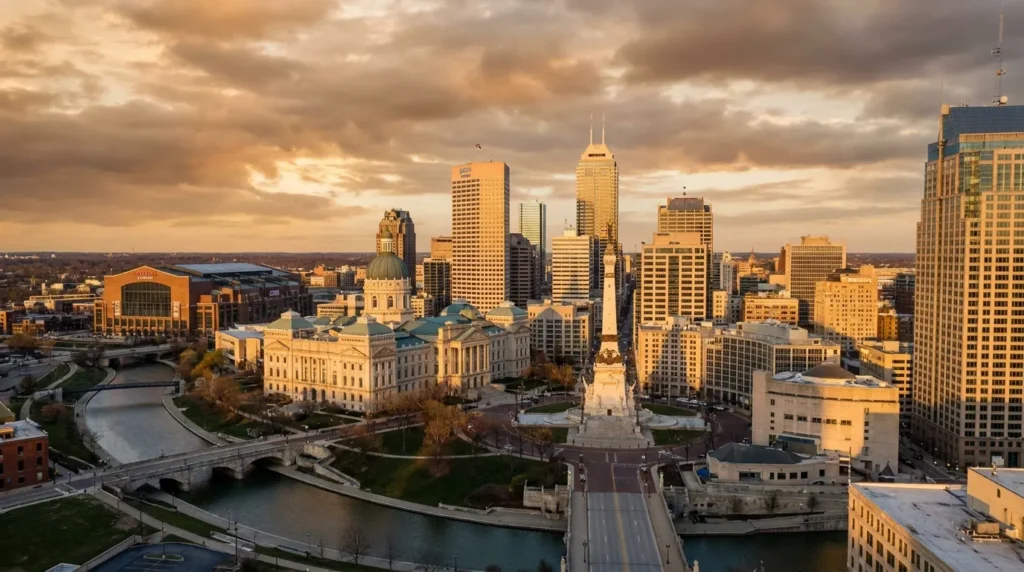
Indianapolis combines the iconic Indianapolis Motor Speedway, world-class museums, a walkable urban core, and canals running through downtown.

The Indianapolis Motor Speedway hosts the traditional Indianapolis 500 on Memorial Day and is home to the IMS Museum, chronicling the history of IndyCar racing. The downtown area features Lucas Oil Stadium (home of the NFL's Indianapolis Colts), Gainbridge Fieldhouse (home of the NBA's Indiana Pacers), all within a compact, walkable district.

White River State Park brings together the Indianapolis Zoo, the Eiteljorg Museum of American Indians and Western Art, the NCAA Hall of Champions, and the Indiana State Museum. The Children's Museum of Indianapolis is the largest of its kind in the world. Newfields, with its Lume sculpture garden and The Virginia B. Fairbanks Art and Nature Park, rounds out the city's arts circuit.

The Canal Walk in the city center has become a gathering spot for runners, cyclists, and gondola riders. The Mass Ave neighborhood concentrates nightlife, independent theaters, and local restaurants. Brown County State Park and Indiana Dunes National Park on Lake Michigan offer natural escapes within a few hours' drive.

  1. 1["Indianapolis Motor Speedway and Museum"
  2. 2"Children's Museum of Indianapolis (largest in the world)"
  3. 3"Indianapolis Museum of Art at Newfields"
  4. 4"Soldiers and Sailors Monument (Monument Circle)"
  5. 5"Eiteljorg Museum of American Indians and Western Art"
  6. 6"Indiana State Museum"
Nightlife7.0 / 10
Parks & green spaces
  • ["Eagle Creek Park"
  • "White River State Park"
  • "Holliday Park"
  • "Garfield Park"
  • "Fort Harrison State Park"
  • +1 more

Latest posts

Posts about Indiana

Coverage and updates related to this destination.

Showing content from Indiana, as there is no specific data for Indianapolis yet.