Visto n' Visa
Blog
Notícias e artigos
Destinations
Careers
Immigrants

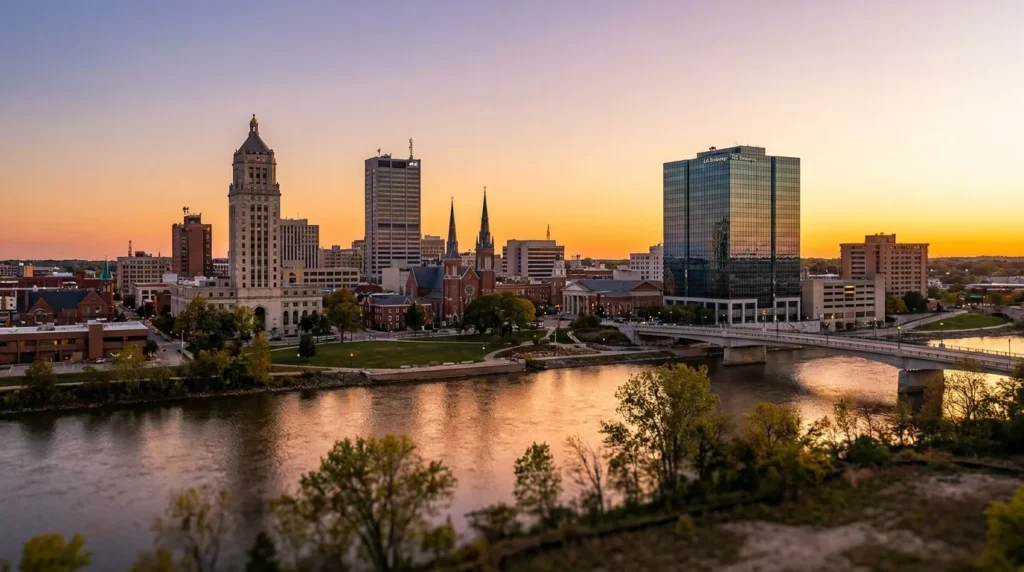
Want to live and work in Fort Wayne?

Personalized immigration plan with eligible visas, costs, and next steps for your goal!

If you are not eligible, you will know exactly why and what to do to improve your approval chances.

Save up to 12 hours in meetings

No pointless assessments.

Save up to 90%

Save money on vague or unfocused consultations

Avoid Fraud and Mistakes

One mistake can cost you your visa

Total Impartiality

Zero commercial bias

Decide with peace of mind

No toxic urgency

Fast and Accurate

Answers in minutes, no guesswork

A significant mix of white, African American, Hispanic, and Burmese residents

Fort Wayne is majority white, with roughly 16% African American, 10% Hispanic, and one of the largest Burmese communities in the U.S., primarily Karen and Chin.

The city absorbed decades of industrial immigration, first German and Irish in the 19th century, then African American during the Great Migration to work in factories, and in recent decades Hispanic (primarily Mexican) and refugees from Myanmar. The Karen and Chin communities, mainly from Kayin State, are among the largest in the United States, with churches, markets, and Buddhist temples concentrated on the Southeast Side.

The Northside and Aboite in the southwest tend to be predominantly white and suburban. The Southeast has a higher concentration of African American and Burmese residents, while the Southwest has seen significant Hispanic growth. Neighborhoods such as West Central, Lakeside, and North Anthony are centrally located and attract a more mixed, urban demographic.

The Brazilian community is small, connected to select evangelical churches. Spanish is widely spoken in businesses along Bluffton Road and southern Broadway. Recent refugee waves have also brought residents from Iraq, Syria, Afghanistan, and the Democratic Republic of Congo. Catholic Charities and Refugee Resettlement Services have assisted many of these communities in establishing themselves.

Languages spoken
  • English
  • Spanish
  • Burmese (Karen, Chin, Burmese)
  • Arabic
Main religions
  • Protestantism
  • Roman Catholicism
  • Lutheranism
  • Buddhism
  • Islam
  • +1 more

One of the lowest costs of living among mid-sized Midwestern cities

Fort Wayne's cost of living is roughly 10-15% below the U.S. national average. Rent, homeownership, and groceries are affordable, and Indiana's state taxes are moderate.

Two-bedroom homes in decent neighborhoods can be rented at prices that would seem impossible in Chicago, Indianapolis, or coastal cities. Homeownership is within reach for the middle class and even for factory workers. Neighborhoods such as Lakeside, North Anthony, and Foster Park feature charming historic homes at price points accessible to most immigrants with stable income.

Indiana's state income tax is a flat rate (3.15%), with Allen County adding a modest county tax. Property taxes are moderate compared to neighboring states. Grocers such as Kroger, Meijer, and Walmart serve the entire city, while Burmese ethnic markets on the Southeast Side and Mexican markets along Bluffton Road offer food at very competitive prices.

Utility bills follow a Midwestern pattern: natural gas heating adds up in January and February, while air conditioning costs peak in July and August. AEP provides electricity. A car is practically a necessity, but gas and insurance are reasonable. For those coming from high-rent cities elsewhere in the U.S., Fort Wayne frees up a meaningful share of the monthly budget.

94Cost index (US = 100)6% below US average
CategorySingleCoupleFamily (2 + 2)
iHousing$1,215$1,403$1,777
iFood$355$711$1,291
iTransport$468$795$1,029
iHealthcare$262$523$982
iChildcare$1,703
iOther$795$1,431$2,011
Monthly total$3,095$4,863$8,793

Source: U.S. BLS Consumer Expenditure Survey 2023 + BEA Regional Price Parities 2023 · Estimates in USD, monthly.

Historic homes, 1970s ranches, and new suburban construction

Fort Wayne offers a wide variety of housing stock: Victorian homes in West Central, ranches from the 1960s-80s in central neighborhoods, and new construction in Aboite, Dupont, and the northeast.

West Central is the most charming historic neighborhood, with restored Victorian homes, tree-lined streets, and proximity to downtown. Foster Park, Lakeside, and North Anthony offer homes from the 1920s-50s on quiet streets, providing solid value for what they deliver. Southwood Park and Forest Park carry a stable, middle-class character.

For those seeking a new suburban neighborhood, Aboite Township in the southwest and Dupont in the northeast are the primary growth areas, with large homes, top-rated schools, and nearby shopping centers such as Jefferson Pointe. Huntertown and Leo-Cedarville (to the north) attract families looking for even more space.

Rental housing is concentrated in apartments near downtown, near Parkview and Lutheran hospitals, and in complexes along Coliseum Boulevard. Those searching for a house to rent will typically find reasonable options in Lakeside, North Highlands, and Waynedale. Purchasing property is feasible even for recently arrived immigrants with stable income from manufacturing or healthcare.

Recommended neighborhoods
  • West Central
  • Foster Park
  • Lakeside
  • North Anthony
  • Aboite Township
  • +2 more

Manufacturing, healthcare, defense, and logistics sustain stable employment

Fort Wayne has a diversified economy anchored by the GM plant, BAE Systems, Steel Dynamics, and two large hospital systems (Parkview and Lutheran). Logistics and insurance round out the picture.

General Motors Fort Wayne Assembly, in Roanoke (just to the southwest), assembles Silverado and Sierra pickups and employs thousands directly. Regional suppliers feed the supply chain throughout the area. BAE Systems maintains defense operations, and Raytheon (RTX) operates advanced engineering facilities. Steel Dynamics, headquartered in Fort Wayne, is one of the largest steel producers in the U.S.

In healthcare, Parkview Health is the region's largest employer, with Parkview Regional Medical Center in the north and several smaller facilities. Lutheran Health Network operates Lutheran Hospital in the south. Together they account for tens of thousands of jobs in nursing, medicine, technical, and administrative roles. Brotherhood Mutual Insurance and Lincoln Financial Group anchor the insurance and financial sector.

The logistics sector is expanding with warehouses along I-69, and Fort Wayne International Airport handles both cargo and commercial flights. Vera Bradley (accessories), Sweetwater Sound (music), and PHP Holdings (corporate healthcare) round out the economic profile. Qualified professionals in engineering, nursing, or technology will find consistent demand.

Dominant sectors
  • Automotive manufacturing
  • Hospital healthcare
  • Defense and aerospace
  • Steel manufacturing
  • Insurance and financial services
  • +1 more
Major employers
  • General Motors Fort Wayne Assembly
  • Parkview Health
  • Lutheran Health Network
  • BAE Systems
  • Steel Dynamics
  • +3 more

Purdue Fort Wayne, the reorganized IPFW, and several private institutions

Fort Wayne is home to Purdue University Fort Wayne (PFW) as its largest university, alongside Indiana Tech, University of Saint Francis, and Ivy Tech. FWCS public schools serve the majority of children.

Purdue University Fort Wayne (PFW) is the city's largest university, offering programs in engineering, sciences, business, arts, and nursing. It is part of the Purdue system (headquartered in West Lafayette). In 2018, the former IPFW was divided between Purdue (engineering, sciences) and Indiana University (health, now IU Fort Wayne).

Indiana Tech, located downtown, is a private university with a strong engineering program, and the University of Saint Francis (USF), a Catholic institution, offers well-regarded programs in nursing, physical therapy, and the arts. Ivy Tech Community College has a large campus serving technical programs, professional training, and transfer pathways to four-year universities.

Fort Wayne Community Schools (FWCS) is the main public district, with magnet schools and bilingual programs in select buildings. Catholic schools (Diocese of Fort Wayne-South Bend) operate several campuses, including Bishop Dwenger and Bishop Luers high schools. Northrop, North Side, and Snider are the traditional public high schools. Suburbs such as Carroll (Northwest Allen) and Homestead (Southwest Allen) are home to top-rated school systems.

Notable universities
  • Purdue University Fort Wayne
  • Indiana University Fort Wayne
  • Indiana Tech
  • University of Saint Francis
  • Ivy Tech Community College

Two major hospital systems and specialized centers

Fort Wayne is served by Parkview Health (the regional leader) and Lutheran Health Network, with large hospitals, broad specialties, and community clinics throughout the city's neighborhoods.

Parkview Regional Medical Center, in the north of the city, is a tertiary hospital with a Level 2 trauma emergency department, cardiology, oncology, neurology, and a regional burn center. Parkview Health operates several smaller facilities across Indiana and Ohio. It is widely recognized as the region's largest employer and serves all of northeast Indiana.

Lutheran Hospital, in the south, is part of Lutheran Health Network (Community Health Systems), with a Level 2 trauma center and specialties in cardiology, orthopedics, and obstetrics/gynecology. It includes Lutheran Children's Hospital for pediatric care. Other smaller hospitals include Saint Joseph Hospital (downtown) and Dupont Hospital (north).

For uninsured immigrants, Neighborhood Health (an FQHC with multiple clinics) provides care on a sliding-fee scale, with interpretation available in Spanish and Burmese. Matthew 25 Health and Care is a charity clinic serving eligible patients. Walgreens, CVS, and Meijer pharmacies are distributed throughout the city. For emergencies, Parkview Regional ER is the first choice for most residents.

Healthcare index62.0 / 100
  • Life expectancyyears at birth
    78.4yrs
  • Doctors per 1kpracticing physicians
    3.7
  • Health spendper capita, per year
    $13,473
  • Public systemoverall quality rating
    Good

A mid-sized city with safety that varies by neighborhood

Fort Wayne has crime rates close to the national average for cities of its size. Northern and southwest neighborhoods are generally safe, while parts of the southeast face greater challenges.

Neighborhoods such as Aboite, Dupont, Northcrest, Lakeside, and West Central are considered safe, with active policing and quiet residential streets. Foster Park and Southwood Park also carry good reputations. Incorporated suburbs like New Haven, Huntertown, and Leo-Cedarville rank among the safest communities in the region.

The Southeast historically records higher rates of violent crime, particularly on specific blocks within the core southeast area of the city. Some near-south and near-east areas also present challenges. The Fort Wayne Police Department publishes updated crime maps that are useful for anyone searching for housing.

For those relocating, renting before buying and visiting a specific block at different times of day is a prudent approach. Street lighting, active commercial presence, the condition of neighboring properties, and pedestrian activity are useful informal indicators. Property crime (break-ins, car theft) is more widespread than violent crime, so basic precautions with home and vehicle security make a meaningful difference.

5.8
Homicides per 100k
per year
Safety index
58.0
Crime index
42.0
Safer neighborhoods
  • Aboite (southwest)
  • Lakeside Park area (north)
  • Forest Park Boulevard
  • Northcrest
  • Southwest Fort Wayne
  • West Central Historic District
Areas to avoid
  • Sectors south of Pontiac Street
  • Industrial areas along Coliseum Boulevard at night
  • Some blocks of the near southeast

Car-oriented city with Citilink bus service and a regional airport

Fort Wayne is heavily car-dependent, served by interstates I-69 and I-469. Citilink operates a limited urban bus network. Fort Wayne International Airport provides regional flight connections.

The city was built around the car. I-69 runs north to south, connecting Indianapolis to Michigan, while I-469 forms a partial beltway around the city. Major arterials include Coliseum Boulevard, Lima Road, Bluffton Road, Maysville Road, and Coldwater Road. Traffic is light outside peak hours, and parking is easy and inexpensive nearly everywhere.

Citilink is the public bus system, with around 12 routes covering the main parts of the city. Service is functional but limited in frequency, with reduced coverage on weekend evenings. For residents living far from the center, a car is practically indispensable. Cycling is viable in summer along the Rivergreenway Trails, which total over 100 miles of urban bike paths.

Fort Wayne International Airport (FWA) is a regional facility with flights to hubs such as Atlanta, Chicago, Detroit, Dallas, and Charlotte. For international travel, most residents drive to IND in Indianapolis or ORD/MDW in Chicago, both roughly two to three hours away. Passenger rail service is not available in the city.

21 min
Avg commute
38
Walkability
Airports
  • FWA - Fort Wayne International Airport
  • International airport
  • Bike infrastructure

What the Climate Is Like Living in Fort Wayne

Fort Wayne has a humid continental climate typical of northeastern Indiana, with hot, humid summers, cold winters with regular snowfall, and four distinct seasons.

Summer in Fort Wayne runs from June through September, with highs between 27°C (81°F) and 31°C (88°F) and high humidity. Thunderstorms are frequent in July and August. Overnight temperatures drop to around 17°C to 19°C (63°F to 66°F), offering some relief. Air conditioning is standard in homes.

Winters are cold. Lows range from -9°C to -3°C (15°F to 26°F) from December through February, with Arctic air pushing temperatures to -20°C (-4°F). Annual snowfall accumulates between 70 and 90 centimeters, with modest lake-effect snow arriving from the north. Central heating is universal, and January and February are the harshest months.

For residents, a full winter wardrobe and central air conditioning for summer are essential. The city is compact, ranking as Indiana's second largest, with a low cost of living compared to other Midwestern mid-size cities. Spring is wet and unsettled, while October brings colorful fall foliage. Occasional tornado risk exists in spring.

Sunny days / year185 days
Avg high (°F)
  • 36°J
  • 38°F
  • 50°M
  • 59°A
  • 70°M
  • 81°J
  • 84°J
  • 82°A
  • 76°S
  • 63°O
  • 50°N
  • 43°D
Avg low (°F)
  • 23°J
  • 21°F
  • 32°M
  • 40°A
  • 51°M
  • 62°J
  • 66°J
  • 64°A
  • 59°S
  • 47°O
  • 35°N
  • 30°D
Rainfall (")
  • 3"J
  • 3"F
  • 4"M
  • 4"A
  • 4"M
  • 4"J
  • 4"J
  • 3"A
  • 3"S
  • 4"O
  • 2"N
  • 2"D

Three rivers, a craft beer scene, the Mad Ants, and diverse ethnic festivals

Fort Wayne's culture blends German industrial heritage, riverfront events, a growing dining scene at Electric Works, and ethnic festivals that reflect the city's broad diversity.

Promenade Park, opened in 2019, transformed the downtown riverfront. Summer festivals, concerts, and the Three Rivers Festival in July draw large crowds. Electric Works, the former General Electric headquarters converted into a mixed-use complex, is the city's most ambitious cultural project in recent years, featuring a public market, restaurants, coworking spaces, and family attractions.

Sportwise, the Fort Wayne TinCaps (Minor League Baseball) play at Parkview Field downtown, and the Fort Wayne Mad Ants (NBA G League) serve as the Indiana Pacers affiliate. Hockey is represented by the Fort Wayne Komets (ECHL). Craft breweries such as Junk Ditch, Mad Anthony, Trubble, and Summit City Brewerks form an active scene.

Food reflects the diversity. Authentic Burmese restaurants on the Southeast Side, Mexican taquerias along Bluffton Road, Korean barbecue, and Middle Eastern cuisine at Hooshmand and others. The Auer Center for Arts and Culture hosts theater, opera, and ballet. Ethnic festivals include the Greek Festival (June), Italian Festival (July), Germanfest (June), and BBQ Ribfest.

Fort Wayne

Fort Wayne Attractions: Three Rivers, Children's Zoo, and Embassy Theatre

Fort Wayne sits at the confluence of the St. Marys, St. Joseph, and Maumee rivers downtown, home to the Fort Wayne Children's Zoo, the historic Embassy Theatre, Promenade Park, and the Lincoln Memorial Museum.

The Fort Wayne Children's Zoo is a nationally recognized attraction, featuring African Journey, Australian Adventure, and Indonesian Rainforest exhibits, located in Franke Park alongside the Foellinger Theatre. Promenade Park, at the junction of the three rivers, is the centerpiece of the new riverfront development, with a riverwalk, pier, evening events, and the Promenade Stage pavilion. The restored Embassy Theatre hosts Broadway tours, concerts, and the Festival of Trees during the holiday season.

The Fort Wayne Museum of Art and the Fort Wayne Children's Zoo complement each other as family-friendly destinations. The History Center, housed in the former city hall, chronicles the history of the 1794 fort and the Miami people. The Lincoln Library and Museum at the Allen County Public Library holds a world-class presidential collection, including handwritten letters and the iconic life mask. The Allen County Public Library is one of the largest genealogical research libraries in the United States.

The TinCaps (Class A baseball) play at Parkview Field downtown, adjacent to the Grand Wayne Convention Center. The West Central Historic District preserves Victorian-era homes, while the Botanical Conservatory in Foster Park features tropical gardens and rotating exhibits. The Three Rivers Festival in July takes over the city for nine days.

  1. 1["Fort Wayne Children's Zoo"
  2. 2"Foellinger-Freimann Botanical Conservatory"
  3. 3"Science Central"
  4. 4"Fort Wayne Museum of Art"
  5. 5"Embassy Theatre"
  6. 6"Old Fort Wayne (historic reconstruction)"
Nightlife5.0 / 10
Parks & green spaces
  • ["Headwaters Park"
  • "Lakeside Park and Rose Garden"
  • "Franke Park"
  • "Foster Park"
  • "Salomon Farm Park"
  • +1 more

Latest posts

Posts about Indiana

Coverage and updates related to this destination.

Showing content from Indiana, as there is no specific data for Fort Wayne yet.