Visto n' Visa
Blog
Notícias e artigos
Destinations
Careers
Immigrants

Want to live and work in Carmel?

Personalized immigration plan with eligible visas, costs, and next steps for your goal!

If you are not eligible, you will know exactly why and what to do to improve your approval chances.

Save up to 12 hours in meetings

No pointless assessments.

Save up to 90%

Save money on vague or unfocused consultations

Avoid Fraud and Mistakes

One mistake can cost you your visa

Total Impartiality

Zero commercial bias

Decide with peace of mind

No toxic urgency

Fast and Accurate

Answers in minutes, no guesswork

Wealthy suburb with a strong Asian community and skilled professionals

Carmel has a predominantly white population (around 75%), with one of Indiana's largest Asian communities (around 11%), 5% African American, and 5% Hispanic. Median income and education levels are very high.

The ethnic composition reflects the profile of a high-skilled professional city. The Asian community is one of the largest and most visible in Indiana proportionally, with strong Indian (software engineers, physicians, managers), Chinese, Korean, and Taiwanese presences. Hindu temples, Sikh gurdwaras, and Asian markets such as Saraga International Grocery in adjacent Indianapolis serve the community.

Restaurants reflect this diversity: Indian Spices, Punjabi Tandoor, Maharaja, Sahib's Hyderabadi, and several sushi and Korean establishments. The Carmel Christkindlmarkt (German Christmas market) is one of the largest celebrations of its kind in the Midwest, reflecting the region's strong German heritage. African American and Hispanic families are growing, especially in newer residential neighborhoods.

The Brazilian community is small, generally tied to multinational executives or physicians. Spanish and Mandarin circulate in business and school environments. Carmel Clay Schools offers Mandarin and French immersion programs, attracting multilingual families. For skilled professionals relocating to the Indianapolis area, Carmel is typically among the top three options, alongside Fishers and Westfield.

Languages spoken
  • English
  • Hindi/Gujarati/Telugu/Tamil
  • Mandarin
  • Spanish
  • Korean
Main religions
  • Protestantism
  • Roman Catholicism
  • Hinduism
  • Islam
  • Judaism
  • +1 more

Indiana's highest cost of living, but still reasonable by American standards

Carmel has a noticeably higher cost of living than the Indiana average and the broader Indianapolis area. Rent and home prices are premium, but still far more affordable than markets such as Boston, San Francisco, or New York.

Carmel is one of the most expensive real estate markets in the Midwest. Homes in planned communities such as Bridgewater, Crooked Stick, Hayden Run, or The Village of WestClay can reach significant values. Even renting an apartment near downtown Carmel is not inexpensive compared to central Indianapolis. In return, the price-to-quality ratio remains favorable compared to coastal US markets.

Indiana's state income tax is a flat rate (3.15%), and Hamilton County adds a small county tax. Property taxes in Hamilton County are moderate, but higher-valued homes generate larger absolute bills. Top-ranked public schools eliminate most of the private school expenses that families in other states would typically carry.

Markets such as Whole Foods, Trader Joe's, Fresh Thyme, Kroger Marketplace, and Meijer serve the city. Restaurants in the Carmel Arts & Design District and City Center are frequently premium. Basic utilities follow Midwest norms: natural gas heating adds up during the long winter, and air conditioning carries costs through the hot summers. Duke Energy and Citizens Energy supply electricity and gas.

91Cost index (US = 100)9% below US average
CategorySingleCoupleFamily (2 + 2)
iHousing$1,180$1,362$1,725
iFood$345$690$1,253
iTransport$454$772$999
iHealthcare$254$508$953
iChildcare$1,653
iOther$772$1,389$1,952
Monthly total$3,005$4,721$8,535

Source: U.S. BLS Consumer Expenditure Survey 2023 + BEA Regional Price Parities 2023 · Estimates in USD, monthly.

Large homes in planned communities, new buildings, and a walkable downtown

Carmel offers a varied housing stock: large homes in planned communities from the 1990s through the 2020s, historic homes near the Arts & Design District, and modern new buildings in City Center and Midtown.

The classic suburban stock dominates, with planned communities such as Bridgewater, Crooked Stick, Hayden Run, The Village of WestClay (inspired by new urbanism), and dozens of others. Homes typically feature three-car garages, yards, and follow colonial, craftsman, and modern farmhouse styles. WestClay is distinctive: planned as a traditional walkable village, with aligned houses, public spaces, and integrated retail.

Downtown Carmel reinvented itself over the past 20 years. The Carmel Arts & Design District features restored historic homes, modern loft buildings and apartments, and walkable streets with galleries, restaurants, and the Indiana Design Center. Carmel City Center, adjacent to the Palladium, has mixed-use buildings with luxury apartments, offices, and gourmet retail. Midtown Carmel rounds out the urban offering.

Rental options are concentrated in luxury apartments near City Center, Midtown, and Penn Township. Townhouses in WestClay, Bridgewater, and older neighborhoods are a common choice. Purchasing requires serious financial preparation, but is attainable for high-income professionals (executives, physicians, consulting partners). The Carmel Clay Schools district exerts a strong influence on the price premium.

Recommended neighborhoods
  • Carmel Arts & Design District
  • City Center
  • Midtown Carmel
  • The Village of WestClay
  • Bridgewater
  • +2 more

Corporate offices, finance, insurance, and technology in high concentration

Carmel's local economy centers on corporate offices: CNO Financial, Allegion, Delta Faucet, Republic Airways, MISO Energy. Eli Lilly and Salesforce in Indianapolis employ many residents.

Companies headquartered in Carmel include CNO Financial Group (insurance), Allegion (security), Delta Faucet Company, Republic Airways (regional carrier), MISO Energy, and KAR Auction Services. Liberty Mutual, Geico, Allstate, and several other insurers have significant operations. Carmel is considered one of the leading insurance hubs in the Midwest.

The financial and professional services sector is strong: regional banks, wealth managers, law firms, and consulting practices. IU Health North in Carmel and St. Vincent Carmel Hospital (Ascension) employ thousands in healthcare. Technology companies such as CrowdMatch, BlueLink, and corporate SaaS firms are growing in the city.

Many professionals commute a short distance (15 to 25 minutes) to downtown Indianapolis (Eli Lilly, Salesforce Tower, Anthem, OneAmerica) via US-31 or Meridian Street. For skilled professionals in engineering, medicine, finance, law, or technology, Carmel serves as an ideal base for accessing the entire Indianapolis job market without living in the city.

Dominant sectors
  • Insurance and financial services
  • Corporate offices
  • Hospital healthcare
  • Technology and SaaS
  • Headquartered manufacturing
  • +1 more
Major employers
  • CNO Financial Group
  • Allegion
  • Delta Faucet Company
  • Republic Airways
  • MISO Energy
  • +3 more

Carmel Clay Schools, a public district among the best in the US

Carmel is served by Carmel Clay Schools, consistently ranked among the top 1 to 3 percent of public districts in the US. It includes a Chinese immersion school and advanced programs across all areas.

Carmel Clay Schools enrolls approximately 16,000 students. Carmel High School (CHS) is regularly ranked among the best public high schools in the United States by US News & World Report, with advanced programs in STEM, arts, and athletics (multiple state and national championships), as well as an IB (International Baccalaureate) curriculum. Forest Dale Elementary offers a Mandarin Chinese immersion program.

Families relocate to Carmel specifically for the school district, and the real estate premium is direct. Robust programs exist for children with special needs. Elementary and middle schools (Carmel Middle, Creekside, Clay) also have strong reputations. For private options, University High School and Sycamore School (Indianapolis) attract students from Carmel.

For higher education, Carmel is 25 minutes from IU Indianapolis (formerly IUPUI), Purdue Indianapolis, Butler University, and the University of Indianapolis. Marian University (Catholic), Anderson University, and Ball State (Muncie, farther out) are also accessible. For elite programs, Notre Dame is two hours away, Purdue West Lafayette is 90 minutes away, and the University of Chicago is three hours away.

Notable universities
  • Indiana University Indianapolis
  • Purdue University Indianapolis
  • Butler University
  • University of Indianapolis
  • Marian University
  • University of Notre Dame
  • Purdue University (West Lafayette)

IU Health North, St. Vincent Carmel, and access to the best of Indianapolis

Carmel has two major hospitals: IU Health North and St. Vincent Carmel Hospital (Ascension). Easy access to Indianapolis's tertiary systems (IU Methodist, Riley Children's, Eskenazi) is available.

IU Health North Hospital, on the northern edge of the city, is a community hospital within the IU Health system offering an emergency department, broad specialties, maternity services, and surgical centers. St. Vincent Carmel Hospital (Ascension), nearby, is the second major hospital, with an emergency department, cardiology, orthopedics, gynecology/obstetrics, and oncology. Both serve all of Hamilton County.

For tertiary care or complex cases, IU Health Methodist Hospital in downtown Indianapolis (25 minutes) and Riley Hospital for Children are the primary regional references. Community Heart and Vascular Hospital in Indianapolis also serves the area. Specialized clinics, dermatologists, ophthalmologists, orthopedists, and plastic surgeons operate in offices along Meridian Street and throughout Carmel.

For primary care, IU Health Physicians, St. Vincent Medical Group, Community MD Offices, and dozens of private clinics serve the city. Walgreens, CVS, Kroger, Meijer, and IU Health pharmacies are widely available. For skilled immigrants with premium employer insurance, healthcare access in Carmel is excellent. For the uninsured, FQHC clinics are located in Indianapolis.

Healthcare index66.0 / 100
  • Life expectancyyears at birth
    78.4yrs
  • Doctors per 1kpracticing physicians
    3.7
  • Health spendper capita, per year
    $13,473
  • Public systemoverall quality rating
    Good

One of the safest cities in the United States

Carmel is consistently listed among the safest cities in the US by publications such as Money, Niche, and SafeWise. Violent crime rates are extremely low, and property crime rates are also well below average.

The city regularly appears on lists of the 5 to 10 safest cities in the United States. The Carmel Police Department maintains a strong presence, rapid response times, and close community relationships. Residential neighborhoods throughout the city are safe, with no significant problem areas. Violent crime is rare.

Property crime does occur, primarily car break-ins in commercial parking lots and theft at shopping centers. Bicycles on the Monon Trail are occasionally targeted for theft. In residences, home alarm systems, Ring doorbells, and IP cameras are common and help keep rates low. Planned communities such as WestClay, Bridgewater, and Crooked Stick have their own patrols.

For newcomers, any part of Carmel works well from a safety standpoint. The most important decisions come down to proximity to work, schools, and neighborhood character: walkable in the Arts District or City Center, gated community in Bridgewater, planned village in WestClay, or a standard community home. Safety is not the limiting factor.

5.8
Homicides per 100k
per year
Safety index
86.0
Crime index
14.0
Safer neighborhoods
  • Carmel Arts & Design District
  • Village of WestClay
  • Bridgewater
  • Old Town Carmel
  • Brookshire
  • Cool Creek North
Areas to avoid
  • Isolated commercial areas near the southern boundary (96th Street) at night
  • Sectors near US-31 after business hours

Car-oriented city with more than 140 roundabouts and the Monon Trail

Carmel is a fully car-oriented suburban city. US-31 and Keystone Parkway are the main corridors. There is no public transit. The Monon Trail and Greenways system is excellent for cycling and walking.

The city was planned for cars, but with a distinctive twist: roundabouts replaced nearly all major traffic lights (more than 140 in total). The traffic engineering is a national reference. US-31 (Meridian Street) runs north to south and leads directly to downtown Indianapolis in 20 minutes. Keystone Parkway, entirely free of traffic lights, serves as an internal expressway.

IndyGo (Indianapolis's transit system) does not serve Carmel. Hamilton County has limited service. For most residents, two cars per household is the norm. Parking is easy, with large free garages at City Center, the Arts & Design District, and shopping centers. Indianapolis International Airport is approximately 35 to 45 minutes away via I-465.

The Monon Trail, a former railroad converted into a 27-mile trail, runs north to south through Carmel and is the backbone of the city's bikeway system. It connects downtown Carmel to Broad Ripple and central Indianapolis. The Carmel Greenways system adds additional trails. For cycling enthusiasts, Carmel ranks among the best suburbs in the US. Usage naturally declines in winter.

24 min
Avg commute
36
Walkability
Airports
  • IND - Indianapolis International Airport (40 min)
  • Bike infrastructure

What the climate is like living in Carmel

Carmel has the humid continental climate typical of central Indiana, with hot and humid summers, cold winters with regular snowfall, and well-defined seasons.

Summer in Carmel runs from June through September, with highs between 82 and 90 degrees Fahrenheit and high humidity. Thunderstorms are frequent in July and August. Nights drop to around 64 to 68 degrees, providing some relief. Central air conditioning is standard in all homes, and lawns require consistent maintenance.

Winters are cold. Lows range from 17 to 28 degrees Fahrenheit from December through February, with Arctic fronts pushing temperatures to around 0 degrees. Annual snowfall accumulates between 20 and 28 inches, less than in Chicago but enough to require regular removal. Central heating is universal in homes.

For daily living, plan a wardrobe for both extremes, central air conditioning, and a covered garage for the car. Carmel is a model city of planned neighborhoods and roundabouts (over 140 replacing traditional traffic signals). October brings colorful fall foliage, and May brings a wet spring with thunderstorms.

Sunny days / year186 days
Avg high (°F)
  • 55°J
  • 62°F
  • 71°M
  • 77°A
  • 84°M
  • 89°J
  • 91°J
  • 93°A
  • 91°S
  • 85°O
  • 71°N
  • 59°D
Avg low (°F)
  • J
  • F
  • 17°M
  • 25°A
  • 34°M
  • 48°J
  • 56°J
  • 53°A
  • 45°S
  • 28°O
  • 18°N
  • 11°D
Rainfall (")
  • 3"J
  • 3"F
  • 4"M
  • 3"A
  • 4"M
  • 4"J
  • 4"J
  • 3"A
  • 2"S
  • 4"O
  • 2"N
  • 2"D

Center for the Performing Arts, Arts & Design District, and Christkindlmarkt

Carmel's cultural scene is unusual for a suburb: it has the world-class Palladium concert hall, an active Arts & Design District, the German Christkindlmarkt, and a variety of summer festivals.

The Center for the Performing Arts, designed by Pelli Clarke Pelli and inaugurated in 2011, is the cultural heart of the city. It includes the Palladium (a 1,600-seat concert hall with internationally recognized acoustics), the Tarkington (a mid-size venue), and the Studio Theater. It hosts the Carmel Symphony Orchestra, jazz shows, ballet, Broadway tours, and concerts by international artists.

The Carmel Arts & Design District, the historic downtown, features art galleries, premium restaurants, design shops, and the Indiana Design Center. Events such as the Carmel International Arts Festival (September), monthly Gallery Walks, and the Carmel Marathon (April) animate the calendar. The Carmel Christkindlmarkt, held in December, is the largest authentic German-style Christmas market in the US, complete with an ice skating rink and gluhwein.

The dining scene is broad: Italian establishments such as Anthony's Chophouse and Toscana, Asian options such as Indian Spices, Nemo's Sushi, and Punjabi Tandoor, and premium American concepts such as Donatello's and Convivio. Breweries such as Hopwood Cellars and Sun King Carmel offer casual options. For nightlife, Indianapolis is 20 minutes away. Hamilton Town Center (in Noblesville) and Clay Terrace shopping center round out retail and entertainment.

Carmel

Attractions in Carmel, award-winning suburb north of Indianapolis

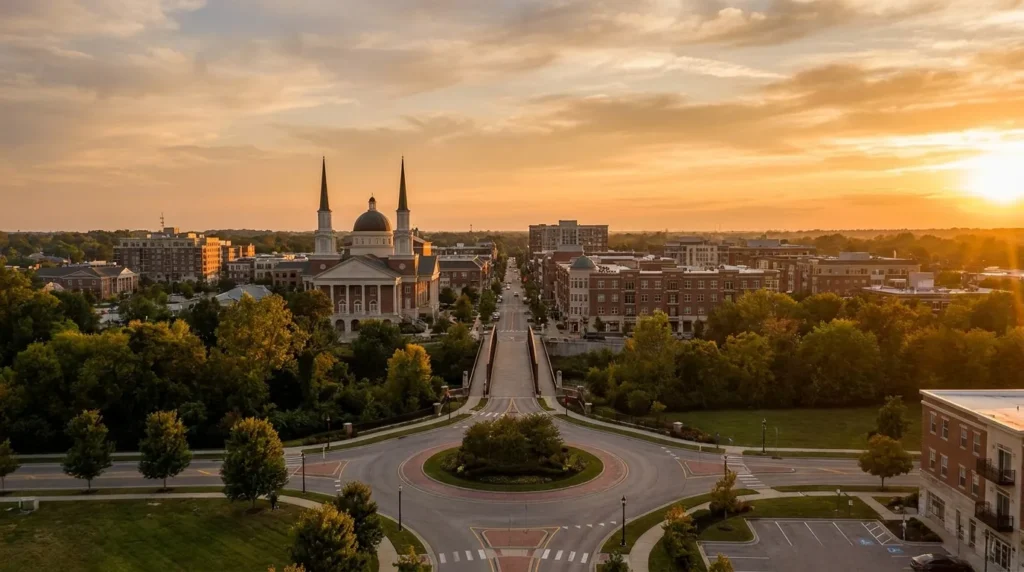
Carmel blends the Arts and Design District, the Center for the Performing Arts at the Palladium, more than 150 roundabouts, and Monon Greenway trails, with daily life defined by high quality of living and a dense cultural calendar.

The Carmel Arts and Design District, along Main Street and Range Line, concentrates galleries, restaurants, and the Indiana Design Center. The Carmel Clay Public Library and Old Town Shops form the central axis. Minutes away, the Center for the Performing Arts, home to the Palladium (concert hall), the Tarkington (theater), and the Studio Theater, hosts programming ranging from the Indiana Wind Symphony to Mannheim Steamroller.

The city is known for having more roundabouts than any other in the United States (over 150), a feature that defines its urban design. City Center, around Carmel City Center Drive, is a mixed-use development with Pedcor offices, restaurants, and Veterans Plaza. The Monon Greenway, a former rail corridor converted into a multi-use path, runs north to south through the city, connecting to Indianapolis at its southern end.

For green space, Central Park, with the Monon Community Center and Waterpark, is the largest urban park. Coxhall Gardens features carillon towers and formal gardens. Founders Park preserves natural land along the White River. CarmelFest in July and Christkindlmarkt in winter, a German Christmas market at Carter Green, are highlights of the family calendar.

  1. 1["The Palladium at Center for the Performing Arts"
  2. 2"Carmel Arts & Design District"
  3. 3"Monon Greenway"
  4. 4"Carmel Christkindlmarkt and Ice Rink"
  5. 5"Museum of Miniature Houses"
  6. 6"Civic Square Plaza"
Nightlife5.0 / 10
Parks & green spaces
  • ["Central Park (Carmel)"
  • "West Park"
  • "Coxhall Gardens"
  • "Founders Park"
  • "Carey Grove Park"
  • +1 more

Latest posts

Posts about Indiana

Coverage and updates related to this destination.

Showing content from Indiana, as there is no specific data for Carmel yet.