Visto n' Visa
Blog
Notícias e artigos
Destinations
Careers
Immigrants

Want to live and work in Aurora?

Personalized immigration plan with eligible visas, costs, and next steps for your goal!

If you are not eligible, you will know exactly why and what to do to improve your approval chances.

Save up to 12 hours in meetings

No pointless assessments.

Save up to 90%

Save money on vague or unfocused consultations

Avoid Fraud and Mistakes

One mistake can cost you your visa

Total Impartiality

Zero commercial bias

Decide with peace of mind

No toxic urgency

Fast and Accurate

Answers in minutes, no guesswork

Aurora has a diverse population with a strong Latino majority

Aurora has approximately 180,000 residents. Latinos (predominantly of Mexican origin) form the largest group, followed by non-Hispanic whites, Black residents, and a growing Asian community, primarily Indian.

Aurora's demographics are predominantly Latino, with Mexicans forming the largest group, followed by Puerto Ricans and Central Americans. Non-Hispanic whites represent slightly under one-third of the population. African Americans have a significant presence in neighborhoods on the east side of the city, and the Indian community is growing in newer developments on the west side.

English and Spanish coexist on equal footing in commerce, schools, and public services. Bilingual signage is standard in government offices. The East Side, near Galena Boulevard and Lake Street, concentrates the most visible elements of Mexican culture, with markets, taquerias, panaderías, and community celebrations.

Brazilians do not have a large community in Aurora, but there is a scattered presence throughout the Fox Valley area. The city has several Catholic parishes (St. Joseph, Holy Angels), Latino evangelical churches, and Indian temples. Coexistence among communities is everyday and unremarkable, with no major reported tensions.

Languages spoken
  • English
  • Spanish
  • Gujarati
  • Hindi
Main religions
  • Catholicism
  • Evangelical Christianity (Latino and general)
  • Hinduism
  • Historic African American Christianity
Aurora's cost of living is lower than Chicago, but Illinois is expensive overall

Aurora offers lower costs than the city of Chicago, with more affordable rents and home prices. Illinois has high property taxes, and local sales taxes add to everyday expenses.

Living in Aurora is less expensive than in central Chicago, though costs vary by neighborhood. The East Side is the most affordable, with lower rents and home sale prices. Newer subdivisions on the West Side and in neighborhoods like Stonebridge carry mid-suburb pricing, closer to Naperville levels.

Illinois has some of the highest property taxes in the country, and Kane County is no exception. Homebuyers need to factor that annual tax into their budget. The sales tax in Aurora runs around 8.25%, depending on which part of the county, with additional hotel and restaurant taxes.

Grocery options include Jewel-Osco, Aldi, Mariano's, and Latino markets such as Cermak Fresh Market and Carnicería Jiménez, offering a range of price points. Winter heating bills (natural gas through Nicor) and car insurance are significant monthly expenses.

100Cost index (US = 100)same as US average
CategorySingleCoupleFamily (2 + 2)
iHousing$1,303$1,503$1,904
iFood$381$762$1,383
iTransport$501$852$1,102
iHealthcare$281$561$1,052
iChildcare$1,824
iOther$852$1,533$2,154
Monthly total$3,318$5,211$9,419

Source: U.S. BLS Consumer Expenditure Survey 2023 + BEA Regional Price Parities 2023 · Estimates in USD, monthly.

Aurora's housing market ranges from affordable East Side homes to Stonebridge

Aurora has Victorian homes in its historic core, modest bungalows on the East Side, and new subdivisions on the West Side. Stonebridge, Oakhurst, and Lakewood Springs are family-oriented areas with good Metra access.

The housing stock is varied. The historic downtown has preserved Victorian and Queen Anne homes, some converted to multifamily use. The East Side concentrates bungalows and modest homes from the 1920s to 1950s, at more accessible price points, with a profile typical of working-class and immigrant neighborhoods.

The West Side has grown over recent decades with planned subdivisions. Stonebridge is a country club community with large homes and access to District 204 schools (among the best in Illinois). Oakhurst, Lakewood Springs, Eola Valley, and the area near Route 59 offer five- and six-bedroom homes for families.

Rental options include condominiums and townhouses in Fox Valley, near the shopping center. Pacific Square and the area around the Aurora Metra station suit those who commute to Chicago. Buying a home in Aurora remains viable for middle-income households, especially compared to Naperville or Wheaton.

Recommended neighborhoods
  • Stonebridge
  • Oakhurst
  • Lakewood Springs
  • Eola
  • Historic downtown
  • +2 more

Aurora's job market blends industry, healthcare, and tech

Aurora has a mixed economy: traditional manufacturing, regional hospitals, retail, the Hollywood Casino, and proximity to Fermilab. Many residents commute to Chicago and Naperville via Metra or I-88.

Caterpillar maintains significant operations in the region, and Cabot Microelectronics is headquartered in Aurora. The Hollywood Casino is a major employer in the hospitality sector. Hospitals such as Rush Copley Medical Center and AMITA Mercy Medical Center employ thousands in healthcare.

The Fermi National Accelerator Laboratory (Fermilab), located in neighboring Batavia, employs physicists, engineers, and high-level technicians. I-88 (the East-West Tollway) is known as the Illinois Research and Development Corridor, home to tech and pharmaceutical headquarters. Aldi has its U.S. headquarters in neighboring Batavia.

Many Aurora residents commute to Naperville, Lisle, and the Chicago Loop via Metra (BNSF line). For qualified immigrants, opportunities exist in technical manufacturing, healthcare, IT, and science. Field work, construction, and restaurant jobs have a strong Latino workforce presence, with openings throughout the year.

Dominant sectors
  • Manufacturing
  • Healthcare
  • Hospitality (casino and hotels)
  • Technology and R&D
  • Logistics
  • +1 more
Major employers
  • Caterpillar
  • Rush Copley Medical Center
  • Hollywood Casino Aurora
  • AMITA Mercy Medical Center
  • Cabot Microelectronics
  • +2 more

Aurora has varied school districts and two local universities

Aurora is divided among five school districts. Indian Prairie School District 204 (West Side) and Naperville 203 are highly rated; East Aurora 131 faces greater challenges. Aurora University and Waubonsee Community College are located here.

Aurora is divided among several districts: Indian Prairie 204 (covering parts of the West Side and Naperville), East Aurora 131, West Aurora 129, and Oswego 308. District 204 is considered one of the best in the state, with schools such as Metea Valley High School and Waubonsie Valley High School consistently ranking among the top in Illinois.

East Aurora 131 serves the historically Latino eastern neighborhoods and faces challenges typical of lower-income districts, though it maintains solid bilingual programs. West Aurora 129 falls in the middle, with East High School and West Aurora High School. Families frequently choose neighborhoods based on the associated school district.

Aurora University is a private university with approximately 6,000 students, with strengths in education, nursing, and business administration. Waubonsee Community College has a campus in Sugar Grove and serves technical training, ESL programs, and transfer pathways to four-year universities such as UIC, NIU, and Illinois State.

Notable universities
  • Aurora University
  • Waubonsee Community College
  • Northern Illinois University (in DeKalb)
  • Illinois Institute of Technology (in Chicago)

Aurora healthcare is well served by Rush Copley and AMITA Mercy

Aurora has two main hospitals: Rush Copley Medical Center and AMITA Mercy Medical Center. Community clinics and VNA Health Care serve lower-income populations. Health insurance is essential.

Rush Copley Medical Center, part of the Rush network, is the most highly regarded hospital in the area, with strong cardiology and a cancer center. AMITA Health Mercy Medical Center (Catholic affiliation) serves Aurora's downtown area. Both have 24-hour emergency departments and maternity units.

For primary care, VNA Health Care operates several clinics in Aurora with sliding-scale fees and a focus on Spanish-speaking and uninsured patients. Aunt Martha's Health Center is another option. Dentists, ophthalmologists, and walk-in clinics are widely available, with multiple Physicians Immediate Care and Northwestern Medicine Immediate Care locations in the area.

As elsewhere in the U.S., employer-sponsored or Illinois marketplace health insurance is decisive. Emergency room visits without coverage can result in substantial medical debt. For immigrants without documentation, community clinics and federally qualified health centers provide care without verifying immigration status, on an income-based sliding fee scale.

Healthcare index62.0 / 100
  • Life expectancyyears at birth
    78.4yrs
  • Doctors per 1kpracticing physicians
    3.7
  • Health spendper capita, per year
    $13,473
  • Public systemoverall quality rating
    Good

Aurora's safety has improved significantly over the past two decades

Aurora had a difficult reputation in the 1990s, but has consistently reduced homicides and violent crime. The West Side and newer neighborhoods are calm; the East Side has seen strong improvement, with some localized pockets that remain a concern.

Aurora has undergone a real transformation in public safety. In the 1990s, it ranked among the more violent cities in Illinois. Community policing initiatives, investment in parks, and downtown revitalization drove the numbers down. Recent years have seen relatively few homicides for a city of this size.

The West Side and newer suburban developments (Stonebridge, Oakhurst, Eola) are quiet, family-oriented neighborhoods with low crime rates and active community watch participation. The historic downtown is safe during business hours and at evening events at the Paramount and the casino.

The East Side has areas with greater challenges, particularly near certain stretches close to Lake Street. For newcomers to the city, reviewing local crime maps, speaking with neighbors, and visiting the neighborhood both during the day and at night before signing a lease is advisable. Overall, Aurora is safe by the standards of a mid-size American industrial city.

5.8
Homicides per 100k
per year
Safety index
63.0
Crime index
37.0
Safer neighborhoods
  • North Aurora
  • Stonebridge
  • Far East Side
  • Neighborhoods near Phillips Park
  • Eola Road corridor
Areas to avoid
  • Parts of the East Side near the historic downtown at night
  • Industrial areas south of downtown

Aurora is served by Metra to Chicago and a well-connected road network

The Aurora Metra BNSF station is the western terminus of the line, with frequent trains to the Loop. I-88 and Route 59 provide fast regional access. A car is the standard for local travel, though Pace covers some routes.

The Metra BNSF is the backbone of Aurora's public transit. The Aurora station, in the downtown area, is the western terminus of the line, with early-morning departures reaching Union Station in Chicago in approximately 1 hour and 10 minutes. The Route 59 station (to the east) is among the busiest in the entire Metra system.

For local and regional travel, a car is virtually required. Interstate 88 (East-West Tollway) runs through Aurora, connecting to I-355 and the Loop via the Eisenhower (I-290). Pace operates suburban bus routes, useful for some local trips, though service frequency is limited.

O'Hare Airport (ORD) is roughly 50 minutes away via I-88 and I-294. Midway (MDW) requires more travel time. Aurora Municipal Airport (KARR) serves general aviation. Rideshare coverage is solid, particularly near downtown and the shopping centers.

1
Metro lines
2
Metro stations
32 min
Avg commute
45
Walkability
Airports
  • ORD — O'Hare International Airport (about 37 miles northeast)
  • MDW — Chicago Midway (about 34 miles east)
  • ARR — Aurora Municipal Airport (general aviation)
  • Bike infrastructure

What the Climate Is Like Living in Aurora

Aurora has a humid continental climate with four distinct seasons, hot and humid summers, cold winters with regular snowfall, and a rainy spring.

Summer in Aurora runs from June through September, with highs between 82°F and 90°F and high humidity. Afternoon thunderstorms are common in July and August, and heat waves with apparent temperatures above 95°F occur several times during the season. Central air conditioning is essentially a necessity during this period.

Winters are cold and snowy. Lows range from 14°F to 27°F from December through February, with extreme lows below -4°F during Arctic air intrusions. Annual snowfall accumulates between 31 and 39 inches, regularly covering streets. Central heating and heavy winter clothing are essential.

For daily living, a full wardrobe for both extremes is necessary, along with efficient central air conditioning and heating. Spring is wet, with frequent rain in April and May, while fall brings vibrant foliage in October. Aurora is about one hour from Chicago by car, which affects commuting patterns.

Sunny days / year189 days
Avg high (°F)
  • 32°J
  • 35°F
  • 49°M
  • 59°A
  • 70°M
  • 81°J
  • 84°J
  • 82°A
  • 76°S
  • 62°O
  • 49°N
  • 41°D
Avg low (°F)
  • 19°J
  • 19°F
  • 31°M
  • 39°A
  • 51°M
  • 61°J
  • 66°J
  • 64°A
  • 59°S
  • 46°O
  • 33°N
  • 28°D
Rainfall (")
  • 2"J
  • 2"F
  • 4"M
  • 4"A
  • 6"M
  • 5"J
  • 6"J
  • 4"A
  • 5"S
  • 5"O
  • 2"N
  • 3"D

Strong Latino culture and a revitalized historic downtown in Aurora

Aurora has a cultural identity shaped by its Mexican population, with festivals, taquerias, and markets. The Paramount Theatre and RiverEdge Park anchor cultural life, and the historic downtown has been revitalized.

The Paramount Theatre, in the downtown core, is one of the most attended theaters in Illinois, known for award-winning Broadway musical productions. RiverEdge Park, on the banks of the Fox River, hosts outdoor concerts in the summer, featuring national acts and Latin bands. The Aurora Regional Fire Museum and SciTech Hands On Museum are popular family destinations.

Latino life is vibrant and visible day to day. Festivals such as Cinco de Mayo and Mexican Independence Day fill the streets with banda music and folk traditions. Taquerias such as Tio Luis, Las Brisas, and Carnicería Jiménez are part of daily life. Mexican bakeries distribute pan dulce every morning on the East Side.

For leisure, the Hollywood Casino, beside the river, draws weekend visitors. Phillips Park, Blackberry Farm, and Stuart Sports Complex offer open-air recreation. Fox Valley Mall and Chicago Premium Outlets (in Aurora) serve everyday shopping and retail tourism.

Aurora

Attractions in Aurora, Illinois and Life on the Fox River

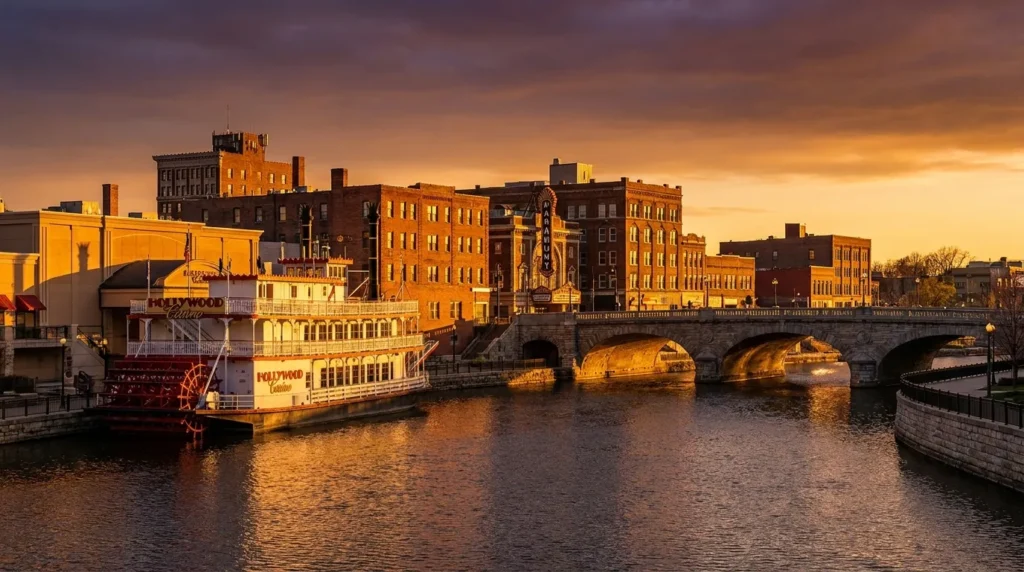
The second-largest city in Illinois, situated in the Fox River Valley west of Chicago, with a reinvented industrial identity, a historic downtown, a riverboat casino, and a strong cultural scene anchored by the Paramount Theatre.

The Paramount Theatre, an Art Deco landmark from 1931, is the city's cultural engine, featuring a Broadway-style musical season. The SciTech Hands On Museum and the Aurora Regional Fire Museum, housed in the former Central Fire Station, are popular family destinations, while the Tanner House Museum offers a window into 19th-century life.

Hollywood Casino Aurora, situated on the Fox River, was one of the state's first riverboat casinos. RiverEdge Park hosts Blues on the Fox and summer concerts. Stolp Island, an urban island in the river, is home to restaurants and galleries, and Aurora University adds academic energy to the West Side.

For outdoor recreation, Phillips Park features a free zoo, an aquatic garden, and a golf course. The Red Oak Nature Center and stretches of the Fox River Trail are well-known spots for hiking and cycling. About 30 minutes away, Morton Arboretum in Lisle is a frequent weekend destination.

  1. 1["Paramount Theatre"
  2. 2"SciTech Hands On Museum"
  3. 3"Aurora Regional Fire Museum"
  4. 4"Hollywood Casino Aurora"
  5. 5"Phillips Park Zoo"
  6. 6"Blackberry Farm"
Nightlife5.0 / 10
Parks & green spaces
  • ["Phillips Park"
  • "Blackberry Farm"
  • "RiverEdge Park"
  • "McCullough Park"
  • "Fox River Trail"
  • +1 more

Latest posts

Posts about Illinois

Coverage and updates related to this destination.

Showing content from Illinois, as there is no specific data for Aurora yet.