Visto n' Visa
Blog
Notícias e artigos
Destinations
Careers
Immigrants

Want to live and work in Twin Falls?

Personalized immigration plan with eligible visas, costs, and next steps for your goal!

If you are not eligible, you will know exactly why and what to do to improve your approval chances.

Save up to 12 hours in meetings

No pointless assessments.

Save up to 90%

Save money on vague or unfocused consultations

Avoid Fraud and Mistakes

One mistake can cost you your visa

Total Impartiality

Zero commercial bias

Decide with peace of mind

No toxic urgency

Fast and Accurate

Answers in minutes, no guesswork

Twin Falls demographics: white majority, strong Hispanic community, and refugees from diverse backgrounds

A majority-white city with a significant Hispanic community and one of the highest per-capita rates of resettled refugees in Idaho.

The ethnic composition is diverse by Idaho standards. The white majority coexists with a large Hispanic community, made up of descendants of Mexican and Central American workers who came to work in local agriculture and agribusiness. Multiple generations of Hispanic families are established here, and Spanish is a natural part of daily life.

Twin Falls is one of the main refugee resettlement hubs in Idaho, with programs that have welcomed families from Iraq, Afghanistan, Syria, Eritrea, Sudan, Bosnia, and the Congo over the past several decades. This has created small but visible communities, with mosques, ethnic markets, and restaurants that give the city an unexpected diversity for its size.

In terms of religion, evangelical Protestantism, Mormonism, Catholicism, and Islam within the refugee community are the most prominent. The median age is relatively young, driven by the presence of families with many children. The city has the profile of an active mid-sized city, with social life organized around schools, churches, mosques, sports leagues, and community events.

Languages spoken
  • English
  • Spanish
  • Arabic
  • Swahili

Cost of living in Twin Falls: moderate, with still-reasonable rents

Moderate cost of living, with rents and property prices below those of larger Idaho cities. Affordable food options supported by strong local agricultural supply.

Twin Falls has a moderate cost of living, higher than small rural towns in the state but still below Boise, Meridian, and Coeur d'Alene. Property prices and rents have risen in recent years with the influx of workers from new manufacturing plants, but they remain at an accessible level for professionals with established income in the area.

Supermarkets such as WinCo, Albertsons, Walmart, and Fred Meyer cover the basics with competitive prices. Hispanic and African markets serve the local community, and fresh produce from the Magic Valley appears at farmers markets in summer. Local restaurants offer good value, with both national chains and independent establishments.

Winters are cold and require heating, typically natural gas. Summers are hot and dry, making air conditioning necessary. Idaho levies a state income tax and a sales tax. For immigrants, especially those working in agribusiness, Twin Falls offers a solid balance between income and cost of living.

89Cost index (US = 100)11% below US average
CategorySingleCoupleFamily (2 + 2)
iHousing$1,164$1,342$1,700
iFood$340$680$1,235
iTransport$447$760$984
iHealthcare$251$501$940
iChildcare$1,628
iOther$760$1,369$1,924
Monthly total$2,962$4,652$8,411

Source: U.S. BLS Consumer Expenditure Survey 2023 + BEA Regional Price Parities 2023 · Estimates in USD, monthly.

Housing in Twin Falls: houses with yards, new neighborhoods, and a reasonable rental supply

A rising market driven by city growth, but still accessible. Homes in established neighborhoods, recent expansion to the south, and new apartments near the commercial corridor.

The housing stock includes older homes in Old Towne, near the historic downtown, with charming architecture and generous yard space. Newer neighborhoods to the south and west, toward the Magic Valley Mall, offer more recently built homes with two-car garages and planned streets. Rural properties on the outskirts, close to farmland, are also available.

Modern apartment supply has grown in recent years, particularly along Pole Line Road and Blue Lakes Boulevard, the city's main commercial corridors. There are complexes designed for families and others geared toward young professionals, with gyms, pools, and common areas. Duplexes and townhouses represent intermediate options.

Renting generally requires proof of income and a reasonable credit score. Local landlords tend to have some flexibility with newly arrived immigrants, especially those with steady employment at local plants. Purchasing property is feasible with standard American financing after building a credit history.

Recommended neighborhoods
  • Old Towne Twin Falls
  • Magic Valley area
  • Sunway Soda Springs area
  • Canyon Springs
  • Falls Avenue area
  • +1 more

Job market in Twin Falls: food processing, healthcare, retail, and logistics

A growing economy fueled by the arrival of major food processing plants. Healthcare, agriculture, retail, and construction round out the base. Steady availability of operational positions.

Twin Falls has become a national hub for food processing. Chobani operates what is reportedly the largest Greek yogurt plant in the world there, employing more than a thousand people. Clif Bar runs a major facility, and Glanbia Foods, the Irish dairy giant, maintains a large operation in the region. Lamb Weston, ConAgra, and other potato and dairy processing companies also have a presence.

The healthcare sector is robust, with St. Luke's Magic Valley Medical Center, a regional hospital serving the entire southern half of the state, employing thousands of professionals. The College of Southern Idaho is a stable employer in education. Retail and hospitality generate jobs throughout the city, particularly along the commercial corridors.

For immigrants, there are steady operational openings in the plants, in agriculture, in distribution centers, and in construction. Refugee resettlement programs often have employer partnerships for job placement. Skilled professionals find opportunities in healthcare, education, and technical roles in the modern manufacturing facilities.

Dominant sectors
  • Food Processing
  • Healthcare
  • Agriculture
  • Retail
  • Logistics
Major employers
  • Chobani
  • St. Luke's Magic Valley Medical Center
  • Glanbia Foods
  • Clif Bar
  • Lamb Weston
  • +2 more

Education in Twin Falls: broad school district, strong community college, and expanding programs

The school district serves the city and surrounding areas, with bilingual programs. The College of Southern Idaho is a key regional institution, offering technical and associate degree programs.

The Twin Falls School District serves much of the city, with schools including Twin Falls High School, Canyon Ridge High School, and Robert Stuart Middle School. Given the local diversity, bilingual programs and English as a Second Language courses are standard. Charter schools and private schools tied to religious traditions are also available.

The College of Southern Idaho, with its campus in Twin Falls, is one of the largest community colleges in the state, enrolling about eight thousand students. It offers vocational programs, two-year associate degrees, transfer partnerships with universities, and a robust support program for refugee and immigrant students, including adult English as a Second Language classes.

For immigrants, the combination of a school district with bilingual programs, an accessible community college with strong refugee support, and proximity to the Idaho State University Twin Falls Center provides a range of educational pathways for children and adults alike. Boise State University, two hours away, rounds out the options.

Notable universities
  • College of Southern Idaho
  • Idaho State University - Twin Falls Center
  • Boise State University
  • Brigham Young University Idaho

Healthcare in Twin Falls: modern regional hospital serving all of Magic Valley

St. Luke's Magic Valley Medical Center is a modern regional hospital with multiple specialties. Community clinics serve low-income populations and refugees.

St. Luke's Magic Valley Medical Center is the primary hospital for the city and the surrounding region, with an emergency department, maternity ward, oncology, cardiology, and a trauma center. It serves a large portion of south-central Idaho. Specialized clinics, imaging centers, and private medical offices are spread throughout the city, particularly along the Pole Line Road corridor.

Community health centers such as Family Health Services provide primary care for low-income families, refugees, and immigrants, with income-adjusted fees and bilingual services in multiple languages. Pharmacies including Walgreens, CVS, Albertsons, and Walmart Pharmacy are present in all major neighborhoods.

Access to the American healthcare system depends on private insurance, typically through an employer. Local manufacturing plants generally offer solid benefits packages. Idaho expanded Medicaid in 2020, covering families within certain income thresholds. For immigrants, especially the recently resettled, community clinics are an essential point of access.

Healthcare index60.0 / 100
  • Life expectancyyears at birth
    78.4yrs
  • Doctors per 1kpracticing physicians
    3.7
  • Health spendper capita, per year
    $13,473
  • Public systemoverall quality rating
    Fair

Safety in Twin Falls: a stable city with pockets that warrant attention

A safe city by American standards, with quiet residential neighborhoods. Moderate violent crime for its size, with common incidents concentrated in specific areas.

Twin Falls has reasonable safety metrics for a city of its size. Residential neighborhoods are quiet, and violent crime is moderate, below the average for large American cities. The most common incidents are parking lot thefts, vehicle break-ins, vandalism, and some drug-related activity in specific areas.

Residential neighborhoods such as Magic Valley, Canyon Springs, and the area near the College of Southern Idaho are considered safe. Parts of Old Towne and older commercial corridors warrant more caution, particularly at night, but nothing approaching the conditions of major urban centers. The city police maintain community outreach programs with Hispanic and refugee communities.

For emergencies, 911 operates in English with translators available for the main languages spoken in the city. Fire and emergency medical services have fast response times in residential areas. Newly arrived immigrants, especially resettled refugees, generally report a smooth adjustment from a safety standpoint.

5.8
Homicides per 100k
per year
Safety index
65.0
Crime index
35.0
Safer neighborhoods
  • Northeast Twin Falls
  • Filer (neighborhood to the west)
  • Kimberly (neighborhood to the east)
  • Neighborhoods near the College of Southern Idaho
Areas to avoid
  • Sections of the old downtown after dark
  • Industrial areas north of Pole Line Road

Transportation in Twin Falls: a car-oriented city with its own regional airport

A city designed around the car, with a regional airport. Interstate 84 runs along the northern edge of the city and provides access to Boise and Salt Lake City.

Daily life in Twin Falls depends on a personal vehicle. The city is close to Interstate 84, which connects to Boise, two hours to the west, and Salt Lake City, about three and a half hours to the south. Major thoroughfares such as Pole Line Road, Blue Lakes Boulevard, Falls Avenue, and Filer Avenue concentrate most commercial activity.

Trans IV Bus provides local public transit with a few routes, and Treasure Valley Transit connects Twin Falls to nearby cities, but frequency and coverage are limited. Rideshare apps like Uber and Lyft operate with a reasonable supply of drivers. For most residents, a car is essential for work, schools, and shopping.

Magic Valley Regional Airport offers commercial flights to Salt Lake City, with connections to the rest of the country. For international travel and a broader range of routes, Boise Airport, two hours by car, is a common alternative. Intercity bus terminals also serve the city for regional travel.

16 min
Avg commute
36
Walkability
Airports
  • TWF — Magic Valley Regional Airport (Joslin Field)
  • Bike infrastructure

What the Climate Is Like Living in Twin Falls

Twin Falls has a semi-arid high-elevation climate, with hot, dry summers, cold winters with moderate snowfall, and a wide gap between daytime and nighttime temperatures.

Summers in Twin Falls are hot and dry, with highs between 82 and 91 degrees Fahrenheit from June through September. Elevation and low humidity ease nighttime temperatures, which typically drop to around 54 degrees. Thunderstorms are occasional and most days are sunny. Regional wildfires can affect air quality in August.

Winters are cold, with lows between 14 and 27 degrees Fahrenheit from December through February. Snowfall accumulates between 20 and 28 inches per season, less than eastern Idaho but enough to warrant winter tires and snow removal. Thermal inversions can trap cold air in the Snake River Valley for days at a stretch.

For daily life, reliable heating and basic air conditioning for warm months are practical necessities. Layering handles the wide daily temperature swings. Spring and fall are short. Easy access to landscapes such as Shoshone Falls and the Snake River Canyon is a notable local advantage.

Sunny days / year200 days
Avg high (°F)
  • 39°J
  • 42°F
  • 52°M
  • 61°A
  • 71°M
  • 82°J
  • 95°J
  • 92°A
  • 82°S
  • 64°O
  • 49°N
  • 40°D
Avg low (°F)
  • 24°J
  • 25°F
  • 31°M
  • 38°A
  • 47°M
  • 56°J
  • 67°J
  • 65°A
  • 55°S
  • 41°O
  • 30°N
  • 25°D
Rainfall (")
  • 1"J
  • 1"F
  • 1"M
  • 1"A
  • 2"M
  • 1"J
  • 0"J
  • 0"A
  • 1"S
  • 1"O
  • 1"N
  • 2"D

Culture in Twin Falls: canyon, base jumping, Hispanic scene, and refugee diversity

A city whose culture is shaped by the dramatic canyon landscape, the diversity brought by refugees and the Hispanic community, and a growing food scene.

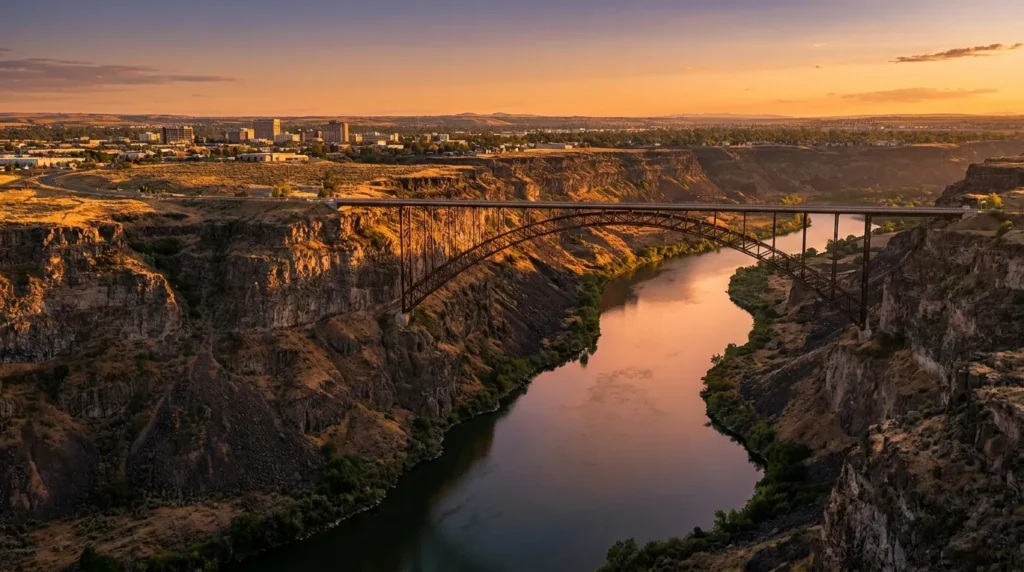
The Snake River Canyon and the Perrine Bridge are central landmarks. The bridge is one of the few places in the world where base jumping is permitted without a special permit, drawing practitioners from around the globe. Shoshone Falls Park, to the east, is a must-see stop, especially in spring when water volume is at its peak. Centennial Waterfront Park, at the canyon floor, offers trails, kayaking, and an ecological station.

The cultural diversity is surprising. Mexican restaurants such as Don Chuy's, along with Vietnamese, Syrian, and Ethiopian establishments, reflect the communities formed by immigrants and refugees. Festivals include Cinco de Mayo, events organized by the refugee community, and the Twin Falls County Fair, a traditional agricultural celebration featuring a rodeo, exhibits, and concerts.

Downtown Twin Falls, in the historic center, has been revitalized in recent years and now hosts cafes, breweries, and local restaurants. The Magic Valley Arts Council organizes events and exhibitions, and the Idaho Center for the Arts presents plays and performances. For larger entertainment options, residents often travel to Boise or head toward the Sun Valley region.

Attractions in Twin Falls, Idaho, in the Magic Valley

A city on the Snake River Canyon, with Shoshone and Twin Falls waterfalls, the Perrine Bridge spanning the Magic Valley, and a strong agricultural and outdoor scene.

Twin Falls is the largest city in the Magic Valley of southern Idaho. Its defining landmark is the Snake River Canyon, crossed by the Perrine Memorial Bridge 148 meters above the gorge. The bridge is one of the few in the United States where BASE jumping is legal year-round, and the overlook draws steady visitor traffic. A nearby ramp was also the site where Evel Knievel attempted to jump the canyon on a steam-powered motorcycle in 1974.

Shoshone Falls, minutes from downtown, is nicknamed the Niagara of the West and drops 65 meters, taller than Niagara Falls. Water levels peak in spring. The Twin Falls waterfall, for which the city is named, is smaller but open and free to the public, and Centennial Waterfront Park at the canyon floor provides river access for kayaking and stand-up paddleboarding.

The historic downtown centers on Main Avenue, featuring buildings from the 1910s within the Twin Falls Historic District. The College of Southern Idaho hosts the Herrett Center for Arts and Science and the Faulkner Planetarium. For larger natural areas, Sawtooth National Forest and Craters of the Moon National Monument are within a few hours by car.

  1. 1["Shoshone Falls (the 'Niagara of the West')"
  2. 2"Perrine Bridge (popular for BASE jumping)"
  3. 3"Snake River Canyon"
  4. 4"Twin Falls Visitor Center"
  5. 5"Centennial Waterfront Park"
  6. 6"Herrett Center for Arts and Science"
Nightlife3.0 / 10
Parks & green spaces
  • ["Shoshone Falls Park"
  • "Centennial Waterfront Park"
  • "City Park"
  • "Dierkes Lake"
  • "Rock Creek Park"
  • +1 more

Latest posts

Straight from the blog

There are no posts specifically about Twin Falls yet. In the meantime, check out our latest posts.