Visto n' Visa
Blog
Notícias e artigos
Destinations
Careers
Immigrants

Want to live and work in Jerome?

Personalized immigration plan with eligible visas, costs, and next steps for your goal!

If you are not eligible, you will know exactly why and what to do to improve your approval chances.

Save up to 12 hours in meetings

No pointless assessments.

Save up to 90%

Save money on vague or unfocused consultations

Avoid Fraud and Mistakes

One mistake can cost you your visa

Total Impartiality

Zero commercial bias

Decide with peace of mind

No toxic urgency

Fast and Accurate

Answers in minutes, no guesswork

Working Population with Strong Latino Presence

Jerome has around 12,000 residents, with the Hispanic population representing nearly 40% of the total. Predominantly Christian, divided between Catholics and Protestants.

Jerome's population is around 12,000 residents in the city proper, growing somewhat when the unincorporated areas of the county are included. It is a small city, but with above-average ethnic diversity for Idaho. The Hispanic community, primarily of Mexican origin, is the largest minority and represents close to half of residents in some neighborhoods near the center.

English is the official language and used in most public services, but Spanish is heard almost everywhere: markets, churches, schools, auto repair shops. Several commercial signs are bilingual, and Spanish-language services are available at health centers, public schools, and some county offices.

In terms of religion, Christianity predominates. The Catholic Church has one of the most active parishes, in part because of the Latino community. There is also a strong Mormon presence, reflecting the region's heritage, and several evangelical denominations. Community life still revolves heavily around churches, especially for recently arrived families seeking a support network.

Languages spoken
  • English
  • Spanish
Main religions
  • Catholic Christianity
  • The Church of Jesus Christ of Latter-day Saints
  • Protestant Evangelicals
  • No religion

Cost of Living Well Below the National Average

Jerome ranks among the most affordable cities in the United States to live in. Rent, groceries, and fuel are accessible, though wages are proportionally lower as well.

The cost of living in Jerome is clearly below the national average for the United States. Renting a two- or three-bedroom house typically costs amounts that, in large cities, would not cover a shared room. Markets such as Smith's, Walmart, and local Ridley's keep prices similar to the rest of rural Idaho, making basic shopping feasible even on a farm or dairy worker's wage.

Fuel, electricity, and natural gas follow regional patterns, generally below the national average. Residential internet is available through providers such as Cable One and Sparklight, with accessible basic plans. Health insurance is where budgets get tight, as anywhere in the United States, especially for those who do not yet have employer benefits.

The tradeoff is wages. Those working in farming, dairy, or meatpacking are paid hourly, in modest ranges. Those with skilled professions (nursing, accounting, industrial mechanics) access higher salaries. For immigrant families willing to work hard, a stable life is achievable: renting a house, buying a used car, and saving something at the end of the month.

Single-Story Homes, Affordable Rents, Small and Competitive Market

Single- and two-story houses with yards predominate, on quiet streets. The rental market is limited, so searching in advance or through local referrals is advisable.

The housing profile in Jerome is typical of a small American city: single-story or two-story houses with garages, yards, and lawns, spread across quiet residential streets. There are some apartment complexes, but supply is limited and most of the population lives in houses, whether owned or rented. Trailers and mobile homes are also common, mainly in residential parks on the outskirts.

The central neighborhood, near Main Street, has older homes, some with good historical character. Newer areas are to the north and east of the city, with construction from the 2000s and 2010s. For families working on farms, it is common to live in employer-provided housing, especially on larger dairy operations in the surrounding area.

Finding a rental can be challenging because the market is small. Many properties are rented by referral or through local Facebook groups before reaching traditional listing sites. Those arriving from outside typically start with temporary rentals in Twin Falls and move to Jerome after securing employment and building connections.

Recommended neighborhoods
  • Downtown (Main Street)
  • North Lincoln
  • Tiger Drive area
  • South Park
  • Crossroads (new northern zone)

Jobs in Dairy, Food Processing, and Logistics

The local economy is dominated by agribusiness and processing. There are steady openings in dairies, meatpacking plants, warehouses, and industrial facilities throughout the Magic Valley region.

Jerome and the neighboring county are home to some of the largest dairy operations in the United States. Idaho produces more cheese than any other state, and a significant portion of that passes through plants located in Magic Valley. Companies such as Glanbia, Chobani (in Twin Falls), and Idaho Milk Products employ hundreds of people, many on rotating shifts with overtime opportunities.

Beyond dairy, there is work in meat processing, potato processing, animal feed plants, and individual farms. Opportunities also exist in logistics, with Amazon warehouses and distribution centers located along Interstate 84. Construction has steady demand to keep pace with the region's population growth.

For those arriving with technical skills, there are openings in industrial mechanics, agricultural equipment maintenance, welding, electrical work, and CDL (commercial truck driving). Healthcare, education, and professional services exist on a smaller scale, with a greater concentration in Twin Falls. Basic English opens many doors, and those fluent in both languages tend to become bridges between supervisors and work crews.

Dominant sectors
  • Dairy and cheese
  • Food processing
  • Agribusiness and farming
  • Logistics and distribution
  • Construction
Major employers
  • Glanbia Nutritionals
  • Idaho Milk Products
  • Davisco Foods
  • Jerome Cheese Company
  • St. Luke's Magic Valley (regional healthcare)
  • +2 more

Solid Public Schools and Accessible Colleges in the Region

Jerome has K-12 public schools with bilingual programs and vocational education. Community college and state universities are a short distance away in Twin Falls and Pocatello.

The Jerome Joint School District serves children and teenagers from preschool through high school (K-12). Some schools offer bilingual programs for students whose first language is Spanish, along with specific support for newly arrived families. Jerome High School is the city's main secondary school, with vocational programs in agriculture, mechanics, and construction, in addition to traditional subjects.

The College of Southern Idaho, in Twin Falls, offers two-year programs, professional certificates, and pathways to transfer to four-year universities. It is the most common entry point for immigrants looking to continue their education. Costs are significantly lower than state universities, and ESL (English as a Second Language) student support is available.

Larger state universities are somewhat farther away: Idaho State University in Pocatello, Boise State University in Boise, and the University of Idaho in Moscow. Many students begin in Twin Falls and transfer after two years, which reduces total cost and makes it easier to balance work and studies.

Notable universities
  • College of Southern Idaho (Twin Falls, 15 min away)
  • Idaho State University (Pocatello)
  • Boise State University
  • University of Idaho (Moscow)
  • Brigham Young University-Idaho (Rexburg)

Local Primary Care and a Nearby Regional Hospital

Jerome has local clinics for primary care, and the regional reference hospital is in Twin Falls, with full services just minutes away by car.

Healthcare in Jerome operates on two levels. For routine consultations, basic tests, and pediatrics, there are local clinics such as St. Luke's Clinic and private practices throughout the city. For emergencies and specialized care, the regional reference hospital is St. Luke's Magic Valley Medical Center in Twin Falls, with a 24-hour emergency room and nearly all medical specialties.

For immigrant families, healthcare access is often tied to employment, since many services go through employer health plans. For those without insurance, programs such as Idaho Medicaid (for eligible low-income families), community clinics with income-based sliding fees (Family Health Services is a regional reference), and reduced-cost dental and vision clinics are available.

Spanish speakers will find services in their language at several clinics and pharmacies in the region. For those who speak other languages, telephone translation services are commonly used in hospitals and larger offices. It is always worth asking whether an interpreter is available before an appointment.

Quiet City with Crime Rates Below the Urban Average

Jerome is a small city with low crime rates compared to urban centers. The most common offenses are petty theft and drug-related incidents in specific areas.

As a small city, Jerome has crime rates well below those of major American urban centers. The most common incidents involve petty theft, property damage, and drug-related offenses, mainly methamphetamine, which is a challenge throughout the Magic Valley region. Violent crimes are rare but do occur.

Policing is handled by the Jerome Police Department within the city and the Jerome County Sheriff outside it. The Idaho State Police also has a presence on the interstate. Response times are reasonable given the city's size, and there are community outreach programs, including Spanish-language services.

For those arriving from elsewhere, the most useful advice is the standard one for any small American city: lock the car and house even on quiet streets, avoid leaving valuables visible in the vehicle, and be mindful near gas stations and bars late at night. Residential neighborhoods and Main Street are safe for walking.

Safer neighborhoods
  • Downtown/Main Street
  • Residential neighborhoods to the east
  • Crossroads (north of the city)
  • Tiger Drive area
Areas to avoid
  • Isolated areas on rural roads at night
  • Budget motel parking lots on US-93 at night

Car-Dependent City with Easy Access to I-84

There is no structured public transit. Nearly every resident depends on a personal vehicle. Interstate 84 cuts through the region, connecting Jerome to Boise and Salt Lake City.

As in most of rural America, almost everyone in Jerome gets around by car. There is no urban bus network, and the regional public transportation system (Trans IV) primarily serves elderly residents and those with special needs. Immigrants typically need a personal vehicle in the first year to get to work, take children to school, and run errands.

Interstate 84 cuts across southern Idaho and passes near Jerome. Boise (the capital, to the west) and Salt Lake City (Utah, to the southeast) are reachable within a few hours. US-93 runs through Jerome from north to south, connecting to Sun Valley and other points in Idaho. The nearest regional airport is in Twin Falls, and the most-used international airport is in Boise, two hours by car.

Within the city, everything is close and the streets are wide, so walking and cycling are viable for short distances, especially outside the winter months. When it snows or strong winds pick up, which happens frequently between December and February, walking is no longer a realistic option.

Airports
  • TWF — Magic Valley Regional Airport (Twin Falls)
  • BOI — Boise Airport (~2h by car)
  • SLC — Salt Lake City International (~3h30 by car)

Culture Blending Rural American Roots and Latino Heritage

Cultural life mixes small-town traditions of the American West (rodeos, county fairs) with Latino influence from decades of Mexican and Central American immigration.

Local culture has two layers that coexist well. On one side, rural traditions of the American West: rodeos, county agricultural fairs, community churches, Fourth of July parades. On the other, the Latino heritage brought by decades of Mexican and Central American immigration, visible in religious celebrations, restaurants, neighborhood markets, and Catholic services held in Spanish.

The food reflects this mix. Classic diners serve traditional American breakfasts of pancakes, eggs, and bacon alongside taquerias with made-to-order tortillas, pozole, birria, and tacos al pastor. Local butcher shops keep fresh meats on various menus. Onions and potatoes, grown in the region, appear frequently.

Annual events bring the city together. The Jerome County Fair, in August, features livestock exhibitions, country music shows, food trucks, and children's activities. The Festival of Lights in winter and the Memorial Day parade are also traditions. For those arriving from elsewhere, attending these events is the fastest way to feel part of the community.

Notable dishes
  • Idaho potato (in various forms, from mashed to fries)
  • Tacos al pastor
  • Birria
  • Finger steaks (Idaho specialty)
  • Huckleberry pie (in summer)
  • +1 more
Annual events
  • Jerome County Fair (August)
  • Festival of Lights (December)
  • Memorial Day Parade
  • Cinco de Mayo (Latin community celebrations)
  • Live After 5 (summer events on Main Street)

Spectacular Natural Attractions Just Minutes from the City

The city itself is small, but the region offers impressive canyons, waterfalls, and state parks. The Snake River Canyon and Shoshone Falls are less than half an hour away.

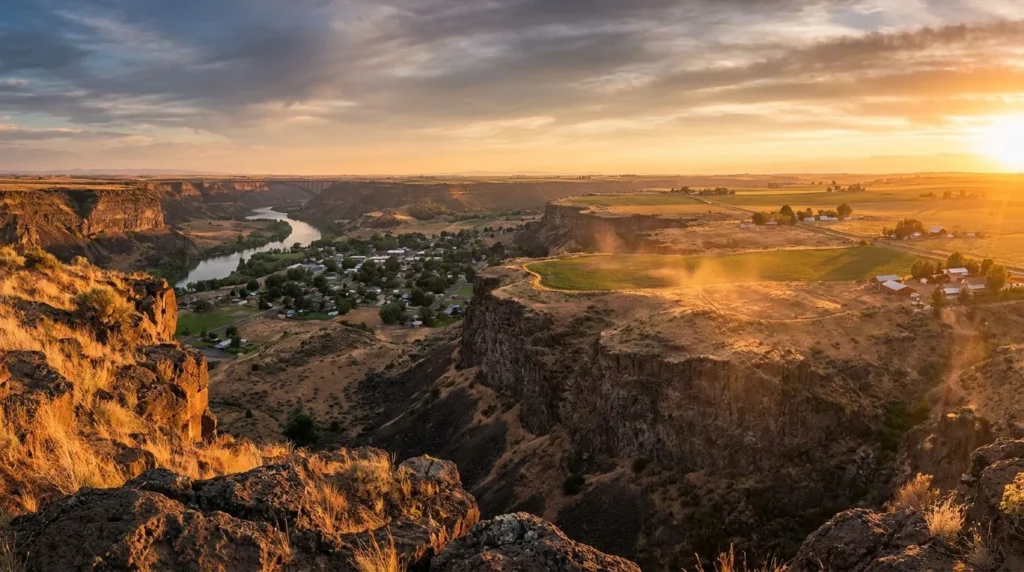
The region's main attraction is not exactly in Jerome, but just minutes away. The Snake River Canyon cuts through the landscape between Jerome and Twin Falls, with canyon walls nearly 150 meters high. The Perrine Bridge, which spans the gorge, is one of the few places in the United States where BASE jumping is legally permitted, and on weekends jumpers are commonly seen leaping from the bridge.

Shoshone Falls, known as the 'Niagara of the West,' is about 20 minutes by car. In late spring, with snowmelt, the water volume surpasses that of Niagara Falls. Centennial Waterfront Park, below the canyon, offers trails, kayaking, and paddleboarding. Jerome itself has quiet neighborhood parks, ideal for families.

Farther east lies Sun Valley, a skiing and mountain tourism area. To the south, Craters of the Moon National Monument features unique volcanic landscapes. For fishing enthusiasts, the Snake River and its tributaries are known for trout. It is a corner of the United States where the dominant natural scenery more than compensates for the city's modest size.

  1. 1Snake River Canyon and Perrine Bridge
  2. 2Shoshone Falls (20 min in Twin Falls)
  3. 3Centennial Waterfront Park
  4. 4Jerome County Historical Museum
  5. 5Box Canyon Springs Nature Preserve
  6. 6Niagara Springs
Parks & green spaces
  • Jerome City Park
  • North Park
  • Frontier Field complex
  • Centennial Waterfront Park (Twin Falls)
  • Box Canyon Springs

Historic Hispanic Community and Growing Diversity

Mexican and Central American immigrants form the base of the foreign-born population. More recently, refugees resettled in Twin Falls and agricultural workers of other nationalities have also arrived.

The immigrant presence in Jerome is long-established and stable. The largest community comes from Mexico, with roots primarily in Michoacán, Jalisco, and Chihuahua, the result of several decades of migration for farm and dairy work. Today many of these families are in the second or third generation and form a central part of the city's economy and social life.

Central Americans, primarily from Guatemala and El Salvador, form the second largest group, generally more recent arrivals. There are also seasonal workers through H-2A visas on some farms. In recent years, the Magic Valley region has received small groups of refugees resettled in Twin Falls (Afghans, Ukrainians, Congolese), some of whom end up moving to Jerome in search of lower rent.

There is also a small presence of Brazilians, mainly working in dairy and industrial mechanics, but in smaller numbers compared to the Spanish-speaking Latino community. For newcomers, local churches, Latino markets, and community health clinics serve as natural networking and information-sharing hubs.

2,500
Foreign-born residents
estimated
Top countries of origin
  • Mexico
  • Guatemala
  • El Salvador
  • Honduras
  • Peru
  • Cuba
  • Brazil
Foreign consulates
  • Mexican Consulate in Boise (regional jurisdiction)
  • El Salvador Consulate in Las Vegas (regional jurisdiction)
  • Guatemalan Consulate in Denver (regional jurisdiction)
  • Brazilian Consulate General in Los Angeles (regional jurisdiction)
Community organizations
  • CSI Refugee Programs (Twin Falls)
  • Family Health Services
  • Hispanic Cultural Center of Idaho
  • Idaho Commission on Hispanic Affairs
  • Catholic Charities of Idaho
  • Magic Valley Community Action Partnership

Latest posts

Straight from the blog

There are no posts specifically about Jerome yet. In the meantime, check out our latest posts.