Visto n' Visa
Blog
Notícias e artigos
Destinations
Careers
Immigrants

Want to live and work in Ammon?

Personalized immigration plan with eligible visas, costs, and next steps for your goal!

If you are not eligible, you will know exactly why and what to do to improve your approval chances.

Save up to 12 hours in meetings

No pointless assessments.

Save up to 90%

Save money on vague or unfocused consultations

Avoid Fraud and Mistakes

One mistake can cost you your visa

Total Impartiality

Zero commercial bias

Decide with peace of mind

No toxic urgency

Fast and Accurate

Answers in minutes, no guesswork

Who lives in Ammon

Predominantly white city with a strong LDS presence, young families, and growth driven by domestic migration within the US and small Latino communities.

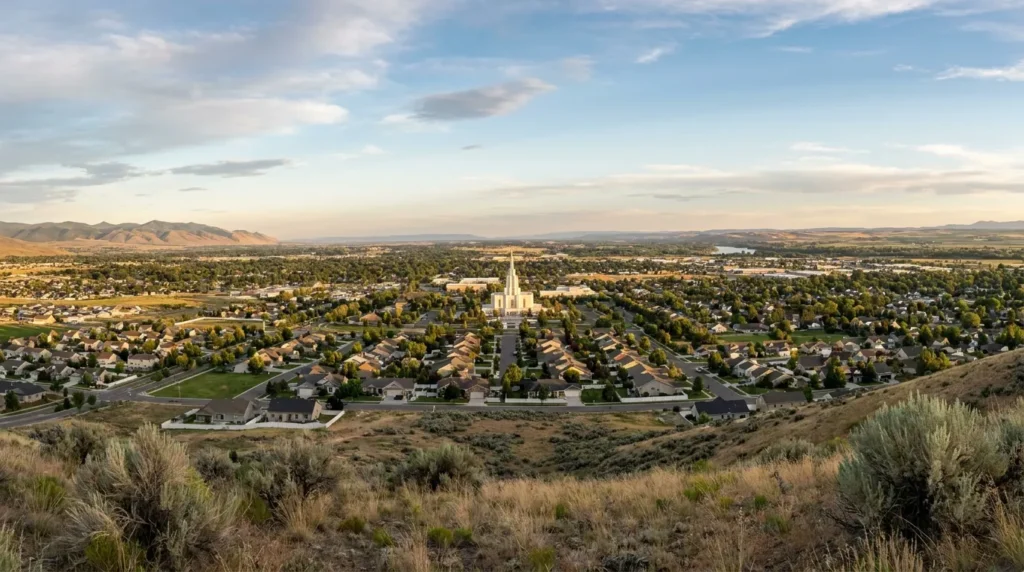
Ammon is a small, family-oriented city with a demographic profile similar to eastern Idaho: a white majority, a young age distribution due to large families connected to the Church of Jesus Christ of Latter-day Saints (Mormon), and a population growth rate above the state average.

The foreign-born population is small but present. The Hispanic community, coming primarily from Mexico and Central America, is the largest immigrant group and works in construction, agriculture in the surrounding rural area, and services. There are also smaller clusters of Filipinos, Indians, and Europeans connected to the Idaho National Laboratory and the local healthcare system.

English is the language of nearly everything. Spanish appears in businesses, some churches, and basic public services. Other languages remain confined to the home circles of individual immigrant families.

Languages spoken
  • English
  • Spanish
  • Tagalog
  • Portuguese
Main religions
  • Church of Jesus Christ of Latter-day Saints (LDS)
  • Evangelical Protestantism
  • Catholicism
  • No religion

Cost of living in Ammon

Ammon is more affordable than the American average in housing, transportation, and food, though complete car dependence weighs on the monthly budget.

Ammon ranks among the most accessible cities in the American West for middle-class families. Rent for a three-bedroom house is typically well below what is paid in Boise, Salt Lake City, or Denver, and buying property is feasible for those with stable income. Property taxes in Idaho are low compared to neighboring states.

Groceries, gas, and utility bills are also below the national average. Walmart, WinCo, Smith's, and Albertsons cover the basics, and seasonal farmers markets run through the summer. Health insurance remains the biggest expense for those without employer benefits, as is standard across the US.

The aspect that surprises immigrants is the cost of a car. Without a car, life in Ammon stalls: there is no useful public transportation, distances are large, and winters are harsh. Financing, insurance, fuel, and maintenance should be counted as a significant fixed expense.

Ammon

Where to live in Ammon

Single-family homes in planned subdivisions predominate; rentals are scarcer than for-sale properties, and supply is growing toward the eastern side of the city.

Ammon's housing stock is dominated by two- and three-bedroom single-family homes, many built in the last 15 years in planned subdivisions with wide streets, sidewalks, and neighborhood parks. Apartments exist, primarily near Hitt Road and 17th Street, but in smaller numbers.

For rentals, expect short search windows and requirements for proof of income, a US credit history, and a deposit of one to two months. Recently arrived immigrants without local credit typically need a cosigner or a larger security deposit. Sites like Zillow, Apartments.com, and local real estate agencies cover the available inventory well.

The newest neighborhoods are to the east and northeast, toward the hills. Buying tends to make sense for those planning to stay more than three years, with financing available through local banks and credit unions such as Idaho Central Credit Union.

Recommended neighborhoods
  • Hawks Landing
  • Mountain Valley
  • Quail Ridge
  • Sand Creek
  • Trailwood
  • +1 more

Job market in Ammon

Jobs come from healthcare, retail, construction, education, and the scientific hub of Idaho National Laboratory, with Idaho Falls serving as the regional economic center.

Ammon's job market is integrated with Idaho Falls. Residents work at Eastern Idaho Regional Medical Center and Mountain View Hospital, in retail chains along Hitt Road and Sunnyside Road, in schools of Bonneville Joint School District 93, and at small construction companies benefiting from the real estate boom.

The major regional engine is Idaho National Laboratory, a US Department of Energy national laboratory with strong demand for engineers, nuclear technicians, materials scientists, and IT professionals. Accessing positions there requires US work eligibility and, in many cases, a security clearance, which limits recently arrived immigrants.

For those starting out, the practical path is support healthcare (CNA, pharmacy technician), services (restaurants, hospitality), construction, and logistics. Idaho's minimum wage is still low, but skilled positions pay well relative to the cost of living.

Dominant sectors
  • Healthcare
  • Retail
  • Construction
  • Public education
  • Nuclear energy research
  • +1 more
Major employers
  • Idaho National Laboratory
  • Eastern Idaho Regional Medical Center
  • Mountain View Hospital
  • Bonneville Joint School District 93
  • Melaleuca
  • +1 more

Education in Ammon

District 93 public schools are well rated by American standards; higher education is in Idaho Falls and Rexburg, with a strong BYU-Idaho presence.

Ammon is served by Bonneville Joint School District 93, known in the region for stable public schools with good scores on state assessments and newer facilities. Elementary schools are located within the city, and high school students primarily attend Hillcrest High School and Bonneville High School. For LDS families, religious seminary alongside high school is also available.

For higher education, Idaho State University has a campus in Idaho Falls offering programs in healthcare, engineering, and business. In Rexburg, 30 minutes away, is Brigham Young University-Idaho (BYU-Idaho), a large university affiliated with the LDS Church with tuition well below the American average for church members.

For immigrants, the typical path is enrolling children in public schools (free, with basic ESL programs) and taking advantage of community colleges such as College of Eastern Idaho for quick technical programs before pursuing a four-year degree.

Notable universities
  • Brigham Young University-Idaho (Rexburg)
  • Idaho State University — Idaho Falls Campus
  • College of Eastern Idaho
  • University of Idaho — Idaho Falls Center

Healthcare in Ammon

The city has access to sizable regional hospitals in Idaho Falls, local family clinics, and reasonable primary care access; the standard American high-cost insurance model applies.

Healthcare access in Ammon is considered good by small-city US standards. Two regional hospitals are within minutes: Eastern Idaho Regional Medical Center, the region's main emergency and surgical center, and Mountain View Hospital, with a full emergency department. For highly specialized cases, patients are transferred to Salt Lake City.

Family clinics, dentists, physical therapists, pediatricians, and pharmacies are distributed along Hitt Road and throughout Idaho Falls. Wait times for appointments tend to be better than in large cities, but a car is required to get there.

The critical point, as throughout the US, is cost. Without employer-sponsored or Marketplace health insurance, any medical visit becomes expensive. Eligible immigrants can seek plans on healthcare.gov, and low-income children have access to Idaho's CHIP program.

Ammon

Safety in Ammon

Ammon is considered one of the safest cities in Idaho, with very low violent crime rates; the main risk is opportunistic vehicle and residential theft.

Ammon consistently appears among the safest cities in Idaho in independent rankings. The violent crime rate is very low, and policing is provided by the Ammon Police Department, with a strong presence in schools and residential neighborhoods. Children ride bicycles unsupervised and neighbors often leave doors unlocked, a common habit in small-town America.

The most frequent crimes are petty theft, break-ins of unlocked vehicles, and drug-related incidents tied to methamphetamine and opioids, a regional problem in eastern Idaho. Commercial areas along Hitt Road concentrate most incidents, still in low volume.

For immigrants, the practical precautions are the same as in any American city: lock the car, do not leave valuables in plain sight, extra caution at night in bar parking lots, and awareness of signs of drug trafficking in isolated industrial areas.

Safer neighborhoods
  • Hawks Landing
  • Mountain Valley
  • Quail Ridge
  • Centennial Ranch
  • Sand Creek
Areas to avoid
  • Isolated commercial areas along Hitt Road at night
  • Industrial areas without lighting in the far south
  • Bar parking lots in Idaho Falls during late-night hours

Getting around Ammon

Car-oriented city; public transportation is virtually nonexistent, and the Idaho Falls regional airport serves domestic flights via hubs such as Salt Lake City and Denver.

Ammon is designed for the car. Main thoroughfares such as Hitt Road, Sunnyside Road, and 17th Street connect residential neighborhoods to shopping centers, hospitals, and downtown Idaho Falls in 10 to 20 minutes. US-20 cuts through the region and provides quick access to West Yellowstone and the national park.

Public transportation is minimal. Greater Idaho Falls Transit (GIFT) operates limited routes and does not serve Ammon in a way that is useful for daily commuting. There is no metro, urban rail, or dense bus network. Cycling works in summer on residential streets, but the long, snowy winter limits its use.

For longer trips, Idaho Falls Regional Airport (IDA) is just a few minutes away and offers flights to Salt Lake City, Denver, Seattle, and Las Vegas, connecting to the rest of the world via hubs. Those who travel internationally often drive to Salt Lake City (approximately 3.5 hours) for more options.

Airports
  • IDA — Idaho Falls Regional Airport
  • Bike infrastructure

Climate

Ammon

Culture and daily life in Ammon

Family-oriented, conservative culture centered on the LDS community, with strong outdoor life and seasonal events inherited from Idaho Falls.

Ammon's culture is typically rural-conservative eastern Idaho. The LDS Church organizes much of social life, with weekly meetings, youth activities, and community service. Even non-Mormons tend to benefit from the social fabric: neighbors know each other, volunteerism is strong, and children move freely in neighborhood parks.

Leisure is predominantly outdoors. In summer, residents fish, hike, camp in Yellowstone and Grand Teton, ride ATVs in the mountains, and use the Snake River. In winter, the Kelly Canyon ski resort is nearby, and snowmobiling is a popular hobby. School sports, especially football and basketball, bring entire families together.

The dining scene is simple: national chains, barbecue, Mexican food, pizza, and some independent restaurants in Idaho Falls. Seasonal festivals, parades, and county fairs complete the cultural calendar.

Notable dishes
  • Idaho potatoes (baked potato, fries, hash browns)
  • Finger steaks (breaded beef strips)
  • Huckleberry pie and huckleberry ice cream
  • Trout (grilled fresh trout)
  • Funeral potatoes (LDS-style potato gratin)
Annual events
  • Melaleuca Freedom Celebration (July 4, Idaho Falls)
  • Eastern Idaho State Fair (Blackfoot, neighboring county)
  • Ammon Days
  • Christmas Light Parade
  • Snake River Roaring Youth Jam

What to see and do in Ammon

Attractions within city limits are limited, but the prime location puts Yellowstone, Grand Teton, and the Snake River within a short drive.

Ammon itself is not a tourist destination. City attractions include neighborhood parks, short trails, community sports complexes, and the shopping centers along Hitt Road, where much of winter social life takes place. McCowin Park is the main local public space.

Minutes away, Idaho Falls offers the Greenbelt, a nearly 5-mile riverside path along the Snake River with views of the urban falls, plus the Museum of Idaho and Tautphaus Park Zoo. The Eagle Rock Art Museum rounds out the cultural offerings.

For immigrants, the main advantage is proximity to nature. Yellowstone is about 2 hours away, Grand Teton about 1.5 hours, and ski resorts such as Kelly Canyon and Grand Targhee are within day-trip range. Fishing, kayaking, and camping in summer are part of the local lifestyle.

  1. 1McCowin Park
  2. 2Hillcrest Country Club
  3. 3Idaho Falls Greenbelt (nearby)
  4. 4Museum of Idaho (Idaho Falls)
  5. 5Tautphaus Park Zoo
  6. 6Heise Hot Springs
Parks & green spaces
  • McCowin Park
  • Peterson Park
  • Lincoln Park
  • Eagle Rock Park
  • Liberty Park
  • +1 more

Immigrant communities in Ammon

The foreign-born population is small, with Hispanics as the largest group, followed by Filipinos, Indians, and Europeans connected to the national laboratory and the healthcare sector.

Eastern Idaho is not a traditional mass-immigration destination, but Ammon is home to small, stable clusters of foreign-born residents. The Hispanic community, coming primarily from Mexico and, in smaller numbers, from Guatemala, El Salvador, and Venezuela, is the largest. Its members work in construction, agriculture, meatpacking plants in the surrounding rural area, and services. Catholic churches in Idaho Falls hold Spanish-language Masses and serve as gathering points.

A second group has grown over the last two decades around the Idaho National Laboratory and the hospitals: engineers and physicians from India, the Philippines, South Korea, China, and Eastern European countries. These are middle-class families spread across residential neighborhoods in Ammon and Idaho Falls.

Brazilians, Portuguese speakers, and other Lusophone residents form a very small group, generally connected to the LDS Church, which has a strong missionary presence in Brazil and Portugal. There are no consulates in the city, but Salt Lake City, about 3.5 hours away, concentrates diplomatic representations for several countries.

1,200
Foreign-born residents
estimated
Top countries of origin
  • Mexico
  • Philippines
  • India
  • Guatemala
  • China
  • South Korea
  • Venezuela
  • Brazil
Foreign consulates
  • Mexican Consulate General in Salt Lake City (jurisdiction)
  • Brazilian Consulate General in Los Angeles (jurisdiction)
  • Philippine Consulate General in Los Angeles (jurisdiction)
  • Indian Consulate in San Francisco (jurisdiction)
  • Guatemalan Consulate General in Salt Lake City (jurisdiction)
Community organizations
  • Catholic Charities of Idaho
  • Hispanic Cultural Center of Idaho (Nampa, statewide)
  • International Rescue Committee — Boise
  • Idaho Office for Refugees
  • Eastern Idaho Hispanic Cultural Center
  • LDS Church Welfare Services

Latest posts

Straight from the blog

There are no posts specifically about Ammon yet. In the meantime, check out our latest posts.