Visto n' Visa
Blog
Notícias e artigos
Destinations
Careers
Immigrants

Want to live and work in Schofield Barracks?

Personalized immigration plan with eligible visas, costs, and next steps for your goal!

If you are not eligible, you will know exactly why and what to do to improve your approval chances.

Save up to 12 hours in meetings

No pointless assessments.

Save up to 90%

Save money on vague or unfocused consultations

Avoid Fraud and Mistakes

One mistake can cost you your visa

Total Impartiality

Zero commercial bias

Decide with peace of mind

No toxic urgency

Fast and Accurate

Answers in minutes, no guesswork

Who Lives in Schofield Barracks

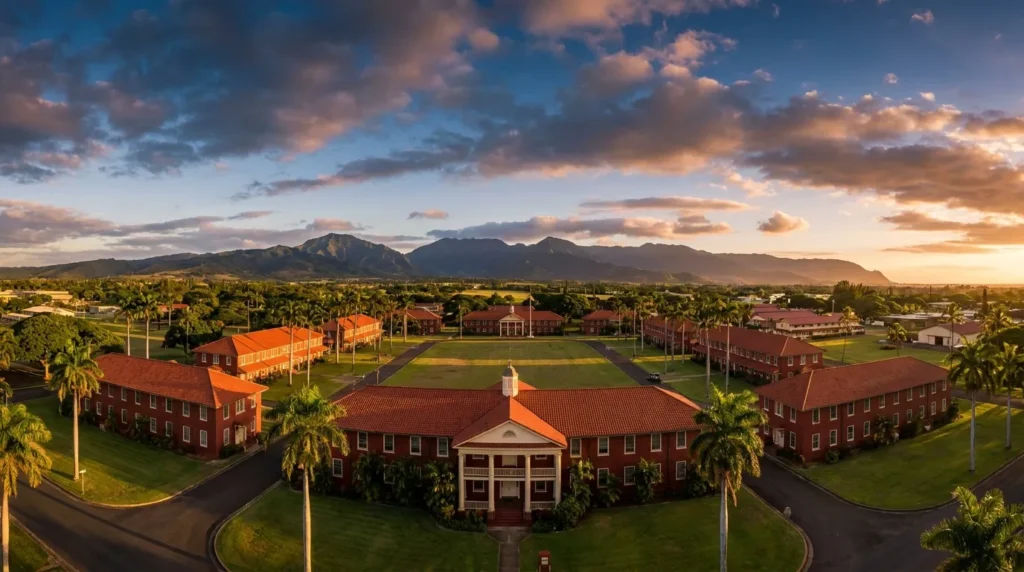
The population is almost entirely military and dependents, with a strong presence of soldiers from the mainland, Hawaii, and multicultural families formed at previous postings around the world.

Schofield Barracks has a population of around 14,000 to 16,000, almost entirely connected to the Army. They are active-duty soldiers of the 25th Infantry Division, their families, and civilian contractors. Turnover is very high: PCS (Permanent Change of Station) cycles move entire families every two or three years.

The diversity is significant for exactly this reason. Military families often have passed through bases in Korea, Germany, Italy, Japan, and across the continental United States, and many spouses are foreign nationals who naturalized through marriage. Together with the local Hawaiian, Samoan, and Filipino community in the surrounding area, this creates a cultural mix rarely found at more isolated bases.

American English is the official and dominant language. Spanish, Tagalog, Korean, and Japanese appear frequently among families. Christian faiths (Catholic, Protestant, Mormon, and various evangelical denominations) coexist with small Buddhist and Shintoist communities, common in Hawaii.

Languages spoken
  • English
  • Spanish
  • Tagalog
  • Korean
  • Japanese
  • +1 more
Main religions
  • Christianity (various denominations)
  • Catholicism
  • Mormonism
  • Buddhism
  • Shintoism
  • +1 more

Cost of Living: Expensive Hawaii, Cushioned by Military BAH

Oahu is one of the most expensive places in the United States, but military members receive a housing allowance (BAH) that covers a significant portion; civilians without that benefit feel the full weight of market prices, fuel, and utilities.

Schofield is in one of the most expensive areas in the United States. Everything not produced on the island arrives by ship, which drives up prices for groceries, appliances, furniture, and building materials. Gasoline, electricity, and utilities cost significantly more than on the mainland. Dining at national chain restaurants is expensive; local restaurants (plate lunch spots, food trucks) remain more affordable.

The major cushion for residents is the military benefits package. Soldiers receive BAH (Basic Allowance for Housing) calibrated to Oahu, have access to the commissary (a military grocery store with mainland prices), and the PX (a tax-free retail store). Families living on post do not pay rent directly: their BAH goes to Island Palm Communities.

For civilians without these subsidies, costs are steep. Renting off-post in Wahiawa, Mililani, or Waipahu is expensive, monthly utility bills frequently exceed $300, and a grocery budget can run 30 to 50 percent higher than in a comparable state on the mainland.

Schofield Barracks

Where to Live: On-Post or in Wahiawa/Mililani

Military families live in on-post housing operated by Island Palm Communities; those who opt for off-post typically choose Wahiawa (more affordable), Mililani (newer), or Waipahu, all a short distance away.

Most garrison families live in on-post housing managed by Island Palm Communities, with houses and townhomes divided across neighborhoods (Aliamanu, Helemano, Wheeler, Porter, and others). Waitlist times vary by rank and family size, and the service member's BAH covers rent automatically.

Those who prefer off-post housing typically rent in Wahiawa, the immediate neighbor, with older homes and relatively lower prices for Oahu. Mililani, a few kilometers to the south, is a planned community with good retail, well-rated schools, and tends to attract officers and civilians. Waipahu and Pearl City are options for those willing to commute farther in exchange for slightly lower rents.

The rental market on Oahu is tight and competitive. Furnished short-term rentals exist but are expensive. Purchasing property without being a local resident is difficult given prices (medians in the hundreds of thousands for condos and significantly more for houses).

Recommended neighborhoods
  • On-post housing (Island Palm Communities)
  • Wahiawa
  • Mililani
  • Mililani Mauka
  • Waipahu
  • +1 more

Job Market: Defense, Healthcare, and Services

The Army is the region's largest employer; surrounding it are positions in healthcare, retail, DoDEA education, and services catering to military families and Oahu's tourism economy.

The dominant employer is the U.S. Army itself, with federal civilians (GS), defense contractors, and military spouses filling administrative, technical, and logistics positions on post. The 25th Infantry Division and support units account for thousands of positions.

Outside the perimeter, healthcare is the second major driver: Wahiawa General Hospital, private clinics, and the Kaiser Permanente network employ nurses, technicians, and physicians. Public education (Hawaii DOE) and DoDEA schools on post offer openings for certified teachers. Retail at Mililani Town Center, Pearlridge, and Honolulu absorbs labor from military spouses.

For immigrants without a military connection, real opportunities lie in hospitality (resorts and hotels in Waikiki, Ko Olina, and North Shore), construction, agriculture (Dole, Kunia), and a growing technology sector in Honolulu. Foreign military spouses frequently work through DoD-contracted companies.

Dominant sectors
  • Defense
  • Federal public administration
  • Healthcare
  • Education
  • Retail
  • +1 more
Major employers
  • U.S. Army (25th Infantry Division)
  • Wahiawa General Hospital
  • Kaiser Permanente
  • DoDEA Schools
  • Hawaii Department of Education
  • +2 more

Education: DoDEA Schools on Post and DOE Schools in the Surrounding Area

Military children attend schools operated by DoDEA within the perimeter or public schools in Wahiawa and Mililani; universities are located in Manoa and West Oahu.

Within Schofield and the neighboring housing areas, DoDEA schools follow a federal American curriculum and serve military dependents: Solomon Elementary, Hale Kula Elementary, Wheeler Middle, and others. They are considered strong schools that help transient families maintain educational continuity.

Those who opt into the state system enroll in Hawaii DOE schools in Wahiawa (Wahiawa Elementary, Wahiawa Middle, Leilehua High) or in Mililani (generally higher-rated schools, such as Mililani High). Charter and private schools exist in Mililani and Honolulu, with high tuition.

For higher education, the route leads to Honolulu: University of Hawaii at Manoa (the state's main public university), University of Hawaii - West Oahu in Kapolei, Hawaii Pacific University downtown, and community colleges including Leeward CC and Honolulu CC, all with agreements for military dependents.

Notable universities
  • University of Hawaii at Manoa
  • University of Hawaii - West Oahu
  • Hawaii Pacific University
  • Leeward Community College
  • Honolulu Community College
  • Brigham Young University - Hawaii (Laie)

Healthcare: Military Tripler Network and Oahu's Civilian System

Military families rely on the Schofield Barracks Health Clinic and the Tripler Army Medical Center complex; civilians use Wahiawa General, Kaiser Permanente, Queens, and Pali Momi.

Within the perimeter, the Schofield Barracks Health Clinic offers primary care, pharmacy, and outpatient services for military members and dependents. More complex cases are referred to Tripler Army Medical Center in Honolulu, the DoD's regional hospital serving the entire Pacific, with English-language care integrated with TRICARE coverage.

For civilians, Wahiawa General Hospital is a few minutes away and handles emergencies and basic inpatient care. Larger networks such as Kaiser Permanente Moanalua, The Queens Medical Center, and Pali Momi Medical Center, in Honolulu or Aiea, offer specialized services including oncology, cardiology, and maternity care.

Specialist access on Oahu can involve long wait times, particularly for psychiatry and dermatology. Those arriving outside TRICARE coverage need American health insurance; without it, emergency room and diagnostic costs are prohibitive.

Schofield Barracks

Safety: Controlled Base and a Calm Surrounding Area

Within the perimeter, security is high with 24-hour Military Police; in the surrounding area, Mililani is considered very safe, Wahiawa has mixed areas, and the recommendation is to avoid industrial zones at night.

Schofield Barracks is a controlled installation, with guarded gates, access only with military identification or authorization, and 24-hour military policing. Violent crime within the base is rare; most incidents involve domestic theft, alcohol, and traffic offenses.

Mililani, to the south, is consistently listed among the safest cities in the United States for its size. Wahiawa, older and more mixed, combines quiet residential streets with some areas where theft and drug use are more visible, particularly near the old town center.

The practical advice mirrors that of any mid-sized city: do not leave valuables visible in a parked car (Oahu has a high incidence of smash-and-grab incidents in tourist areas), avoid isolated trails alone after dark, and stay aware in beach parking areas. For families with children, the region is calm by American standards.

Safer neighborhoods
  • On-post housing (Schofield)
  • Mililani Town
  • Mililani Mauka
  • Wheeler Field
  • Helemano
Areas to avoid
  • Industrial areas of Wahiawa at night
  • Isolated trailhead and beach parking areas after sunset

Transportation: H-2 to Honolulu, TheBus, and a Personal Vehicle

A car is practically essential; the H-2 connects Schofield to Honolulu in 30 to 50 minutes off-peak, and the public TheBus system serves major routes to Wahiawa, Mililani, and Pearl Harbor.

Schofield Barracks is car-dependent. Interstate H-2 leads directly to H-1, which connects to Honolulu, Pearl Harbor, and the airport. Off peak, the trip to downtown Honolulu takes 35 to 50 minutes; during peak hours, particularly southbound in the morning, it can exceed 1 hour and 30 minutes.

The public TheBus system runs regular lines to Wahiawa, Mililani, Pearl City, Aiea, and Honolulu, but with lower frequencies than mainland metropolitan areas. There is no urban rail serving Schofield (the Skyline operates only in southern Oahu, from Kapolei to Aloha Stadium, with extensions planned).

The international airport is Daniel K. Inouye, in Honolulu, about 35 kilometers away, with flights to the entire continental United States, Asia, and the Pacific. There are no structured bike lanes within the CDP; recreational cycling takes place on trails and rural roads to the north.

Airports
  • HNL - Daniel K. Inouye International Airport (Honolulu, ~35 km)

Climate

Schofield Barracks

Culture: Military Tradition Mixed with Local Aloha

Military ceremonies, parades, and change-of-command events set the pace of the calendar, while Hawaiian culture, the plantation-era traditions of Wahiawa, and Asian and Samoan influences mark the surrounding area.

The culture of Schofield is first military and American: change-of-command ceremonies, Memorial Day and Veterans Day parades, football games, and weekend cookouts. The Tropic Lightning Museum, inside the base, tells the history of the 25th Infantry Division from World War II through modern Pacific operations.

Beyond the gates, the culture is distinctly Hawaiian and Pacific Islander. Wahiawa preserves traces of its plantation-era roots with plate lunch restaurants (kalua pork, loco moco, poke bowls) and festivals. Filipino, Japanese, Korean, and Samoan heritage appears in ethnic grocery stores, churches, and family gatherings. The Dole Plantation, to the north, has become a tourist attraction and symbol of the area's agricultural past.

Events such as Sunset on the Beach in Waikiki, the Aloha Festivals in September, and the Honolulu Festival in March offer cultural programming accessible to Schofield residents. Hula, slack-key guitar, and luaus round out the Hawaiian repertoire.

Notable dishes
  • Plate lunch
  • Loco moco
  • Poke
  • Kalua pork
  • Spam musubi
  • +3 more
Annual events
  • Memorial Day Ceremony at Schofield
  • Tropic Lightning Week
  • Wahiawa Pineapple Festival
  • Aloha Festivals
  • Honolulu Festival
  • +1 more

What to See: Military Museum, a Plantation, and North Shore 30 Minutes Away

The Tropic Lightning Museum, Dole Plantation, Waianae hiking trails, and the famous North Shore with its big-wave beaches are all a short drive from Schofield Barracks.

Inside the base, the Tropic Lightning Museum preserves the memory of the 25th Infantry Division from World War II through modern Pacific operations. The Pacific Aviation Museum on Ford Island and the USS Arizona Memorial at Pearl Harbor are 30 to 40 minutes away via H-2/H-1.

To the north, the Dole Plantation offers its famous pineapple maze, a tourist train, and gardens. Continuing along the Kamehameha Highway leads to the North Shore: Haleiwa, with its surf-town charm, and the legendary beaches of Waimea Bay, Pipeline, and Sunset Beach, where giant waves arrive from November through February.

For nature, Kaena Point State Park at the western tip of the island, the Diamond Head trails in Honolulu, Manoa Falls, and the lookouts along Tantalus Drive round out the options. Honolulu, Waikiki, and the Bishop Museum offer the urban and cultural side within a short drive.

  1. 1Tropic Lightning Museum
  2. 2Dole Plantation
  3. 3USS Arizona Memorial (Pearl Harbor)
  4. 4Pacific Aviation Museum
  5. 5North Shore (Haleiwa, Waimea, Pipeline, Sunset Beach)
  6. 6Kaena Point State Park
Parks & green spaces
  • Wahiawa Botanical Garden
  • Lake Wilson (Wahiawa Reservoir)
  • Kaena Point State Park
  • Mililani District Park
  • Helemano Wilderness Area

Immigrant Communities: Filipinos, Japanese, Koreans, and a Global Military Family

Oahu is one of the most multicultural regions in the United States; around Schofield there are strong Filipino, Japanese, Korean, Micronesian, and Samoan communities, along with military spouses from dozens of countries.

Hawaii has been a majority-minority state since the early twentieth century, and Oahu, especially the Wahiawa-Waipahu-Honolulu corridor, has one of the highest concentrations of Asian and Pacific Islander heritage in the United States. Filipinos form the largest recent immigrant community, followed by Japanese, Koreans, Chinese, Vietnamese, and Micronesian peoples (Marshall Islands, Chuuk, Pohnpei) under COFA compacts.

The military community adds another layer: spouses born in South Korea, Japan, Germany, the Philippines, Mexico, Colombia, and dozens of other countries who married service members at earlier postings and followed careers to Hawaii. Multilingual Catholic, Baptist, and Mormon churches, cultural festivals, and ethnic markets (Don Quijote, Palama Supermarket, Filipino markets in Wahiawa) sustain these communities.

For those arriving as recent immigrants without a military connection, integration tends to be easier than on the mainland: Oahu's multicultural fabric, the aloha spirit, and the established presence of many communities reduce culture shock. The main challenges are cost of living and a job market concentrated in hospitality and services.

2,200
Foreign-born residents
estimated
Top countries of origin
  • Philippines
  • Japan
  • South Korea
  • China
  • Mexico
  • Germany
  • Micronesia (Federated States)
  • Samoa
Foreign consulates
  • Consulate General of Japan in Honolulu
  • Consulate General of the Philippines in Honolulu
  • Consulate General of South Korea in Honolulu
  • Consulate General of Australia in Honolulu
  • Consulate General of China in San Francisco (jurisdiction)
  • +2 more
Community organizations
  • Catholic Charities Hawaii
  • Pacific Gateway Center
  • Filipino Community Center (Waipahu)
  • Japanese Cultural Center of Hawaii
  • Korean Community Council of Hawaii
  • Susannah Wesley Community Center

Latest posts

Straight from the blog

There are no posts specifically about Schofield Barracks yet. In the meantime, check out our latest posts.