Visto n' Visa
Blog
Notícias e artigos
Destinations
Careers
Immigrants

Want to live and work in Kihei?

Personalized immigration plan with eligible visas, costs, and next steps for your goal!

If you are not eligible, you will know exactly why and what to do to improve your approval chances.

Save up to 12 hours in meetings

No pointless assessments.

Save up to 90%

Save money on vague or unfocused consultations

Avoid Fraud and Mistakes

One mistake can cost you your visa

Total Impartiality

Zero commercial bias

Decide with peace of mind

No toxic urgency

Fast and Accurate

Answers in minutes, no guesswork

Diverse population of Native Hawaiians, Asian Americans, and mainland newcomers

Kihei combines Hawaiian roots, Filipino and Japanese plantation heritage, and a steady flow of mainlanders, forming a multicultural community of around 20,000 residents.

Kihei's population hovers around 20,000 and grows in winter as snowbirds flee the cold mainland. The ethnic composition reflects Maui's history: about a third identify as Asian (predominantly Filipino and Japanese), a quarter as White, and a significant share as Native Hawaiian or multiracial. Interracial marriages are common and many families identify with three or more heritages.

English is the lingua franca, but Hawaiian Pidgin (Hawaiian Creole English) appears in everyday conversation, especially among those born on the island. Tagalog, Ilocano, Japanese, and Spanish are also heard in markets, churches, and construction sites. The presence of Native Hawaiian grows in immersion schools and street names.

The age range is varied: young families in neighborhoods like Maui Meadows, retirees in beachfront condo complexes, and tourism workers between 25 and 40 sharing rentals. Median income is reasonable by Hawaiian standards, but housing costs consume a large share of nearly everyone's budget.

Languages spoken
  • English
  • Hawaiian Pidgin
  • Tagalog
  • Ilocano
  • Japanese
  • +2 more
Main religions
  • Protestant Christianity
  • Roman Catholicism
  • Buddhism
  • Traditional Hawaiian religion
  • No religion

High cost of living, dominated by housing and imported food

Living in Kihei costs significantly more than the US average, with rent and groceries driven up by island isolation.

Kihei ranks among the most expensive areas in the United States. Housing takes the largest share: a one-bedroom apartment runs between 2,200 and 2,800 dollars a month, and family homes easily exceed 3,500. Purchasing is even more challenging, with median prices near 900,000 dollars for condos and above 1.2 million for houses.

Groceries are expensive because nearly everything arrives by ship from the mainland. Foodland and Safeway cover daily needs, but many residents combine Costco runs (in Kahului, a 40-minute drive) with local farmers markets to cut monthly spending. Dining out varies widely: poke bowls and plate lunches run 12 to 18 dollars, while restaurants in Wailea easily exceed 60 dollars per person.

Electricity is expensive, around 40 cents per kWh, which explains the popularity of solar panels. Gasoline typically runs above the national average. Cost-conscious residents offset expenses by cooking at home, buying fish directly from local fishers, and skipping car trips when work is close to South Kihei Road.

Kihei

Beachfront condos, hillside homes, and competition for long-term rentals

Kihei's housing stock is dominated by tourist condos converted to residential rentals, single-family homes in Maui Meadows, and few affordable options for local workers.

Newcomers encounter three housing realities: beachfront condos along South Kihei Road (Kihei Akahi, Maui Vista, Island Surf) with easy beach access but restrictive short-term rental rules, single-family homes in higher neighborhoods like Maui Meadows and Kihei Bay, and newer residential complexes such as Hokulani Golf Villas. Competition for long-term rentals is fierce because many owners prefer vacation rental income.

Maui Meadows is the most sought-after middle-class neighborhood, with spacious homes, ocean views, and cooler air from the elevation. Kihei Town Center concentrates daily commerce and has lower rents, but with traffic and noise. North Kihei, near the whale sanctuary, is quieter and less touristy.

Those who move to work in tourism generally share housing with coworkers. Supply opened slightly after the 2023 Lahaina fires, when the state pressured owners to convert units for residents, but affordable housing remains the main local political issue.

Recommended neighborhoods
  • Maui Meadows
  • Kihei Bay Vista
  • North Kihei
  • Kihei Town Center
  • Wailea Ekahi (adjacent)
  • +1 more

Tourism-driven economy, with healthcare and construction in second place

Kihei's economy runs on tourism but also employs workers in healthcare, construction, retail, and small technology businesses connected to the Maui Research and Technology Park.

Tourism drives Kihei's economy. Resorts in Wailea (bordering to the south), restaurants along South Kihei Road, dive operators, surf schools, and whale-watching tour companies employ thousands in roles ranging from housekeeping to multilingual guides. Wages in this sector vary widely depending on tips and season.

Healthcare is the island's second-largest employer, anchored by Maui Memorial Medical Center in Wailuku and a network of private clinics in Kihei. Construction maintains a strong pace as luxury resorts and residences continue to be built. The Maui Research and Technology Park houses astronomy, renewable energy, and oceanography firms connected to the University of Hawaii.

For immigrants without fluent English, opportunities concentrate in cleaning, landscaping, cooking, and construction, areas where the Filipino community already has established networks. Remote workers represent a growing share, drawn by reliable internet, climate, and outdoor routines. Starting a food truck, therapy practice, or services business for the local community is also a viable path.

Dominant sectors
  • Tourism and hospitality
  • Healthcare
  • Construction
  • Retail
  • Real estate
  • +1 more
Major employers
  • Wailea Beach Resort (Marriott)
  • Grand Wailea
  • Four Seasons Resort Maui
  • Maui Memorial Medical Center
  • Hawaiian Telcom
  • +1 more

Local public schools and a university campus in Kahului

Kihei has K-12 public schools serving the local community, nearby private options, and the University of Hawaii Maui College campus a half hour away.

The public system serves most families, with Kihei Elementary, Lokelani Intermediate, and Kihei Charter School as local anchors. Kihei Charter School offers STEM programs and has a strong reputation. For high school, many students bus to Maui High School in Kahului or Baldwin High School in Wailuku.

Private options include Carden Academy of Maui (K-8) in Pukalani and Seabury Hall (grades 6-12) in Olinda, both well-regarded but with high tuition. For bilingual families, Hawaiian-immersion programs (Pūnana Leo) serve early childhood. Demand for spots is high and waitlists are common.

For higher education, the University of Hawaii Maui College in Kahului offers associate degrees and bachelor's programs in areas such as hospitality, nursing, and sustainable technology. Those seeking a traditional university typically go to Oahu (University of Hawaii at Manoa) or to the mainland. Continuing education and online courses are popular paths for residents seeking career changes.

Notable universities
  • University of Hawaii Maui College (Kahului)
  • Pacific Rim Christian University (extension)
  • Seabury Hall (private, high school)

Local clinics in Kihei and the main hospital in Wailuku

Kihei has clinics and urgent care for everyday needs, and Maui Memorial Medical Center in Wailuku is the referral hospital for emergencies and complex procedures.

Primary care in Kihei is covered by clinics such as Kihei-Wailea Medical Center, Maui Medical Group, and Minit Medical Urgent Care. These work well for routine visits, vaccinations, and minor emergencies. Dentists, ophthalmologists, and physical therapists also have offices scattered along South Kihei Road.

For serious emergencies, hospitalizations, and surgeries, Maui Memorial Medical Center in Wailuku is the island's only full-service hospital, about a 30-minute drive away. For highly specialized cases (complex oncology, transplants, major trauma), patients are transferred to Honolulu on Oahu.

Those relocating from the US mainland need to adjust to the logistics: ambulance response times can be longer and specialist availability is lower than in major metropolitan areas. International immigrants should secure robust health insurance, ideally with coverage for inter-island medical evacuation. Kaiser Permanente operates on Maui and is the most widely used insurer among residents with employer-sponsored plans.

Kihei

Generally safe community, with attention to car break-ins at beaches and parking lots

Kihei is one of Maui's safest communities, with rare violent crime, and the main concerns involving vehicle break-ins and belongings left in beach parking lots.

Kihei is generally safe for residents and visitors. Violent crime is rare and Maui County Police maintain a visible presence, especially on South Kihei Road at night. Walking along the waterfront at night is common practice and draws little concern in most stretches.

The most frequent issue is vehicle break-ins at beach parking lots. Smashed windows for backpacks, cameras, and documents are the most common complaint. The rule is to leave nothing visible in any vehicle, especially at Makena, La Perouse Bay, and Big Beach. Poorly locked bicycles also disappear.

Natural hazards deserve more attention than crime: rip currents at unguarded beaches, box jellyfish on certain lunar-cycle days, intense sun exposure, and occasional tsunamis and tropical storms. Registering with the Hawaii Emergency Management Agency alert system and following beach flag guidelines are part of local life.

Safer neighborhoods
  • Maui Meadows
  • Wailea Ekahi (adjacent)
  • Kihei Town Center during the day
  • North Kihei residential area
Areas to avoid
  • Isolated beach parking lots at night
  • South Kihei Road late at night on weekends

Car-dependent city with local bus service and the airport 30 minutes away

Getting around Kihei requires a car, with South Kihei Road as the main artery, Maui Bus covering basic routes, and Kahului Airport a half hour away.

Owning a car in Kihei is nearly essential. South Kihei Road runs through the city from north to south, concentrating commerce, beaches, and neighborhoods. Piilani Highway is the faster alternative for bypassing commercial traffic. Parking is easy in most places, except at popular beaches on weekends.

Maui Bus operates the Kihei Islander and Kihei Villager routes connecting Kihei to Wailuku and Kahului for a 2-dollar fare. It covers the basics but has limited frequency and does not serve higher neighborhoods like Maui Meadows. Biking works well on flat stretches near the coast, and the city has invested in beachfront bike lanes.

Kahului Airport (OGG) is about a 30-minute drive away and connects Maui to the mainland and other Hawaiian islands via Hawaiian Airlines, Southwest, Alaska, and United. Short inter-island flights are common. Uber and Lyft operate but with high prices and irregular availability outside the tourist corridor.

Airports
  • OGG — Kahului Airport (Maui, 30 min drive)
  • JHM — Kapalua Airport (West Maui, regional flights)
  • Bike infrastructure

Climate

Kihei

Living Hawaiian culture, open-air markets, and seasonal festivals

Kihei's daily life is steeped in Hawaiian culture: live music at waterfront bars, canoe festivals, winter whale watching, and Saturday farmers markets.

Hawaiian culture permeates daily life in Kihei more than at more polished resorts. Hula classes in parks, outrigger canoe competitions at Kalama Beach, live Hawaiian music at bars like South Shore Tiki Lounge and Three's Bar & Grill. Lūʻau (festivals with traditional food and dance) take place at nearby hotels and are open to residents and visitors alike.

Local cuisine blends Polynesian, Asian, and American traditions. Plate lunch (protein, rice, and macaroni salad), poke (seasoned raw fish), kalua pork, loco moco, and shave ice are signatures. Spots like Da Kitchen, Foodland Poke Counter, Kihei Caffe, and 808 Deli are regulars for locals.

The calendar has its own rhythm: humpback whale season from December to April, the Maui Whale Festival in February, Fourth Friday in Kihei with music and food trucks, and the Maui Fair in September. The Saturday farmers market at Kihei Foodland is a weekly gathering point for residents.

Notable dishes
  • Poke
  • Plate lunch
  • Kalua pork
  • Loco moco
  • Spam musubi
  • +3 more
Annual events
  • Maui Whale Festival
  • Fourth Friday Kihei
  • Maui Fair
  • Kihei Fourth of July Parade
  • Wailea Wine and Food Festival
  • +1 more

Beaches for every preference, natural parks, and whale watching

Kihei offers a string of famous beaches, a humpback whale marine sanctuary, parks, and easy access to unique volcanic landscapes.

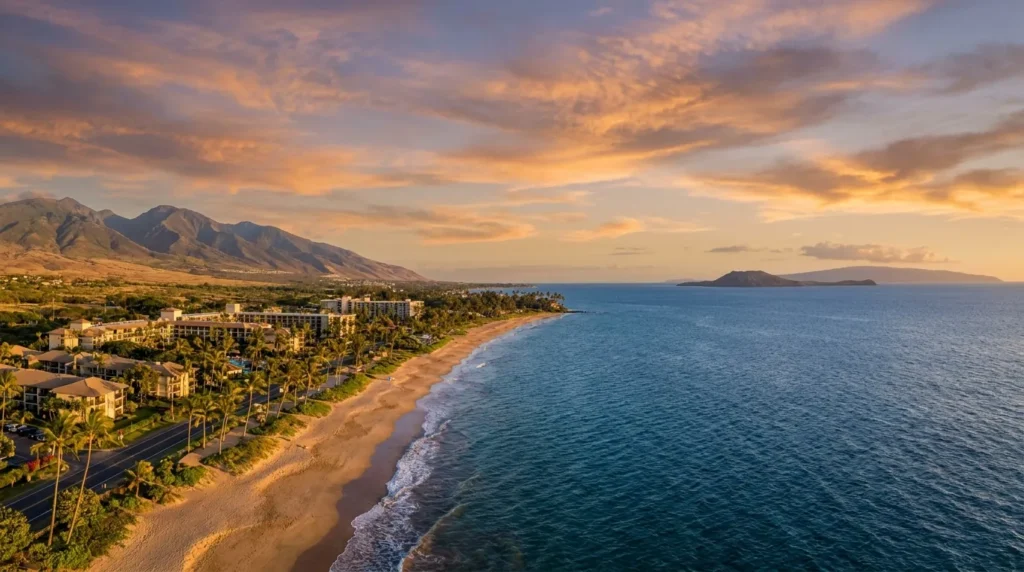
The Kamaole Beach Parks sequence (I, II, and III) defines outdoor life in Kihei. White sand, restrooms, barbecue grills, and generally calm water make them favorites for families. Farther north is Kalama Park, with a playground, courts, and a stage for events. To the south, Wailea Beach and Polo Beach offer a more upscale setting.

The Hawaiian Islands Humpback Whale National Marine Sanctuary is headquartered in Kihei and maintains a free visitor center explaining humpback whale migration. From December to April, whales can be seen from the beach itself. Boat tours departing from Maalaea Harbor are popular and well-regulated.

For day trips, Haleakala National Park (a nearly 10,000-foot volcano) is about an hour and a half by car and offers an iconic sunrise from the summit. The Road to Hana, with waterfalls and tropical forests, is a classic excursion. Snorkeling at Molokini Crater, diving at Turtle Town, and kayaking at La Perouse Bay round out the outdoor offerings.

  1. 1Kamaole Beach Parks I, II and III
  2. 2Kalama Park
  3. 3Hawaiian Islands Humpback Whale National Marine Sanctuary
  4. 4Wailea Beach Path
  5. 5Maui Ocean Center (in Maalaea)
  6. 6Big Beach (Oneloa)
Parks & green spaces
  • Kalama Park
  • Kamaole Beach Park I
  • Kamaole Beach Park II
  • Kamaole Beach Park III
  • Kihei Wetlands (Kealia Pond National Wildlife Refuge)
  • +1 more

Historic Filipino community, mainlanders, and international worker flow

The Filipino community in Kihei is the largest among foreign-born groups, complemented by Japanese, Mexican, Micronesian, and mainland US residents.

Kihei's migration history is tied to the sugarcane and pineapple plantations that dominated Maui in the 20th century. Filipino, Japanese, Chinese, Korean, and Portuguese workers arrived in successive waves and formed the current demographic base. The Filipino community remains the most visible, with Catholic churches offering services in Tagalog and Ilocano, markets like Maui Marketplace, and festivals such as Barrio Fiesta.

In recent decades, the main flow has been mainland Americans seeking retirement, second homes, or an outdoor lifestyle. There is also a growing presence of Micronesians and Marshallese, particularly in services and construction. Mexicans and Central Americans work primarily in landscaping, construction, and restaurant kitchens.

For newcomers, initial connections typically happen through churches, children's schools, surf groups, and volunteering with environmental or community nonprofits. The Maui Filipino Chamber of Commerce and Asian cultural centers in Kahului offer integration programs. The sense of ohana (extended family) makes it easier to build bonds, though respecting local culture and learning at least the basics of Hawaiian and Pidgin are part of settling in.

4,500
Foreign-born residents
estimated
Top countries of origin
  • Philippines
  • Japan
  • Mexico
  • Marshall Islands
  • Micronesia
  • China
  • South Korea
  • Vietnam
Foreign consulates
  • Consulate General of Japan in Honolulu
  • Consulate General of the Philippines in Honolulu
  • Consulate General of Mexico in Honolulu
  • Consulate General of South Korea in Honolulu
  • Micronesian Consular Office in Honolulu
Community organizations
  • Maui Filipino Chamber of Commerce
  • Binhi at Ani Filipino Community Center
  • Maui Economic Opportunity (MEO)
  • Catholic Charities Hawaii
  • Maui Family YMCA
  • Hawaii Immigrant Justice Center

Latest posts

Straight from the blog

There are no posts specifically about Kihei yet. In the meantime, check out our latest posts.