Visto n' Visa
Blog
Notícias e artigos
Destinations
Careers
Immigrants

Want to live and work in Savannah?

Personalized immigration plan with eligible visas, costs, and next steps for your goal!

If you are not eligible, you will know exactly why and what to do to improve your approval chances.

Save up to 12 hours in meetings

No pointless assessments.

Save up to 90%

Save money on vague or unfocused consultations

Avoid Fraud and Mistakes

One mistake can cost you your visa

Total Impartiality

Zero commercial bias

Decide with peace of mind

No toxic urgency

Fast and Accurate

Answers in minutes, no guesswork

A majority-Black city with a Gullah-Geechee heritage

African Americans form the majority, with strong Gullah-Geechee coastal traditions. White residents make up the second-largest share, and the Hispanic population is growing. SCAD draws students from over 100 countries.

Savannah has an African American majority, at around 53% of the population, with non-Hispanic whites representing about 38% and Hispanics growing toward 7%. The African American heritage is deep and historically tied to the Gullah-Geechee culture, descendants of enslaved Africans who preserved a creole language, cuisine, and distinct traditions on the sea islands of Georgia and South Carolina.

SCAD attracts students from more than 100 countries, giving downtown an unexpectedly cosmopolitan layer for a city of this size in the South. There is a modest Asian community (Vietnamese, Korean, Indian), a small Brazilian presence linked to Gulfstream and the port, and a Hispanic community concentrated in neighborhoods such as Garden City and parts of Pooler.

English is the dominant language, with a distinct coastal Southern accent. Spanish is functional in commerce and construction. Some communities on the Sea Islands (Sapelo, Pin Point) still preserve Geechee as a family language. Religiously, Savannah is part of the Bible Belt, but with a stronger Catholic presence than is typical of inland Georgia, a legacy of Irish immigrant settlement. The Cathedral of Saint John the Baptist is one of the city's landmarks.

Languages spoken
  • English
  • Spanish
  • Geechee Creole
  • Korean
Main religions
  • Protestant Christianity
  • Catholicism
  • No religion
  • Judaism

Moderate costs overall, with rising rents in the Historic District

Total cost of living is below the national average, but the Historic District has become expensive. Neighborhoods farther out remain affordable. Georgia's state tax is moderate; hurricane insurance adds to housing costs.

Savannah has become more expensive in recent years due to growing tourism and an influx of retirees, but overall costs remain reasonable by American standards. Rents for a one-bedroom apartment in the Historic District or Starland District have risen significantly and can approach national averages. In neighborhoods such as Midtown, Ardsley Park, or Southside, more affordable options remain. Purchasing property in historic neighborhoods has become a high-capital endeavor.

Georgia levies a moderate state income tax, around 5.39%. Groceries at Kroger, Publix, and Walmart are reasonably priced. Small Latin markets operate in Garden City and Pooler. Gas is inexpensive. Summer electricity bills are substantial, with air conditioning running nearly continuously. Homeowner's insurance has risen because of hurricane and tidal flood risk, particularly for properties near the Savannah River or on the barrier islands.

Dining out is central to local life, but can be costly. Restaurants in the Historic District carry prices inflated by tourist demand. In Starland, Habersham Village, and Sandfly, good meals are available at lower prices. Parking in the Historic District is paid and competitive; residents typically hold permits. Remote work growth has drawn professionals from other states, adding pressure to the housing market.

87Cost index (US = 100)13% below US average
CategorySingleCoupleFamily (2 + 2)
iHousing$1,141$1,317$1,668
iFood$334$667$1,212
iTransport$439$746$965
iHealthcare$246$491$922
iChildcare$1,597
iOther$746$1,343$1,887
Monthly total$2,906$4,564$8,251

Source: U.S. BLS Consumer Expenditure Survey 2023 + BEA Regional Price Parities 2023 · Estimates in USD, monthly.

Historic homes, coastal islands, and expanding suburbs in Pooler

The Historic District has expensive mansions and townhouses. Ardsley Park, Midtown, and Starland attract families. Tybee Island offers beach living. Pooler is a fast-growing suburb. Rentals require standard credit screening.

Savannah's real estate market is a patchwork. The Historic District contains antebellum mansions, nineteenth-century townhouses, and apartments in restored buildings, priced high by state standards. Starland District is the creative favorite, with renovated homes and craft breweries. Ardsley Park, designed in the 1910s, has large family homes on tree-lined streets and is among the most sought-after neighborhoods. Midtown and Habersham Village serve professionals and families.

For more affordable options, Southside has newer condominiums and family homes at lower price points, with schools of varying quality. Tybee Island, 30 minutes out, is beach living, offering expensive oceanfront homes and more affordable rental cottages. Wilmington Island and Skidaway Island are suburban, with nautical clubs. Pooler, to the west near the airport and the Gulfstream plant, has become a rapidly expanding suburb of new family homes.

Rentals follow standard American credit screening, with one to two months' security deposit typical. In the Historic District, many properties operate as short-term rentals through platforms like Airbnb due to tourism demand, which reduces long-term rental supply and pushes prices up. Property taxes are moderate, with a homestead exemption available to residents. Hurricane and flood insurance factor into the budget for properties near water.

Recommended neighborhoods
  • Ardsley Park
  • Starland District
  • Historic District
  • Midtown
  • Habersham Village
  • +3 more

Port, tourism, Gulfstream, SCAD, and healthcare

The Port of Savannah, Gulfstream Aerospace (business jets), SCAD, and hospitals anchor the economy. Tourism employs large numbers in hospitality. Logistics continues to grow alongside port expansion.

Savannah's job market rests on strong pillars. The Port of Savannah, operated by the Georgia Ports Authority, is the fourth-largest container port in the United States and the largest export port serving a single metro area. It generates activity in trucking, rail (CSX, Norfolk Southern), warehousing, and thousands of jobs in logistics and operations. Ongoing port expansion continues to create positions in construction and operations.

Gulfstream Aerospace, manufacturer of business jets, is headquartered and operates its main factory in Savannah, employing thousands in engineering, assembly, and support. It is one of Georgia's largest private employers. SCAD employs many in teaching, administration, events, and gallery operations. Memorial Health University Medical Center and St. Joseph's/Candler are the regional reference hospitals.

Tourism drives hospitality employment. Hotels in the Historic District, bed-and-breakfasts, restaurants, and tour operations employ thousands, with peak activity in spring and fall. For those arriving with intermediate English, openings exist in hospitality, construction, logistics, and production. Manufacturing is also a strong employer: Hyundai opened a major electric vehicle plant in Bryan County, near Savannah, in 2024.

Dominant sectors
  • Port logistics
  • Aerospace manufacturing
  • Tourism and hospitality
  • Higher education and arts
  • Healthcare
  • +1 more
Major employers
  • Georgia Ports Authority
  • Gulfstream Aerospace
  • Hyundai Motor Group Metaplant America
  • SCAD
  • Memorial Health
  • +1 more

SCAD, Savannah State, the Armstrong Campus, and variable K-12 options

SCAD is a world-recognized art and design institution. Savannah State is an HBCU. Georgia Southern's Armstrong Campus is the public undergraduate option. The strongest K-12 schools are in northern Chatham County and on the islands.

Savannah College of Art and Design (SCAD) is a private institution founded in 1978 that has become a global reference in graphic design, animation, fashion, film, and architecture. It operates campuses in Savannah, Atlanta, Hong Kong, and Lacoste, France, and draws students from more than 100 countries. Tuition is high, but merit scholarships are available.

Savannah State University is a historically Black public university founded in 1890, with strong programs in marine sciences and biology. Georgia Southern University operates the Armstrong Campus (formerly Armstrong State) in Savannah, offering programs in health sciences and education. Savannah Technical College provides vocational training and has a formal partnership with Gulfstream for aeronautical mechanics programs.

At the K-12 level, the Savannah-Chatham County Public School System operates schools with varying performance. Magnet schools such as Savannah Arts Academy, Jenkins High, and Woodville-Tompkins Technical have strong reputations. Private options include Savannah Country Day School (secular) and Saint Vincent's Academy (Catholic). For immigrant families, the public school system is free and operates ESOL programs serving students without fluent English.

Notable universities
  • Savannah College of Art and Design
  • Savannah State University
  • Georgia Southern University (Armstrong Campus)
  • Savannah Technical College

Two main hospital systems serving the Georgia coast

Memorial Health University Medical Center and St. Joseph's/Candler handle high-complexity care. Memorial is the only Level I trauma center on the Georgia coast. Private insurance is the norm.

Healthcare in Savannah is strong for the coastal region. Memorial Health University Medical Center is the only Level I trauma center on the Georgia coast and the leading high-complexity hospital, with cardiology, oncology, neurosurgery, and pediatrics (Backus Children's Hospital). It serves a broad catchment area that includes parts of South Carolina and southern Georgia.

St. Joseph's/Candler is the second major system, Catholic-affiliated, with two main hospitals and a tradition in cardiology, robotic surgery, and oncology. Both systems compete for patients and cover most common healthcare needs. Highly specialized or rare cases are referred to Atlanta (Emory) or Jacksonville.

The standard American coverage model applies: private insurance through an employer or through Healthcare.gov. Without insurance, emergency care can be extremely expensive. Federally qualified community health centers, such as J.C. Lewis Primary Health Care Center, provide care on a sliding-fee scale or at no cost for those who qualify. Spanish-speaking physicians serve the Latino community; a smaller number serve Portuguese-speaking patients, particularly in communities tied to the port and Gulfstream.

Healthcare index65.0 / 100
  • Life expectancyyears at birth
    78.4yrs
  • Doctors per 1kpracticing physicians
    3.7
  • Health spendper capita, per year
    $13,473
  • Public systemoverall quality rating
    Fair

Historic District is safe by day; exercise caution at night and in specific neighborhoods

The Historic District is safe during the day, with normal precautions at night. Some areas to the west and south have above-average crime rates. The most serious risk is a hurricane, which can trigger mandatory evacuation orders.

Safety in Savannah varies by neighborhood and time of day. The Historic District is considered safe during the day, with heavy tourist foot traffic and visible patrols. At night, on darker side streets and around the bars of River Street, extra attention to personal belongings is warranted. Ardsley Park, Habersham Village, Wilmington Island, Tybee Island, and Pooler are calm, low-crime neighborhoods.

Areas to the west of downtown (West Savannah, parts of Cuyler-Brownsville) and to the south, in neighborhoods such as Yamacraw Village, record higher rates of violent and property crime. As with any mid-sized American city, researching a specific block before signing a lease is advisable. The Savannah Police Department publishes crime maps and maintains a dedicated unit for the tourist district.

The most serious natural risk is a hurricane. Savannah has faced mandatory evacuation orders multiple times in recent years (Matthew in 2016, Irma in 2017, Dorian in 2019). Older homes in the Historic District were built to withstand storms, but coastal zones (Tybee Island, Wilmington Island) are the first to be evacuated. Hurricane and flood insurance is a budget line item for properties near water, and a household evacuation plan is essential from June through November.

5.8
Homicides per 100k
per year
Safety index
42.0
Crime index
58.0
Safer neighborhoods
  • Historic District (north)
  • Ardsley Park
  • Gordonston
  • Isle of Hope
  • Tybee Island
  • Skidaway Island
  • Starland District
Areas to avoid
  • Cuyler-Brownsville at night
  • Parts of West Savannah after dark
  • Yamacraw Village during late hours
  • Isolated areas near MLK Boulevard at night

Walkable downtown, car required elsewhere

The Historic District is walkable and tourist-friendly. A car is essential for the rest of the city. Chatham Area Transit provides basic bus service. The regional airport offers direct flights to multiple hubs.

Savannah offers a rare advantage for the South: the historic core is genuinely walkable. The 22 squares, compact blocks, and dense tree canopy allow residents and visitors to reach most destinations on foot or by bicycle within a short radius. Free CAT trolleys cover tourist routes within the historic center. Those living in the Historic District can manage without a personal vehicle.

Outside the Historic District, a car is necessary. I-95 runs north-south to the west of the city, I-16 connects to Macon and Atlanta, and US-17 leads into South Carolina. Chatham Area Transit (CAT) operates bus routes with limited coverage and low frequency. Uber and Lyft function well downtown and for medium-distance trips. Traffic is light by American standards, with minor congestion in the historic center during tourist season.

Savannah/Hilton Head International Airport, in Pooler, operates direct flights to more than 25 destinations, including New York, Boston, Chicago, Atlanta, Dallas, and Washington. Most major domestic carriers serve the airport. No scheduled international commercial flights operate from Savannah; connections to Latin America or Europe require a layover in Atlanta, Charlotte, or Miami. The Port of Savannah accommodates occasional cruise calls.

19 min
Avg commute
48
Walkability
Airports
  • SAV — Savannah/Hilton Head International Airport
  • International airport
  • Bike infrastructure

What the Climate Is Like Living in Savannah

A historic coastal Georgia city with very hot, humid summers near 33 degrees Celsius, mild winters, and Atlantic breezes across all seasons.

Savannah's summer is long and oppressive. From May through September, highs range between 31 and 34 degrees Celsius, with high humidity and afternoon thunderstorms. The Atlantic breeze provides some relief near the coast, but central air conditioning is an essential feature of any residence.

Winter is mild and brief. From December through February, highs range between 14 and 18 degrees Celsius and lows approach 4 degrees, with occasional frost and extremely rare snowfall. Central heating is useful, but medium-weight coats handle most days of the season.

Spring and fall are the seasons favored by residents and visitors alike. Spring brings intense blooming across the historic squares, and fall moderates the heat without bringing cold. Hurricane season weighs on the city from August through October, requiring evacuation planning and adequate insurance coverage.

Sunny days / year220 days
Avg high (°F)
  • 62°J
  • 67°F
  • 72°M
  • 77°A
  • 83°M
  • 87°J
  • 90°J
  • 88°A
  • 85°S
  • 79°O
  • 68°N
  • 64°D
Avg low (°F)
  • 45°J
  • 49°F
  • 53°M
  • 57°A
  • 65°M
  • 71°J
  • 74°J
  • 74°A
  • 69°S
  • 62°O
  • 51°N
  • 47°D
Rainfall (")
  • 3"J
  • 3"F
  • 4"M
  • 4"A
  • 3"M
  • 6"J
  • 6"J
  • 7"A
  • 5"S
  • 3"O
  • 4"N
  • 4"D

Preserved colonial culture, Gullah heritage, festivals, and SCAD-driven arts

Savannah is a culturally dense destination. Colonial architecture, Gullah-Geechee heritage, film history (Forrest Gump was filmed here), jazz and film festivals, and an arts scene fueled by SCAD define the city.

Savannah holds a singular cultural position in the South. The historic core is the largest National Historic Landmark District in the country. Colonial, Federal, Gothic Revival, and antebellum architecture lines streets canopied by oak trees draped in Spanish moss. The Mercer Williams House and Davenport House offer windows into local history. Forrest Gump was filmed in Chippewa Square, and the iconic bench is now on display at the Savannah History Museum.

The Gullah-Geechee heritage is an essential part of the city's identity. The Pin Point Heritage Museum, located in a Gullah community, and the Beach Institute, an African American art and history center, preserve and interpret this history. The First African Baptist Church, founded in 1773, is one of the oldest Black churches in the United States. The Owens-Thomas House includes a preserved slave quarters interpreted as a museum, addressing the history of enslavement directly.

The culinary scene draws on Southern cooking with a coastal character: low country boil (shrimp, corn, and potatoes simmered together), shrimp and grits, oysters, and biscuits with gravy. The Olde Pink House, Mrs. Wilkes' Dining Room, and Husk Savannah are established references. Festivals include the Savannah Music Festival (April), the SCAD Savannah Film Festival (October), and the famous St. Patrick's Day Parade, one of the largest in the United States, which takes over the city on March 17.

What to See in Savannah: Historic Squares and the River

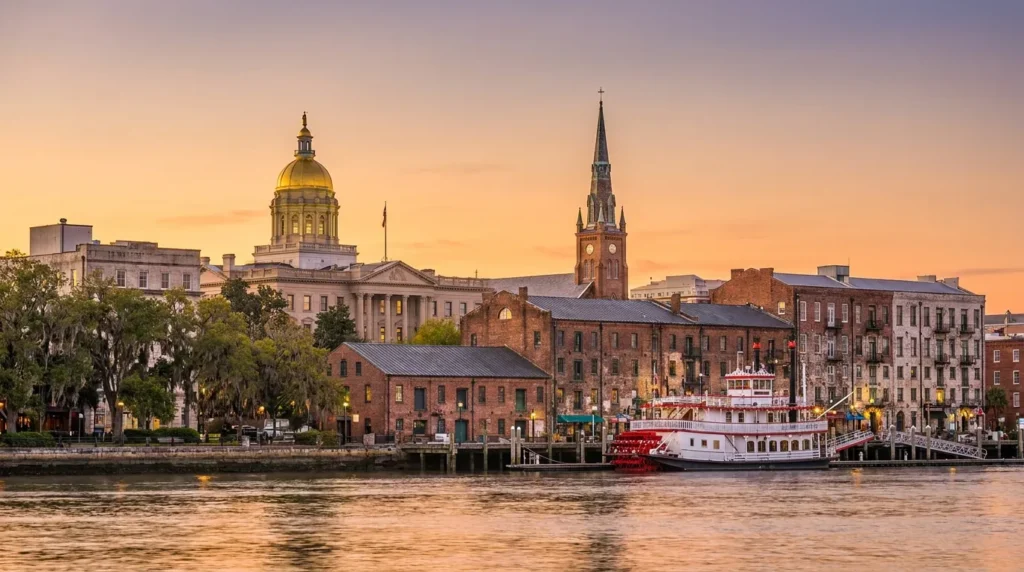
Savannah is Georgia's oldest city, founded in 1733. Twenty-two tree-lined squares in the historic district, antebellum homes, and the Savannah River define daily life.

The Historic District, roughly one square kilometer, contains 22 squares including Forsyth Square (with its iconic fountain), Chippewa Square (where Forrest Gump was filmed), and Monterey Square (home to the Mercer-Williams House from Midnight in the Garden of Good and Evil). River Street, paved in cobblestone, runs along the Savannah River with restaurants, bars, and riverboat tours.

The Telfair Museums (comprising Telfair Academy, Owens-Thomas House, and Jepson Center) span art from the antebellum South to contemporary works. The SCAD Museum of Art reflects the influence of the Savannah College of Art and Design, which occupies more than 90 buildings throughout the city. The Cathedral Basilica of St. John the Baptist stands as one of the South's most prominent religious landmarks.

Bonaventure Cemetery, draped in Spanish moss-covered oaks, draws as many visitors as any museum. Tybee Island, 30 minutes away, offers beaches and Georgia's oldest lighthouse. Life in Savannah slows in the humid summer heat, with high mosquito activity, and reaches a festive peak on St. Patrick's Day, the second largest celebration in the country after New York City.

  1. 1["Forsyth Park"
  2. 2"River Street"
  3. 3"Bonaventure Cemetery"
  4. 4"Mercer-Williams House Museum"
  5. 5"Telfair Museums (Jepson Center
  6. 6Owens-Thomas)"
Nightlife7.0 / 10
Parks & green spaces
  • ["Forsyth Park"
  • "Daffin Park"
  • "Lake Mayer Park"
  • "Wormsloe Historic Site (oak avenue)"
  • "Skidaway Island State Park"
  • +1 more

Latest posts

Posts about Georgia

Coverage and updates related to this destination.

Showing content from Georgia, as there is no specific data for Savannah yet.