Visto n' Visa
Blog
Notícias e artigos
Destinations
Careers
Immigrants

Want to live and work in Augusta?

Personalized immigration plan with eligible visas, costs, and next steps for your goal!

If you are not eligible, you will know exactly why and what to do to improve your approval chances.

Save up to 12 hours in meetings

No pointless assessments.

Save up to 90%

Save money on vague or unfocused consultations

Avoid Fraud and Mistakes

One mistake can cost you your visa

Total Impartiality

Zero commercial bias

Decide with peace of mind

No toxic urgency

Fast and Accurate

Answers in minutes, no guesswork

Majority Black city with a diverse military presence

Augusta has an African American majority, with a white population, a growing Hispanic community, and military personnel of all backgrounds stationed at the base. English dominates; Spanish is expanding in commerce.

Augusta's demographic profile is defined by its Black majority, around 56% of the population, a legacy of the American South's history. Non-Hispanic whites account for roughly 34%, and the Hispanic community is growing, currently estimated at 5 to 7%, led by Mexicans, Puerto Ricans, and Central Americans. There is a small Asian community, concentrated primarily in healthcare and technology.

The Fort Eisenhower military presence introduces a diversity uncommon in inland Georgia: soldiers' families, officers, and civilians from every U.S. state, with a strong number of Hispanic and East Coast African American residents, along with some Korean and Filipino families. This diversity is reflected in schools and neighborhoods near the base.

English is the common language, with a Southern accent milder than many expect. Spanish is present in retail and construction. Religiously, Augusta falls within the Bible Belt, with a strong Baptist, Methodist, and Black Pentecostal church presence. There is a historical Catholic community tied to Italian and Irish families, along with small synagogues and a mosque serving the diverse military population.

Languages spoken
  • English
  • Spanish
  • Korean
  • Tagalog
Main religions
  • Protestant Christianity
  • Catholicism
  • No religion
  • Judaism

One of the lowest costs of living among mid-sized U.S. cities

Cheap rents, viable homeownership on a median salary, affordable groceries, and low gas prices. Georgia's state income tax is moderate. Summer electricity bills are the heaviest expense.

Augusta ranks among the most affordable mid-sized cities in the Southeast. Rent for a one-bedroom apartment falls well below the national average, even in desirable neighborhoods like Summerville or near Augusta University. Buying a home is realistic for tech professionals or military personnel, with three-bedroom houses available at price points that would be unthinkable in Atlanta or Florida.

Georgia's state income tax is moderate, around 5.39%. Groceries at Kroger, Publix, and Walmart are reasonably priced. Large Latin grocery stores are absent, but ethnic shops on Wheeler Road and Peach Orchard Road provide adequate options. Gas is inexpensive. Summer electricity bills can run high due to air conditioning use from May through September.

Dining out is honest value. A Southern buffet lunch for 10 to 15 dollars is easy to find at places like Sconyers Bar-B-Que. More upscale restaurants exist in Downtown and Summerville at prices well below Atlanta. Parking in the city is free or cheap, and vehicle wear is lower than in major metros given the short distances involved.

98Cost index (US = 100)2% below US average
CategorySingleCoupleFamily (2 + 2)
iHousing$1,277$1,474$1,867
iFood$374$747$1,357
iTransport$491$835$1,080
iHealthcare$275$550$1,032
iChildcare$1,788
iOther$835$1,504$2,113
Monthly total$3,252$5,110$9,237

Source: U.S. BLS Consumer Expenditure Survey 2023 + BEA Regional Price Parities 2023 · Estimates in USD, monthly.

Spacious homes in historic neighborhoods and new suburban developments

Summerville and The Hill are historic districts with older homes. Evans and Martinez, in the adjacent county, attract military families. Augusta rents are among the most affordable in the state.

Augusta offers a varied real estate landscape. Summerville, surrounding Augusta University, is the most charming historic neighborhood, with renovated Victorian homes, tree-lined streets, and a university-connected population. The Hill, adjacent to Summerville, follows a similar character. Downtown Augusta has newer residential buildings and lofts in converted warehouses near the Riverwalk.

For families, most newcomers gravitate toward Columbia County, specifically Evans and Martinez. That area contains some of the best public school districts in the state and new subdivisions with four-bedroom homes at competitive prices. North Augusta, on the South Carolina side, is a popular choice for military families because of the different state tax structure and the short commute to the base. Hephzibah, to the south, offers cheaper homes in a more rural setting.

Renting requires standard American credit checks and one to two months' security deposit. For military personnel, there is a robust month-to-month rental market that does not require a formal guarantor, as many arrive under transfer orders. Property tax in Georgia is moderate, and the state offers a discount for owner-occupied residences through the homestead exemption.

Recommended neighborhoods
  • Summerville
  • The Hill
  • Evans
  • Martinez
  • North Augusta
  • +2 more

Military cybersecurity, healthcare, paper and pulp, retail

Fort Eisenhower and the U.S. Army Cyber Command employ thousands. Augusta University Medical Center is the largest civilian employer. International Paper's industry defines the regional economy.

Augusta's labor market is driven by three fronts. The first is the Fort Eisenhower military and cyber complex, which houses the U.S. Army Cyber Command and the National Security Agency Georgia, employing thousands of soldiers, Department of Defense civilians, and contractors from firms such as Booz Allen Hamilton, Leidos, and Lockheed Martin. For those working in cybersecurity with security clearance, it is one of the most stable hubs in the country.

The second front is healthcare. Augusta University Medical Center, with its affiliated medical school, is one of the region's largest civilian employers. Trinity Hospital and Doctors Hospital supplement the network. The third front is industrial: International Paper, Graphic Packaging, and DSM operate plants in Augusta, and the Savannah River Site, a federal nuclear complex under the Department of Energy, sits across the river in Aiken.

For those arriving without a military connection or clearance, openings exist in healthcare, retail, hospitality, and construction. Average salaries are lower than in Atlanta, but the cost of living compensates. Intermediate English speakers find opportunities in logistics and services. Remote work expanded after the pandemic and has drawn professionals who take advantage of the city's low cost of living.

Dominant sectors
  • Cybersecurity and defense
  • Healthcare
  • Paper and pulp
  • Nuclear energy
  • Higher education
  • +1 more
Major employers
  • Fort Eisenhower / U.S. Army Cyber Command
  • Augusta University Medical Center
  • Savannah River Site
  • International Paper
  • Graphic Packaging
  • +1 more

Augusta University and strong school districts in Columbia County

Augusta University is the main public university, with a respected medical school. K-12 schools in Columbia County (Evans, Martinez) rank among the best in Georgia.

Augusta University is the region's largest public university, the product of several institutional mergers and a recognized leader in medicine (Medical College of Georgia), nursing, dentistry, computer science, and cybersecurity. Its cyber program, developed in partnership with Fort Eisenhower, draws students from across the country. Paine College, a historically Black college, offers undergraduate programs in the humanities. Augusta Technical College serves technical training and is well aligned with the military workforce profile.

At the K-12 level, the gap between Richmond County (Augusta city) and Columbia County (Evans, Martinez) is significant. Columbia County holds some of the state's highest-rated districts, with schools such as Lakeside High School and Greenbrier High School receiving consistently strong evaluations. Richmond County has strong magnet schools, including Davidson Fine Arts and Lucy Craft Laney, but the district average is lower overall. Private options such as Augusta Preparatory Day School serve families with larger budgets.

For immigrant families with children, the public school system is free and requires only proof of address. ESOL programs serve students without fluent English, and the military presence means schools are accustomed to families arriving mid-year without prior notice. Some schools are expanding Spanish immersion programs, particularly in Columbia County.

Notable universities
  • Augusta University
  • Medical College of Georgia
  • Paine College
  • Augusta Technical College
  • Georgia Military College

Regional medical hub led by Augusta University Medical Center

Augusta serves as a medical reference for eastern Georgia and South Carolina. AU Medical Center, Doctors Hospital, and Charlie Norwood VA handle high-complexity care. Private insurance is the norm.

Healthcare is one of Augusta's genuine strengths. Wellstar MCG Health, embedded within Augusta University, is the primary academic medical center and covers high-complexity care in oncology, cardiology, pediatrics (Children's Hospital of Georgia), and transplants. Doctors Hospital, part of HCA Florida, handles emergency and general surgery. Piedmont Augusta rounds out the network.

Because of the military base, Eisenhower Army Medical Center serves soldiers and their dependents, and the Charlie Norwood Department of Veterans Affairs Medical Center serves veterans. This means a significant portion of the population holds Tricare or VA coverage, which improves access and reduces out-of-pocket costs for those enrolled.

For civilians without a military connection, the standard American system applies: employer-sponsored private insurance or plans purchased through Healthcare.gov. Without insurance, emergency care can be extremely expensive. Community clinics such as Christ Community Health Services offer sliding-scale fees based on income. Augusta has a reasonable supply of Brazilian and Hispanic physicians, concentrated primarily around the university.

Healthcare index63.0 / 100
  • Life expectancyyears at birth
    78.4yrs
  • Doctors per 1kpracticing physicians
    3.7
  • Health spendper capita, per year
    $13,473
  • Public systemoverall quality rating
    Fair

Safety varies by neighborhood: Columbia County is quiet, the city is mixed

Evans, Martinez, and Summerville are safe. Certain areas of Augusta city, especially east and south of downtown, have higher crime rates. The primary risks are theft and residential burglary.

Safety in Augusta varies considerably. Neighboring cities in Columbia County, such as Evans and Martinez, have very low crime rates and rank among the safest areas in Georgia. North Augusta on the South Carolina side is also calm. Within Augusta city, Summerville and The Hill are safe, but areas to the east and south of downtown, including older parts of Olde Town and Harrisburg, record above-average crime rates.

The most common crimes are opportunistic vehicle theft and residential burglary. Violent crime exists but is concentrated in specific zones. As in most mid-sized American cities, checking the block before signing a lease and reviewing crime maps from the Augusta Police Department is recommended. Law enforcement and military presence is strong around Fort Eisenhower.

The most relevant natural hazard is tornadoes in spring. Augusta also experiences occasional ice storms that can paralyze the city. Hurricanes arrive weakened but can bring heavy rainfall and downed trees. Comprehensive homeowner's insurance, a flashlight, water supply, and an evacuation plan are advisable, particularly for those living in single-story homes without a basement.

5.8
Homicides per 100k
per year
Safety index
44.0
Crime index
56.0
Safer neighborhoods
  • Summerville (Hill area)
  • West Augusta
  • Forest Hills
  • Walton Way Extension
  • National Hills
  • Martinez (neighboring city)
Areas to avoid
  • South Augusta in certain stretches at night
  • Areas along Deans Bridge Road after dark
  • Harrisburg at late hours
  • Industrial areas near the Savannah River

Car-dependent city with limited public transit and a small regional airport

Augusta requires a personal vehicle. There is no metro system; Augusta Public Transit buses cover only basic routes. The regional airport connects to hubs such as Atlanta and Charlotte with short flights.

Augusta is, plainly, a car-dependent city. Interstate 20 cuts through the region east to west, connecting to Atlanta three hours away and to Columbia, SC, one hour away. Interstate 520 forms a partial beltway around the city. Washington Road, Wrightsboro Road, and Walton Way are the main urban arteries. Traffic exists during peak hours around Fort Eisenhower and Augusta University, but nothing comparable to major metros.

Augusta Public Transit operates buses on limited routes with low frequency, serving primarily those traveling to the university or downtown. The service is insufficient for workers with variable schedules. There is no metro or light rail. Uber and Lyft operate in the city but with lower availability than in larger markets, though prices tend to be reasonable.

Augusta Regional Airport, close to downtown, operates Delta flights to Atlanta and American Airlines flights to Charlotte and Dallas, with connections to the rest of the country. For international flights, most residents drive to Hartsfield-Jackson Atlanta International Airport, roughly two and a half hours away. Car rentals are readily available at both airports.

22 min
Avg commute
34
Walkability
Airports
  • AGS — Augusta Regional Airport
  • DNL — Daniel Field
  • Bike infrastructure

What the climate is like living in Augusta

A city in eastern Georgia with hot, humid summers reaching around 91°F, mild winters with occasional frost, and long transitional seasons.

Augusta's summer is long and hot. From May through September, highs range from 88 to 93°F, with high humidity and afternoon thunderstorms. Central air conditioning is standard in all area homes, and summer electricity bills tend to be substantial.

Winter is mild and brief. From December through February, highs range from 55 to 63°F and lows hover near 37°F, with occasional frost and rare snowfall. Central heating is useful, but a medium-weight coat handles most days of the year.

Spring and fall are the seasons residents prefer most. The Masters golf tournament takes place in April, during the spring. The overall climate is comfortable, with a gradual transition between seasons.

Sunny days / year218 days
Avg high (°F)
  • 58°J
  • 63°F
  • 70°M
  • 76°A
  • 83°M
  • 88°J
  • 92°J
  • 90°A
  • 85°S
  • 77°O
  • 66°N
  • 60°D
Avg low (°F)
  • 41°J
  • 45°F
  • 50°M
  • 55°A
  • 63°M
  • 70°J
  • 74°J
  • 73°A
  • 67°S
  • 58°O
  • 48°N
  • 43°D
Rainfall (")
  • 5"J
  • 4"F
  • 4"M
  • 4"A
  • 3"M
  • 4"J
  • 4"J
  • 4"A
  • 3"S
  • 3"O
  • 3"N
  • 4"D

Masters golf, James Brown's music, and Southern tradition

Local culture blends Southern heritage, the Black gospel and soul tradition (Augusta is James Brown's hometown), the Masters Tournament each April, and a modest theater and arts scene in Downtown.

The Masters Tournament, held during the first week of April at Augusta National, is the event that defines the city's external identity. Hotels fill up, restaurants run at capacity, and locals often rent out their homes for considerable sums. Even those with no interest in golf feel the impact. Beyond that, local culture is classically Southern: Baptist churches, music festivals, buffet cooking, warmth, and a slower pace.

James Brown, the Godfather of Soul, grew up in Augusta, and the city has a statue of him downtown on the street bearing his name (James Brown Boulevard). The Augusta Museum of History dedicates an entire wing to him. The Riverwalk, along the Savannah River, hosts walking paths and events such as the Westobou Festival, Arts in the Heart of Augusta, and the Ironman 70.3 Augusta each September.

The food scene features Southern buffets of ribs, fried chicken, mac and cheese, and collard greens (Sconyers Bar-B-Que, Boll Weevil Cafe). A craft brewery scene is emerging downtown (Riverwatch Brewery, Savannah River Brewing). Honest Mexican restaurants and small Korean establishments serve the military community. For more refined dining, Frog Hollow Tavern and Craft & Vine in Downtown are the standard references.

Augusta

Home of the Masters golf tournament and the Savannah River on the South Carolina border

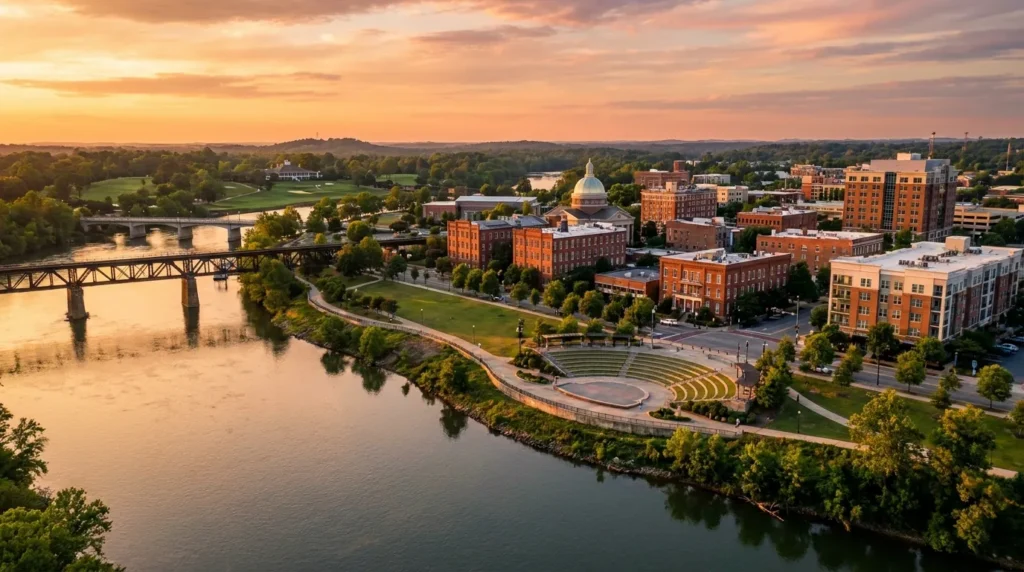
Georgia's second-largest city, known for the Masters Tournament at Augusta National, the Riverwalk along the Savannah River, and a strong military and medical presence tied to Fort Eisenhower.

Augusta reaches its annual peak in April, when the Masters Tournament draws golf fans from around the world to Augusta National Golf Club. Outside that week, the club remains closed, but the city stays active thanks to Fort Eisenhower (formerly Fort Gordon), AU Health (a university medical center), and the Cyber Command, which has attracted cybersecurity professionals in recent years.

The Riverwalk along the Savannah River is a pleasant destination in any season, featuring restaurants, the Morris Museum of Art (dedicated to Southern art), and Augusta Common, where festivals take place. The James Brown Statue on Broad Street commemorates Augusta as the hometown where the Godfather of Soul grew up, and the Imperial Theatre maintains an active cultural calendar.

Phinizy Swamp Nature Park, to the southeast, is a refuge for birdwatching and turtle spotting, with boardwalks over the wetlands. The Augusta Canal, designated a National Heritage Area, offers canal boat tours and flat trails that follow the historic waterway once used by 19th-century textile mills.

  1. 1["Augusta National Golf Club (Masters)"
  2. 2"Augusta Riverwalk"
  3. 3"Morris Museum of Art"
  4. 4"Augusta Museum of History"
  5. 5"Boyhood Home of President Woodrow Wilson"
  6. 6"Phinizy Swamp Nature Park"
Nightlife4.0 / 10
Parks & green spaces
  • ["Augusta Riverwalk"
  • "Phinizy Swamp Nature Park"
  • "Pendleton King Park"
  • "Lake Olmstead Park"
  • "Augusta Canal Towpath"
  • +1 more

Latest posts

Posts about Georgia

Coverage and updates related to this destination.

Showing content from Georgia, as there is no specific data for Augusta yet.