Visto n' Visa
Blog
Notícias e artigos
Destinations
Careers
Immigrants

Want to live and work in Albany?

Personalized immigration plan with eligible visas, costs, and next steps for your goal!

If you are not eligible, you will know exactly why and what to do to improve your approval chances.

Save up to 12 hours in meetings

No pointless assessments.

Save up to 90%

Save money on vague or unfocused consultations

Avoid Fraud and Mistakes

One mistake can cost you your visa

Total Impartiality

Zero commercial bias

Decide with peace of mind

No toxic urgency

Fast and Accurate

Answers in minutes, no guesswork

African American majority and a family-oriented profile define the population

Albany has a predominantly African American population, with a strong presence of long-established local families and a recent influx of Latino immigrants connected to agriculture.

Albany is one of the most prominent majority-African American cities in the state, a legacy of its agricultural history and twentieth-century internal migration. Non-Hispanic white residents constitute a significant minority, and there is slow but steady growth in the Hispanic population, primarily of Mexican and Central American origin, tied to harvests, construction, and services.

The age profile is balanced, with a notable share of families with school-age children and retirees who relocated for more affordable housing. Religious communities structure much of social life, with a strong presence of Baptist, Methodist, and Pentecostal churches, as well as Catholic parishes serving the Hispanic community.

The total city population is around 66,000, in slow decline over recent decades, though Dougherty County as a whole carries greater regional weight. For newcomers, the city can feel small and socially segmented by neighborhood, with historically white, Black, and more recently Hispanic areas existing side by side but with limited daily mixing.

Languages spoken
  • English
  • Spanish
Main religions
  • Protestant Christianity (Baptist, Methodist, Pentecostal)
  • Catholicism
  • No religion

One of the lowest costs of living in the southeastern United States

Affordable rent, accessible gas prices, and moderate property taxes make Albany one of the most budget-friendly cities in the American Southeast for families.

Albany is known for a cost of living well below the national average. House rentals with yards cost a fraction of what comparable properties run in Atlanta, Orlando, or Nashville, and home purchase prices rank among the lowest in Georgia. Families relocating from metropolitan areas often find they can trade an apartment for a single-story house with a garage and yard.

Day-to-day expenses are also low. Supermarkets such as Walmart, Publix, and Kroger dominate the city, gas prices tend to stay below the state average, and the electricity bill is the heaviest recurring expense due to nearly continuous air conditioning through summer. Property taxes are moderate, and Georgia maintains a reasonable income tax rate.

The challenge is that wages track the cost: many jobs are in services, agriculture, and public-sector work with modest pay. For remote workers earning big-city salaries, Albany becomes a genuine opportunity to save; for those reliant on the local job market, budgeting still requires planning, particularly around healthcare, a vehicle, and homeowners insurance.

91Cost index (US = 100)9% below US average
CategorySingleCoupleFamily (2 + 2)
iHousing$1,190$1,374$1,740
iFood$348$696$1,264
iTransport$458$779$1,007
iHealthcare$256$513$962
iChildcare$1,667
iOther$779$1,402$1,969
Monthly total$3,031$4,764$8,609

Source: U.S. BLS Consumer Expenditure Survey 2023 + BEA Regional Price Parities 2023 · Estimates in USD, monthly.

Affordable single-family homes, segmented neighborhoods, and few apartment buildings

Single-family houses predominate, with neighborhoods that differ sharply by income and history. Low rents and accessible purchase prices, but with notable variation across different parts of the city.

Albany is a city of houses, not apartment buildings. Most of the housing stock consists of single-family homes on mid-size lots, spread across neighborhoods that developed between the 1950s and 1980s. Apartments exist, primarily along Dawson Road and near Phoebe Putney, but represent a small share of the market.

The city is geographically segmented by the Flint River and corridors like Slappey Boulevard. The northwest side, around neighborhoods such as Northwest Albany, Lake Park, and Doublegate, is home to middle-to-upper-income families, better-rated schools, and tree-lined streets. Downtown and the southern areas contain older historic houses at lower price points, some requiring renovation, and generally less urban infrastructure.

For those arriving, the practical approach is to visit neighborhoods at different times of day before signing a lease, speak with neighbors, and check block-by-block crime data on the local police portal. A three-bedroom house typically rents for far less than in any major American city, making purchase a realistic option even for recent arrivals.

Recommended neighborhoods
  • Northwest Albany
  • Lake Park
  • Doublegate
  • Sherwood
  • Stonebridge
  • +1 more

Military base, hospital, and agribusiness sustain local employment

Marine Corps Logistics Base Albany, the Phoebe Putney Health System, and the peanut and pecan agro-industry are the city's largest employers.

Albany's job market revolves around three engines. The first is Marine Corps Logistics Base Albany, a Marine installation that employs thousands of civilians and military personnel in logistics, maintenance, and administration. It is one of the most stable large employers in southwest Georgia, offering above-average local salaries and federal benefits.

The second is the Phoebe Putney Health System, a regional reference hospital serving the entire area, with ongoing demand for nurses, technicians, physicians, and administrative staff. The third is agribusiness: Albany bills itself as the peanut capital of the world, with processing facilities such as Mars-Wrigley and regional companies tied to pecans, cotton, and livestock.

Beyond those pillars, retail, restaurants, transportation, and smaller manufacturers provide additional employment. Those arriving with technical backgrounds in healthcare, logistics, electrical trades, or retail typically find positions quickly. For recent immigrants, there is recurring demand in construction, landscaping, food processing, and surrounding farmwork, though wages in those sectors tend to be modest.

Dominant sectors
  • Defense and military logistics
  • Healthcare
  • Agribusiness (peanuts, pecans, cotton)
  • Retail
  • Public education
Major employers
  • Marine Corps Logistics Base Albany
  • Phoebe Putney Memorial Hospital
  • Procter & Gamble Albany Plant
  • Mars-Wrigley Confectionery
  • Dougherty County School System
  • +2 more

A historic university and a public school system with ongoing challenges

Albany is home to Albany State University, a century-old HBCU, along with a technical college and public schools consolidated under the Dougherty County School System.

The main higher education institution is Albany State University, a historically Black public university (HBCU) founded in 1903. It offers undergraduate programs in education, health sciences, business, criminal justice, and applied sciences, and serves as one of the city's cultural and economic anchors. For immigrants seeking affordable graduate or undergraduate education, ASU is often a competitively priced option.

Albany Technical College complements the university with career-oriented training in nursing, automotive technology, electrical trades, culinary arts, information technology, and logistics. It serves as an important entry point for those seeking rapid re-entry into the workforce and maintains partnerships with local employers.

Elementary and secondary education falls under Dougherty County School System. Quality varies significantly between schools, and many middle-income families opt for private or charter schools, particularly on the northwest side of the city. Neighborhoods like Lake Park and Sherwood are home to the district's higher-rated public schools.

Notable universities
  • Albany State University
  • Albany Technical College
  • Darton State College (campus integrated into ASU)

Phoebe Putney anchors medical care for the region

Phoebe Putney Memorial Hospital is the reference facility for southwest Georgia, offering services from emergency care to oncology. Complementary clinics and community health centers round out the network.

Healthcare in Albany centers on the Phoebe Putney Health System, which operates Phoebe Putney Memorial Hospital, a regional general hospital. It handles emergency care, cardiology, oncology, obstetrics, orthopedics, and neurology, with capacity to serve not just the city but all of southwest Georgia. Patients from smaller neighboring communities travel here for complex treatments.

Beyond the main hospital, outpatient clinics, imaging centers, and private practices are spread throughout the city. The pediatrics, orthopedics, and cardiology networks are reasonably solid, though highly specialized care, such as transplants or rare surgeries, still requires travel to Atlanta or Jacksonville.

For uninsured immigrants, Albany Area Primary Health Care operates federally qualified health centers (FQHCs) that charge on a sliding-fee scale based on income, providing general medicine, dental, and mental health services. It is one of the most accessible options for newcomers without health insurance, with bilingual services available at several locations.

Albany

Above-average crime rates citywide, with well-defined safer and higher-risk neighborhoods

Albany has property and violent crime rates above the national average, concentrated in specific areas. Northwest neighborhoods are considered the safest.

Albany appears in crime rankings with indicators above the US national average, particularly for property crime and, in specific neighborhoods, violent crime. The local reality reflects a city with well-defined pockets of insecurity, products of decades of economic inequality and population decline.

In practice, the northwest side of the city, around neighborhoods like Doublegate, Lake Park, Sherwood, and Northwest Albany, has low violent crime rates and a calm profile, with middle-class homes, private schools, and organized commercial areas. The east-central and southern parts of the city account for most police reports, particularly in blocks with deteriorated housing and inadequate street lighting.

Newcomers typically adapt well by following three basic precautions: researching block by block before renting, avoiding late-night movement in low-activity areas, and investing in locks, exterior lighting, and basic home security cameras. The municipal police maintain active community communication channels and public reports with incident-density maps.

Safer neighborhoods
  • Northwest Albany
  • Doublegate
  • Lake Park
  • Sherwood
  • Stonebridge
  • Radium Springs
Areas to avoid
  • East Albany (areas near Oglethorpe Boulevard)
  • South Albany (Mock Road area)
  • Downtown at night (outside of events)

Car-dependent city with a regional airport and limited bus service

Albany is entirely car-dependent. A regional airport offers flights to Atlanta, a basic urban bus system operates limited routes, and intercity bus stations connect to nearby cities.

As in most mid-sized cities in the American South, life in Albany assumes a personal vehicle. The layout is spread out, with long commercial boulevards connecting residential neighborhoods, and distances that look short on a map become impractical on foot under the heat. Parking is easy and free throughout most of the city.

Public transit exists but is limited. Albany Transit System runs urban bus lines during business hours, primarily covering downtown, the university, and corridors like Dawson Road. For intercity travel, Greyhound and regional carriers connect Albany to Atlanta, Macon, Tallahassee, and Jacksonville.

Southwest Georgia Regional Airport (ABY) is a few minutes from downtown and operates scheduled service to Atlanta-Hartsfield via Delta Connection, linking the city to the rest of the world with a single layover. Frequent travelers often combine ABY with Tallahassee International in Florida, about two hours away, or drive directly to Hartsfield in Atlanta, roughly three and a half hours out.

Airports
  • ABY — Southwest Georgia Regional Airport

Climate

Albany

Birthplace of the blues, soul food, and civil rights history

Albany carries significant weight in the history of the civil rights movement, a musical heritage rooted in blues and gospel, and a cuisine tied to the rural American South.

Albany holds a distinct place in American history because of the Albany Movement, an early 1960s campaign that mobilized the Black community against racial segregation and saw the direct participation of Martin Luther King Jr. That legacy is preserved at the Albany Civil Rights Institute, housed in a former Baptist church that served as the movement's headquarters.

Musically, the city is the birthplace of Ray Charles, who grew up in the area, and maintains deep roots in blues, gospel, and soul. The cultural scene includes the Albany Symphony Orchestra, the Albany Museum of Art, and the historic Bridge House, the city's first public building. Events throughout the year celebrate both African American heritage and the region's agricultural identity.

On the table, rural Southern cooking prevails: pork barbecue, fried chicken, Flint River catfish, bacon-seasoned vegetables, corn, and biscuits. Peanuts appear in everything from sweets to savory dishes. Family restaurants and diners coexist with national chains, and seasonal festivals help keep culinary traditions alive among younger generations.

Notable dishes
  • Fried Flint River catfish
  • Georgia-style pork barbecue
  • Boiled peanuts
  • Pecan pie
  • Southern fried chicken
  • +2 more
Annual events
  • Albany Fall Festival
  • Mardi Gras Mayhem on Pine
  • Juneteenth Celebration
  • Snickers Marathon Energy Bar Marathon
  • Albany Folk Festival
  • +1 more

The Flint River, museums, and a civil rights legacy anchor the main attractions

Albany's top attractions combine riverside nature, the history of the civil rights movement, an art museum, and family-friendly parks.

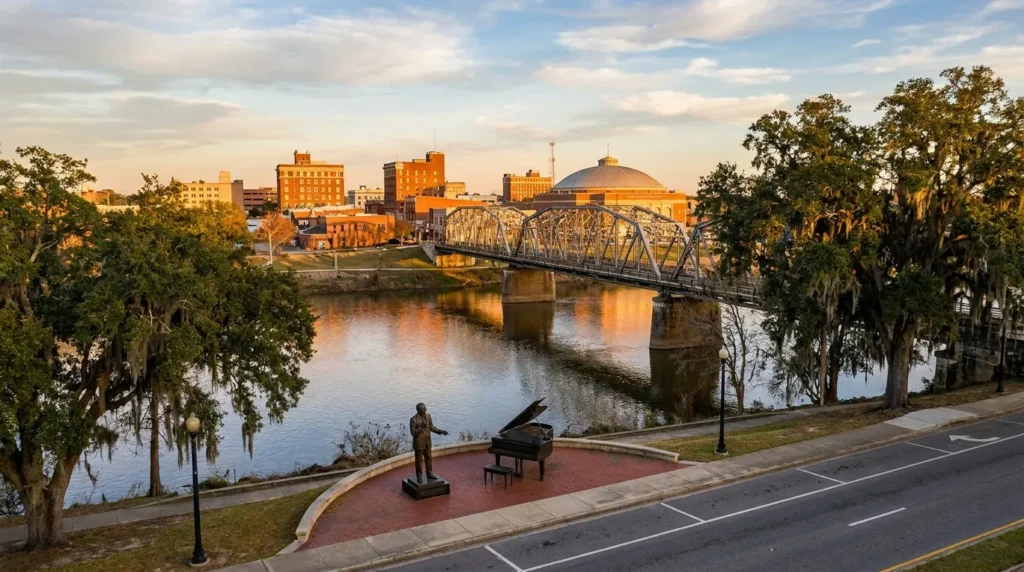
Flint RiverQuarium, downtown, is an aquarium dedicated to the wildlife of the Flint River, drawing families with open tanks, native fish, and exhibits on local ecosystems. Adjacent is Ray Charles Plaza, featuring a statue and an interactive piano honoring the musician who grew up in the area. From here, the elevated Bridge House walkway serves as the starting point for walks along the river.

Albany Civil Rights Institute, housed in the former Mount Zion Baptist Church, documents the history of the Albany Movement with a collection of original photographs, documents, and recordings. It provides essential context for understanding the city. Albany Museum of Art, on the Albany State University campus, holds a collection of American and African art with rotating exhibitions.

For outdoor activities, Chehaw Park combines a zoo, trails, and camping within a native Georgia reserve. Radium Springs, a former resort known for the intense blue of its spring waters, has been restored as a public garden. On weekends, families gravitate toward nearby lakes such as Lake Worth and Lake Chehaw for fishing and picnics.

  1. 1Flint RiverQuarium
  2. 2Albany Civil Rights Institute
  3. 3Ray Charles Plaza
  4. 4Albany Museum of Art
  5. 5Chehaw Park & Zoo
  6. 6Radium Springs Gardens
Parks & green spaces
  • Chehaw Park
  • Radium Springs Gardens
  • Riverfront Park
  • Tift Park
  • Turtle Grove Park
  • +1 more

A small but growing immigrant presence centered on agriculture and healthcare

Albany has a modest immigrant community, with the most visible presence from Mexicans, Guatemalans, Indians, and Filipinos connected to agriculture, commerce, and healthcare.

Albany is not a traditional international immigration hub, but its immigrant community is growing, primarily of Mexican and Central American origin. Families from Guatemala, Honduras, and El Salvador arrived over recent decades connected to seasonal agricultural work in surrounding peanut and pecan fields, and some have established small businesses downtown and in the southern part of the city.

There are also smaller but professionally present communities of Indians and Filipinos, connected to Phoebe Putney Hospital and the university. Physicians, nurses, and Asian technicians form part of the local healthcare workforce and maintain active cultural associations. Koreans and Vietnamese operate a portion of the convenience stores and Asian restaurants.

For newcomers, the support infrastructure is more limited than in larger Florida or metro Georgia cities. Catholic and Protestant churches offer masses and services in Spanish, and regional organizations assist with translation, documentation, and English courses. The nearest consulate for most nationalities is in Atlanta, about three hours away.

3,500
Foreign-born residents
estimated
Top countries of origin
  • Mexico
  • Guatemala
  • India
  • Honduras
  • Philippines
  • El Salvador
  • Vietnam
  • South Korea
Foreign consulates
  • Consulate General of Mexico in Atlanta
  • Consulate General of Guatemala in Atlanta
  • Consulate General of India in Atlanta
  • Consulate General of the Philippines in Atlanta
  • Consulate General of El Salvador in Atlanta
  • +1 more
Community organizations
  • Catholic Social Services of the Diocese of Savannah
  • Latin American Association (Atlanta, serves the region)
  • Albany Area Primary Health Care
  • Albany Multicultural Coalition
  • United Way of Southwest Georgia

Latest posts

Posts about Georgia

Coverage and updates related to this destination.

Showing content from Georgia, as there is no specific data for Albany yet.