Visto n' Visa
Blog
Notícias e artigos
Destinations
Careers
Immigrants

Want to live and work in Tampa?

Personalized immigration plan with eligible visas, costs, and next steps for your goal!

If you are not eligible, you will know exactly why and what to do to improve your approval chances.

Save up to 12 hours in meetings

No pointless assessments.

Save up to 90%

Save money on vague or unfocused consultations

Avoid Fraud and Mistakes

One mistake can cost you your visa

Total Impartiality

Zero commercial bias

Decide with peace of mind

No toxic urgency

Fast and Accurate

Answers in minutes, no guesswork

Tampa demographics: strong Cuban and Spanish roots, a growing Latino population

Tampa's identity was forged by Cuban, Spanish, and Italian immigration in Ybor City. Today it has a diverse Hispanic community, a historically significant Black population, and a growing influx of transplants from the Northeast.

Tampa has roughly 400,000 residents within city limits and more than three million across the metro area. The population breaks into three broad groups: white Americans, Hispanics (primarily Cuban, Puerto Rican, Mexican, and Colombian), and Black Americans.

The legacy of early-twentieth-century Cuban, Spanish, and Italian immigration in Ybor City shaped the local culture and cuisine. There is a growing Indian community linked to hospitals and technology, as well as Vietnamese and Filipino communities, and an expanding Brazilian community in neighborhoods such as Brandon, Wesley Chapel, and South Tampa.

The age profile skews young, with many professionals who relocated from the Northeast and Midwest. English dominates, but Spanish is heard naturally throughout the city. Retirees concentrate in surrounding areas (St. Petersburg, Sarasota), while active professionals cluster downtown.

Languages spoken
  • English
  • Spanish
  • Vietnamese
  • Tagalog
  • Portuguese
Main religions
  • Catholicism
  • Protestantism
  • Pentecostalism
  • Judaism
  • No religion

Cost of living in Tampa: risen quickly, but still below Miami

Tampa became one of Florida's most expensive major cities after 2020, but remains significantly more affordable than Miami. There is no state income tax.

Tampa's cost of living has climbed in recent years. Rent for a two-bedroom apartment in central neighborhoods is substantially higher than it was before the pandemic. Buying property has also become more expensive, particularly in South Tampa and Hyde Park. Even so, Tampa remains more accessible than Miami.

Florida levies no state income tax, which is a real advantage for higher-earning professionals. The sales tax in Hillsborough County runs around seven and a half percent. Electric bills weigh heavily in summer due to air conditioning. Homeowner's insurance has risen sharply with hurricane season exposure.

Publix, Winn-Dixie, Aldi, Trader Joe's, and Whole Foods cover most grocery needs. For Latin products, stores such as Sedano's and Cuban markets in West Tampa handle the basics. Restaurants span a wide price range.

98Cost index (US = 100)2% below US average
CategorySingleCoupleFamily (2 + 2)
iHousing$1,275$1,471$1,863
iFood$372$745$1,353
iTransport$491$833$1,079
iHealthcare$275$549$1,030
iChildcare$1,785
iOther$833$1,501$2,109
Monthly total$3,246$5,099$9,219

Source: U.S. BLS Consumer Expenditure Survey 2023 + BEA Regional Price Parities 2023 · Estimates in USD, monthly.

Housing in Tampa: bungalows in South Tampa, downtown apartments, and expanding suburbs

Tampa offers everything from historic bungalows in Hyde Park to new apartments in Water Street and growing suburbs in Brandon, Wesley Chapel, and Riverview.

South Tampa concentrates the most sought-after neighborhoods: Hyde Park, Davis Islands, Palma Ceia, and Bayshore. These feature restored bungalows and single-family homes with well-rated schools and proximity to downtown. Downtown and Water Street have new luxury apartment buildings with walkable urban amenities.

Families looking for more space at lower cost turn to the growing suburbs of Brandon, Riverview, Wesley Chapel (in Pasco County), and FishHawk Ranch. New Tampa also offers good houses and schools. Seminole Heights, just north of Downtown, is the hip neighborhood of 1920s homes with a thriving craft brewery scene.

The rental market requires proof of income. Foreign nationals without a credit score typically must pay a larger security deposit. Hurricane and flood insurance is an important consideration: properties near the bay require specific coverages that are often mandatory for financing.

Recommended neighborhoods
  • Hyde Park
  • South Tampa (Palma Ceia, Davis Islands)
  • Seminole Heights
  • Water Street and Downtown
  • Brandon
  • +2 more

Tampa job market: healthcare, finance, defense, and technology

Tampa has a diversified economy: USF Health, MacDill Air Force Base, bank and insurance headquarters, a major port, and a growing technology sector around Water Street.

Healthcare is the largest employer: USF Health, Tampa General Hospital, AdventHealth, and Moffitt Cancer Center account for tens of thousands of jobs. MacDill Air Force Base, home to US Central Command (CENTCOM), carries enormous weight in defense and military contracting.

Finance concentrates Citigroup, JP Morgan Chase, Raymond James (headquartered in St. Petersburg), and numerous insurance companies. Logistics is strong because of Port of Tampa Bay. Technology has gained traction through Water Street Tampa, a large urban development project backed by Jeff Vinik, along with companies such as Bisnow, ReliaQuest, and a cluster of local startups.

Tourism employs a significant workforce through Busch Gardens, the Florida Aquarium, and sports venues. Salaries for technology and healthcare roles are competitive with the national average, and the cost of living still compares favorably to Miami or Orlando.

Dominant sectors
  • Healthcare
  • Defense and federal government
  • Financial services
  • Port logistics
  • Technology and startups
  • +1 more
Major employers
  • Tampa General Hospital
  • USF Health
  • Moffitt Cancer Center
  • MacDill Air Force Base / CENTCOM
  • Citigroup
  • +3 more

Education in Tampa: large public school system, USF, and respected private options

Hillsborough County Public Schools serves the city. The University of South Florida (USF) is one of Florida's largest universities. There are strong private and charter school options.

Hillsborough County Public Schools is the eighth-largest public school district in the United States. Competitive magnet programs include Plant High School in South Tampa and Hillsborough High School for IB programs. Established private schools include Berkeley Preparatory School, Tampa Preparatory School, and Jesuit High School.

Higher education is anchored by the University of South Florida (USF), a large public research university with strong programs in healthcare, engineering, and business. The University of Tampa (UT), a smaller private institution, sits in the city center along the river. Hillsborough Community College handles technical education and transfer pathways.

Stetson University College of Law has a campus in Tampa. ESL and English-language courses are offered through USF and private language schools for international students. Families often opt for private schools or suburbs with strong public schools (Westchase, Wesley Chapel).

Notable universities
  • University of South Florida (USF)
  • University of Tampa
  • Hillsborough Community College
  • Stetson University College of Law (Tampa)

Healthcare in Tampa: university hospitals and Moffitt Cancer Center

Tampa is the Gulf Coast's medical hub. Tampa General Hospital, USF Health, AdventHealth, and Moffitt Cancer Center are regional and national references across multiple specialties.

Tampa General Hospital, on Davis Islands, is the main academic medical center affiliated with USF Health, with a Level I trauma center and a transplant program. AdventHealth Tampa and St. Joseph's Hospital (BayCare) serve other parts of the metro area.

Moffitt Cancer Center is a nationally recognized oncology reference, drawing patients from across Florida and beyond. For pediatrics, Johns Hopkins All Children's Hospital is located in St. Petersburg. A broad network of BayCare, AdventHealth, and USF Health clinics covers the entire metropolitan area.

ACA marketplace plans, Medicare, and Tricare (for MacDill military personnel) are widely accepted. Community health centers serve uninsured populations. CVS, Walgreens, and Publix Pharmacy locations are found throughout the area. Telemedicine is widely used.

Healthcare index68.0 / 100
  • Life expectancyyears at birth
    78.4yrs
  • Doctors per 1kpracticing physicians
    3.7
  • Health spendper capita, per year
    $13,473
  • Public systemoverall quality rating
    Good

Safety in Tampa: highly variable by neighborhood, with hurricane awareness required

Safety in Tampa varies significantly by neighborhood. South Tampa, Westchase, Brandon, and Hyde Park are calm. Some areas east and north of Downtown have higher crime rates.

Tampa's crime rates run somewhat above the national average, but the picture depends heavily on the neighborhood. South Tampa, Hyde Park, Westchase, FishHawk, and Wesley Chapel reflect the safety profile of a typical mid-sized American city. Sulphur Springs, parts of East Tampa, and some zones near USF have higher incident rates.

Car theft, vehicle break-ins, and opportunistic crimes are the most common complaints. The Tampa Police Department patrols the city, while the Hillsborough County Sheriff's Office covers unincorporated areas.

The most significant natural risk is hurricanes (June through November). Tampa Bay lies in a storm surge zone. Flooding during heavy rain affects multiple neighborhoods. The evacuation system is organized by zone. Tornadoes occur but are generally weak.

5.8
Homicides per 100k
per year
Safety index
50.0
Crime index
50.0
Safer neighborhoods
  • Hyde Park
  • Davis Islands
  • Westshore
  • South Tampa
  • New Tampa
  • Channelside
  • Bayshore Beautiful
Areas to avoid
  • East Tampa in certain stretches
  • Sulphur Springs
  • Sections of the University area after dark
  • Industrial areas around the port

Transportation in Tampa: a car is essential, with I-275 and I-4 as main arteries

Tampa is a car-dependent city. Public transit is limited. I-275 and I-4 structure most commutes. Traffic has worsened with population growth.

Most residents depend on a car. HART operates buses and the small TECO Line streetcar between Downtown and Ybor City, useful for tourists but limited for daily commuting. There is no metro rail. Rideshare apps work well throughout the area.

Main highways include I-275 (which crosses the bay via the Howard Frankland Bridge and the Sunshine Skyway), I-4 (to Orlando), I-75 (running north-south toward Sarasota and Naples), and the Veterans Expressway (tolled, serving the airport and northern suburbs). Peak-hour traffic has worsened with population growth.

Tampa International Airport (TPA) has a strong reputation, broad domestic service, and several international routes (Cancun, Toronto, London). St. Petersburg-Clearwater Airport (PIE) serves low-cost carriers. Amtrak has a Downtown station with service to Miami, Orlando, and New York.

1
Metro lines
11
Metro stations
27 min
Avg commute
50
Walkability
Airports
  • TPA — Tampa International Airport
  • PIE — St. Pete-Clearwater International Airport
  • TPF — Peter O. Knight Airport
  • International airport
  • Bike infrastructure

What the climate is like living in Tampa

A Tampa Bay city with hot, rainy summers near 33°C, dry and mild winters, and Gulf of Mexico breezes throughout the year.

Summer in Tampa is long and tropical. From May through October, highs range from 31 to 34°C, with nearly daily afternoon thunderstorms. Gulf breezes help moderate the heat near the coast, but central air conditioning is an essential feature of any home in the city.

Winter is dry and sunny, with highs between 22 and 26°C and lows around 12°C. Heating is rarely needed, and the season draws tourists and seasonal residents. Low humidity makes it ideal for beach outings and outdoor activities.

Hurricane season runs from June through November, peaking in August and September. The bay has long shielded the city from direct hits, but the risk remains. For those arriving from tropical climates, the weather closely resembles coastal cities in that region, making the transition straightforward.

Sunny days / year246 days
Avg high (°F)
  • 70°J
  • 76°F
  • 79°M
  • 82°A
  • 87°M
  • 88°J
  • 89°J
  • 89°A
  • 86°S
  • 84°O
  • 77°N
  • 73°D
Avg low (°F)
  • 54°J
  • 59°F
  • 62°M
  • 66°A
  • 70°M
  • 75°J
  • 77°J
  • 77°A
  • 74°S
  • 70°O
  • 62°N
  • 57°D
Rainfall (")
  • 2"J
  • 2"F
  • 2"M
  • 4"A
  • 3"M
  • 7"J
  • 9"J
  • 11"A
  • 8"S
  • 3"O
  • 3"N
  • 3"D

Culture in Tampa: Ybor City, professional sports, museums, and craft breweries

Tampa blends Cuban and Spanish heritage in Ybor City with major professional sports teams, growing museums, and an expanding food and drink scene.

Ybor City is the historic heart of the city, with brick sidewalks, restored cigar factories, and the Columbia Restaurant, founded in 1905 (Florida's oldest restaurant). It also serves as a nightlife and live-music district. The Tampa Cuban sandwich is a point of local pride.

Sports teams include the Tampa Bay Buccaneers (NFL), the Tampa Bay Lightning (NHL, recent Stanley Cup champions), and the Tampa Bay Rays (MLB, based in St. Petersburg). Busch Gardens is the region's major theme park. Raymond James Stadium and Amalie Arena host concerts and major events.

Museums include the Tampa Museum of Art, the Florida Museum of Photographic Arts, the Glazer Children's Museum, and the Salvador Dali Museum (in St. Petersburg, about 30 minutes away). Craft breweries have multiplied in Seminole Heights. Festivals such as Gasparilla (a pirate parade) and the Florida State Fair animate the city each year.

Tampa

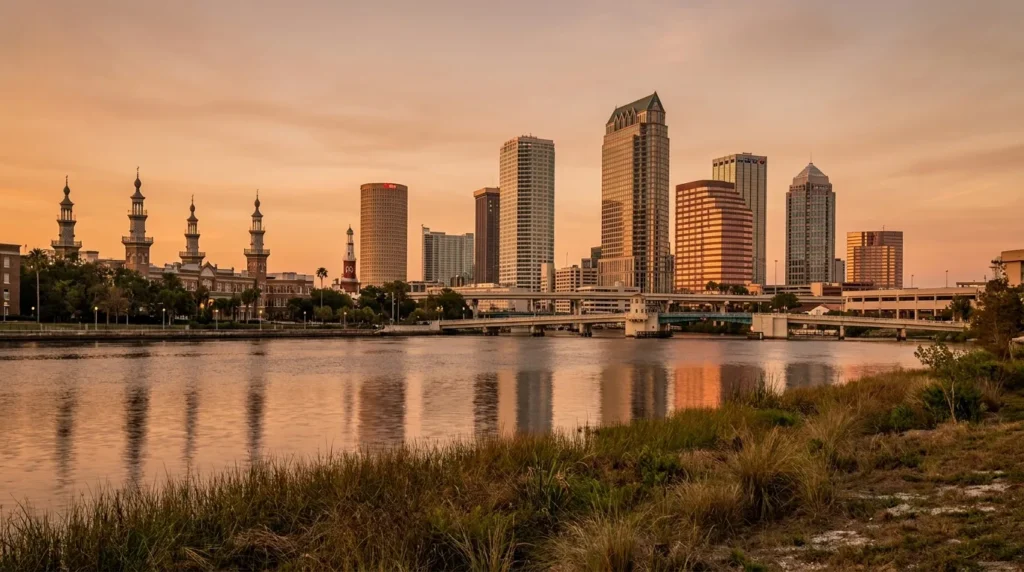
Tampa on the Gulf Coast, Ybor City, Riverwalk, and growing neighborhoods

A Gulf Coast city in Florida, with Cuban heritage in Ybor City, theme parks, a vibrant Tampa Riverwalk, and new neighborhoods like Water Street revitalizing downtown.

Tampa sits on the bay of the same name in central-western Florida and has grown rapidly over the past two decades. Downtown, once empty after 6 p.m., has become a dense residential area anchored by Water Street, Channelside, and Sparkman Wharf. The Tampa Riverwalk, a 4-kilometer path along the Hillsborough River, connects museums, parks, and Amalie Arena, home of the Tampa Bay Lightning. Neighborhoods like Hyde Park, Seminole Heights, and South Tampa remain the city's more traditional residential hubs.

Ybor City is the historic district founded by Cuban, Spanish, and Italian immigrants who worked in the cigar factories. Today, 7th Avenue blends bars, free-roaming chickens on the sidewalks, and social clubs like Centro Asturiano and Círculo Cubano. Busch Gardens, a theme park combining roller coasters and a zoo, and ZooTampa at Lowry Park are established family destinations.

For beaches, St. Petersburg, Clearwater Beach, and Honeymoon Island State Park are 30 to 60 minutes away. Bayshore Boulevard features the longest continuous sidewalk in the United States, stretching 7 kilometers along the waterfront. For the arts, the Tampa Museum of Art, Glazer Children's Museum, and Florida Aquarium concentrate cultural offerings near the Riverwalk.

  1. 1["Busch Gardens Tampa Bay"
  2. 2"Tampa Riverwalk"
  3. 3"Ybor City Historic District"
  4. 4"Florida Aquarium"
  5. 5"Tampa Museum of Art"
  6. 6"Henry B. Plant Museum"
Nightlife7.0 / 10
Parks & green spaces
  • ["Curtis Hixon Waterfront Park"
  • "Lettuce Lake Park"
  • "Hillsborough River State Park"
  • "Al Lopez Park"
  • "Bayshore Boulevard (waterfront path)"
  • +1 more

Latest posts

Posts about Florida

Coverage and updates related to this destination.

Showing content from Florida, as there is no specific data for Tampa yet.