Visto n' Visa
Blog
Notícias e artigos
Destinations
Careers
Immigrants

Want to live and work in Tallahassee?

Personalized immigration plan with eligible visas, costs, and next steps for your goal!

If you are not eligible, you will know exactly why and what to do to improve your approval chances.

Save up to 12 hours in meetings

No pointless assessments.

Save up to 90%

Save money on vague or unfocused consultations

Avoid Fraud and Mistakes

One mistake can cost you your visa

Total Impartiality

Zero commercial bias

Decide with peace of mind

No toxic urgency

Fast and Accurate

Answers in minutes, no guesswork

Tallahassee Demographics: Strong Black American Community and University Profile

Tallahassee has one of the highest proportions of Black Americans among Florida cities, a young profile driven by the universities, and a growing, though still modest, Latino presence.

Tallahassee has around 200,000 residents, with a profile distinct from most Florida cities: the Black American community makes up nearly 35% of the population, a legacy of the region's Southern history and of Florida A&M University, a historically Black university. White residents form the majority, with a strong Southern presence.

The university profile defines the city: FSU and FAMU together enroll more than 50,000 students, with a significant international student presence from China, India, and Latin America. Tallahassee Community College adds thousands more. The Hispanic community is smaller than in central and south Florida, but it is growing.

The age profile skews young during the academic year. English is the dominant language, with a Southern accent among older generations. Brazilians are few in number, primarily students and researchers affiliated with the universities.

Languages spoken
  • English
  • Spanish
  • Mandarin Chinese
  • Arabic
  • Portuguese
Main religions
  • Protestantism (Baptists and Methodists)
  • Catholicism
  • Pentecostalism
  • No religion
  • Judaism

Cost of Living in Tallahassee: Among the Lowest of Florida's Major Cities

Tallahassee's cost of living is well below Miami, Orlando, Tampa, and Jacksonville. Housing in particular is affordable, with rents low by Florida standards.

The cost of living in Tallahassee is below the national average and well below the Florida average. Two-bedroom apartment rents are among the lowest in the state, partly due to student-oriented housing supply. Purchasing a home is also feasible for mid-income professionals.

Florida levies no state income tax. Sales tax in Leon County is approximately seven and a half percent. Electricity bills are high in summer. Homeowner's insurance is lower than elsewhere in Florida because of the city's distance from the coast, outside the main hurricane zones, though not entirely risk-free.

Publix, Aldi, Trader Joe's, Whole Foods, and Walmart serve the city well. The Tallahassee Farmers' Market is a local institution. For ethnic groceries, the selection is smaller than in south Florida, but Asian (Oriental Food and Gifts), Latin, and Indian stores are available.

104Cost index (US = 100)4% above US average
CategorySingleCoupleFamily (2 + 2)
iHousing$1,353$1,563$1,979
iFood$396$791$1,437
iTransport$521$885$1,145
iHealthcare$291$583$1,094
iChildcare$1,895
iOther$885$1,593$2,239
Monthly total$3,446$5,415$9,789

Source: U.S. BLS Consumer Expenditure Survey 2023 + BEA Regional Price Parities 2023 · Estimates in USD, monthly.

Housing in Tallahassee: Tree-Lined Homes, Student Apartments, and Historic Neighborhoods

The market is divided between single-family homes in residential neighborhoods and student-oriented apartments near FSU and FAMU. Historic areas of Midtown and Northeast attract professionals.

Tallahassee has an interesting real estate market: tree-lined homes in neighborhoods such as Midtown, Northeast, and Killearn Estates attract professionals and families. The housing stock includes homes from the 1950s and 1970s, new construction in suburban neighborhoods like SouthWood, and older bungalows.

Student-oriented apartments surround FSU (Collegetown, West Pensacola) and FAMU. Generally less expensive than in larger cities, though quality varies. Neighborhoods such as Betton Hills, Indianhead Acres, and Lafayette Park have a walkable, neighborhood feel.

Renting typically requires standard American income verification, but the student market offers more flexibility. Home purchases require hurricane insurance, as parts of Tallahassee carry some risk, though lower than elsewhere in Florida. Property taxes are moderate.

Recommended neighborhoods
  • Midtown
  • Northeast (Betton Hills, Lafayette Park)
  • Killearn Estates
  • SouthWood
  • Indianhead Acres
  • +1 more

Job Market in Tallahassee: State Government, Universities, and Healthcare

Tallahassee's economy is dominated by state government (as the capital), the universities (FSU, FAMU, TCC), and healthcare (Tallahassee Memorial and Capital Regional).

State government is the largest employer. Departments, agencies, the legislature, the judiciary, and regulatory bodies are all located at the Capitol. FSU and FAMU together employ tens of thousands of faculty, staff, and administrators. Tallahassee Community College adds more jobs in the education sector.

Healthcare is significant: Tallahassee Memorial HealthCare and HCA Florida Capital Hospital serve the region and northern Georgia. The tech sector is beginning to grow, with companies such as Mainline Information Systems and startups linked to FSU's National High Magnetic Field Laboratory.

Lobbying, political communications, and professional associations (Florida Bar, Florida Education Association) also provide employment. State employee salaries are moderate, and the low cost of living offsets this. Students and researchers form a parallel market for freelance and service work.

Dominant sectors
  • State government
  • Higher education
  • Healthcare
  • Scientific research
  • Law and lobbying
  • +1 more
Major employers
  • State of Florida (state government)
  • Florida State University (FSU)
  • Florida A&M University (FAMU)
  • Tallahassee Memorial HealthCare
  • HCA Florida Capital Hospital
  • +2 more

Education in Tallahassee: A University City with FSU, FAMU, and TCC

Tallahassee is a university city by nature. FSU, FAMU, and Tallahassee Community College define the environment. Leon County Schools serves K-12.

Florida State University (FSU) is a public research university with strong programs in law, business, political science, social sciences, and home to the National High Magnetic Field Laboratory. FAMU is the largest historically Black university in the country by enrollment, with strong programs in pharmacy, agriculture, and engineering (in partnership with FSU).

Tallahassee Community College (TCC) is a nationally recognized community college with an excellent transfer program. Leon County Schools operates the K-12 system. Schools such as Leon High School, Lincoln High School, and Chiles High School have strong reputations. Private options include Maclay School and Trinity Catholic.

International students are well-served. ESL programs are offered by FSU's Center for Intensive English Studies and by TCC. Tallahassee is a research hub for magnetism, biology, and meteorology. As the state capital, government and universities interact constantly.

Notable universities
  • Florida State University (FSU)
  • Florida A&M University (FAMU)
  • Tallahassee Community College (TCC)
  • Keiser University (Tallahassee Campus)

Healthcare in Tallahassee: Two Major Hospitals Serving the Panhandle and Southern Georgia

Tallahassee Memorial HealthCare (TMH) and HCA Florida Capital Hospital are the two primary hospitals, serving the entire Panhandle and southern Georgia.

Tallahassee Memorial HealthCare (TMH) is the largest hospital, a nonprofit with a trauma center, maternity unit, and multiple specialties. HCA Florida Capital Hospital is the other major option, with an emergency department and general care. Both serve as regional referral centers for patients from across the Panhandle and small towns in southern Georgia.

The FSU College of Medicine has strengthened local medical research, training physicians with a focus on rural health. For highly specialized cases (complex transplants, advanced oncology), patients are sometimes referred to Jacksonville (Mayo Clinic) or Atlanta hospitals.

ACA plans, Medicare, and most private insurers are widely accepted. Community and federally qualified health centers (Bond Community Health Center) serve uninsured populations. CVS, Walgreens, and Publix Pharmacy locations are distributed throughout the city.

Healthcare index65.0 / 100
  • Life expectancyyears at birth
    78.4yrs
  • Doctors per 1kpracticing physicians
    3.7
  • Health spendper capita, per year
    $13,473
  • Public systemoverall quality rating
    Good

Safety in Tallahassee: University City Standards, with Occasional Hurricanes

Tallahassee's crime rates are above the average for similarly sized Florida cities, driven by specific areas. Residential and university neighborhoods are calm.

Crime rates in Tallahassee are slightly above the average for Florida cities of similar size, but distribution is highly uneven. Neighborhoods such as Killearn, Midtown, Northeast, and SouthWood are calm. Areas near FAMU and some southern zones have higher incident rates.

The most common crimes are car theft, burglary, and altercations linked to student nightlife. The Tallahassee Police Department and the Leon County Sheriff's Office patrol the city, and both campuses have their own police departments (FSUPD, FAMUPD). Safety is considered reasonable for a Southern university city.

The most relevant natural hazard is hurricanes, even though Tallahassee is inland. Storms from the Gulf, such as Hurricane Michael in 2018, which caused severe damage to the surrounding area, can cause serious harm. Tornadoes occur during storms and are generally weak. Urban flooding during heavy rain affects low-lying parts of the city.

5.8
Homicides per 100k
per year
Safety index
44.0
Crime index
56.0
Safer neighborhoods
  • Killearn Estates
  • Betton Hills
  • Midtown
  • SouthWood
  • Buck Lake
  • Indianhead Acres
  • Bull Run
Areas to avoid
  • Frenchtown
  • Stretches of South Monroe after dark
  • Griffin Heights
  • Isolated areas near FAMU Way at night

Transportation in Tallahassee: Car-Dependent, with Some Options for Students

Tallahassee is a car-dependent city, with a partial exception for the FSU and FAMU campuses. StarMetro operates bus service. Interstates 10 and US-27 connect to Georgia, Pensacola, and Jacksonville.

A car is necessary for most residents of Tallahassee. StarMetro operates bus service with reasonable city coverage, more useful for students than for most working professionals. The universities run internal circulator systems. Rideshare apps such as Uber and Lyft are available.

Interstate 10 crosses the city east to west, connecting to Jacksonville (about two and a half hours) and Pensacola (about three hours). US-27 runs south to Perry and north into Georgia. US-90 crosses the city. Traffic is light for a state capital, heavier around the campuses.

Tallahassee International Airport (TLH) offers limited domestic service, primarily to Atlanta, Charlotte, Dallas, and Miami. International flights typically route through Atlanta or Orlando. Amtrak service was suspended after Hurricane Katrina, with no return scheduled.

22 min
Avg commute
42
Walkability
Airports
  • TLH — Tallahassee International Airport
  • International airport
  • Bike infrastructure

What the climate is like living in Tallahassee

Florida's capital city features very hot and humid summers near 33 degrees Celsius, mild winters with occasional cold nights, and a transitional climate between Florida and Georgia.

Tallahassee's summer is long and oppressive. From May through September, highs range between 31 and 34 degrees Celsius, with high humidity and frequent afternoon thunderstorms. Central air conditioning is standard in all residences, and summer electricity costs can weigh heavily on household budgets.

Winter is the coldest of any Florida city, owing to its northern location in the state. Between December and February, lows can approach 2 to 5 degrees Celsius during cold fronts. Heating is necessary for several weeks of the year, though most days remain between 16 and 20 degrees Celsius.

Hurricane season runs from June through November; being inland, the city typically receives heavy rain and tropical storms rather than direct landfalls. The climate resembles that of inland cities in the southeastern United States, with heavy summer heat and notable seasonal temperature swings.

Sunny days / year226 days
Avg high (°F)
  • 64°J
  • 69°F
  • 75°M
  • 79°A
  • 87°M
  • 90°J
  • 89°J
  • 90°A
  • 87°S
  • 82°O
  • 71°N
  • 66°D
Avg low (°F)
  • 47°J
  • 51°F
  • 55°M
  • 58°A
  • 65°M
  • 72°J
  • 74°J
  • 74°A
  • 71°S
  • 63°O
  • 53°N
  • 49°D
Rainfall (")
  • 5"J
  • 4"F
  • 4"M
  • 5"A
  • 2"M
  • 6"J
  • 6"J
  • 7"A
  • 4"S
  • 3"O
  • 2"N
  • 4"D

Culture in Tallahassee: College Sports, State Museums, and Southern Heritage

Local culture blends college sports (FSU Seminoles, FAMU Rattlers), Southern heritage, state museums, and an independent arts scene tied to the universities.

College sports are a local institution. The FSU Seminoles (football, basketball) play at Doak Campbell Stadium, with more than 80,000 seats. The FAMU Rattlers, particularly in football and through the Marching 100 band, are a source of pride for the Black American community. Game days animate the entire city.

Museums include the Florida Historic Capitol, the Museum of Florida History, Mission San Luis (a 17th-century Spanish site), and the Tallahassee Museum (part zoo, part history). Cascades Park, downtown, hosts outdoor concerts. FSU Opera, the Tallahassee Symphony, and local theaters maintain an active arts scene.

Southern heritage is present in the food (BBQ, Gulf-caught fried fish, soul food around FAMU), in the music, and in the pace of life. Festivals such as Word of South and Springtime Tallahassee mark the calendar. Bars and restaurants in Midtown and Collegetown concentrate the nightlife.

Tallahassee

Attractions in Tallahassee, Florida's capital in the heart of the Panhandle

State capital and university city home to FSU and FAMU. Tallahassee blends century-old live oaks, a historic Capitol, state parks, and easy access to the Gulf of Mexico at St. Marks and Apalachicola.

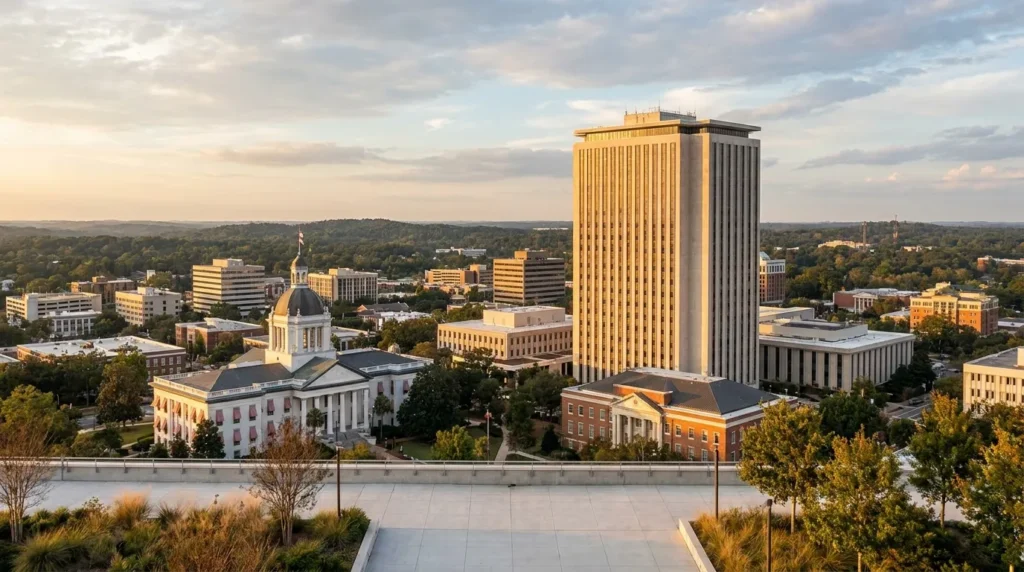
The Florida Historic Capitol, with its red-and-white dome, stands beside the modern New Capitol, and both can be visited free of charge. Mission San Luis recreates a 17th-century Spanish and Apalachee mission, and the Tallahassee Museum, with native wildlife and historic structures, is a must-visit for families. Cascades Park, featuring an interactive fountain and amphitheater, anchors the revitalized downtown.

The canopy roads, lined with live oaks draped in Spanish moss, are a defining feature of the city, particularly Old St. Augustine Road and Miccosukee Road. Lake Ella in Midtown and Lake Jackson to the north offer urban green retreats, while Wakulla Springs State Park, with its crystal-clear springs and glass-bottom boat tours, sits just twenty minutes away. Apalachicola National Forest surrounds the city to the south and west.

College sports shape the city's calendar: FSU Seminoles at Doak Campbell Stadium, FAMU Rattlers at Bragg Memorial Stadium, and the nationally renowned 100 Marching Band. Railroad Square Art Park, with galleries and craft breweries, and the downtown First Friday events round out the cultural scene. St. George Island beach and the oysters of Apalachicola are within an hour's drive.

  1. 1["Florida State Capitol and Historic Capitol Museum"
  2. 2"Alfred B. Maclay Gardens State Park"
  3. 3"Tallahassee Museum"
  4. 4"Cascades Park"
  5. 5"Mission San Luis de Apalachee"
  6. 6"Goodwood Museum and Gardens"
Nightlife5.0 / 10
Parks & green spaces
  • ["Cascades Park"
  • "Alfred B. Maclay Gardens State Park"
  • "Tom Brown Park"
  • "Lake Ella Park"
  • "Lafayette Heritage Trail Park"
  • +1 more

Latest posts

Posts about Florida

Coverage and updates related to this destination.

Showing content from Florida, as there is no specific data for Tallahassee yet.