Visto n' Visa
Blog
Notícias e artigos
Destinations
Careers
Immigrants

Want to live and work in Fort Lauderdale?

Personalized immigration plan with eligible visas, costs, and next steps for your goal!

If you are not eligible, you will know exactly why and what to do to improve your approval chances.

Save up to 12 hours in meetings

No pointless assessments.

Save up to 90%

Save money on vague or unfocused consultations

Avoid Fraud and Mistakes

One mistake can cost you your visa

Total Impartiality

Zero commercial bias

Decide with peace of mind

No toxic urgency

Fast and Accurate

Answers in minutes, no guesswork

Diverse population with a strong Latin and Caribbean presence

A multicultural city with significant Hispanic, Haitian, and Jamaican communities. English is predominant, but Spanish and Haitian Creole are spoken throughout entire neighborhoods.

Fort Lauderdale has a highly mixed population profile. The distribution among non-Hispanic whites, Black residents (with strong Haitian and Jamaican roots), and Hispanics is balanced, with no absolute majority. The Hispanic segment is driven by Cubans, Colombians, Venezuelans, and Puerto Ricans, and the Brazilian community is one of the largest outside Sao Paulo in the state.

The Sistrunk neighborhood holds deep African-American historical roots, while neighboring Wilton Manors is an LGBTQ+ landmark in South Florida. The age range is varied: retirees coexist with young families and remote workers who relocated during and after the pandemic.

English is the common language in services and schools, but Spanish works without friction in nearly everything, and Haitian Creole is spoken by a significant portion of the population. Christianity, across various denominations, predominates religiously, with Judaism present since the 1950s and a growing evangelical Latin community in recent decades.

Languages spoken
  • English
  • Spanish
  • Haitian Creole
  • Portuguese
Main religions
  • Protestant Christianity
  • Catholicism
  • Judaism
  • No religion

High cost by Florida standards, but below Miami

Rent and the market have risen significantly over the past five years. The absence of state income tax helps, but car and homeowner's insurance weigh heavily on budgets.

The cost of living in Fort Lauderdale climbed considerably after the migration wave of 2020 and 2021. Renting a one-bedroom apartment in neighborhoods like Victoria Park or Flagler Village typically runs above the US national average, and buying property has become a competitive pursuit for those arriving with equity from other cities.

Florida has no state income tax, which helps with take-home pay. On the other hand, car insurance ranks among the most expensive in the country, homeowner's insurance has risen due to hurricane risk, and summer electricity bills are substantial with air conditioning running around the clock. Grocery shopping at Publix and Whole Foods is pricey; Aldi and Latin markets like Sedano's bring costs down.

Dining out has also become more expensive. Lunch on Las Olas can easily exceed $25 per person, but food trucks in FATVillage and restaurants in Oakland Park offer reasonable options. Those who work from home and cook regularly can balance the budget; those who commute far and drive daily feel the pressure of gas and tolls on I-95 and I-595.

101Cost index (US = 100)1% above US average
CategorySingleCoupleFamily (2 + 2)
iHousing$1,314$1,517$1,921
iFood$384$768$1,395
iTransport$506$859$1,112
iHealthcare$283$566$1,062
iChildcare$1,840
iOther$859$1,547$2,174
Monthly total$3,346$5,257$9,504

Source: U.S. BLS Consumer Expenditure Survey 2023 + BEA Regional Price Parities 2023 · Estimates in USD, monthly.

Canal-side neighborhoods, beachfront condos, and family suburbs

Options range from townhouses in Coral Ridge to high-rises on the beach. Neighborhoods near the canals command premium prices; western suburbs offer better square footage per dollar.

The real estate market divides between the east, where the beach, canals, and most expensive neighborhoods are located, and the west, where planned suburbs and gated communities predominate. Las Olas Isles and Rio Vista suit those looking for a private dock at the back of their property. Victoria Park is a favorite among young professionals, with bungalow-style homes and easy access to downtown.

Flagler Village has become a hub for new apartment buildings with gyms, pools, and coworking spaces. Coral Ridge offers solid family homes with decent public schools. For those looking for value, Oakland Park and Wilton Manors are minutes from downtown and still have attractive properties. Plantation, Davie, and Sunrise, to the west, draw families for the space and schools.

The Florida standard applies as elsewhere in the state: condos charge monthly HOA fees that can be substantial, hurricane insurance is factored into costs, and structural inspections became mandatory after the Surfside collapse in 2021. Annual leases typically require a guarantor, first month, last month, and a security deposit, the equivalent of three months upfront.

Recommended neighborhoods
  • Victoria Park
  • Flagler Village
  • Coral Ridge
  • Rio Vista
  • Wilton Manors
  • +2 more

Tourism, marine industry, healthcare, and financial services

A diversified economy anchored by hospitality, marinas, private hospitals, and the back-office operations of major banks. The tech sector is growing in Flagler Village and Pompano Beach.

Fort Lauderdale's economy rests on three classic pillars: tourism, the marine industry, and healthcare. The Fort Lauderdale International Boat Show, held each October, is the world's largest in its segment and generates millions of dollars daily. Shipyards, marinas, and yacht suppliers employ specialized technicians year-round, and the Dania Beach and Pompano Beach areas concentrate this supply chain.

In the financial sector, Citrix, JM Family Enterprises, and AutoNation maintain headquarters or large offices in the region. Hospitals such as Broward Health and Holy Cross Hospital employ thousands in nursing, medicine, and administration. Fort Lauderdale-Hollywood International Airport is one of the largest direct and indirect employers in the area, with a major presence from JetBlue, Spirit, and Southwest.

For those arriving with professional-level English, hospitality opens doors quickly, though wages are modest. Tech professionals find remote positions and local offices connected to Miami. Construction is active and absorbs Hispanic and Brazilian labor on residential and commercial projects.

Dominant sectors
  • Tourism and Hospitality
  • Marine Industry and Marinas
  • Healthcare
  • Financial Services
  • Aviation
  • +1 more
Major employers
  • Broward Health
  • Citrix
  • AutoNation
  • JM Family Enterprises
  • Holy Cross Hospital
  • +2 more

Large public school system, charter schools, and regional universities

Broward County Public Schools is one of the largest districts in the US, with uneven quality across schools. Good charter and private options exist. Regional universities cover undergraduate and graduate study.

The Broward County school district is one of the largest in the country, with more than 250,000 students. Quality varies by neighborhood, and parents typically research attendance boundaries carefully before choosing where to live. Schools like Pine Crest School, a private institution, and Fort Lauderdale High School, a public magnet, are well-regarded. A strong charter network exists in Plantation and Coral Springs.

In higher education, Nova Southeastern University, in Davie, is the region's largest private institution, with strong programs in law, psychology, and health sciences. Florida Atlantic University has campuses in Davie and Boca Raton, offering engineering, business, and nursing. Broward College serves those seeking an associate degree or a pathway to a four-year school at lower tuition.

For those arriving with young children, the public school system is free even for immigrants with temporary status, requiring only proof of address and a translated vaccination record. ESOL programs in public schools help children who arrive without fluent English, with adaptation typically occurring within a few months.

Notable universities
  • Nova Southeastern University
  • Florida Atlantic University
  • Broward College
  • Keiser University
  • Art Institute of Fort Lauderdale

Robust private hospital network with a relevant public presence

Broward Health, HCA Florida, and Holy Cross cover the region. Most services require private insurance, with community clinics available for those without coverage.

The hospital offering is strong. Broward Health Medical Center, downtown, is one of the state's leading public reference hospitals for trauma and maternity care. Holy Cross Hospital, a Catholic institution, is noted for cardiology and oncology. HCA Florida operates multiple units in the area, covering nearly everything from emergency care to transplants.

As in any American city, health insurance is essential. Those employed by formal companies typically receive employer-sponsored plans with deductibles and co-payments. Self-employed individuals purchase through Healthcare.gov, and subsidies are available depending on income. Without insurance, a single emergency room visit can cost thousands of dollars.

For those without coverage, federally qualified community health centers such as Broward Community and Family Health Centers offer services on a sliding-fee scale based on income. Cash-pay private practices also operate in the Las Olas area with more predictable pricing. CVS and Walgreens pharmacies operate 24 hours at multiple locations and offer walk-in vaccinations.

Healthcare index68.0 / 100
  • Life expectancyyears at birth
    78.4yrs
  • Doctors per 1kpracticing physicians
    3.7
  • Health spendper capita, per year
    $13,473
  • Public systemoverall quality rating
    Good

Safety varies by neighborhood, with quiet areas and zones to avoid

The city has safe areas like Coral Ridge and Victoria Park, and zones with higher crime rates in the west-central area. The main risks are opportunistic theft and isolated altercations in bar districts.

Safety in Fort Lauderdale varies significantly from neighborhood to neighborhood, as in most mid-sized American cities. Coral Ridge, Las Olas Isles, Rio Vista, and Wilton Manors are quiet, with active communities and low rates of violent crime. Victoria Park and Flagler Village have an active nightlife and incidents tend to involve opportunistic theft from cars or bicycles.

Areas west of I-95 and north of downtown, such as parts of Sistrunk and Riverside Park, record higher crime rates. That does not mean living there is unfeasible, but knowing the block before signing a lease is advisable. The Fort Lauderdale Police Department maintains a visible presence on Las Olas and the beach, and public cameras cover the downtown area.

Hurricanes represent the most serious natural risk. Homes built to post-Andrew codes feature reinforced windows, but properties near canals and the beach face real flood risk. Having an evacuation plan, a separate flood insurance policy, and checking a property's elevation level before buying or renting is strongly advisable.

5.8
Homicides per 100k
per year
Safety index
48.0
Crime index
52.0
Safer neighborhoods
  • Las Olas Isles
  • Rio Vista
  • Coral Ridge
  • Victoria Park
  • Harbor Beach
  • Imperial Point
  • Colee Hammock
Areas to avoid
  • Sistrunk corridor after dark
  • Stretches of Riverland Road at night
  • Isolated areas north of Sunrise Boulevard
  • Industrial areas near the port after working hours

A car is practically essential, with some limited alternatives

I-95, I-595, and the Florida Turnpike run through the city. Public transit exists but is limited. Brightline connects to Miami, West Palm Beach, and Orlando at high speed.

Fort Lauderdale was built around the car. I-95 runs north-south, I-595 extends west toward FLL Airport and the Sawgrass Expressway, and the Florida Turnpike offers a toll-road alternative for avoiding traffic. Those living east of US-1 manage well over short distances, but those commuting to Miami face serious congestion daily.

Public transit exists but is limited. Broward County Transit operates buses with reasonable downtown coverage and stretched schedules in the suburbs. The Sun Trolley runs short tourist routes and serves as a connector. Brightline, a private high-speed train, stops at the city's central station and reaches Miami in 30 minutes and West Palm Beach in 40, with an extension to Orlando.

FLL Airport is practical: direct flights to Brazil, Colombia, the Caribbean, Canada, and most of the US, generally at lower fares than MIA. Port Everglades is one of the world's largest cruise ports, serving as a base for Royal Caribbean, Celebrity, and Princess. Ride-share apps like Uber and Lyft operate well throughout the metro area.

3
Metro stations
27 min
Avg commute
55
Walkability
Airports
  • FLL — Fort Lauderdale-Hollywood International Airport
  • FXE — Fort Lauderdale Executive Airport
  • MIA — Miami International Airport
  • International airport
  • Bike infrastructure

What the Climate Is Like Living in Fort Lauderdale

A tropical city in Southeast Florida with hot, humid summers, frequent afternoon rain, mild winters, and Atlantic breezes throughout the year.

Summer in Fort Lauderdale is long and tropical. From May through October, highs range between 88 and 93 degrees Fahrenheit, with humidity above 80% and afternoon thunderstorms occurring almost daily. Central air conditioning is standard in all residences, and summer electricity consumption adds significantly to utility bills.

Winter is dry and sunny, with highs between 75 and 81 degrees and lows rarely dropping below 59. Heating is unnecessary in most homes, and the season draws visitors from colder northern states. This is generally considered the most pleasant time of year to live in the city.

Hurricane season runs from June through November, peaking between August and October. Residents near the coast need an evacuation plan, impact-resistant windows, and appropriate insurance coverage. The overall climate is comparable to coastal tropical cities in terms of heat and rainfall patterns.

Sunny days / year247 days
Avg high (°F)
  • 76°J
  • 78°F
  • 80°M
  • 83°A
  • 84°M
  • 86°J
  • 87°J
  • 88°A
  • 86°S
  • 84°O
  • 80°N
  • 77°D
Avg low (°F)
  • 61°J
  • 66°F
  • 67°M
  • 70°A
  • 72°M
  • 75°J
  • 77°J
  • 77°A
  • 76°S
  • 74°O
  • 69°N
  • 64°D
Rainfall (")
  • 3"J
  • 4"F
  • 2"M
  • 4"A
  • 6"M
  • 10"J
  • 7"J
  • 9"A
  • 11"S
  • 7"O
  • 6"N
  • 4"D

Art scene, Caribbean cuisine, and outdoor beach life

The culture blends Southern US roots, nautical heritage, and strong Caribbean and Latin American influence. Galleries in FATVillage, festivals, and street art give the city its character.

The local cultural scene combines Southern US heritage with strong Caribbean and Latin American influence. The FATVillage Arts District, west of downtown, concentrates galleries, studios, and the monthly Art Walk fair, with street food and live music. The Museum of Discovery and Science is a reliable stop for families with children, and the NSU Art Museum brings international exhibitions.

The culinary scene stands out with Peruvian ceviches on Las Olas, Cuban sandwiches at Sedano's, Jamaican jerk chicken in Sistrunk, and Argentine empanadas in Wilton Manors. Brazilian restaurants in Pompano Beach serve churrasco and feijoada on Saturdays, drawing a mix of immigrants and curious locals.

Outdoor life is central to the city's identity. Nearly everyone has a boat, paddles the canals, or spends Sundays at the beach. The Tortuga Music Festival, in April, brings country and rock acts to a stretch of sand. Pride Fort Lauderdale, in February, is one of the largest in the South.

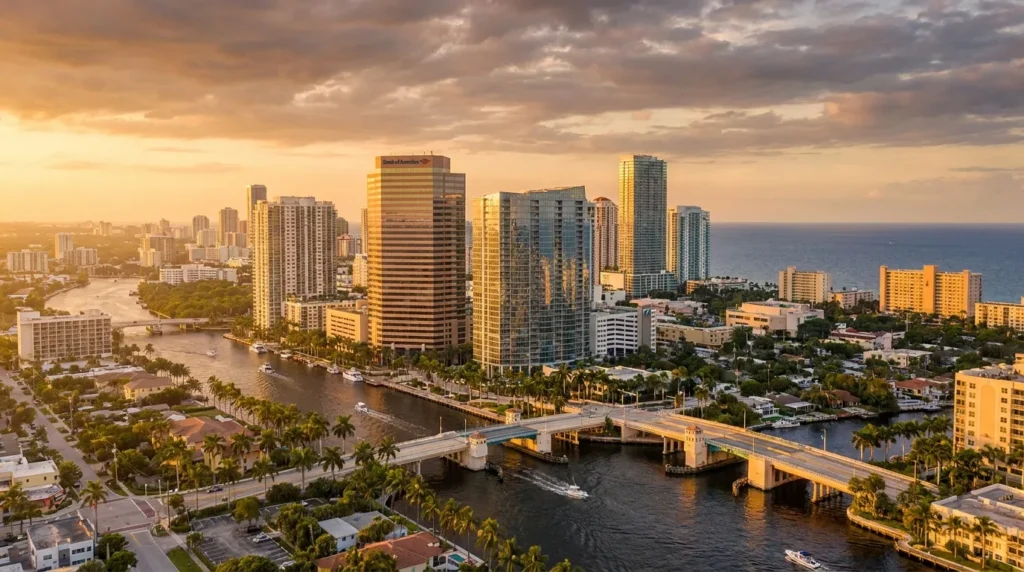
Fort Lauderdale

What to See and Do While Living in Fort Lauderdale

Fort Lauderdale combines wide beaches, over 300 miles of navigable canals, the Las Olas district with galleries and dining, and direct connections to Miami and Palm Beach.

Fort Lauderdale Beach, with the Hugh Taylor Birch State Park boardwalk to the north, is the city's main recreational hub. Las Olas Boulevard concentrates galleries, restaurants, and the Las Olas Riverfront. The NSU Art Museum features Northern European and American art. The Museum of Discovery and Science, with its IMAX theater, is a traditional family destination.

The Riverwalk runs along the New River toward the Broward Center for the Performing Arts. Stranahan House Museum, the oldest house in the city, tells the story of its early settlers. The Bonnet House Museum and Gardens, a retreat built by the Bartlett couple, blends art with nature. For boating, Bahia Mar Yachting Center serves as the home base for the Fort Lauderdale International Boat Show, the largest in the world.

Sawgrass Mills in Sunrise is one of the largest outlet malls in the United States. Neighboring Wilton Manors is a prominent LGBTQ+ hub in South Florida. The Tri-Rail and Brightline connect to Miami International Airport and downtown Miami. Fort Lauderdale-Hollywood International Airport (FLL) offers direct flights to São Paulo via LATAM and Azul.

  1. 1["Fort Lauderdale Beach Promenade"
  2. 2"Las Olas Boulevard"
  3. 3"Riverwalk Fort Lauderdale"
  4. 4"Bonnet House Museum and Gardens"
  5. 5"NSU Art Museum"
  6. 6"Museum of Discovery and Science"
Nightlife8.0 / 10
Parks & green spaces
  • ["Hugh Taylor Birch State Park"
  • "Holiday Park"
  • "Snyder Park"
  • "George English Park"
  • "Flamingo Gardens"
  • +1 more

Latest posts

Posts about Florida

Coverage and updates related to this destination.

Showing content from Florida, as there is no specific data for Fort Lauderdale yet.