Visto n' Visa
Blog
Notícias e artigos
Destinations
Careers
Immigrants

Want to live and work in Cape Coral?

Personalized immigration plan with eligible visas, costs, and next steps for your goal!

If you are not eligible, you will know exactly why and what to do to improve your approval chances.

Save up to 12 hours in meetings

No pointless assessments.

Save up to 90%

Save money on vague or unfocused consultations

Avoid Fraud and Mistakes

One mistake can cost you your visa

Total Impartiality

Zero commercial bias

Decide with peace of mind

No toxic urgency

Fast and Accurate

Answers in minutes, no guesswork

Cape Coral demographics: majority white with a strong German presence and growing Hispanic community

The population is predominantly white, with strong German, Italian, and Northern American heritage. The Hispanic community is growing, driven by Cubans, Puerto Ricans, and Venezuelans.

Cape Coral has more than 200,000 residents, with a whiter demographic profile than the Florida average. Retiree migration from the North (Ohio, Michigan, Pennsylvania, New York) is a long-standing tradition. There is a significant German community, tied to the city's historic real estate investment history, along with Italian and Canadian residents.

The Hispanic community is growing quickly, particularly Cubans, Puerto Ricans, Mexicans, and Venezuelans, many arriving from Miami in search of lower costs. There are Haitian families and a growing influx of Filipino and Indian healthcare professionals. Brazilians are fewer in number, more concentrated in Fort Myers Beach and Naples.

The age profile includes retirees and young families in increasing proportions. Children and teenagers represent an important share of population growth. English dominates, Spanish is increasingly common, and German can be heard in some neighborhoods.

Languages spoken
  • English
  • Spanish
  • German
  • Tagalog
  • Portuguese
Main religions
  • Protestantism
  • Catholicism
  • Pentecostalism
  • Judaism
  • No religion

Cost of living in Cape Coral: risen quickly, but still attractive near the Gulf

Cape Coral has become more expensive since 2020 but remains more affordable than Naples and Sarasota. Canal homes and large lots weigh on the budget; residential insurance is a significant challenge.

The cost of living in Cape Coral has risen considerably in recent years due to domestic and international migration. Rents and home prices have increased, but the city remains more accessible than Naples, Bonita Springs, or Sarasota. Homes on navigable canals command the highest prices.

Florida levies no state income tax. Sales tax in Lee County is around six and a half percent. Summer electricity bills are substantial. Homeowner's insurance has risen sharply because of hurricanes, especially after Hurricane Ian in 2022, which devastated the region. Fuel is reasonably affordable.

Publix, Aldi, Walmart, Winn-Dixie, and Sprouts provide solid grocery coverage. For ethnic products, stores in Fort Myers cover the basics. Restaurants span a wide range, from casual to upscale in neighborhoods such as Tarpon Point and Cape Harbour.

104Cost index (US = 100)4% above US average
CategorySingleCoupleFamily (2 + 2)
iHousing$1,353$1,563$1,979
iFood$396$791$1,437
iTransport$521$885$1,145
iHealthcare$291$583$1,094
iChildcare$1,895
iOther$885$1,593$2,239
Monthly total$3,446$5,415$9,789

Source: U.S. BLS Consumer Expenditure Survey 2023 + BEA Regional Price Parities 2023 · Estimates in USD, monthly.

Housing in Cape Coral: canal homes with private docks, suburban communities

The market is dominated by single-family homes, many with a canal in the backyard and a private dock. Gated communities, pool homes, and some apartment options are also available.

Cape Coral is a single-family home city. The housing stock ranges from homes built in the 1970s and 1980s in established neighborhoods to new construction in gated communities. The most sought-after properties have a backyard canal with direct Gulf access.

Neighborhoods such as Tarpon Point, Cape Harbour, Sandoval, Pelican, and Coral Lakes are in high demand. Neighborhoods with canals that lack direct Gulf access (freshwater canals) cost less. Newer areas to the east and northeast offer more recent homes at better prices.

Standalone apartment complexes are a minority. For quick rentals without a credit score, complexes such as Linger Lodge and some 55+ communities are options. Purchase requires hurricane insurance (mandatory for financed properties). Homes in flood zones (FEMA AE) require federal NFIP coverage, which became significantly more expensive after Hurricane Ian.

Recommended neighborhoods
  • Tarpon Point
  • Cape Harbour
  • Sandoval
  • Pelican
  • Coral Lakes
  • +1 more

Job market in Cape Coral: healthcare, construction, retail, and marine services

The local economy is driven by healthcare (Lee Health), construction, retail, hospitality, and boat-related services. Many residents commute to Fort Myers for work.

Lee Health (the regional network including Cape Coral Hospital, Gulf Coast Medical Center, and HealthPark) is the largest employer. Construction employs a large share of the workforce, fueled by the real estate boom and post-Ian rebuilding. Retail at area malls (Coralwood Mall, Bell Tower) and in neighboring Fort Myers is a major sector.

Hospitality employs a significant number at nearby beaches. Marine services (marinas, boat maintenance, fishing charters, engine shops) represent a real niche. Fort Myers is home to the Chico's FAS headquarters and Hertz, both of which employ many corporate professionals.

Remote work became common after the pandemic and has contributed to the migration of professionals from large cities. Average wages fall below the national average, especially in hospitality and retail. Qualified professionals typically earn well in healthcare and technology.

Dominant sectors
  • Healthcare
  • Construction
  • Retail
  • Hospitality and tourism
  • Marine services
  • +1 more
Major employers
  • Lee Health (Cape Coral Hospital)
  • Cape Coral City Government
  • Lee County Public Schools
  • Walmart
  • Publix
  • +1 more

Education in Cape Coral: Lee County school district and Florida SouthWestern State College

The School District of Lee County serves the city. Florida SouthWestern State College and Florida Gulf Coast University are nearby. Private schools serve faith-based families.

The School District of Lee County operates the public schools. Cape Coral is home to Mariner High School, Cape Coral High School, and Ida Baker High School. Charter schools such as Oasis and Christa McAuliffe are popular alternatives. Catholic private schools (St. Andrew Catholic School) serve faith-based families.

Florida SouthWestern State College has a campus in Fort Myers offering technical programs, associate degrees, and transfer pathways. Florida Gulf Coast University (FGCU), also nearby, is the four-year public university, with strong programs in education, business, and healthcare.

For larger universities, students travel to the University of South Florida (Tampa), the University of Florida (Gainesville), or Florida State University (Tallahassee). English as a Second Language courses are offered by private schools and FSW. ESL programs in public schools serve the growing Hispanic population.

Notable universities
  • Florida SouthWestern State College (Fort Myers)
  • Florida Gulf Coast University (FGCU)
  • Hodges University (Fort Myers)
  • Keiser University (Fort Myers)

Healthcare in Cape Coral: Lee Health dominates

Lee Health is the dominant provider, operating Cape Coral Hospital, HealthPark Medical Center, and Gulf Coast Medical Center. For high-complexity cases, some patients are referred to Tampa or Miami.

Cape Coral Hospital, part of Lee Health, is the local hospital, with a 24-hour emergency department and multiple specialties. In Fort Myers, Lee Health operates HealthPark Medical Center (with a strong cardiology program), Gulf Coast Medical Center (trauma), and Golisano Children's Hospital (pediatrics).

For high-complexity cases such as transplants or highly specialized oncology, patients may be referred to Moffitt Cancer Center in Tampa or hospitals in Miami. Community health clinics serve uninsured populations, and there is a broad network of private practices.

ACA marketplace plans, Medicare, and most private insurance are widely accepted. CVS, Walgreens, Publix Pharmacy, and Walmart pharmacies are present throughout the city. Telemedicine has become common. Spanish-language care has expanded alongside demographic growth.

Healthcare index64.0 / 100
  • Life expectancyyears at birth
    78.4yrs
  • Doctors per 1kpracticing physicians
    3.7
  • Health spendper capita, per year
    $13,473
  • Public systemoverall quality rating
    Fair

Safety in Cape Coral: among the safest large cities in the United States

Cape Coral consistently ranks among the safest large cities in the United States. Hurricanes are the primary risk, with the trauma of Hurricane Ian still recent.

Cape Coral has crime rates among the lowest for large cities in the United States. Residential neighborhoods, low density, gated communities, and a demographic skewed toward retirees and families contribute to this profile. The most common crimes are theft and vehicle break-ins, which are rare by national standards.

The Cape Coral Police Department is well-staffed for the city's size. The Lee County Sheriff's Office covers unincorporated surrounding areas. Police-community relations are considered good, with active neighborhood programs.

The most significant natural risk is hurricanes, with the season running from June through November. Hurricane Ian, in September 2022, struck Cape Coral with force, causing severe flooding and widespread destruction. Homes on canals and barrier islands (Sanibel, Pine Island) are especially vulnerable. Hurricane and flood insurance are essential.

5.8
Homicides per 100k
per year
Safety index
68.0
Crime index
32.0
Safer neighborhoods
  • Sandoval
  • Tarpon Point
  • Cape Harbour
  • Burnt Store Marina (north)
  • Pelican
  • Coral Lakes
Areas to avoid
  • Parts of North Cape with vacant lots at night
  • Industrial areas along Pine Island Road after dark

Transportation in Cape Coral: car essential, bridges to Fort Myers

Cape Coral is a car-dependent city. There is no rail and no meaningful bus service. Four bridges connect Cape Coral to Fort Myers. The regional airport is RSW.

Cape Coral is entirely car-dependent. There is no rail service, and LeeTran operates basic bus routes with insufficient coverage for daily commuting. Rideshare apps such as Uber and Lyft are available but with fewer drivers than in larger cities.

Four bridges connect Cape Coral to Fort Myers: the Cape Coral Bridge (toll), the Midpoint Memorial Bridge (toll), the Edison Bridge (free), and the Caloosahatchee Bridge (free, US-41). Bridge traffic is heavy during peak hours. US-41 and I-75 are the main regional roads.

The main airport is Southwest Florida International (RSW) in Fort Myers, with broad domestic service and some international routes. Ferries to Key West depart from Fort Myers Beach, and RSW offers charter flights to the Caribbean.

27 min
Avg commute
28
Walkability
Airports
  • RSW — Southwest Florida International Airport
  • FMY — Page Field (Fort Myers)
  • Bike infrastructure

What the Climate Is Like Living in Cape Coral

A coastal city in southwest Florida with hot, rainy summers, mild and sunny winters, no frost, and a constant sea breeze.

Summer in Cape Coral is long and tropical. From May through October, highs range between 88 and 93 degrees Fahrenheit, with high humidity and near-daily afternoon thunderstorms. Central air conditioning is essential in any residence, and summer electricity bills are a notable expense for newcomers to the area.

Winter is dry and sunny, with highs between 72 and 79 degrees Fahrenheit and lows that rarely drop below 54. Heating is unnecessary in most homes, and the season attracts retirees from the northern states. This seasonal contrast creates strong tourist activity from December through April.

Hurricane season runs from June through November, peaking in August and September. Coastal residents need an evacuation plan and appropriate insurance coverage. The climate is generally warm year-round, with long stretches that feel similar to a subtropical coastal environment.

Sunny days / year271 days
Avg high (°F)
  • 80°J
  • 83°F
  • 86°M
  • 89°A
  • 91°M
  • 92°J
  • 92°J
  • 92°A
  • 91°S
  • 87°O
  • 86°N
  • 81°D
Avg low (°F)
  • 40°J
  • 47°F
  • 48°M
  • 57°A
  • 65°M
  • 73°J
  • 76°J
  • 76°A
  • 70°S
  • 63°O
  • 53°N
  • 46°D
Rainfall (")
  • 2"J
  • 2"F
  • 1"M
  • 3"A
  • 5"M
  • 9"J
  • 7"J
  • 8"A
  • 8"S
  • 4"O
  • 4"N
  • 3"D

Culture in Cape Coral: life on the water, Gulf beaches, and local events

Cape Coral's culture is defined by life on the water: boating, fishing, paddleboarding, and nearby beaches. There are no major museums; Fort Myers offers a more developed arts scene.

Life on the water defines the city: boating, jet skiing, paddleboarding, kayaking, and sport fishing on the Gulf. Marinas at Tarpon Point and Cape Harbour are social hubs. Sunset cruises and fishing charters draw residents and visitors alike. Sanibel, Captiva, and Fort Myers Beach are the top weekend destinations.

The city has the Yacht Club Community Park, with a freshwater beach on the river, and the Sun Splash Family Waterpark. Annual events such as the Cape Coral Festival of the Arts (January) and the Burrowing Owl Festival animate the calendar. The Cultural Park Theater is the local performing arts venue.

For museums, galleries, and a broader arts scene, residents travel to Fort Myers (Edison and Ford Winter Estates, Sidney & Berne Davis Art Center), Naples, or Sarasota. Restaurants reflect the German presence (Schnitzel House, Rumrunners), along with Italian and American options.

Cape Coral

Life in Cape Coral, Southwest Florida

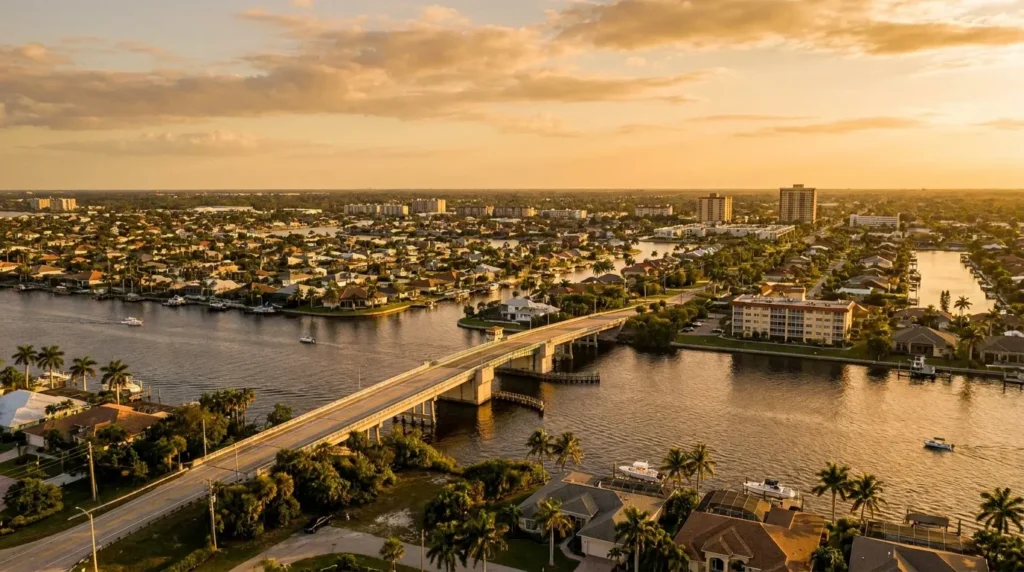
A planned city on the Gulf Coast with more navigable waterways than any other city in the world, life centered around the water, Sun Splash, and the South Cape district.

Cape Coral was planned in the 1950s as a canal-based residential city, and to this day the lifestyle revolves around the water. There are more than 400 miles of canals, many navigable to the Caloosahatchee River and the Gulf of Mexico. Owning a home with a private dock is a major part of the appeal. Cape Harbour and Tarpon Point Marina concentrate waterfront restaurants and boat rentals.

Four Mile Cove Ecological Preserve protects native mangroves and offers kayak rentals by the hour. Sun Splash Family Waterpark, the city's municipal water park, is a classic destination. Rotary Park Environmental Center features nature trails and a butterfly garden. South Cape, along Cape Coral Parkway and SE 47th Terrace, is the main area for bars, restaurants, and nightlife.

The nearest beach is Fort Myers Beach, about 30 minutes away. Sanibel and Captiva Islands are a short drive across the Sanibel Causeway and are renowned for shell collecting. For larger natural areas, the J.N. Ding Darling National Wildlife Refuge on Sanibel is a must-visit, and the Everglades are a few hours to the south.

  1. 1["Sun Splash Family Waterpark"
  2. 2"Four Mile Cove Ecological Preserve"
  3. 3"Cape Coral Yacht Club Beach"
  4. 4"Rotary Park Environmental Center"
  5. 5"Tarpon Point Marina"
  6. 6"Cape Harbour"
Nightlife5.0 / 10
Parks & green spaces
  • ["Four Mile Cove Ecological Preserve"
  • "Rotary Park Environmental Center"
  • "Jaycee Park"
  • "Joe Stonis Park"
  • "Sirenia Vista Park"
  • +1 more

Latest posts

Posts about Florida

Coverage and updates related to this destination.

Showing content from Florida, as there is no specific data for Cape Coral yet.