Visto n' Visa
Blog
Notícias e artigos
Destinations
Careers
Immigrants

Want to live and work in Lakewood?

Personalized immigration plan with eligible visas, costs, and next steps for your goal!

If you are not eligible, you will know exactly why and what to do to improve your approval chances.

Save up to 12 hours in meetings

No pointless assessments.

Save up to 90%

Save money on vague or unfocused consultations

Avoid Fraud and Mistakes

One mistake can cost you your visa

Total Impartiality

Zero commercial bias

Decide with peace of mind

No toxic urgency

Fast and Accurate

Answers in minutes, no guesswork

Lakewood population: majority white with a growing Hispanic community

Approximately 73% non-Hispanic white and 22% Hispanic. More diverse than other Denver suburbs, with a strong Latino presence in eastern neighborhoods.

Lakewood is predominantly non-Hispanic white, at around 73%. The Hispanic community reaches roughly 22%, primarily of Mexican origin, with families established for generations in eastern neighborhoods along Colfax Avenue and Alameda. Asian residents, including Chinese, Vietnamese, and Korean communities, account for around 3%, and Black residents for close to 2%.

English is dominant, but Spanish is widely spoken in eastern neighborhoods. Mexican grocery stores, taquerias, and bakeries such as Panaderia La Mexicana are scattered along Colfax. The Brazilian community is small, composed mainly of students and professionals who chose Lakewood for its lower cost compared to Denver.

The median age is around 41 years, older than Denver's, reflecting the family-oriented profile and a strong retiree presence. Families with children concentrate in neighborhoods such as Green Mountain, Bear Creek, and Sun Valley. Retirees are also drawn by the quieter pace, easy access to hospitals, and light rail connectivity.

Languages spoken
  • English
  • Spanish
  • Vietnamese
  • Russian
  • Korean
  • +1 more
Main religions
  • No religion (about 33%)
  • Protestant Christian
  • Roman Catholic
  • Mormon
  • Buddhist
  • +1 more

Cost of living in Lakewood: cheaper than Denver, above the national average

Rent and home prices are lower than in Denver. Food and services are in line with Colorado averages. State income tax is 4.4%.

Lakewood is less expensive than Denver, though the gap has been narrowing. A one-bedroom apartment rents for between $1,300 and $1,700 per month, depending on location and building. Newer complexes near Belmar or light rail stations trend toward the higher end. A three-bedroom house rents for between $2,200 and $3,000.

Grocery prices at chains like King Soopers, Safeway, Sprouts, and the Costco in Belmar are comparable to the rest of Colorado. A meal at a casual restaurant runs $13 to $22 per person. Belmar offers an open-air shopping district with restaurants such as Bonefish Grill and Yard House, plus an Alamo Drafthouse cinema.

Colorado's state income tax is 4.4%. There is no local income tax. Xcel Energy utility bills can be significant in winter. Car insurance is higher than the national average due to hail risk. An individual health insurance plan without a subsidy runs $400 to $700 per month. Commuters who use the light rail to Denver save considerably on parking, which can cost $15 to $30 per day downtown.

102Cost index (US = 100)2% above US average
CategorySingleCoupleFamily (2 + 2)
iHousing$1,331$1,536$1,946
iFood$389$778$1,413
iTransport$512$870$1,126
iHealthcare$287$573$1,075
iChildcare$1,864
iOther$870$1,567$2,202
Monthly total$3,389$5,324$9,626

Source: U.S. BLS Consumer Expenditure Survey 2023 + BEA Regional Price Parities 2023 · Estimates in USD, monthly.

Housing in Lakewood: 1960s-1980s homes and new apartments in Belmar

Ranch and split-level homes from the 1960s through 1980s dominate. Belmar has newer buildings. Modern apartment complexes have grown near light rail stations.

The typical Lakewood housing stock consists of single-family homes built between the 1960s and 1980s in ranch and split-level styles, with two-car garages, finished basements, and yards. Neighborhoods such as Green Mountain, Bear Creek, and Applewood are the most sought-after for families. Purchase prices range from $500,000 to $800,000 depending on the area. Newer homes are concentrated in the southern and western parts of the city.

Belmar has become Lakewood's modern hub. The former enclosed mall was redeveloped into a mixed-use neighborhood with apartments above retail, restaurants, and entertainment. New buildings continue to rise along the W Line light rail stations, including Sheridan, Federal, Lakewood/Wadsworth, and Garrison. Rents here are in line with Denver averages, with the added benefit of a direct downtown connection.

Landlords typically require income of three times the monthly rent, a credit score of 600 or higher, and references. Newcomers without a U.S. credit history may need a co-signer or an additional month's deposit upfront. Popular listing platforms include Zillow, Apartments.com, Trulia, Craigslist, and Facebook Marketplace.

Recommended neighborhoods
  • Belmar (new urban, restaurants)
  • Green Mountain (suburban, trails)
  • Bear Creek (near the park)
  • Applewood (classic, large homes)
  • Sun Valley (family-oriented)
  • +3 more

Job market in Lakewood: federal government, healthcare, and renewable energy

The Federal Center is the largest employer. The National Renewable Energy Laboratory in Golden and the broader energy sector drive demand. Many residents commute to Denver for work.

The Denver Federal Center, a large complex on West 6th Avenue, houses more than 26 federal agencies, including the USGS, Bureau of Land Management, Bureau of Reclamation, and FEMA Region 8, employing roughly 6,000 people. It is one of the largest federal campuses outside Washington, D.C. U.S. citizens with security clearances will find a wide range of stable positions there.

The National Renewable Energy Laboratory (NREL), in nearby Golden (about 10 minutes away), is the national center for clean energy research and employs engineers and scientists at senior levels. Lockheed Martin Space Systems, at Waterton Canyon south of Lakewood, operates a facility that builds satellites and spacecraft. Engineering salaries in these sectors range from $90,000 to $160,000 per year.

Healthcare drives additional demand through St. Anthony Hospital, part of CommonSpirit Health, and numerous clinics across the city. Many workers are employed in Denver and live in Lakewood, using the light rail for their commute. Colorado's minimum wage was $14.42 per hour in 2024. The service sector, including retail and restaurants, typically pays near that minimum.

Dominant sectors
  • Federal government (Denver Federal Center)
  • Renewable energy and research
  • Aerospace and defense
  • Healthcare and hospitals
  • Retail and commerce
  • +2 more
Major employers
  • Denver Federal Center (USGS, BLM, etc.)
  • Lockheed Martin Space Systems
  • National Renewable Energy Laboratory (NREL, Golden)
  • St. Anthony Hospital
  • Jefferson County Public Schools
  • +2 more

Education in Lakewood: varied schools and a community college

Jefferson County Public Schools is the main district. School quality varies by neighborhood. Red Rocks Community College is the primary local higher-education institution.

Jefferson County Public Schools, known as Jeffco, is Colorado's second-largest school district and serves Lakewood. Quality varies considerably by school. Neighborhoods such as Green Mountain, Bear Creek, and Applewood have better-rated schools, including Green Mountain Elementary, Dunstan Middle, and Bear Creek K-8. Families frequently factor school boundaries into their housing decisions.

Charter options include D'Evelyn Junior/Senior High School, one of the highest-rated public schools in the state. Private options include Bear Creek High School and Green Mountain Lutheran. Families with young children tend to gravitate toward the western and southern parts of the city.

Red Rocks Community College, located in Lakewood, is the primary local higher-education institution, offering two-year programs, technical certifications, and firefighter training. For four-year degrees, most students attend schools in Denver, such as CU Denver, Metro State, or the University of Denver, or Colorado School of Mines in Golden. Tuition for international students varies by institution.

Notable universities
  • Red Rocks Community College
  • Colorado Christian University
  • Colorado School of Mines (Golden, nearby)
  • Rocky Mountain College of Art and Design (RMCAD)

Healthcare in Lakewood: St. Anthony Hospital and proximity to Denver's network

St. Anthony Hospital is the primary facility. Proximity to larger Denver hospitals and CU Anschutz ensures access to complex specialties.

St. Anthony Hospital, part of the CommonSpirit Health network, is Lakewood's main hospital, with a full emergency department, a Level I trauma center, and a helipad. Emergency care is well regarded, and a broad range of specialties is available on site. For complex conditions such as transplants or advanced oncology, patients are typically referred to the CU Anschutz Medical Campus in Aurora.

Walk-in clinics such as UCHealth Urgent Care, Centura Health, and AFC Urgent Care handle routine needs. Clinics inside grocery stores, including The Little Clinic at King Soopers locations, are also available. As is the case throughout the United States, healthcare without insurance is expensive. A basic walk-in clinic visit runs $100 to $250, while an emergency room visit can exceed $2,000.

An individual health insurance plan on the marketplace at healthcare.gov costs $400 to $750 per month for a single adult. Telemedicine is a lower-cost alternative for straightforward issues. Salud Family Health Center and Inner City Health Center, with nearby locations, provide care on a sliding fee scale for low-income patients regardless of immigration status.

Healthcare index65.0 / 100
  • Life expectancyyears at birth
    78.4yrs
  • Doctors per 1kpracticing physicians
    3.7
  • Health spendper capita, per year
    $13,473
  • Public systemoverall quality rating
    Good

Safety in Lakewood: quiet suburb with problem pockets along Colfax

Residential neighborhoods are generally safe. Property crime exists. Colfax Avenue has more troubled stretches with drug activity and visible homelessness.

Lakewood is considered safe in most areas. Neighborhoods such as Green Mountain, Bear Creek, Applewood, Sun Valley, and Belmar have low crime rates. Walking at night in residential areas is generally comfortable. Schools and municipal parks function well and are a regular part of family life.

Property crime, including car break-ins, smash-and-grab incidents, and catalytic converter theft, has increased, as it has across the greater Denver metropolitan area. Nothing should be left visible in a vehicle, even an empty bag. Catalytic converter theft targeting trucks and SUVs is also a known issue. Bikes parked in public areas require a U-lock.

Colfax Avenue in the eastern part of the city has stretches with a visible homeless population, budget motels, and drug activity, particularly involving fentanyl and methamphetamine. That corridor is best avoided at night. The Lakewood Police Department maintains a solid response record. Violent crimes against strangers are rare.

5.8
Homicides per 100k
per year
Safety index
60.0
Crime index
40.0
Safer neighborhoods
  • Green Mountain
  • Belmar
  • Solterra
  • Applewood
  • Bear Creek
  • Lakewood Estates
Areas to avoid
  • Areas near West Colfax Avenue late at night
  • Isolated stretches of Sheridan Boulevard at night
  • Some industrial sections during off-hours

Transportation in Lakewood: light rail and moderate car dependence

The W Line light rail connects Lakewood to downtown Denver. For most of the city, a car remains the primary mode of transport. Reasonable bike paths through the parks.

Lakewood's main mobility advantage is the RTD W Line light rail, which runs from downtown Denver's Union Station to Golden, with stops throughout Lakewood, including Sheridan, Federal, Lamar, Lakewood/Wadsworth, Garrison, Oak, Federal Center, Red Rocks, and Jefferson County Government Center. A single fare is $3 and includes transfers.

For daily errands within Lakewood, a car is still the primary option. The city is spread out, and reaching grocery stores, schools, and parks typically requires a vehicle. Major corridors such as Wadsworth, Kipling, Sheridan, and Colfax run through the city. RTD bus routes supplement the light rail but operate on less frequent schedules on weekends.

Bike paths run along Bear Creek Trail and Lakewood Gulch Trail, connecting to the W Line Bikeway. Workers commuting to Denver can bring bikes aboard the light rail. For the airport (DEN), the route involves taking the W Line to Union Station, then the A Line to DEN, totaling about 1 hour and 30 minutes.

1
Metro lines
5
Metro stations
26 min
Avg commute
43
Walkability
Airports
  • DEN — Denver International Airport (regional access)
  • APA — Centennial Airport (general aviation, regional)
  • BJC — Rocky Mountain Metropolitan Airport (general aviation)
  • Bike infrastructure

What the Climate Is Like in Lakewood

Lakewood has a semi-arid climate on the Front Range, with hot, dry summers, cold and sunny winters with frequent snow, and thinner air due to altitude.

Summer is dry and hot, running from June through August. High temperatures typically range from 82°F to 90°F (28°C to 32°C), with peaks above 97°F (36°C) in July. Afternoon hailstorms are a regular occurrence. Air conditioning sees occasional use, and the low humidity makes the heat more bearable.

Winter is cold but notably sunny, from December through February, with highs between 41°F and 48°F (5°C to 9°C) and lows between 14°F and 23°F (-10°C to -5°C). Snow falls regularly, with annual accumulation around 55 inches (1.4 m), though it typically melts quickly. Central heating is essential.

The elevation of 5,600 ft (1,707 m) intensifies UV radiation and calls for greater daily hydration. For residents, air conditioning, reliable heating, daily sunscreen, and awareness of spring hailstorms are important practical considerations.

Sunny days / year245 days
Avg high (°F)
  • 43°J
  • 41°F
  • 49°M
  • 61°A
  • 69°M
  • 81°J
  • 88°J
  • 87°A
  • 82°S
  • 64°O
  • 54°N
  • 46°D
Avg low (°F)
  • 19°J
  • 14°F
  • 22°M
  • 31°A
  • 42°M
  • 53°J
  • 60°J
  • 59°A
  • 51°S
  • 36°O
  • 27°N
  • 23°D
Rainfall (")
  • 1"J
  • 1"F
  • 2"M
  • 2"A
  • 4"M
  • 2"J
  • 1"J
  • 2"A
  • 1"S
  • 1"O
  • 1"N
  • 1"D

Culture in Lakewood: suburban life with easy outdoor access

More residential than urban in character, with events at Belmar, large nearby state parks, and a growing number of small craft breweries.

Lakewood's culture is quintessentially American suburban: centered on family, parks, youth sports, and backyard gatherings. Belmar anchors community events such as the Belmar Farmers' Market in summer, seasonal festivals including Lakewood on Parade and Cider Days, and the Lakewood Cultural Center, which hosts plays, concerts, and exhibitions.

Outdoor life is the main draw. Bear Creek Lake Park, within city limits, has a beach, trails, and camping. Nearby, William F. Hayden Park at Green Mountain offers trails with panoramic views of Denver. Within 20 minutes lie Red Rocks Amphitheatre, a natural outdoor concert venue of national renown, and Mount Falcon. Further west, Golden, Idaho Springs, and Evergreen offer breweries and a mountain-town atmosphere.

Craft beer is thriving: Caution Brewing, WestFax Brewing, and 14er Brewing are well-regarded local spots. Mexican food is ubiquitous along Colfax and Alameda, with authentic taquerias throughout. Lakewood does not have a standalone cultural scene comparable to Denver's, but its proximity compensates. Many residents head into Denver for nightlife and weekend activities.

Lakewood

Lakewood Attractions: Denver Suburb with Direct Access to the Rockies

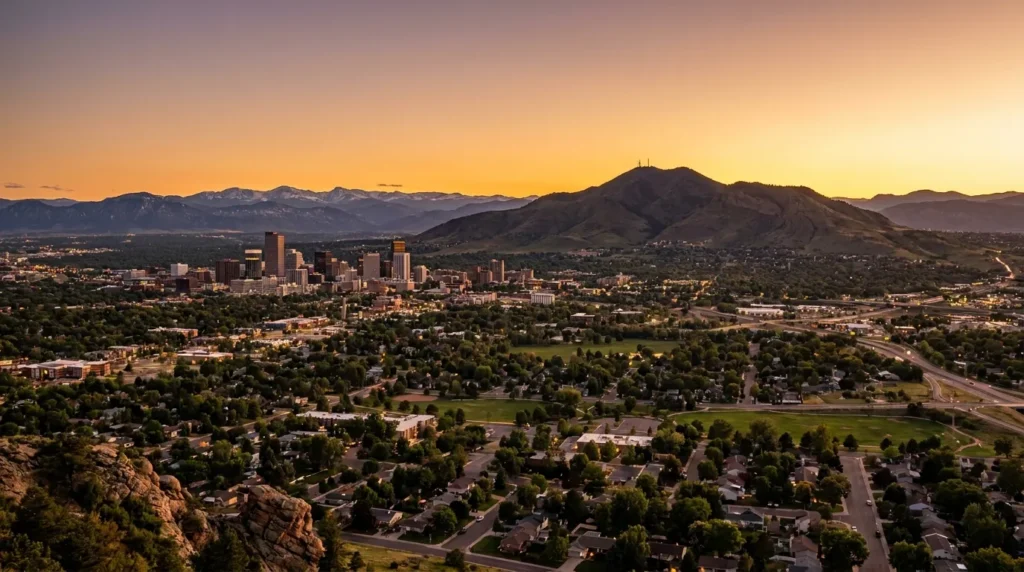
Lakewood sits west of Denver, at the edge of the Rocky Mountains. Attractions combine regional parks, new cultural districts, and easy access to skiing and alpine trails.

The Belmar District, redesigned from a former shopping mall, became a civic center with movie theaters, restaurants, and the Lakewood Cultural Center, which hosts theater, concerts, and visual arts exhibitions. The 40 West Arts District, along Colfax Avenue, is Colorado's official arts district and anchors the Lakewood Arts Festival each July.

Bear Creek Lake Park, with a lake for swimming and windsurfing, and William Frederick Hayden Park, with its reddish sandstone cliffs, give Lakewood an outdoor profile that is hard to match. Red Rocks Park and Amphitheatre, one of the most famous amphitheaters in the United States, is 15 minutes away in the neighboring town of Morrison and serves as a cultural magnet for the region.

Skiing at Loveland and A-Basin is about an hour's drive on I-70, with Vail and Breckenridge roughly two hours away. For quick urban outings, the Light Rail W Line connects Lakewood to downtown Denver in about 30 minutes, with stops near Coors Field, Union Station, and the Denver Art Museum.

  1. 1["Belmar shopping district"
  2. 2"Lakewood Heritage Center"
  3. 3"Lakewood Cultural Center"
  4. 4"40 West Arts District"
  5. 5"Bear Creek Lake Park"
  6. 6"William F. Hayden Park on Green Mountain"
Nightlife5.0 / 10
Parks & green spaces
  • ["Bear Creek Lake Park"
  • "William F. Hayden Park on Green Mountain"
  • "Belmar Park"
  • "Crown Hill Park"
  • "Two Ponds National Wildlife Refuge"
  • +1 more

Latest posts

Posts about Colorado

Coverage and updates related to this destination.

Showing content from Colorado, as there is no specific data for Lakewood yet.