Visto n' Visa
Blog
Notícias e artigos
Destinations
Careers
Immigrants

Want to live and work in Grand Junction?

Personalized immigration plan with eligible visas, costs, and next steps for your goal!

If you are not eligible, you will know exactly why and what to do to improve your approval chances.

Save up to 12 hours in meetings

No pointless assessments.

Save up to 90%

Save money on vague or unfocused consultations

Avoid Fraud and Mistakes

One mistake can cost you your visa

Total Impartiality

Zero commercial bias

Decide with peace of mind

No toxic urgency

Fast and Accurate

Answers in minutes, no guesswork

Diverse population at mid-size city scale

Grand Junction is home to approximately 67,000 residents, with a longstanding Hispanic community and recent flows of healthcare and energy professionals from around the world.

The demographic composition is predominantly non-Hispanic white, with the largest minority being the Hispanic community, established for generations in the Grand Valley through fruit farming and ranching. English dominates daily life, but Spanish appears in businesses, schools, and public services.

In recent years, the city has received professionals from abroad, particularly doctors, nurses, and engineers attracted by St. Mary's Medical Center and the region's energy operations. Smaller immigrant communities from Southeast Asia, Eastern Europe, and Latin America maintain ethnic restaurants and grocery stores around North Avenue.

The median age is slightly above the national average, reflecting the city's appeal to retirees seeking low costs and sunny weather. At the same time, Colorado Mesa University injects a young population that circulates through neighborhoods near campus, giving the city a balance of established families, students, and newcomers.

Languages spoken
  • English
  • Spanish
Main religions
  • Protestant Christianity
  • Catholicism
  • Mormonism (LDS Church)
  • No religious affiliation

Cost below Colorado's average and western urban centers

Grand Junction has housing, food, and services costs below those of Denver, Boulder, and most western U.S. cities, though summer utilities weigh on household budgets.

The monthly budget for an average family centers on housing, transportation, and healthcare. A two-bedroom apartment rents for significantly less than in Denver and Fort Collins, and large supermarkets such as City Market and Safeway compete with the regional Sam's Club and Costco, keeping grocery prices in check.

A car is practically essential, so fuel and insurance factor heavily into expenses. Electricity bills rise during summer months because of air conditioning, which runs almost continuously from June through August. Natural gas consumption in winter is moderate, as the city has a milder climate than the rest of the state.

Local restaurants are more affordable than in nearby tourist destinations such as Aspen or Telluride, and weekend farmers' markets offer fruits and vegetables from the Grand Valley at accessible prices. For immigrants arriving from large cities, the overall sense is one of a lighter budget and greater predictability.

98Cost index (US = 100)2% below US average
CategorySingleCoupleFamily (2 + 2)
iHousing$1,278$1,475$1,868
iFood$373$747$1,356
iTransport$492$835$1,081
iHealthcare$276$550$1,032
iChildcare$1,789
iOther$835$1,504$2,114
Monthly total$3,254$5,111$9,240

Source: U.S. BLS Consumer Expenditure Survey 2023 + BEA Regional Price Parities 2023 · Estimates in USD, monthly.

Single-story homes, condominiums, and the Redlands neighborhoods

The real estate market centers on single-family homes in quiet neighborhoods, with pockets of apartments near the university and upscale options on the Redlands hillsides.

Renters typically find more inventory in apartments near Colorado Mesa University and along North Avenue. Single-family rentals tend to be single-story homes with yards and garages, common in neighborhoods such as Orchard Mesa, Clifton, and Fruitvale. Prices are well below the state's urban centers, but supply is limited and desirable units move quickly.

For buyers, the Redlands is the most sought-after neighborhood: larger homes, views of Colorado National Monument, and wide streets. Downtown and the area around historic Seventh Street offer restored century-old homes that attract professionals and retirees. Young families often look to Fruita, a neighboring city 15 minutes away, with well-rated schools and more space.

Newcomers typically rent first near downtown or the university to get to know the city, then move to the Redlands, Fruita, or Palisade based on budget and lifestyle. Local agencies such as Bray Real Estate and The Christi Reece Group dominate the market and assist those arriving without U.S. credit history.

Recommended neighborhoods
  • Redlands
  • Downtown
  • Fruitvale
  • Orchard Mesa
  • Fruita (nearby)
  • +1 more

Healthcare, energy, education, and tourism drive the city

The labor market is dominated by healthcare and services, with a strong energy presence (oil, gas, and historic uranium) and growth in outdoor tourism and remote technology work.

The largest employer is St. Mary's Medical Center, with thousands of staff and ongoing demand for physicians, nurses, and technicians. Colorado Mesa University follows closely, sustaining jobs in education, research, and campus services. Mesa County Valley School District 51 and the municipal government also concentrate a relevant volume of positions.

Energy has historically driven the region: oil, natural gas, and, in past decades, uranium mining. Today the presence is more discreet, but operations in the Piceance Basin still hire engineers, technicians, and operators. Outdoor tourism grows with mountain biking, wineries, and nearby national parks, feeding hospitality, restaurants, and adventure operators.

For remote workers, fiber-optic internet is available across much of the city and the cost of living is attractive. Immigrants on H-1B visas frequently arrive for healthcare and engineering positions; employer-sponsored visa holders typically transfer through St. Mary's, Community Hospital, or regional energy companies.

Dominant sectors
  • Healthcare
  • Education
  • Energy (oil and gas)
  • Outdoor tourism
  • Agriculture (fruits and wine)
  • +1 more
Major employers
  • St. Mary's Medical Center
  • Colorado Mesa University
  • Mesa County Valley School District 51
  • Community Hospital
  • Mesa County
  • +2 more

Colorado Mesa University anchors higher education

The city has a robust public school network in Mesa County Valley District 51, private and religious options, and Colorado Mesa University as the primary center of higher education.

Mesa County Valley School District 51 administers dozens of public schools across Grand Junction, Fruita, Palisade, and Clifton. The most sought-after schools are typically in the Redlands and Fruita, with consistently strong state assessment results. Charter schools such as Mesa Valley Community School and Independence Academy expand options for families seeking different approaches.

Colorado Mesa University is the heart of local higher education, with approximately 11,000 students enrolled in programs ranging from nursing and engineering to visual arts and business administration. Western Colorado Community College, affiliated with CMU, offers technical training and two-year programs aimed at the regional job market.

For immigrant families, the district provides English as a Second Language (ESL) programs in nearly every school, and CMU maintains support services for international students. Access to private childcare and Head Start is reasonable, though waitlists appear in higher-demand neighborhoods.

Notable universities
  • Colorado Mesa University
  • Western Colorado Community College
  • Colorado Technical University (online)

Regional healthcare hub for the western slope

Grand Junction concentrates the medical infrastructure for the entire western slope of Colorado, with major hospitals, rare specialties, and trauma centers.

St. Mary's Medical Center, operated by SCL Health, is the largest hospital between Denver and Salt Lake City, with a Level II trauma center, CareFlight helicopter service, and specialties including oncology, cardiology, and neurology. It draws patients from several smaller regional cities, including from Utah and Wyoming.

Community Hospital, a newer facility, complements the offering with a modern surgical center and emergency care. Independent clinics, family practices, and mental health centers cover most day-to-day needs. The Veterans Affairs Medical Center serves regional veterans with its own hospital facility.

For newly arrived immigrants, employer-based health plans are broadly accepted. Those without coverage can seek care at community clinics such as MarillacHealth, which offers sliding-scale fees. The city has earned national recognition for a collaborative healthcare model involving hospitals, clinics, and local insurers.

Grand Junction

Mid-size city with crime rates near the state average

Grand Junction has crime rates near the Colorado average, with issues concentrated in specific areas and family neighborhoods widely regarded as safe.

The Redlands, Fruita, and most of the historic downtown have a quiet reputation, with low rates of violent crime and strong community engagement. Families with children tend to prioritize these areas for their schools and calm residential atmosphere.

Areas along North Avenue and parts of Orchard Mesa see more incidents of petty theft, vandalism, and substance-related issues, reflecting challenges typical of older commercial corridors. These are not dangerous neighborhoods in a strict sense, but they warrant extra awareness at night and care with valuables left in vehicles.

The Grand Junction Police Department maintains community policing programs and partnerships with Colorado Mesa University. Overall, residents describe the city as safe for its size, with a sense of security considerably greater than in major urban centers.

Safer neighborhoods
  • Redlands
  • Fruita
  • Historic Downtown
  • Neighborhoods near CMU
  • Palisade
Areas to avoid
  • North Avenue corridor at night
  • Isolated sections of Orchard Mesa
  • Industrial areas around Riverside Parkway after dark

Car-dependent city with an active regional airport

Most residents rely on a car, but the city has a regional airport, Grand Valley Transit bus service, and reasonable bike infrastructure for its size.

Grand Junction Regional Airport (GJT) connects the city to Denver, Salt Lake City, Phoenix, Dallas, and some seasonal routes. International travelers typically connect through Denver International or Salt Lake City. There is no direct international airport, which is a consideration for immigrants who travel frequently.

Grand Valley Transit regional bus service runs routes through downtown, Clifton, Fruita, and Palisade, but frequency and coverage are limited compared to a large city. Interstate I-70 runs through the city, connecting it to the rest of Colorado to the east and Utah to the west. Amtrak's California Zephyr stops at the local station, offering a slow but scenic connection to Denver and Chicago.

For daily life, a personal vehicle handles nearly everything: short distances, abundant free parking, and light traffic. The Riverfront Trail follows the Colorado River and is popular among residents. Bicycles and e-scooters have gained traction, particularly among Colorado Mesa University students.

Airports
  • GJT — Grand Junction Regional Airport
  • Bike infrastructure

Climate

Grand Junction

Wine, outdoor festivals, and public art

Local culture blends the Grand Valley's agricultural heritage, a wine scene centered in Palisade, outdoor festivals, and public art installations downtown.

Downtown Grand Junction is known for Art on the Corner, a permanent outdoor sculpture exhibition that rotates annually. Main Street becomes a gathering point for events such as the Downtown Farmers' Market on summer Thursdays. Local restaurants highlight valley ingredients, with Palisade peaches, regional wines, and local lamb appearing on menus.

The wine scene is the region's signature draw. More than 25 wineries around Palisade produce award-winning labels, and Colorado Mountain Winefest, held every September, draws visitors from across the country. Country Jam, a summer country music festival, is another major event, filling hotels and lodges.

Hispanic communities maintain Cinco de Mayo and Día de los Muertos celebrations, and Colorado Mesa University schedules cultural events open to the public throughout the academic year. For newcomers, the calendar is modest compared to major metropolitan areas, but it has a clear identity: outdoor life, wine, and local community.

Notable dishes
  • Palisade peach
  • Grand Valley regional wines
  • Western Colorado lamb
  • Palisade lavender
  • Local craft beer (Kannah Creek, Edgewater)
Annual events
  • Colorado Mountain Winefest
  • Country Jam Music Festival
  • Palisade Peach Festival
  • Downtown Farmers' Market
  • Junior College World Series
  • +1 more

Red canyons, vineyards, and open-air art

Grand Junction's main attractions combine desert scenery, wineries, mountain biking, urban sculptures, and access to national parks within a short drive.

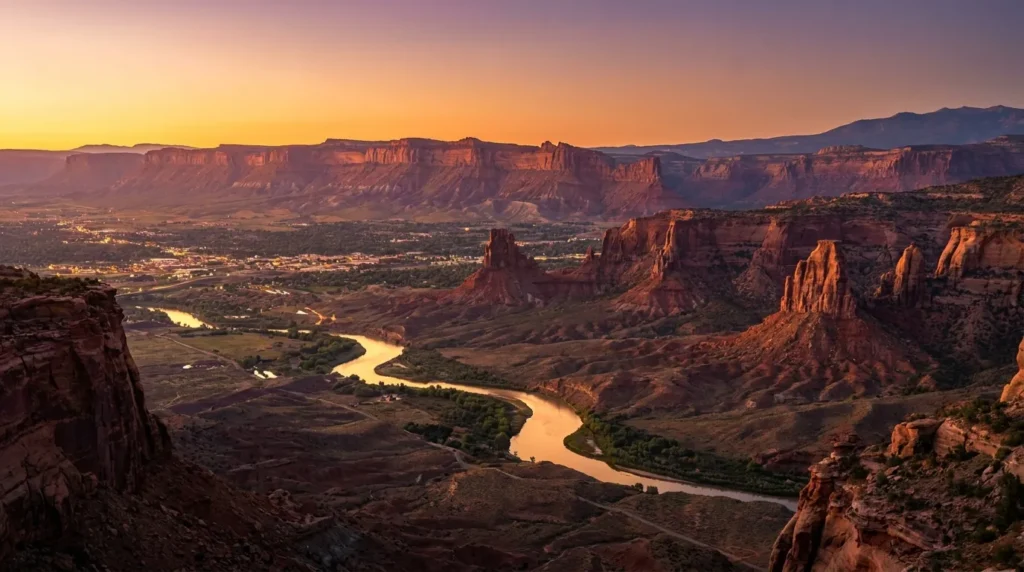
Colorado National Monument, a few minutes from downtown, is the city's signature landmark: red canyons, rock formations, and the famous Rim Rock Drive with spectacular overlooks. Grand Mesa, considered one of the largest flat-topped mountains in the world, offers fishing, winter skiing, and hundreds of lakes in summer.

Downtown, Main Street stands out for the permanent Art on the Corner sculpture program, transforming the sidewalk into an open-air gallery. The Museums of Western Colorado documents regional history through dinosaur fossils, railroads, and frontier life. The Western Colorado Botanical Gardens is a must for anyone interested in desert plants.

The Palisade vineyards are 20 minutes away and open year-round for tastings, restaurant dining, and cycling between wineries. The Riverfront Trail runs nearly 20 miles along the Colorado River, connecting parks, fishing areas, and overlooks. For mountain biking, the Lunch Loops trails and those near Fruita draw cyclists from across the country.

  1. 1Colorado National Monument
  2. 2Grand Mesa
  3. 3Palisade Wineries
  4. 4Art on the Corner (Main Street)
  5. 5Museums of Western Colorado
  6. 6Riverfront Trail
Parks & green spaces
  • Lincoln Park
  • Riverside Park
  • Connected Lakes State Park
  • James M. Robb Colorado River State Park
  • Canyon View Park
  • +1 more

Historic Hispanic community and diverse recent arrivals

The largest immigrant community is Hispanic, primarily of Mexican origin, with a growing presence of healthcare professionals from Southeast Asia and Eastern Europe.

The Hispanic community of the Grand Valley traces back several generations, rooted in peach and cherry farming and cattle ranching. Today it sustains markets, restaurants, bakeries, and churches around North Avenue and in Clifton. Celebrations such as Cinco de Mayo and Día de los Muertos are visible on the local cultural calendar.

Healthcare professionals, particularly physicians and nurses from the Philippines, India, and Eastern European countries, arrive drawn by St. Mary's Medical Center. Smaller communities of Vietnamese, Chinese, and Korean immigrants maintain ethnic restaurants throughout the city. Brazilians appear in smaller numbers, generally in healthcare, hospitality, or higher education.

For practical support, the area has Catholic Charities, Hilltop Community Resources, and the local office of Lutheran Family Services, which assist newcomers with documentation, language, and housing. Consulates are concentrated in Denver, about four hours by car, which is the main limitation for immigrants requiring in-person consular services.

4,500
Foreign-born residents
estimated
Top countries of origin
  • Mexico
  • Philippines
  • India
  • Vietnam
  • China
  • Ukraine
  • South Korea
  • Brazil
Foreign consulates
  • Consulate General of Mexico in Denver
  • Consulate General of Canada in Denver
  • Honorary Consulate of Germany in Denver
  • Consulate General of Japan in Denver
  • Consulate General of Brazil in Los Angeles (nearest jurisdiction)
Community organizations
  • Catholic Charities of the Diocese of Pueblo
  • Hilltop Community Resources
  • Lutheran Family Services Rocky Mountains
  • Latino Chamber of Commerce of Mesa County
  • MarillacHealth

Latest posts

Posts about Colorado

Coverage and updates related to this destination.

Showing content from Colorado, as there is no specific data for Grand Junction yet.