Visto n' Visa
Blog
Notícias e artigos
Destinations
Careers
Immigrants

Want to live and work in Commerce City?

Personalized immigration plan with eligible visas, costs, and next steps for your goal!

If you are not eligible, you will know exactly why and what to do to improve your approval chances.

Save up to 12 hours in meetings

No pointless assessments.

Save up to 90%

Save money on vague or unfocused consultations

Avoid Fraud and Mistakes

One mistake can cost you your visa

Total Impartiality

Zero commercial bias

Decide with peace of mind

No toxic urgency

Fast and Accurate

Answers in minutes, no guesswork

Who lives in Commerce City

A young and predominantly Hispanic city in its older sections, with a significant recent influx of Anglo and Asian families into the new northern subdivisions.

Commerce City's population exceeds sixty thousand and skews young, with a median age below the Colorado average. Nearly half of residents identify as Hispanic or Latino, a legacy of the Mexican migration that settled around the refineries and rail lines throughout the twentieth century.

In the older neighborhoods south of 72nd Avenue, the Mexican-American community predominates, with multi-generational families, Spanish-language businesses, and Catholic churches as gathering points. In the newer northern subdivisions, such as Reunion and Buffalo Run, the profile is more diverse: Anglo, African American, Indian, and Filipino families have arrived over the past fifteen years, attracted by new homes priced below Denver levels.

Spanish is widely spoken in daily life alongside English. Public schools offer bilingual programs and many municipal services operate in both languages. Roman Catholicism is the majority religion, though Hispanic evangelical churches are growing and small but active Muslim and Hindu communities are present in the northern part of the city.

Languages spoken
  • English
  • Spanish
Main religions
  • Roman Catholic
  • Evangelical
  • Unaffiliated
  • Other Christian traditions

Cost of living in Commerce City

Less expensive than Denver and Boulder, but rising quickly with the expansion of new subdivisions and the arrival of families relocating from the capital.

Commerce City is one of the more affordable options within the Denver metropolitan area, though that is changing. The median price for a home in the newer northern neighborhoods hovers around five hundred thousand dollars, compared to significantly higher prices in Denver, Highlands Ranch, or Boulder. In the older southern neighborhoods, smaller homes can still be found at lower price points.

Apartment rents vary considerably: in newer complexes in the Reunion area they tend to run close to two thousand dollars per month for a two-bedroom unit, while older buildings near Vasquez Boulevard come in below that. Basic utilities such as water, electricity, and natural gas are billed separately and fluctuate significantly in winter, when heating drives costs up.

Grocery prices align with the national average, with King Soopers, Walmart, and Hispanic markets such as Avanza offering options across all budgets. Gasoline tends to be cheaper here than in other parts of Colorado due to proximity to the local refinery. Public transit is limited, so one vehicle per adult is practically essential.

98Cost index (US = 100)2% below US average
CategorySingleCoupleFamily (2 + 2)
iHousing$1,278$1,475$1,868
iFood$373$747$1,356
iTransport$492$835$1,081
iHealthcare$276$550$1,032
iChildcare$1,789
iOther$835$1,504$2,114
Monthly total$3,254$5,111$9,240

Source: U.S. BLS Consumer Expenditure Survey 2023 + BEA Regional Price Parities 2023 · Estimates in USD, monthly.

Housing in Commerce City

Large new homes in the north, older and smaller homes in the south, with far fewer apartment buildings than Denver.

Commerce City's real estate market is dominated by single-family homes. In the north, subdivisions such as Reunion, The Villages at Buffalo Run, Belle Creek, and Second Creek Farm feature relatively new construction built from the 2000s onward, with three to five bedrooms, two-car garages, and backyards. Many communities include shared amenities such as pools, playgrounds, and walking trails.

In the south, neighborhoods like Adams City, Derby, and Irondale have much older homes, typically built between 1940 and 1970, smaller and more modest but often on larger lots. Prices here are significantly lower and attract first-time buyers and investors. Streets in this area are closer to the rail lines and the refinery.

Apartment complexes exist near Quebec Street and along the E-470 corridor, but in smaller numbers than in Denver or Aurora. Those who prefer renting typically find options in these complexes or in houses with rooms available for sublease. For-sale inventory is larger than rental inventory, reflecting the city's profile as a homeowning community.

Recommended neighborhoods
  • Reunion
  • The Villages at Buffalo Run
  • Belle Creek
  • Second Creek Farm
  • Prairie Gateway
  • +1 more

Job market in Commerce City

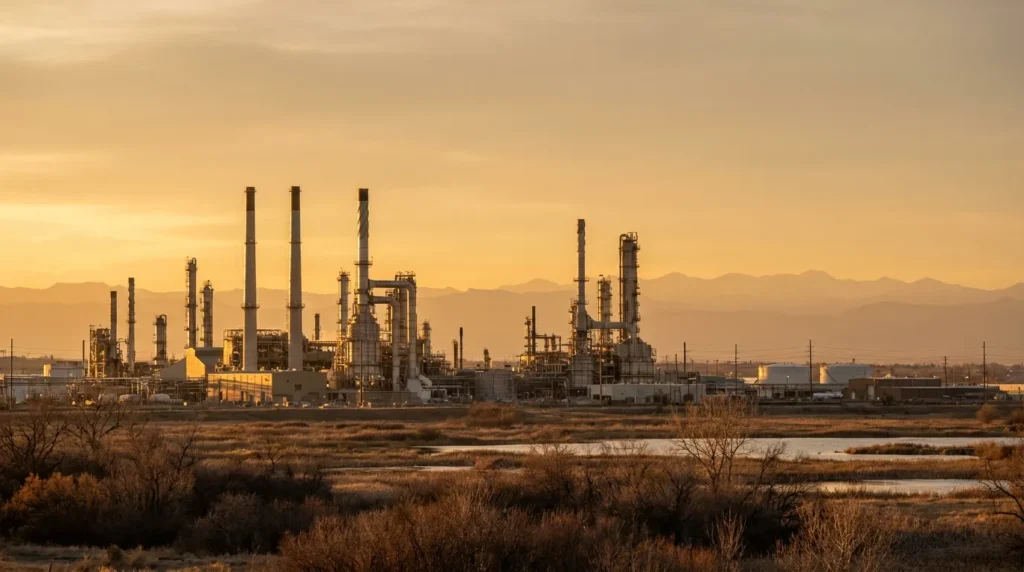
An industrial and logistics economic base anchored by the refinery, distribution centers, and construction, complemented by easy access to Denver employment.

Commerce City's economy has deep industrial roots. The Suncor refinery, one of the largest in the Rocky Mountain region, employs hundreds of people directly and sustains a network of suppliers. Surrounding it, logistics warehouses serve major retailers such as Amazon, Walmart, and UPS, taking advantage of proximity to I-76, I-270, and Denver International Airport.

Construction is another strong sector, driven by the expansion of northern subdivisions and infrastructure projects across the metro area. Local and national firms hire masons, electricians, plumbers, and equipment operators. Transportation and warehousing also employ a large share of the workforce, with trucking companies and cross-docking operations concentrated along Brighton Boulevard.

Those seeking office, technology, or healthcare positions typically work in Denver, Westminster, or the Anschutz Medical Campus in Aurora, all within a reasonable commute by car. Median wages in Commerce City fall below those of wealthier neighboring cities, though the lower cost of living offsets part of that gap.

Dominant sectors
  • Refining and petrochemicals
  • Logistics and warehousing
  • Construction
  • Light manufacturing
  • Road transportation
  • +1 more
Major employers
  • Suncor Energy
  • United Parcel Service
  • Amazon
  • Walmart Distribution
  • School District 27J
  • +1 more

Education in Commerce City

The city is served by two school districts with distinct profiles. There are no major universities within city limits, but institutions in Denver are easily accessible.

Commerce City is served by two public school districts. Adams 14 covers the older southern portion and has historically faced performance and funding challenges, with schools in neighborhoods such as Adams City and Kemp. District 27J covers the northern portion, posts stronger outcomes, and serves the newer Reunion and Belle Creek subdivisions with newer, better-resourced schools.

Beyond the public schools, charter options such as Pinnacle Charter School have a solid reputation in the area. Families seeking private education typically look at Catholic and Christian schools in Denver and Thornton. Spanish bilingual programs are common in the southern schools, reflecting local demographics.

There are no universities within Commerce City. Residents attend Front Range Community College in Westminster, Metropolitan State University of Denver, the University of Colorado Denver, the Community College of Aurora, and, for research-focused options, the University of Colorado Boulder, all reachable by car or train.

Notable universities
  • Front Range Community College (Westminster)
  • Metropolitan State University of Denver
  • University of Colorado Denver
  • Community College of Aurora
  • Regis University

Healthcare in Commerce City

Basic care within the city and major hospitals a short drive away in Denver, Thornton, and Aurora.

Commerce City has clinics and outpatient care centers but no major hospital within city limits. Salud Family Health Centers serves lower-income residents through community clinics covering primary care, pediatrics, dentistry, and mental health, with income-based sliding-scale fees and a bilingual staff.

For emergencies and hospital care, residents use Platte Valley Medical Center in Brighton, North Suburban Medical Center in Thornton, or the UCHealth and Children's Hospital complex at the Anschutz Medical Campus in Aurora, considered one of Colorado's top medical centers. All are within a reasonable drive.

Health coverage follows the standard American model: employer-sponsored private insurance, Medicaid for lower-income residents, and state marketplace plans through Connect for Health Colorado. Documented immigrants may enroll in the marketplace and, in some cases, Medicaid. Without insurance, emergency care is costly, but community clinics help cover basic needs.

Commerce City

Safety in Commerce City

Crime rates above the Colorado average, concentrated in the older industrial south, while the newer northern subdivisions are considered quiet.

Safety in Commerce City varies considerably by area. The older, industrial southern portion has crime rates above the state average, primarily vehicle theft, break-ins, and incidents linked to the proximity of highways and warehouses. The presence of industrial areas with little nighttime foot traffic contributes to this pattern.

In the northern portion, in subdivisions like Reunion, Belle Creek, and The Villages at Buffalo Run, the atmosphere is quite different. New residential streets with homeowners associations, adequate lighting, and low turnover make daily life calm. Opportunistic car break-ins still occur, but violent crime is rare in these neighborhoods.

The Commerce City Police Department maintains community policing programs and publishes neighborhood-level crime reports on the official city website. Practical advice for newcomers includes not leaving valuables visible in parked cars, choosing housing near main thoroughfares, and visiting neighborhoods at different times of day before signing a lease or purchase agreement.

Safer neighborhoods
  • Reunion
  • The Villages at Buffalo Run
  • Belle Creek
  • Second Creek Farm
  • North Range
Areas to avoid
  • Industrial areas south of 64th Avenue at night
  • Sections of Vasquez Boulevard with low foot traffic
  • Refinery vicinity after dark

Getting around Commerce City

A car-dependent city with excellent highway and airport access, but limited public transit and few bike lanes.

Commerce City is a city built around the car. The main arteries are I-76, I-270, and E-470, which provide quick connections to downtown Denver, the international airport, and the rest of the metro area. Traffic tends to worsen during peak hours along I-270, particularly between Vasquez Boulevard and the I-25 interchange.

Public transit is operated by RTD, the Denver regional transit agency. Bus lines serve the city, but frequencies are low outside peak hours. The N Line commuter rail station at 72nd Avenue connects southern Commerce City to Union Station in Denver, making it the most practical option for those who work downtown without a car.

Bike lanes are few and limited to select newer segments such as the Sand Creek Regional Greenway corridor and portions of the E-470 Trail. Spread-out zoning and wide arterials make walking impractical outside residential neighborhoods. Denver International Airport is approximately twenty-five minutes away via E-470, one of the city's major logistical advantages.

Airports
  • DEN — Denver International (approx. 25 min via E-470)
  • Bike infrastructure

Climate

Commerce City

Culture and daily life in Commerce City

A working-class identity, a strong Mexican-American heritage, passion for soccer at Dick's Sporting Goods Park, and growing community events in the newer neighborhoods.

Commerce City's culture reflects its history as a working-class city. Local pride is rooted in the refineries, the railroads, and the families who built the community over decades. The older neighborhoods host street festivals, Spanish-language masses, family-run Mexican restaurants, and markets selling fresh tortillas and carne asada cuts.

The Colorado Rapids, the Major League Soccer club, play at Dick's Sporting Goods Park and are one of the city's defining landmarks. On match days the stadium fills and generates a festive atmosphere. The venue also hosts amateur soccer tournaments, concerts, and community events throughout the year. Memorial Day Parade and Cinco de Mayo are important dates on the local calendar.

The food scene blends American bar food and barbecue with a strong Mexican tradition. Taquerias, paleterias, and panaderias are part of everyday life in neighborhoods like Derby and Adams City. In the newer northern subdivisions, national chains and modern coffee shops share space with Asian and Indian restaurants that arrived alongside the newer residents.

Notable dishes
  • Tacos al pastor
  • Colorado-style burrito with green chile
  • Carne asada
  • Posole
  • Tamales
Annual events
  • Memorial Day Parade
  • Cinco de Mayo Celebration
  • Commerce City Days
  • Colorado Rapids matches
  • Mile High 4th of July

Things to do in Commerce City

Professional sports, an urban wildlife refuge, fishing lakes, and easy access to the Colorado mountains about an hour away.

Commerce City's standout attraction is the Rocky Mountain Arsenal National Wildlife Refuge, one of the largest urban wildlife refuges in the United States. Nearly fifteen thousand acres support bison, deer, bald eagles, and coyotes just minutes from the city center. The refuge has trails, a visitor center, and scenic drives accessible by car or bicycle.

Dick's Sporting Goods Park hosts the Colorado Rapids and stages Major League Soccer matches from March through November. It also hosts amateur soccer tournaments, festivals, and concerts. For fishing and outdoor recreation, Barr Lake State Park, just to the north, offers trails, birdwatching, and good spots for canoeing.

Commerce City's location makes short getaways easy. The Rocky Mountains and ski resorts such as Winter Park are about an hour and a half away via I-70. Downtown Denver, with its museums, restaurants, the RiNo Art District, and Coors Field, is twenty minutes away. For families, Anderson Farms' pumpkin patch in Erie is a fall tradition.

  1. 1Rocky Mountain Arsenal National Wildlife Refuge
  2. 2Dick's Sporting Goods Park
  3. 3Barr Lake State Park
  4. 4Sand Creek Regional Greenway
  5. 5Bison Ridge Recreation Center
  6. 6Prairie Gateway Open Space
Parks & green spaces
  • Rocky Mountain Arsenal National Wildlife Refuge
  • Barr Lake State Park
  • Sand Creek Regional Greenway
  • Pioneer Park
  • Fronterra Park
  • +1 more

Immigrant communities in Commerce City

A city with a deep-rooted Mexican presence and recent growth of Central American, Indian, Filipino, and East African communities in the newer northern subdivisions.

Commerce City has one of the highest proportions of foreign-born residents in the Denver metropolitan area. The Mexican community is by far the largest, with multiple generations established in the older southern neighborhoods, owning businesses, restaurants, auto shops, and markets along 72nd Avenue and Vasquez Boulevard.

Over the past fifteen years, other significant groups have arrived. Families from El Salvador, Guatemala, and Honduras have settled in the south and central portions of the city, many working in construction and services. Indian and Filipino communities have moved into the newer northern subdivisions, drawn by affordable homes and technology and healthcare jobs in greater Denver. There is also a growing presence of Ethiopians, Eritreans, and Somalis, particularly near the Aurora border.

Immigrant support services are concentrated primarily in Denver and Aurora but serve Commerce City residents. Schools offer English Language Learner programs and bilingual community clinics are available. Proximity to Denver provides access to multiple consulates and immigration legal aid organizations.

14,000
Foreign-born residents
estimated
Top countries of origin
  • Mexico
  • El Salvador
  • Guatemala
  • Honduras
  • India
  • Philippines
  • Ethiopia
  • Vietnam
Foreign consulates
  • Mexican Consulate General in Denver
  • Salvadoran Consulate in Aurora
  • Guatemalan Consulate in Denver
  • Honorary Consulate of Peru in Denver
  • Consulate General of Japan in Denver
  • +1 more
Community organizations
  • Salud Family Health Centers
  • Centro Humanitario
  • Servicios de La Raza
  • Catholic Charities of Denver
  • African Community Center of Denver
  • Asian Pacific Development Center

Latest posts

Posts about Colorado

Coverage and updates related to this destination.

Showing content from Colorado, as there is no specific data for Commerce City yet.