Visto n' Visa
Blog
Notícias e artigos
Destinations
Careers
Immigrants

Want to live and work in Colorado Springs?

Personalized immigration plan with eligible visas, costs, and next steps for your goal!

If you are not eligible, you will know exactly why and what to do to improve your approval chances.

Save up to 12 hours in meetings

No pointless assessments.

Save up to 90%

Save money on vague or unfocused consultations

Avoid Fraud and Mistakes

One mistake can cost you your visa

Total Impartiality

Zero commercial bias

Decide with peace of mind

No toxic urgency

Fast and Accurate

Answers in minutes, no guesswork

Colorado Springs Population: White Majority, Growing Latino Community, and High Military Turnover

Approximately 67% non-Hispanic white and 18% Hispanic, with a constant flow of military families from across the country contributing to high residential turnover.

The population of Colorado Springs is predominantly non-Hispanic white, at around 67%. Hispanics make up about 18%, primarily of Mexican origin, with established families in neighborhoods such as Southeast Springs. Black residents account for around 6%, with strong ties to Fort Carson, and Asians (Filipinos, Koreans, and Vietnamese) make up nearly 4%.

English is dominant, with Spanish present in schools and markets such as Carniceria El Tigre. Military turnover means new residents are constantly arriving from Texas, Georgia, California, and North Carolina. Military families typically stay two to four years before being reassigned. The Brazilian community is small, connected to a few evangelical churches and service members married to Brazilians.

The median age is around 35. The population skews younger than the American average due to the military presence. Retired seniors also relocate here seeking the dry climate and lower costs compared to Denver, particularly in neighborhoods like Briargate and Rockrimmon.

Languages spoken
  • English
  • Spanish
  • Korean
  • Tagalog (Filipino)
  • Vietnamese
  • +1 more
Main religions
  • Protestant Christian (strong evangelical presence)
  • Roman Catholic
  • Unaffiliated (approximately 28%)
  • Mormon
  • Orthodox

Cost of Living in Colorado Springs: Cheaper Than Denver, but Rising

Rent and home prices are lower than in Denver, but city growth is pushing costs upward. Food and services are near the American average.

Colorado Springs is more affordable than Denver, though the gap is narrowing. A one-bedroom apartment rents for between USD 1,200 and USD 1,600 per month in neighborhoods such as Old Colorado City and Westside. In newer areas like Briargate or Powers Corridor, prices rise to USD 1,400 to USD 1,800. A three-bedroom house for rent ranges from USD 1,800 to USD 2,500.

Grocery chains including King Soopers, Safeway, Walmart Supercenter, and Sprouts have prices comparable to the rest of Colorado. A meal at a popular restaurant costs USD 12 to USD 20 per person. Military families have access to the on-base commissary at lower prices. Fuel and car insurance are similar to the rest of the state.

State income tax is 4.4% (2024). There is no local income tax. The utility bill (Colorado Springs Utilities, which is municipally operated) is considered affordable by American standards. Those working as government contractors or in the armed forces receive exemptions and benefits that significantly offset total living costs.

105Cost index (US = 100)5% above US average
CategorySingleCoupleFamily (2 + 2)
iHousing$1,371$1,582$2,004
iFood$401$801$1,455
iTransport$527$896$1,160
iHealthcare$296$590$1,107
iChildcare$1,920
iOther$896$1,614$2,268
Monthly total$3,491$5,483$9,914

Source: U.S. BLS Consumer Expenditure Survey 2023 + BEA Regional Price Parities 2023 · Estimates in USD, monthly.

Housing in Colorado Springs: Suburban Homes Dominate, With Military Neighborhoods Near the Bases

Large homes in newer subdivisions are the norm. Neighborhoods near military bases see high turnover. Rents remain more accessible than in Denver.

The dominant housing type in Colorado Springs is the single-family home in suburban subdivisions, common in neighborhoods like Briargate, Stetson Hills, Powers Corridor, and Rockrimmon. Homes tend to be newer (1990s to 2020s), with two-car garages, basements, and central air. Old Colorado City and Downtown have older Victorian homes and bungalows with historic character.

Military families typically live near the base where they are stationed. Those assigned to Fort Carson tend to settle in the southern part of the city. Those at Peterson or Schriever stay to the east. The Air Force Academy draws residents to the northern part of town and Monument. On-base housing is available, but many prefer renting off-base to accumulate the housing allowance (BAH).

To rent, landlords typically require income three times the rent, a credit score above 600, and references. Military members with a Leave and Earnings Statement (LES) are often preferred. Popular listing sites include Zillow, Apartments.com, Trulia, and Craigslist. Local brokers specializing in military families assist those arriving in the area.

Recommended neighborhoods
  • Briargate (new, family-friendly)
  • Old Colorado City (historic, charming)
  • Downtown (urban living, bars)
  • Rockrimmon (established suburb, good schools)
  • Black Forest (rural, large homes)
  • +3 more

Job Market in Colorado Springs: Military, Defense, Aerospace, and Tourism

The economy is driven by military bases and defense contractors. Aerospace is growing with US Space Command. Tourism and healthcare also provide significant employment.

The primary economic driver is the military installation network. Fort Carson has approximately 26,000 soldiers and thousands of civilian employees. Peterson Space Force Base, Schriever, Cheyenne Mountain, and the USAFA collectively employ thousands more. Defense contractors such as Lockheed Martin, Northrop Grumman, Boeing, L3Harris, and General Dynamics maintain significant operations in the area.

The aerospace sector has expanded with the establishment of the US Space Force and the relocation of US Space Command headquarters. Cybersecurity firms like SAIC and Booz Allen Hamilton are active hirers driven by military contracts. Salaries in defense-related engineering range from USD 90,000 to USD 160,000 per year. Many positions require a security clearance, a process that can take months.

Tourism employs many workers because of Pikes Peak, Garden of the Gods, Cave of the Winds, and nearby Cripple Creek (casinos). Healthcare draws job seekers to UCHealth Memorial Hospital, Penrose-St. Francis, and Children's Hospital Colorado. The state minimum wage is USD 14.42 per hour in 2024. The service sector typically pays near minimum wage.

Dominant sectors
  • Defense and military
  • Aerospace and space tech
  • Cybersecurity
  • Tourism and hospitality
  • Healthcare and hospitals
  • +2 more
Major employers
  • Fort Carson (US Army)
  • Peterson Space Force Base
  • US Air Force Academy
  • Lockheed Martin
  • Northrop Grumman
  • +3 more

Education in Colorado Springs: Varied Districts and Universities Focused on Defense and the Arts

School quality varies by district; District 20 (north) is considered the best. The city is home to the US Air Force Academy and UCCS.

The school system is divided into several districts (D11, D12, D20, D38, Falcon, among others). District 20 (Academy School District), in the north, is generally the highest-rated, along with Cheyenne Mountain (D12) on the west side. District 11, in the central area, serves many immigrant families and has more mixed performance. Families often choose their home based on the school district.

The US Air Force Academy (USAFA) is the most prominent institution, commissioning officers for the Air Force and Space Force. Admission is highly competitive and requires a congressional nomination. The University of Colorado Colorado Springs (UCCS) is the main public university, with strong programs in cybersecurity and nursing. Colorado College, in the Old North End, is an elite private liberal arts school operating on a block plan (one course at a time).

Pikes Peak State College (community college), University of the Rockies, and several technical schools focused on military certifications also serve the area. Tuition for international students at UCCS is approximately USD 25,000 per year. An F-1 visa and I-20 form are required for those intending to study.

Notable universities
  • US Air Force Academy (USAFA)
  • University of Colorado Colorado Springs (UCCS)
  • Colorado College (private)
  • Pikes Peak State College
  • Colorado Technical University
  • Nazarene Bible College

Healthcare in Colorado Springs: Major Hospitals and Military Coverage

UCHealth Memorial and Penrose-St. Francis are the main providers. Military members and their families have access to the TRICARE system and Evans Army Community Hospital.

The main civilian hospitals are UCHealth Memorial (downtown and in Briargate), Penrose-St. Francis (part of CommonSpirit Health), and Children's Hospital Colorado, which specializes in pediatrics. Emergency care is considered strong. For highly specialized surgeries or transplants, patients are sometimes referred to Denver.

Military families have access to Evans Army Community Hospital at Fort Carson or the 21st Medical Group at Peterson. Coverage is through TRICARE, which covers nearly everything with low copays. Retired military members also remain on TRICARE for Life. Veterans have access to the Department of Veterans Affairs (VA), with a clinic in Colorado Springs.

For uninsured civilians, walk-in clinics such as AFC Urgent Care and Concentra handle minor issues (USD 100 to USD 200). An individual health insurance plan on the marketplace costs USD 350 to USD 700 per month. Telemedicine (Teladoc) is a more affordable alternative. Dental and vision coverage are rarely included in primary plans.

Healthcare index62.0 / 100
  • Life expectancyyears at birth
    78.4yrs
  • Doctors per 1kpracticing physicians
    3.7
  • Health spendper capita, per year
    $13,473
  • Public systemoverall quality rating
    Good

Safety in Colorado Springs: Generally Safe, With Some Pockets of Concern

Suburban neighborhoods and military areas are very safe. Some pockets to the southeast and along Platte Avenue have higher crime concentrations.

Colorado Springs is considered safe in most areas. Neighborhoods such as Briargate, Rockrimmon, Black Forest, and Old North End have very low crime rates. Military families and retirees concentrate in these areas for that reason. The city's quieter pace is one of the main draws for those leaving Denver.

Property crime (car theft, smash-and-grab in trailhead parking lots like Garden of the Gods) is the most common issue. Valuables should not be left visible in a vehicle, even an empty bag. Catalytic converter theft from trucks and SUVs has increased in recent years. Bicycles at public parking areas require a U-lock.

Some areas to the southeast (near Platte Avenue, Murray, and Academy) have higher concentrations of serious crime and drug activity. Knob Hill and parts of Hancock Expressway are also avoided at night. The Colorado Springs Police Department (CSPD) generally has a quick response time. Violent crimes against strangers remain rare compared to larger cities.

5.8
Homicides per 100k
per year
Safety index
50.0
Crime index
50.0
Safer neighborhoods
  • Briargate
  • Broadmoor
  • Old North End
  • Rockrimmon
  • Northgate
  • Wolf Ranch
Areas to avoid
  • Areas near South Academy Boulevard at night
  • Central stretches late at night
  • Hillside during off-peak hours
  • Some sections of Southeast Colorado Springs after dark

Transportation in Colorado Springs: Car Dependence and Limited Bus Service

A sprawling, car-dependent city. The municipal bus system covers only the essentials. Downtown is walkable, but the rest of the city requires a vehicle.

Colorado Springs is car-dependent. The city is spread out, with suburban subdivisions crossed by wide arterials (Powers, Academy, Nevada). There is no commuter rail, subway, or light rail. The Mountain Metro Transit system operates municipal bus service along the main corridors, but with limited schedules, especially on weekends.

Downtown is walkable, with restaurants, bars, and the Olympic and Paralympic Museum. The neighboring Manitou Springs is also easy to explore on foot. For everything else (groceries, work, school), a car is practically required. Peak-hour traffic on Powers and I-25 can be heavy, though nothing like Denver or Los Angeles.

Colorado Springs Airport (COS) is a small airport with direct flights to Denver, Dallas, Phoenix, Las Vegas, Chicago, and a handful of other destinations. For international flights, most travelers use Denver International Airport (DEN), about 1.5 hours north. Bustang, a state intercity bus, connects the two cities for USD 12.

23 min
Avg commute
35
Walkability
Airports
  • COS — Colorado Springs Airport
  • DEN — Denver International Airport (regional access)
  • International airport
  • Bike infrastructure

What the Climate Is Like Living in Colorado Springs

Colorado Springs has a semi-arid high-altitude climate at the foot of Pikes Peak, with warm dry summers, cold but sunny winters, and frequent snowfall.

Summer is dry and moderated by elevation, running from June through August. High temperatures typically range from 79°F to 86°F, with peaks above 91°F in July. Nights cool to around 54°F to 61°F. Afternoon thunderstorms with hail are common in July. Air conditioning sees limited use and low humidity makes the heat more manageable.

Winter is cold but sunny, from December through February, with highs between 41°F and 48°F and lows between 14°F and 23°F. Snow falls regularly, with an annual accumulation of around 40 inches, though strong sunshine causes it to melt quickly. Central heating is essential.

The elevation (6,035 ft) intensifies UV radiation and requires greater hydration. For residents, air conditioning, robust heating, daily sunscreen, and awareness of spring hailstorms are important considerations.

Sunny days / year243 days
Avg high (°F)
  • 42°J
  • 41°F
  • 51°M
  • 62°A
  • 69°M
  • 81°J
  • 87°J
  • 86°A
  • 80°S
  • 65°O
  • 53°N
  • 45°D
Avg low (°F)
  • 19°J
  • 15°F
  • 25°M
  • 32°A
  • 43°M
  • 53°J
  • 59°J
  • 59°A
  • 52°S
  • 36°O
  • 27°N
  • 22°D
Rainfall (")
  • 1"J
  • 1"F
  • 1"M
  • 1"A
  • 3"M
  • 2"J
  • 1"J
  • 1"A
  • 1"S
  • 1"O
  • 1"N
  • 1"D

Culture in Colorado Springs: Military, Evangelical, and Outdoors-Focused

A conservative culture shaped by military bases and the evangelical community. Outdoor life is intense, centered on Garden of the Gods and Pikes Peak.

The culture of Colorado Springs rests on three pillars: military, religious, and outdoors. Patriotism is visible in flags on homes, Memorial Day events, and parades. The evangelical community is large, with the headquarters of Focus on the Family, New Life Church, and hundreds of churches. The political profile is predominantly Republican.

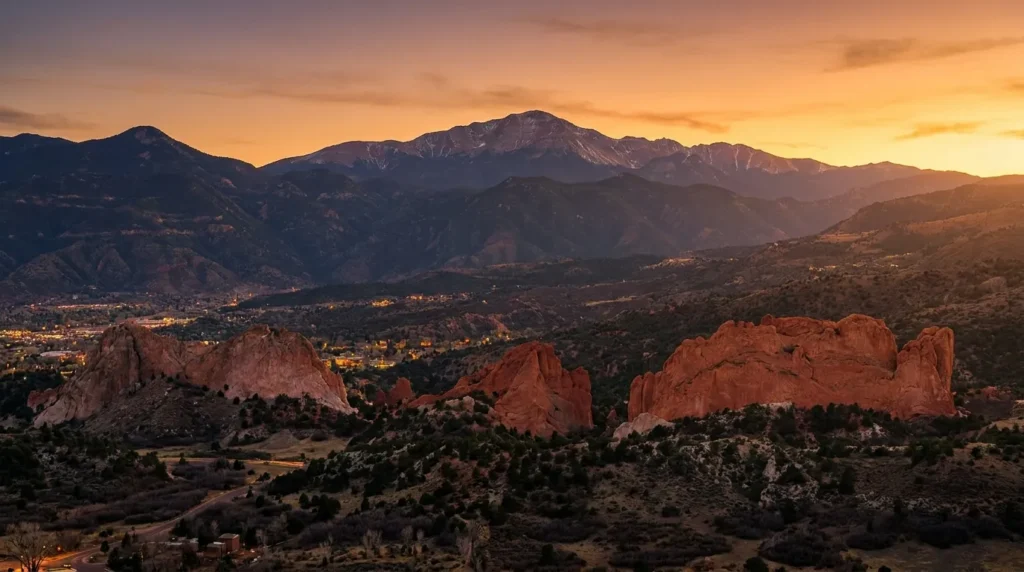
Outdoor life is intense. Garden of the Gods, a natural park with red sandstone formations, is free and draws over five million visitors per year. Pikes Peak (4,302 m) can be reached by car, cog railway, or on foot. The Manitou Incline is a steep trail popular among runners and military personnel. Cripple Creek and Victor, former mining towns, have small casinos and museums.

The craft brewery scene is growing, though on a smaller scale than Denver. Phantom Canyon Brewing and Bristol Brewing are local landmarks. Mexican food is ubiquitous, with green chile being a local staple. Events such as the Pikes Peak International Hill Climb (a car race up the mountain), the Pikes Peak Marathon, and the Western Street Breakfast at the annual rodeo mark the calendar.

Colorado Springs

Colorado Springs Attractions at the Foot of Pikes Peak

A mid-sized city on the eastern edge of the Rocky Mountains with a strong military and Olympic sports presence, visually defined by Pikes Peak and red sandstone formations.

The signature landmark is Garden of the Gods, a free municipal park featuring dramatic red sandstone formations. Nearby, the Pikes Peak Highway climbs to 14,115 feet, and the Manitou and Pikes Peak Cog Railway reaches the same summit by train. Cave of the Winds in Manitou Springs rounds out the trio.

The city is home to the U.S. Olympic and Paralympic Training Center, open to public tours, and the U.S. Olympic and Paralympic Museum in downtown. The United States Air Force Academy, with its modernist Cadet Chapel, is another essential stop. The Broadmoor Hotel anchors the city's luxury social scene.

For culture, the Colorado Springs Fine Arts Center at Colorado College and the Pioneers Museum in the historic courthouse are the main references. Old Colorado City, a restored historic district, concentrates restaurants and galleries, and the Cheyenne Mountain Zoo sits above the city with sweeping views of the plains.

  1. 1["Garden of the Gods"
  2. 2"Pikes Peak"
  3. 3"United States Air Force Academy"
  4. 4"Cheyenne Mountain Zoo"
  5. 5"Manitou Cliff Dwellings"
  6. 6"Olympic and Paralympic Museum"
Nightlife5.0 / 10
Parks & green spaces
  • ["Garden of the Gods Park"
  • "North Cheyenne Cañon Park"
  • "Palmer Park"
  • "Memorial Park"
  • "Bear Creek Regional Park"
  • +1 more

Latest posts

Posts about Colorado

Coverage and updates related to this destination.

Showing content from Colorado, as there is no specific data for Colorado Springs yet.