Visto n' Visa
Blog
Notícias e artigos
Destinations
Careers
Immigrants

Want to live and work in Sacramento?

Personalized immigration plan with eligible visas, costs, and next steps for your goal!

If you are not eligible, you will know exactly why and what to do to improve your approval chances.

Save up to 12 hours in meetings

No pointless assessments.

Save up to 90%

Save money on vague or unfocused consultations

Avoid Fraud and Mistakes

One mistake can cost you your visa

Total Impartiality

Zero commercial bias

Decide with peace of mind

No toxic urgency

Fast and Accurate

Answers in minutes, no guesswork

Sacramento's population: considered one of the most diverse cities in the United States

A balanced mosaic: ~30% Hispanic, ~28% white, ~19% Asian, ~13% African American. Strong Hmong, Ukrainian, Russian, and Mexican communities.

Sacramento appears in Brookings and Time Magazine studies as one of the most multiculturally diverse cities in the United States, with no clear ethnic majority. Roughly 30% of the population is Hispanic (primarily Mexican), 28% white, 19% Asian (Chinese, Filipino, Vietnamese, Hmong), 13% African American, and 7% multiracial or other origins.

The city has one of the largest Ukrainian and Russian communities (Pentecostal and Baptist immigrants from the former Soviet Union) in the United States, concentrated in West Sacramento, North Highlands, and Antelope. It also has the largest Hmong community in California after Fresno. South Sacramento has a significant Afghan and Iranian presence, linked to refugee resettlement. Pakistani and Indian populations are growing in the suburbs.

The Brazilian community is small, spread across Roseville, Folsom, and North Sacramento, composed largely of students and professionals. Median income is solidly middle class, with the public sector stabilizing employment. Established families tend to settle in East Sacramento, Land Park, Curtis Park, and the suburbs (Roseville, Folsom, Elk Grove). Young adults gravitate toward Midtown and East Sac.

Languages spoken
  • English
  • Spanish (Mexican)
  • Hmong
  • Russian and Ukrainian (evangelical community)
  • Vietnamese
  • +3 more
Main religions
  • Christian (Catholic, Protestant, Slavic evangelical)
  • No religion
  • Buddhist
  • Muslim
  • Sikh
  • +1 more

Cost of living in Sacramento: far more affordable than SF, but rising

Rent is half to a third of San Francisco prices. Homeownership remains more accessible. Food, gas, and taxes follow standard California levels.

Sacramento is one of the most affordable major cities in California. A one-bedroom apartment in central neighborhoods (Midtown, East Sacramento, Land Park) typically rents for USD 1,500 to USD 2,000 per month. A three-bedroom house runs USD 2,200 to USD 3,000. Purchasing a modest home starts around USD 450,000, compared to USD 1.3 million in San Francisco.

Grocery shopping at Safeway, Raley's, Bel Air, and Trader Joe's follows standard American pricing. Latin markets (Vallarta, Cardenas), Asian supermarkets (SF Supermarket, 99 Ranch), and Russian-Ukrainian grocers (Yummi Market) offer ethnic products at competitive prices. A meal at a casual restaurant costs between USD 16 and USD 25. The city has a strong farm-to-fork dining scene, with upscale meals more accessible than in San Francisco.

A car is practically essential outside the city center. Gas follows California's high standard (USD 4.80 to USD 5.80 per gallon). State income tax is progressive up to 13.3%, and sales tax is approximately 8.75%. Individual health insurance for those without employer coverage runs USD 350 to USD 650 per month. Summer heat drives up electricity bills due to air conditioning use.

120Cost index (US = 100)20% above US average
CategorySingleCoupleFamily (2 + 2)
iHousing$1,557$1,797$2,276
iFood$455$911$1,653
iTransport$599$1,019$1,318
iHealthcare$335$671$1,258
iChildcare$2,180
iOther$1,019$1,833$2,576
Monthly total$3,965$6,231$11,261

Source: U.S. BLS Consumer Expenditure Survey 2023 + BEA Regional Price Parities 2023 · Estimates in USD, monthly.

Housing in Sacramento: charming historic homes downtown, new suburbs on the edges

Historic homes in Midtown, East Sac, and Land Park. New suburban developments in Natomas, Roseville, Folsom, and Elk Grove. Good variety of housing types.

Sacramento offers a wide variety of housing options. The city core features charming historic homes in East Sacramento, Land Park, Curtis Park, Midtown (with its famous lettered-and-numbered street grid), and Oak Park. Many date from 1900 to 1940, with front porches, high ceilings, and mature tree canopy. New apartment buildings have appeared in Midtown, Downtown, and near the Golden 1 Center (Kings arena).

The suburbs offer newer, planned communities with well-regarded schools. Roseville, Folsom (near Folsom Lake), Granite Bay, Elk Grove (to the south), and Rocklin are among the most sought-after by families. Natomas, north of Downtown, has homes from the 2000s and 2010s at reasonable prices. West Sacramento, across the river, is technically a separate city but is part of the urban fabric.

Rental applications typically require a credit check, proof of income (2.5 to 3 times the monthly rent), and references. Newcomers without a U.S. credit history may need a co-signer or a larger upfront deposit. Popular platforms include Zillow, Apartments.com, Trulia, and Facebook Marketplace. Finding housing is easier than in San Francisco, with more inventory and a less competitive market.

Recommended neighborhoods
  • Midtown (young, central, dining scene)
  • East Sacramento (charming, families, historic homes)
  • Land Park (zoo, park, families)
  • Curtis Park (tree-lined, quiet)
  • Folsom (suburb, schools, lake)
  • +3 more

Job market in Sacramento: state government, healthcare, education, and technology

The California state government is the largest employer. Healthcare (UC Davis, Sutter, Kaiser) is a major sector. Technology in Folsom and Roseville is growing.

The California state government is Sacramento's largest employer, with tens of thousands of civil servants working in buildings throughout Downtown. Agencies such as CalTrans, CDCR (corrections), the Department of Justice, the Franchise Tax Board, and EDD (employment development) are headquartered here. Public-sector salaries are stable and come with strong benefits (CalPERS pension).

Healthcare is the second-largest sector. UC Davis Medical Center is a top academic hospital, particularly in cancer care and trauma. Sutter Health, Kaiser Permanente, Dignity Health (Mercy), and Adventist Health collectively employ tens of thousands. Education is also significant: Sacramento State, Los Rios Community College District, and Sacramento Unified School District are major employers.

Technology is growing, especially in Folsom and Roseville. Intel (Folsom), VSP Vision (Rancho Cordova), Apple (Sacramento office), and local startups employ engineers. Logistics and construction are also strong, with Amazon, FedEx, and UPS operating distribution centers. The state minimum wage is USD 16 per hour (2024). Software engineers earn USD 110,000 to USD 170,000. Mid-level state employees earn USD 70,000 to USD 110,000.

Dominant sectors
  • California state government
  • Healthcare (UC Davis, Sutter, Kaiser)
  • Higher education
  • Technology (Folsom, Roseville)
  • Construction
  • +3 more
Major employers
  • State of California (government)
  • UC Davis Medical Center
  • Sutter Health
  • Kaiser Permanente
  • Dignity Health
  • +5 more

Education in Sacramento: varied districts, Sacramento State, and UC Davis nearby

Public school quality varies by district. Folsom, Elk Grove, and Roseville have highly rated schools. Sacramento State is the local university; UC Davis is 30 minutes away.

Sacramento is served by several school districts. Sacramento City Unified School District covers the urban core, with variable quality across schools. Neighboring districts such as Folsom Cordova Unified, San Juan Unified (Citrus Heights, Carmichael), Elk Grove Unified, Roseville Joint Union, and Rocklin tend to receive stronger ratings. Many families choose a suburb specifically for the school district.

California State University, Sacramento (Sac State), at the eastern end of the city, is the local public university within the Cal State system, with roughly 30,000 students. It is strong in business, public administration, and nursing. The University of California, Davis (UC Davis), in Davis about 18 miles to the west, is one of the top public universities in the United States, particularly in agriculture, veterinary medicine, biology, and medicine (UC Davis Medical Center is located in Sacramento).

Other institutions include the University of the Pacific (Sacramento Campus, McGeorge School of Law), Drexel University Sacramento, and the Los Rios Community Colleges (Sacramento City, American River, Cosumnes River, Folsom Lake). Tuition for international students ranges from USD 8,000 (community college) to USD 50,000 (UC Davis). Many immigrants start at a community college and transfer to a four-year institution.

Notable universities
  • California State University, Sacramento (Sac State)
  • University of California, Davis (UC Davis, nearby)
  • University of the Pacific (McGeorge School of Law)
  • Sacramento City College (community college)
  • American River College
  • Cosumnes River College
  • Folsom Lake College
  • Drexel University Sacramento

Healthcare in Sacramento: UC Davis at the top, Sutter and Kaiser strong across the region

UC Davis Medical Center is the regional reference, leading in cancer care and trauma. Sutter, Kaiser, and Dignity (Mercy) provide solid coverage throughout the area.

Sacramento has a strong hospital network for its size. UC Davis Medical Center, in Oak Park, is the only Level 1 Trauma Center and the only transplant center in the northern Valley region, and a reference in cancer care (NCI-Designated Cancer Center), neurology, and pediatrics. Sutter Health operates hospitals in Sacramento, Roseville, and Davis. Kaiser Permanente has a large presence with hospitals in Sacramento, Roseville, South Sacramento, and Folsom.

Dignity Health operates Mercy General, Mercy San Juan, and Mercy Folsom. Adventist Health is also present. Shriners Hospital for Children handles specialized pediatric care. The system runs on private health insurance, typically employer-sponsored. State employees receive generous plans through CalPERS.

Without coverage, a basic walk-in clinic visit costs USD 100 to USD 200. Those without income may qualify for Medi-Cal, which was expanded to cover undocumented adults starting in 2024 in California. Community clinics such as WellSpace Health and Sacramento Native American Health Center operate on a sliding-scale fee basis. In emergencies, all hospitals are required to provide care regardless of ability to pay.

Healthcare index65.0 / 100
  • Life expectancyyears at birth
    78.4yrs
  • Doctors per 1kpracticing physicians
    3.7
  • Health spendper capita, per year
    $13,473
  • Public systemoverall quality rating
    Good

Safety in Sacramento: mixed, safer in the suburbs, pockets of concern downtown

Crime varies significantly by neighborhood. Suburbs (Folsom, Roseville, Granite Bay) are safe. Some central and southern areas have higher crime rates.

Sacramento has a crime rate above the national average, but the variation between neighborhoods is substantial. Suburbs such as Folsom, Roseville, Granite Bay, Elk Grove, and El Dorado Hills rank among the safest in the state. East Sacramento, Land Park, Curtis Park, and Midtown are calm during the day and reasonably safe at night, with police presence and foot traffic.

South Sacramento (Meadowview, Valley Hi), Del Paso Heights, and parts of Oak Park have higher crime rates, with historically active gang activity and drug trafficking. The homelessness crisis is visible Downtown, along the American River Parkway, and in some parks. It has not reached San Francisco levels, but it has grown. The Sacramento Police Department and the Sheriff's office operate with limited staffing.

The most common crimes affecting newcomers are smash-and-grab car break-ins (never leave valuables in sight), catalytic converter theft, residential burglary in homes without security systems, and porch piracy. Extra caution is warranted in shopping center parking lots and American River Parkway trailheads. For most new residents, choosing a suburb or one of the charming central neighborhoods avoids the majority of safety concerns.

5.8
Homicides per 100k
per year
Safety index
42.0
Crime index
58.0
Safer neighborhoods
  • East Sacramento
  • Land Park
  • Curtis Park
  • Pocket-Greenhaven
  • Natomas
  • Sierra Oaks
Areas to avoid
  • Del Paso Heights at night
  • Oak Park in isolated stretches
  • Meadowview late at night
  • Industrial areas south of I-80 during off-hours

Transportation in Sacramento: a car-dependent city with light rail downtown

The car dominates. SacRT operates light rail (Gold, Blue, Green Lines) and buses. The city center is walkable and has a decent bike network.

Sacramento is predominantly a car-dependent city. Major freeways (I-5, I-80, Highway 99, US-50) run through the region. Traffic exists but is far lighter than in Los Angeles or the Bay Area. Parking is cheaper and more available than on the coast.

SacRT (Sacramento Regional Transit) operates three light rail lines (Gold, Blue, Green) connecting Downtown to Folsom (Gold), the airport and Natomas (Green, partially), and the south (Blue to Cosumnes River College). Buses round out the network. In Midtown, Downtown, and East Sacramento, car-free living is feasible, especially by bicycle, but a car is essential in any suburb.

Sacramento International Airport (SMF) is in Natomas, about 20 minutes from downtown. It offers flights to major U.S. cities, Mexico City, Guadalajara, and some Caribbean connections. For transatlantic or transpacific international flights, most travelers connect through SFO. Amtrak's Capitol Corridor links Sacramento to Davis, Berkeley, and Oakland in a few hours. Uber and Lyft are available, and the bike lane network is improving.

3
Metro lines
53
Metro stations
26 min
Avg commute
47
Walkability
Airports
  • SMF — Sacramento International Airport
  • SAC — Sacramento Executive Airport (general aviation)
  • MHR — Sacramento Mather Airport (cargo)
  • International airport
  • Bike infrastructure

What the climate is like living in Sacramento

Sacramento has an inland Mediterranean climate, with long, very hot, dry summers, mild and rainy winters, and dense fog on some mornings.

Summer is long, hot, and dry, running from May through September. High temperatures typically range from 90°F to 97°F (32°C to 36°C), with peaks above 104°F (40°C) in July. Humidity is low, which helps, but wildfire smoke in recent summers has degraded air quality for weeks at a time. Air conditioning is essential and runs heavily in the afternoons.

Winter is short and mild, from December through February, with highs between 55°F and 61°F (13°C to 16°C) and lows between 39°F and 45°F (4°C to 7°C). Snow does not fall, occasional frost occurs on cold mornings, and tule fog reduces visibility on some January mornings. Heating sees real but limited use.

Annual rainfall averages around 470 mm (18.5 in), concentrated from November through March. For residents, reliable air conditioning, an air purifier, and an emergency plan for earthquakes and wildfire smoke are important considerations.

Sunny days / year266 days
Avg high (°F)
  • 58°J
  • 61°F
  • 65°M
  • 76°A
  • 84°M
  • 94°J
  • 98°J
  • 99°A
  • 93°S
  • 82°O
  • 65°N
  • 56°D
Avg low (°F)
  • 41°J
  • 40°F
  • 44°M
  • 49°A
  • 54°M
  • 60°J
  • 61°J
  • 63°A
  • 60°S
  • 53°O
  • 43°N
  • 40°D
Rainfall (")
  • 5"J
  • 3"F
  • 4"M
  • 1"A
  • 1"M
  • 0"J
  • 0"J
  • 0"A
  • 1"S
  • 2"O
  • 1"N
  • 6"D

Culture in Sacramento: a small-town capital feel, farm-to-fork dining, and Tower District

A state capital with a strong culinary scene (farm-to-fork), river recreation, the Kings as a sports anchor, and a history rooted in the Gold Rush.

Sacramento has a quieter, more pragmatic culture than coastal California. The city bills itself as America's Farm-to-Fork Capital, drawing on its proximity to farmland and an abundance of restaurants that source local ingredients. The Tower District is home to the historic Tower Theatre and a cluster of bars. Midtown concentrates the younger nightlife scene, and the Second Saturday Art Walk is a monthly community event.

The food scene blends Mexican cuisine (Mas Taco, Tacos Mi Rancho), Italian, Vietnamese, Hmong, Southern American, barbecue, and farm-to-fork bistros (The Kitchen, Localis, Mulvaney's B&L). The craft beer scene is well established (Track 7, New Helvetia), and the Capital Floral Festival takes place each fall. Farmers markets are a local tradition, with the Sunday market on Florin Road drawing regulars.

The city's history is tied to the 1849 Gold Rush: Sutter's Fort, the Old Sacramento Waterfront with its period-era buildings, the California State Railroad Museum, and the State Capitol (free admission) mark that past. Sports life revolves around the Sacramento Kings (NBA, Golden 1 Center) and Sacramento Republic FC. The American River Parkway offers more than 30 miles of trails and a bike path along the river. Lake Tahoe and snowboarding at Heavenly are about 2 hours away.

Attractions and life in Sacramento, California's capital

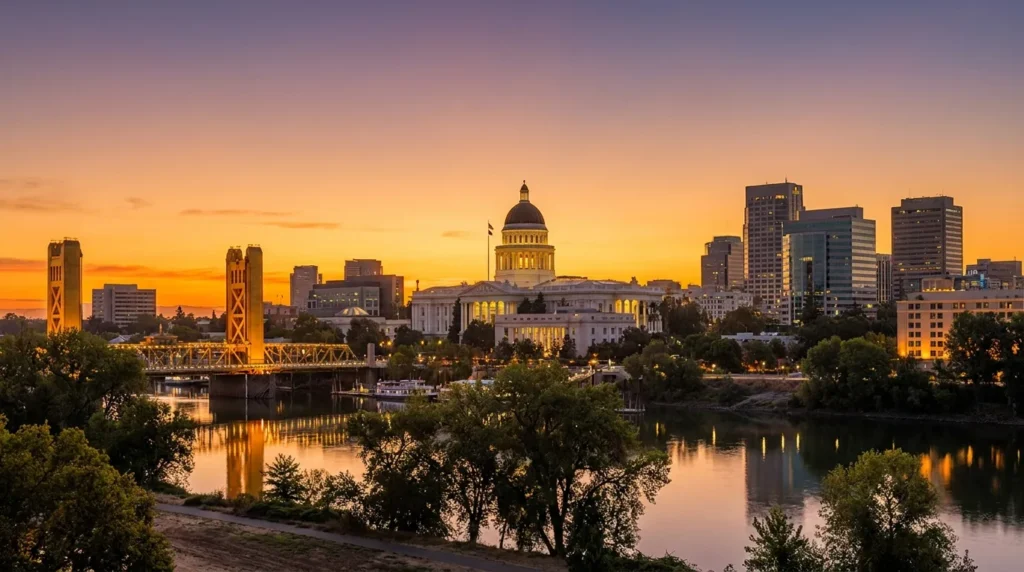
Sacramento combines the California State Capitol, the Old Sacramento Waterfront along the river, major museums, and the American River Parkway, which anchors the outdoor daily life of this California capital.

The political center is the California State Capitol, with surrounding grounds open to the public, and Capitol Mall connecting it to the Sacramento River. A few blocks away lies the Old Sacramento Waterfront, with wooden boardwalks, the California State Railroad Museum (a national landmark for rail history), and the Delta King, a riverboat hotel moored on the water. The Midtown neighborhood brings together murals, cafes, restaurants, and the Second Saturday Art Walk.

Sacramento brands itself the farm-to-fork capital, with the Sacramento Central Farmers Market under the W X overpass and the illuminated Tower Bridge as an urban backdrop. The Crocker Art Museum, the oldest art museum in the American West, and Sutter's Fort State Historic Park preserve the region's artistic tradition and Gold Rush era, respectively. The Golden 1 Center, in the Downtown Commons, hosts Kings games and concerts.

For outdoor recreation, the American River Parkway offers 50 km of trails used daily for running, cycling, and rowing. William Land Park is home to the Sacramento Zoo and Funderland. Bushy Lake and Discovery Park, at the confluence of the rivers, are popular for fishing and picnics. In October, the Aftershock Festival brings weeks of heavy music to the city.

  1. 1["California State Capitol"
  2. 2"Old Sacramento Waterfront"
  3. 3"Crocker Art Museum"
  4. 4"California State Railroad Museum"
  5. 5"Sutter's Fort State Historic Park"
  6. 6"Sacramento Zoo"
Nightlife7.0 / 10
Parks & green spaces
  • ["William Land Park"
  • "McKinley Park"
  • "Discovery Park"
  • "American River Parkway"
  • "Capitol Park"
  • +1 more

Latest posts

Posts about California

Coverage and updates related to this destination.

Showing content from California, as there is no specific data for Sacramento yet.