Visto n' Visa
Blog
Notícias e artigos
Destinations
Careers
Immigrants

Want to live and work in Fresno?

Personalized immigration plan with eligible visas, costs, and next steps for your goal!

If you are not eligible, you will know exactly why and what to do to improve your approval chances.

Save up to 12 hours in meetings

No pointless assessments.

Save up to 90%

Save money on vague or unfocused consultations

Avoid Fraud and Mistakes

One mistake can cost you your visa

Total Impartiality

Zero commercial bias

Decide with peace of mind

No toxic urgency

Fast and Accurate

Answers in minutes, no guesswork

Fresno's population: Hispanic majority, unique Hmong community, and Asian diversity

About 50% Hispanic (Mexican), 17% Asian with the largest Hmong community in the US, and the remainder White and African American.

Fresno has a distinct demographic profile within California. Approximately half the population is Hispanic, with strong Mexican roots tied to agricultural labor. Neighborhoods in the south and southwest (Calwa, Highway City, West Fresno) feature Spanish-language businesses, tortillerías, markets, and churches. Undocumented residents are present in significant numbers, connected to the harvest economy.

The most distinctive characteristic of Fresno is its Hmong community. The city has the largest Hmong diaspora in the United States, with approximately 30,000 people, refugees from Laos following the Vietnam War. There are Hmong markets, restaurants, temples, and festivals; Hmong New Year in December and January is a major event. There are also significant Armenian (Fresno was one of the earliest centers of Armenian immigration to the US), Sikh-Punjabi, and Mexican communities.

The Brazilian community is small but present, connected to Fresno State students and some families in agriculture. Median income is considerably lower than on the California coast, though the cost of living is as well. The city is divided between north (wealthier, Clovis, North Fresno) and south (poorer, with a long history of pollution issues and infrastructure gaps).

Languages spoken
  • English
  • Spanish (Mexican, dominant)
  • Hmong (largest community in the US)
  • Armenian
  • Punjabi (Sikh community)
  • +3 more
Main religions
  • Christian (Catholic and Evangelical)
  • Non-religious
  • Hmong animism and Buddhism
  • Sikh
  • Armenian Apostolic Church
  • +1 more

Cost of living in Fresno: among the lowest in California

Rent and real estate cost roughly half of coastal California. Food and gas follow the state standard, but housing makes the biggest difference.

Fresno has one of the lowest costs of living in California. A one-bedroom apartment in central neighborhoods (Tower District, Downtown, North Fresno) typically runs between $1,100 and $1,500 per month. A three-bedroom rental home runs $1,800 to $2,500. Purchasing a modest home costs between $350,000 and $500,000, far less than in Los Angeles or San Francisco.

Grocery shopping at chains like Save Mart, Food 4 Less, FoodMaxx, and Vallarta (Mexican) is reasonably priced. Asian Village and Hmong markets carry Asian products at competitive prices. A meal at a popular restaurant typically costs between $14 and $22. Mexican restaurants offer full combo plates for $10 to $14. Pho or Hmong food runs $12 to $15.

Gas follows California's high standard ($4.50 to $5.50 per gallon). State income tax is progressive up to 13.3%, though the impact on median incomes is relatively modest. Private health insurance for those without employer coverage runs $350 to $600 per month. A car is absolutely essential; daily life in Fresno without one is very difficult.

96Cost index (US = 100)4% below US average
CategorySingleCoupleFamily (2 + 2)
iHousing$1,249$1,441$1,825
iFood$365$730$1,325
iTransport$480$817$1,057
iHealthcare$269$538$1,009
iChildcare$1,748
iOther$817$1,470$2,066
Monthly total$3,180$4,996$9,030

Source: U.S. BLS Consumer Expenditure Survey 2023 + BEA Regional Price Parities 2023 · Estimates in USD, monthly.

Housing in Fresno: sprawling single-story homes, North Fresno and Clovis for families

A horizontal city with many single-story homes. North Fresno and Clovis (neighboring city) are the preferred residential areas for families.

Fresno is a sprawling, horizontal city filled with stucco single-story homes, yards, and garages. The divide between north and south is clear. North Fresno (above Shaw Avenue) concentrates newer neighborhoods, better schools, and shopping centers (Fashion Fair, River Park). Clovis, a neighboring city immediately adjacent, is considered the best place for families, with some of the top schools in the Valley.

South and West Fresno feature older neighborhoods with smaller homes, a larger Hispanic population, and lower incomes. These areas carry a long history of pollution (refineries, storage facilities) and infrastructure gaps. The Tower District, near downtown, is the city's most eclectic neighborhood, with historic theaters, bars, restaurants, and art. Downtown is slowly revitalizing.

When renting, landlords typically require a credit check, proof of income (2.5 to 3 times the rent), and references. Those arriving without a US credit history may need a co-signer or may be asked to pay several months upfront. Popular platforms include Zillow, Apartments.com, Trulia, Craigslist, and Facebook Marketplace. In general, finding housing in Fresno is easier than in Los Angeles or San Francisco, as supply is greater.

Recommended neighborhoods
  • North Fresno (newer, shopping centers, families)
  • Clovis (neighboring city, top schools)
  • Tower District (eclectic, bars, charm)
  • Woodward Park (large park, family atmosphere)
  • Old Fig Garden (historic, tree-lined)
  • +3 more

Job market in Fresno: agriculture, healthcare, government, and logistics

Agriculture is the backbone. Hospitals (Community Health, Saint Agnes) and government are major employers. Technology remains a small sector.

Fresno and the Central Valley are the agricultural heart of the United States. Almonds, pistachios, grapes (raisins, wine, table), processing tomatoes, citrus, and stone fruits dominate. Direct jobs in harvesting, packing houses, irrigation, transport, and processing employ tens of thousands, many of Mexican origin. Companies like Sun-Maid Growers (raisins), Wonderful Pistachios (based in Lost Hills, nearby), and Setton Pistachio are major players.

Healthcare is the second-largest sector. Community Medical Centers, Saint Agnes, Kaiser Permanente, and Adventist Health employ tens of thousands. California State University, Fresno (Fresno State) and Fresno Unified School District are also major employers. Government (Fresno County, City of Fresno, Caltrans) employs many workers in downtown offices.

Logistics has grown with e-commerce: Amazon, Ulta Beauty, and several other companies operate distribution centers in the Valley due to its central location. Technology remains small compared to the Bay Area, though companies like Bitwise Industries (currently in recovery) attempted to create a local hub. The state minimum wage stands at $16 per hour (2024). Agricultural work typically pays near the minimum, often on a piece-rate basis.

Dominant sectors
  • Agriculture and agribusiness
  • Healthcare
  • Government (county, city, state)
  • Logistics and distribution
  • Education (Fresno State, Fresno Unified)
  • +3 more
Major employers
  • Community Medical Centers
  • Saint Agnes Medical Center
  • Fresno Unified School District
  • Fresno County
  • Kaiser Permanente
  • +4 more

Education in Fresno: Fresno Unified varies, Clovis is the benchmark, Fresno State is the university

Resident children have access to public school. Fresno Unified varies considerably by neighborhood; Clovis Unified is considered one of the best districts in the state. Fresno State is the local university.

Fresno Unified School District (FUSD) is the third largest in California. Quality varies considerably by neighborhood. Neighboring districts like Clovis Unified, Central Unified, and Sanger Unified tend to rank higher. Families who have the option often choose to live in Clovis for its schools. Private schools (Fresno Christian, San Joaquin Memorial) and charter schools are also available.

California State University, Fresno (Fresno State) is the city's public university, part of the Cal State system, with approximately 24,000 students. It has strong programs in agriculture, viticulture (the only public university in the US with its own commercial vineyard), engineering, business, and nursing. The Bulldogs football team is central to local identity.

Fresno Pacific University (a private Mennonite Christian institution) and Fresno City College (a community college founded in 1910, one of the oldest in California) round out the local options. Tuition for international students ranges from approximately $7,000 at the community college level to $30,000 at the Fresno State international rate. Many immigrants begin at Fresno City College and transfer to Fresno State or a UC campus.

Notable universities
  • California State University, Fresno (Fresno State)
  • Fresno Pacific University (private Mennonite)
  • Fresno City College (community college)
  • Reedley College
  • Clovis Community College
  • California Health Sciences University
  • San Joaquin College of Law

Healthcare in Fresno: regional network covers the whole valley, but specialist shortage persists

Community Medical Centers and Saint Agnes lead the network. An important regional hub, but specialist shortages and long wait times are ongoing challenges.

Fresno is the regional medical center for the entire Central Valley. Community Regional Medical Center (part of Community Medical Centers) is the largest hospital, with the only Level 1 Trauma Center and burn unit in the region. Saint Agnes Medical Center, Kaiser Permanente Fresno, Clovis Community Medical Center, and Adventist Health complete the main network. Children's Hospital Central California is the regional pediatric referral hospital.

The system operates on private health insurance, typically through an employer. Without coverage, a basic walk-in clinic visit costs $100 to $200. Those without income may qualify for Medi-Cal. The Central Valley's primary challenge is a shortage of medical specialists, particularly outside Community Regional. Patients often travel to San Francisco or Los Angeles for certain treatments.

Community clinics such as United Health Centers and Clinica Sierra Vista serve rural areas and low-income neighborhoods on a sliding-fee scale. For undocumented immigrants, Medi-Cal was expanded to cover adults starting in 2024 in California, improving access considerably. Emergency rooms are required by law to treat patients regardless of ability to pay.

Healthcare index60.0 / 100
  • Life expectancyyears at birth
    78.4yrs
  • Doctors per 1kpracticing physicians
    3.7
  • Health spendper capita, per year
    $13,473
  • Public systemoverall quality rating
    Fair

Safety in Fresno: crime above national average, varies greatly by neighborhood

Violent and property crime are above the national average, concentrated in southwest neighborhoods. North Fresno and Clovis are considerably safer.

Fresno has crime rates above the national average, particularly for theft, vehicle theft, and drug trafficking. The divide is clear: North Fresno and Clovis are safe and comfortable for evening walks. South and West Fresno have neighborhoods with a history of gang activity and higher crime rates. Areas like Calwa, parts of Edison, and West Fresno require more caution.

Homelessness is a visible issue, mainly Downtown, around E Street and Ventura Avenue, and near Roeding Park. It has not reached the scale seen in San Francisco or Los Angeles, but it is noticeable. The Fresno Police Department operates with a relatively small force for a city of this size. Drug-related crime involving fentanyl and methamphetamine has increased in recent years.

The most common crimes affecting newcomers are smash-and-grab car break-ins (nothing should be left visible in vehicles), catalytic converter theft, and residential burglary in neighborhoods without alarm systems. Extra caution is advised in mall parking lots at night and when walking alone in Downtown areas. In general, living in North Fresno or Clovis avoids most of these concerns.

5.8
Homicides per 100k
per year
Safety index
34.0
Crime index
66.0
Safer neighborhoods
  • Woodward Park
  • Fig Garden
  • Bullard area
  • Clovis (neighboring city)
  • Old Fig Garden
  • Northeast Fresno
Areas to avoid
  • Downtown Fresno at night
  • West Fresno in isolated stretches
  • Areas near Highway 99 late at night
  • Southeast Fresno during empty hours

Transportation in Fresno: car-dependent city, FAX buses cover the basics

A car is practically required. FAX buses exist but are limited. The future High-Speed Rail is expected to connect Fresno to San Francisco and Los Angeles.

Fresno is entirely car-dependent. Highway 99 runs north-south through the city, and Highway 41 connects Yosemite to Highway 198 to the south. Internal traffic is not as heavy as in Los Angeles or San Francisco, and parking is cheap and abundant. The vast majority of residents own a car.

FAX (Fresno Area Express) operates bus service throughout the city, with basic lines connecting neighborhoods, shopping centers, and Fresno State. The system is functional but slow, with infrequent service. In Downtown and the Tower District, getting around by bus and on foot is feasible, but virtually every other part of the city requires a car.

Fresno Yosemite International Airport (FAT) is small but functional, with direct flights to Los Angeles, San Francisco, Seattle, Phoenix, Denver, Dallas, Las Vegas, Chicago, Guadalajara, and Leon (Mexico). For Yosemite, YARTS (a tourist bus service) is also available. California High-Speed Rail, currently under construction with the first phase running through Fresno, is expected to connect the city to San Francisco and Los Angeles within a few hours, though the project remains ongoing.

22 min
Avg commute
39
Walkability
Airports
  • FAT, Fresno Yosemite International Airport
  • VIS, Visalia Municipal Airport (regional)
  • International airport
  • Bike infrastructure

What the climate is like living in Fresno

Fresno has a hot Mediterranean climate in the Central Valley, with long and very hot summers, mild winters marked by dense fog, and rainfall concentrated in the winter months.

Summer is long and intense, running from May through September. High temperatures typically range from 95 to 104 degrees Fahrenheit, with peaks above 108 in July. Humidity is low, but wildfire smoke in recent summers has significantly degraded air quality. Industrial-strength air conditioning is essential.

Winter is short and mild, from December through February, with highs between 55 and 61 degrees and lows between 37 and 43 degrees. Tule fog, the dense valley fog that forms on winter mornings, can reduce visibility to near zero and demands extra caution on the roads. Heating needs are limited.

Annual rainfall averages around 11.4 inches, concentrated from November through March. Air quality is a recurring concern in summer. For those living here, reliable air conditioning, an air purifier, and close attention to wildfire and fog alerts are important considerations.

Sunny days / year269 days
Avg high (°F)
  • 59°J
  • 63°F
  • 67°M
  • 78°A
  • 86°M
  • 97°J
  • 104°J
  • 103°A
  • 95°S
  • 83°O
  • 67°N
  • 58°D
Avg low (°F)
  • 40°J
  • 39°F
  • 45°M
  • 51°A
  • 58°M
  • 67°J
  • 73°J
  • 73°A
  • 66°S
  • 54°O
  • 43°N
  • 40°D
Rainfall (")
  • 3"J
  • 2"F
  • 4"M
  • 1"A
  • 1"M
  • 0"J
  • 0"J
  • 0"A
  • 0"S
  • 0"O
  • 1"N
  • 3"D

Culture in Fresno: agricultural, Mexican, Hmong, and gateway to national parks

Culture blends agricultural roots with Mexican, Armenian, and Hmong influences. Small-city lifestyle with easy access to Yosemite, Sequoia, and Kings Canyon.

Fresno's culture is practical, agricultural, and multicultural. The Tower District is the city's eclectic heart, home to the historic Tower Theatre (an art deco cinema from 1939), bars, restaurants, and the annual Pride parade. The Forestiere Underground Gardens, a subterranean garden built by a Sicilian immigrant, is a beloved local landmark.

The cuisine blends Mexican food (taquerias, mariscos at Sal's Mexican Restaurant and La Elegante), Armenian dishes (George's Shish Kabob, dolma, kebab, baklava), Hmong specialties (Hmong Village Marketplace, larb, spicy papaya salad), and American farm cooking (barbecue and grilled meats with local produce). The Vineyard, Toledo's, and Black Angus are traditional local restaurants.

The most compelling cultural draw is access to nature. Yosemite National Park is 90 minutes away by car, Sequoia and Kings Canyon about an hour. These are among the most visited parks in the US. Hiking trails, winter snow, lakes, and giant sequoias are all within reach. Fresno State (Cal State Fresno) fields the Bulldogs football team, a strong point of local pride. Events include the Big Fresno Fair (October), Hmong New Year, and the Highway 99 Wine Trail.

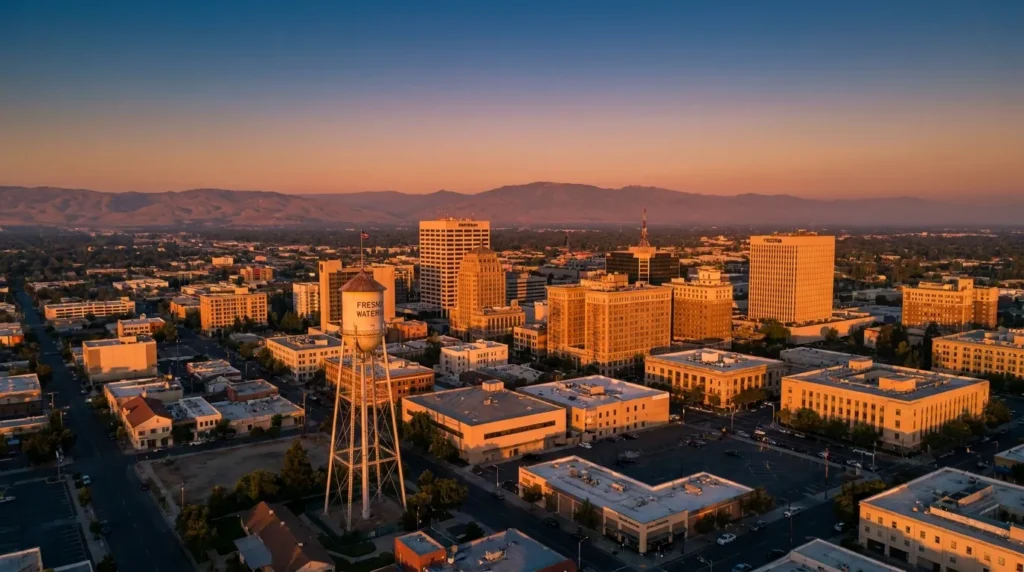
Fresno

Agricultural capital of California's Central Valley

Fresno is the hub of the Central Valley, a gateway to Yosemite, Kings Canyon, and Sequoia, with the Forestiere Underground Gardens, Tower District, and Blossom Trail on the local calendar.

Fresno anchors the San Joaquin Valley and serves as a natural base for reaching the national parks to the east. Yosemite, Kings Canyon, and Sequoia are roughly one to two hours away, and hiking and camping trips are a regular part of life here. In January and February, the Fresno County Blossom Trail takes visitors through almond, peach, and citrus farms in full bloom.

The Tower District brings together restaurants, cafes, and the Tower Theatre, which hosts art films and live theater. The Forestiere Underground Gardens, an underground excavation built by a Sicilian immigrant, stands as a one-of-a-kind attraction, while the Fresno Chaffee Zoo, Shinzen Friendship Garden, and Woodward Park round out urban leisure options. The Fresno Art Museum and Discovery Center serve families well.

Local sports revolve around the Fresno State Bulldogs and the Triple-A Fresno Grizzlies, and events like the Big Fresno Fair, Rogue Festival, and Fresno Greek Fest draw neighborhoods together. In summer, Bass Lake and Millerton Lake become popular weekend destinations.

  1. 1["Forestiere Underground Gardens"
  2. 2"Fresno Chaffee Zoo"
  3. 3"Tower District"
  4. 4"Fresno Art Museum"
  5. 5"Shinzen Friendship Garden"
  6. 6"Meux Home Museum"
Nightlife5.0 / 10
Parks & green spaces
  • ["Woodward Park"
  • "Roeding Park"
  • "Kearney Park"
  • "Shinzen Friendship Garden"
  • "Eaton Trail"
  • +1 more

Latest posts

Posts about California

Coverage and updates related to this destination.

Showing content from California, as there is no specific data for Fresno yet.