Visto n' Visa
Blog
Notícias e artigos
Destinations
Careers
Immigrants

Want to live and work in Texarkana?

Personalized immigration plan with eligible visas, costs, and next steps for your goal!

If you are not eligible, you will know exactly why and what to do to improve your approval chances.

Save up to 12 hours in meetings

No pointless assessments.

Save up to 90%

Save money on vague or unfocused consultations

Avoid Fraud and Mistakes

One mistake can cost you your visa

Total Impartiality

Zero commercial bias

Decide with peace of mind

No toxic urgency

Fast and Accurate

Answers in minutes, no guesswork

Who lives in Texarkana today

A small city with a strong African American presence, a non-Hispanic white majority, and a growing Hispanic community tied to meatpacking and construction work.

The population on the Arkansas side is around 30,000 residents, and combining the Texas side, the metropolitan area exceeds 65,000. The composition is typically Southern: a strong African American presence, a non-Hispanic white majority, and a Hispanic share that has grown over the past two decades, driven by positions in meat processing, agriculture, and construction.

English is the dominant language in commerce, schools, and government offices. Spanish is already present in some markets, churches, and clinics, especially in the northern and eastern neighborhoods. Protestant Christian denominations carry enormous weight in social life: Baptists, Methodists, and Pentecostals organize not only worship services but also community outreach, free ESL classes, and assistance for newcomers.

The age distribution is balanced, with young families and a significant elderly population. Median income falls below the national average, which explains the low housing prices but also limits luxury services. For immigrants accustomed to large cities, the initial adjustment comes from the quiet evenings and the human scale of everything.

Languages spoken
  • English
  • Spanish
  • Vietnamese
  • Lao
Main religions
  • Southern Baptist
  • Methodist
  • Catholic
  • Pentecostal
  • No religion

Cost of living in Texarkana: among the most affordable in the US

Rent, food, fuel, and utilities fall well below the national American average. It is possible to live comfortably on less than what a large city would require.

Texarkana ranks among the most affordable cities in the United States. A three-bedroom home in a residential neighborhood costs what would buy only a studio apartment in Dallas or Houston. Groceries, gasoline, utility bills, and cell phone plans follow the same pattern: consistently below the national average, stretching the paycheck of those working in logistics, healthcare, or industry.

Dining out is inexpensive, especially at Southern chains such as Whataburger, Chick-fil-A, and local Texas barbecue joints. Stores like Walmart, Brookshire's, and the Hispanic market La Michoacana cover most shopping needs. Health insurance remains the highest and most unpredictable expense, particularly for self-employed workers or those at small businesses without robust benefits.

A car is a necessary expense. Living well in Texarkana without a personal vehicle is not practical: public transportation is limited, and residential neighborhoods are far from markets and workplaces. Affordable fuel prices (Texas prices are lower than in Arkansas) help, but the monthly budget must include insurance, maintenance, and loan or financing payments.

Texarkana

Where to live in Texarkana

Spacious homes with yards at low prices, with different options on each side of the state line. The Texas side typically has lower property taxes.

The housing stock is dominated by single-story brick homes with yards and two-car garages. Neighborhoods like Pleasant Grove, on the Texas side, attract families because of the schools. On the Arkansas side, areas near the Texarkana Country Club and north of Arkansas Boulevard feature well-maintained properties at prices that would buy only a studio apartment in major metropolitan areas.

Those arriving without money for a down payment often start by renting in apartment complexes along Summerhill Road or near Central Mall. Rents are affordable, but quality varies considerably from building to building: visiting in person before signing a lease and asking about flood history is advisable, as some areas flood during heavy storms.

Buying is a realistic option even for those earning an average salary. Local banks and credit unions such as Red River FCU offer competitive financing, and state programs assist first-time homebuyers. The Texas side typically has higher property taxes but no state income tax; the Arkansas side has the reverse. Running the numbers before choosing an address is worthwhile.

Recommended neighborhoods
  • Pleasant Grove
  • Wake Village
  • Nash
  • Historic downtown, Arkansas side
  • Summerhill Road
  • +1 more

Local job market

Logistics, healthcare, lumber manufacturing, and public services drive employment. Warehouse, hospital, and construction positions are the most accessible for newcomers.

Texarkana is a rail and highway hub. Union Pacific operates a large rail yard in the city, and Interstate 30 connects Dallas directly to Little Rock and Memphis. This explains the strength of the logistics and transportation sector: distribution centers, trucking companies, and heavy maintenance shops employ thousands of people, with frequent openings for CDL drivers, operators, and mechanics.

Healthcare is the other pillar. CHRISTUS St. Michael Health System and Wadley Regional Medical Center are major employers, with openings in nursing, technical roles, administrative support, and housekeeping. The lumber industry (Domtar operates one of the largest pulp mills in the US in the region) and the Red River Army Depot military base round out the economic base.

For recently arrived immigrants, the fastest path to a first job is logistics (Amazon and other nearby distribution centers), food processing, construction, and cleaning services. Starting wages are modest by American standards, but combined with the low cost of living, saving from the outset is possible.

Dominant sectors
  • Transportation and logistics
  • Healthcare
  • Paper and lumber manufacturing
  • Defense and public administration
  • Retail
Major employers
  • CHRISTUS St. Michael Health System
  • Wadley Regional Medical Center
  • Red River Army Depot
  • Domtar
  • Cooper Tire & Rubber Company
  • +2 more

Education in Texarkana

Two public school systems (one per state), religious private options, and Texas A&M University-Texarkana serving higher education.

The school system is divided by state. On the Texas side, Texarkana ISD and Liberty-Eylau ISD are the main public networks, with Pleasant Grove ISD considered the best in the area. On the Arkansas side, the Texarkana Arkansas School District serves the majority of families. Religious private schools (Trinity Christian Academy, St. James Day School, Sacred Heart) offer alternatives for those seeking faith-based education.

For higher education, Texas A&M University-Texarkana is the main institution: a small campus, tuition that is affordable by American standards, and programs focused on education, business, nursing, and technology. Texarkana College is the local community college, popular for short technical programs (nursing, welding, mechanics) and as a bridge to four-year degrees.

ESL (English as a Second Language) offerings are still limited compared to large cities, but Texarkana College, churches, and community organizations offer free or low-cost classes. For adult immigrants seeking retraining, community colleges are the most direct path to a certificate in healthcare, business, or IT.

Notable universities
  • Texas A&M University-Texarkana
  • Texarkana College
  • University of Arkansas Hope-Texarkana

Healthcare and medical services

Two main hospitals cover urgent care, deliveries, and surgery. For complex cases, Little Rock or Dallas is the referral destination.

The hospital network in Texarkana is anchored by two major institutions: CHRISTUS St. Michael Health System, a Catholic hospital, and Wadley Regional Medical Center, part of Steward Health Care. Both offer 24-hour emergency services, maternity wards, ICUs, general surgery, and specialties such as cardiology and oncology. For highly complex cases (transplants, advanced pediatric oncology), patients are referred to Little Rock, Dallas, or Houston.

Community clinics such as ARcare and Genesis PrimeCare offer low-cost or sliding-scale care for those without health insurance, including undocumented immigrants. Vaccinations, pediatrics, basic dental care, and women's health services are available through these networks, and practitioners typically have interpreters or Spanish-language materials.

Employer-sponsored health insurance is the standard path for most residents, but the federal Marketplace (HealthCare.gov) and Medicaid (with different rules in Arkansas and Texas) serve low-income families. Out-of-pocket costs are high, so finding a community clinic or enrolling in the Marketplace as soon as possible is a priority for newcomers.

Texarkana

Safety in Texarkana

A small city with crime rates above the national average in some neighborhoods, but with extensive quiet residential areas. Extra caution is advised at night in the downtown and some older sections.

As in many small Southern American cities, Texarkana has crime rates somewhat above the national average in aggregate statistics, but the experience varies enormously by neighborhood. Residential areas to the south (Pleasant Grove, Wake Village) and outlying suburbs are safe by the standards of American middle-class communities. The downtown and some older sections have higher rates of theft and nighttime incidents.

Day-to-day life is calm: people leave cars unlocked in church parking lots, know the grocery store cashier by name, and ride bikes with children through the neighborhood. Local police are visible and respond quickly, and the relationship with the community is reasonably positive. The greater risk is not interpersonal violence but highway traffic on state roads and severe weather (tornadoes in spring).

For immigrants, the practical advice is the same as for any midsize American city: choose a neighborhood carefully, avoid the downtown on foot late at night, keep documents in order (Arkansas and Texas have different state laws on minor traffic infractions), and build relationships with neighbors. Local churches are a powerful informal safety network.

Safer neighborhoods
  • Pleasant Grove
  • Wake Village
  • Nash
  • Richmond Road area
  • South Summerhill Road
Areas to avoid
  • Downtown at night (Arkansas side)
  • Industrial areas north of I-30
  • Areas near the old railroad depot after dark

Getting around Texarkana

A car-dependent city with a small regional airport and limited local bus service. For international flights, Dallas and Little Rock are the practical options.

Texarkana is entirely car-dependent. The distances between neighborhoods, markets, and workplaces require a personal vehicle, and the local public transit system (Texarkana Urban Transit) operates few routes with limited schedules, better suited for occasional trips than a regular work commute. Cycling is possible in some neighborhoods, but the city has few dedicated bike lanes and summer heat discourages many riders.

Texarkana Regional Airport offers short-haul flights to Dallas via American Eagle, connecting to the rest of the world through the DFW hub. For international tickets at reasonable prices, most residents drive to Dallas (about three hours) or Little Rock (two and a half hours). Greyhound and Amtrak (the Texas Eagle line, Chicago to San Antonio) still serve the city, providing an alternative to driving for long-distance travel.

Interstate 30 runs east-west through the city, and US-59/US-71 brings north-south traffic. Congestion is light compared to major metropolitan areas, but commercial routes along Summerhill Road and State Line Avenue become congested during peak hours. Parking is plentiful and free in nearly every location.

Airports
  • TXK — Texarkana Regional Airport

Climate

Texarkana

Local culture: Southern American in two versions

A blend of Texan and Arkansas traditions, with country music, barbecue, college football, and a small but active cultural scene in the historic downtown.

The cultural life of Texarkana is that of the Deep South. On autumn Friday evenings, the high school stadium fills for football games. On weekends, churches, barbecue joints, and pickup truck parking lots set the tone. The city embraces a dual identity: Arkansas hospitality mixed with Texan pride, and residents joke endlessly about who has the better barbecue, team, or weather.

The Perot Theatre, restored in Art Deco style, hosts musicals, concerts, and performances by the Texarkana Symphony Orchestra. The Regional Arts Center promotes exhibitions by local artists and workshops. For children, Discovery Place offers educational programming. Small festivals mark the calendar: the Four States Fair & Rodeo in September, the Quadrangle Festival in the historic downtown, and the Cattle Baron's Ball raise funds and draw crowds.

Food is its own religion. Barbecue joints such as Big Jake's and Texas Pit Bar-B-Que dominate, but the city also offers Tex-Mex, Cajun dishes (from east Texas and Louisiana), and a growing Hispanic scene with taquerias, panaderias, and ethnic markets. Breakfast biscuits and gravy is an institution.

Notable dishes
  • Texas-style barbecue (brisket and sausage)
  • Chicken-fried steak
  • Pecan pie
  • Tamales (local Christmas tradition)
  • Fried catfish
  • +1 more
Annual events
  • Four States Fair & Rodeo
  • Quadrangle Festival
  • Texarkana Juneteenth Celebration
  • Scott Joplin International Ragtime Festival
  • Cattle Baron's Ball
  • +1 more

What to see and do in Texarkana

The famous post office building on the state line, restored theaters, nearby state parks, and festivals celebrating the city's musical heritage.

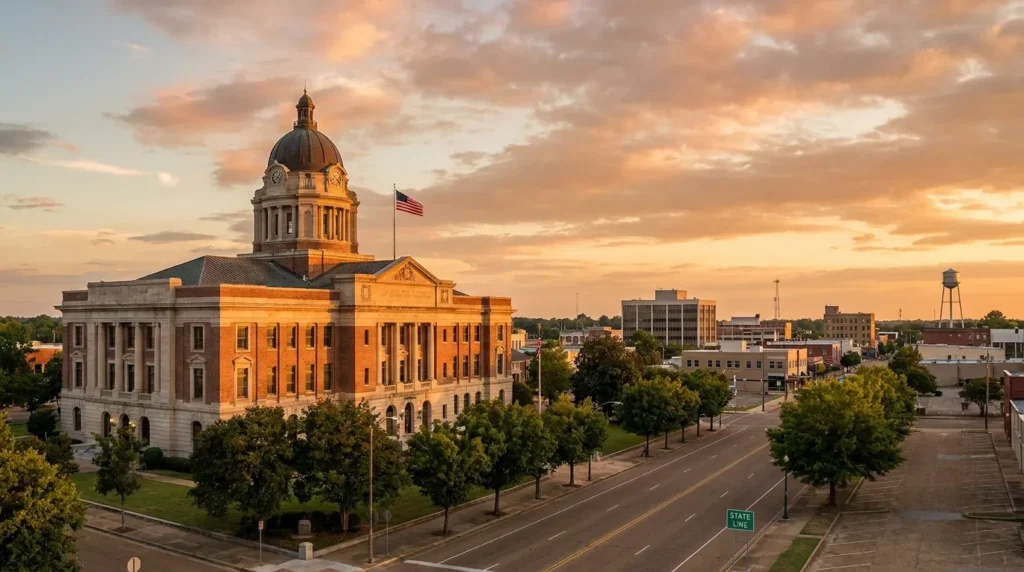
The top attraction is Photographer's Island in front of the US Post Office and Federal Courthouse: the building sits precisely on the state line between Texas and Arkansas, and a photo with one foot in each state is a must for any visitor. The Texarkana Museum of Regional History, the Ace of Clubs House (a historic mansion shaped like a playing card), and Discovery Place round out the itinerary.

The Perot Theatre is the cultural centerpiece: a restored Art Deco venue hosting performances throughout the year. For the outdoors, Spring Lake Park offers trails, picnic areas, and a children's playground. A bit farther out, Crater of Diamonds State Park (in Arkansas) and Daingerfield State Park (in Texas) are popular weekend trips for families.

The city has a special connection to music: Scott Joplin, the father of ragtime, was born here, and the annual festival in his honor draws musicians from around the world. Conway Twitty also spent part of his life in Texarkana. For history enthusiasts, the historic Front Street on the Arkansas side and State Line Avenue with its vintage signs are classic spots for photography.

  1. 1US Post Office and Federal Courthouse (building on the state line)
  2. 2Perot Theatre
  3. 3Ace of Clubs House
  4. 4Texarkana Museum of Regional History
  5. 5Discovery Place
  6. 6Photographer's Island
Parks & green spaces
  • Spring Lake Park
  • Bringle Lake Park
  • Grim Park
  • Sportsplex Park
  • Wright Patman Lake (nearby)

Immigrant communities in Texarkana

A small but growing Hispanic community (Mexican, Salvadoran, Honduran), established Vietnamese and Lao groups, and a recent wave of West Africans tied to meatpacking work.

Texarkana is not one of the major American immigration hubs, but it has a diversity that surprises those who expect only a rural Southern city. The Hispanic community is the largest and most visible: historically predominantly Mexican, with a growing presence of Salvadorans, Hondurans, and Guatemalans who have come to work in construction, regional meatpacking plants, and services. Taquerias, markets such as La Michoacana, and Spanish-language Masses at Catholic churches mark this presence.

There are also established Vietnamese and Lao communities dating back to the 1970s, when Southeast Asian refugees were resettled by the US government through local churches. Vietnamese restaurants, a small Buddhist temple, and second- and third-generation families maintain these roots. More recently, West Africans (Nigeria, Ghana, the Democratic Republic of Congo) and Marshallese (from the Pacific) have arrived for work and family reunification.

Integration happens through churches, schools, and employers. There is no dense ethnic neighborhood as in large cities; families are spread throughout the city. For newcomers, connecting with a religious community or an organization such as Catholic Charities is the fastest way to find compatriots, English-language help, and guidance on documents.

3,500
Foreign-born residents
estimated
Top countries of origin
  • Mexico
  • Vietnam
  • El Salvador
  • Honduras
  • Laos
  • Philippines
  • Nigeria
  • Marshall Islands
Foreign consulates
  • Consulate General of Mexico in Little Rock (jurisdiction)
  • Consulate General of Vietnam in Houston (jurisdiction)
  • Consulate of El Salvador in Dallas (jurisdiction)
  • Consulate of Honduras in Dallas (jurisdiction)
Community organizations
  • Catholic Charities of Texarkana
  • Harvest Texarkana Regional Food Bank
  • United Way of Greater Texarkana
  • Hispanic Ministry of Sacred Heart Catholic Church
  • Texarkana Resources for the Disabled

Latest posts

Posts about Arkansas

Coverage and updates related to this destination.

Showing content from Arkansas, as there is no specific data for Texarkana yet.