Visto n' Visa
Blog
Notícias e artigos
Destinations
Careers
Immigrants

Want to live and work in Springdale?

Personalized immigration plan with eligible visas, costs, and next steps for your goal!

If you are not eligible, you will know exactly why and what to do to improve your approval chances.

Save up to 12 hours in meetings

No pointless assessments.

Save up to 90%

Save money on vague or unfocused consultations

Avoid Fraud and Mistakes

One mistake can cost you your visa

Total Impartiality

Zero commercial bias

Decide with peace of mind

No toxic urgency

Fast and Accurate

Answers in minutes, no guesswork

Springdale's population: the most diverse city in Arkansas

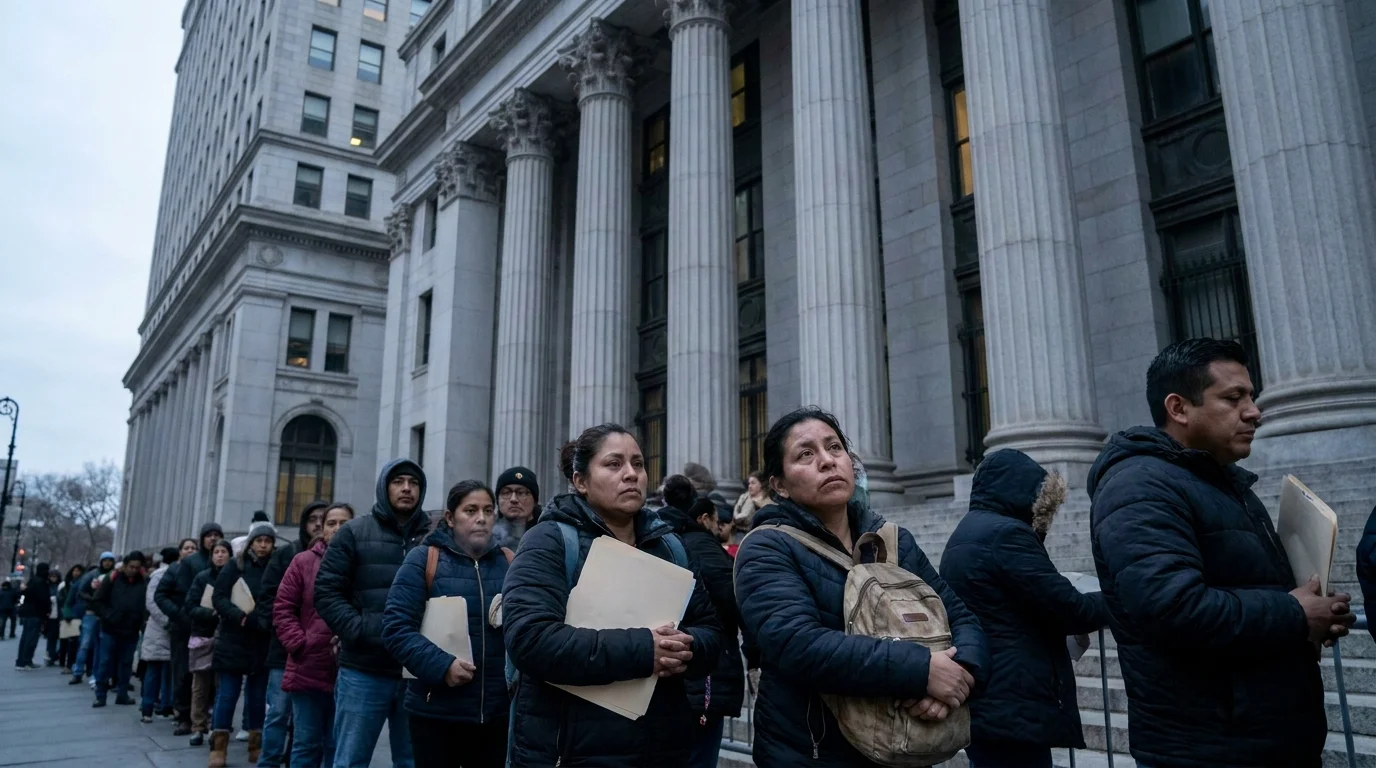
A strong Hispanic and Marshallese presence, with Mexicans, Salvadorans, and Marshallese representing a significant share of residents and Tyson workers.

Springdale is arguably the most diverse city in Arkansas. Decades of poultry plant operations attracted Hispanic and Marshallese workers, and today nearly half the population is Hispanic, primarily Mexican, Salvadoran, and Guatemalan. The Marshallese community, originating from the Marshall Islands in the Pacific, is the largest outside the islands themselves, numbering more than 15,000 people.

English is the official language, but Spanish and Marshallese are heard in grocery stores, gas stations, and schools. Several public schools offer bilingual programs, and hospitals and courts provide Marshallese interpreters. Mexican, Salvadoran, and Marshallese grocery stores line Thompson Street and Sunset Avenue.

The religious landscape includes Baptists, Catholics (with strong growth from the Hispanic community), Pentecostals, and the Marshallese United Church of Christ, which holds services in Marshallese. A small immigrant community connected to supply chain and service-sector employment exists in the broader area, though no identifiable cluster is concentrated in Springdale proper.

Languages spoken
  • English
  • Spanish (strong presence)
  • Marshallese (largest community in the US)
  • Portuguese (small)
  • Vietnamese (small)
Main religions
  • Baptist Christian
  • Catholic (strong among Hispanic community)
  • Pentecostal Christian
  • Marshallese United Church of Christ (UCC)
  • Methodist Christian

Cost of living in Springdale: among the lowest in the metro area

Rent and home prices fall below Fayetteville and Bentonville. Food and gas follow regional norms. Industrial wages pull the median income down.

Springdale is the most affordable city to live in within Northwest Arkansas. A one-bedroom apartment typically rents for between USD 700 and USD 1,000 per month. Home purchase prices are lower than in neighboring Fayetteville, Rogers, and Bentonville. Those employed at Tyson plants or in supply chain roles commonly choose to live in Springdale to keep costs down.

Walmart and Aldi stores are widely distributed throughout the city. Ethnic markets such as El Mercadito, Carniceria Guanajuato, and various Asian and Marshallese grocers offer specialty products at competitive prices. Dining out is affordable: a meal at a taqueria, a home-style Marshallese restaurant, or an Asian eatery typically runs between USD 8 and USD 14.

Arkansas levies a state income tax (up to 4.4%), and the local sales tax rate is approximately 9.75%. Gas, electricity, and water costs align with state averages and remain comparatively low. Many factory workers receive employer-sponsored health insurance. Starting wages at Tyson plants generally range from USD 17 to USD 20 per hour depending on the shift.

84Cost index (US = 100)16% below US average
CategorySingleCoupleFamily (2 + 2)
iHousing$1,098$1,267$1,605
iFood$321$642$1,165
iTransport$422$718$929
iHealthcare$236$473$887
iChildcare$1,538
iOther$718$1,292$1,816
Monthly total$2,795$4,392$7,940

Source: U.S. BLS Consumer Expenditure Survey 2023 + BEA Regional Price Parities 2023 · Estimates in USD, monthly.

Housing in Springdale: modest homes, trailer parks, and new apartment construction

Older single-family homes and trailer parks predominate. New developments are expanding near I-49 and in adjacent Tontitown.

Springdale has a larger stock of modest housing than neighboring cities. Historic neighborhoods near downtown feature small, older homes, many rented to working-class families. Trailer parks (manufactured home communities) are a common entry-level option, with accessible monthly rental costs.

New subdivisions are appearing to the north, toward Tontitown and Cave Springs, and to the west near I-49, featuring brick homes with two-car garages and yards. West Springdale and the area around Arvest Ballpark concentrate newer apartment complexes. Those who prefer a more university-adjacent environment often live in Fayetteville and commute roughly 20 minutes.

Rental applications typically require a credit score, proof of income (generally three times the monthly rent), and an application fee. Newcomers without a US credit history often need a co-signer or must pay a larger security deposit. Zillow and Apartments.com are the most commonly used platforms, and Spanish-language Facebook groups help recent arrivals find housing.

Recommended neighborhoods
  • West Springdale (newer homes, near I-49)
  • Tontitown (neighboring town, homes with larger lots)
  • Downtown Springdale (under revitalization)
  • Cave Springs (near XNA airport)
  • Har-Ber area (Har-Ber High School district)
  • +1 more

Job market in Springdale: poultry, transportation, and Tyson corporate

The poultry industry (Tyson, George's, Cargill) employs thousands. Transportation, construction, and corporate positions at Tyson Foods headquarters are also major employment drivers.

Springdale is the center of the US poultry industry. Tyson Foods, headquartered in the city, is the largest employer, with corporate offices and multiple processing plants. George's, Cargill, and Simmons Foods plants round out the sector. Production line, maintenance, supervisory, and supply chain positions are abundant, with starting wages typically ranging from USD 17 to USD 20 per hour.

Beyond the plant floor, Tyson's corporate headquarters employs professionals in finance, technology, marketing, legal, and data science, with salaries from USD 70,000 to USD 150,000 or more for senior roles. JB Hunt Transport in neighboring Lowell and regional logistics companies hire drivers, dispatchers, and analysts. Construction is also in high demand due to the regional development boom.

Regional healthcare systems (Northwest Health, Mercy) and public education provide stable employment. English is essential for administrative roles, but production floor positions are available to Spanish and Marshallese speakers, with bilingual training provided. The city is a common destination for newly arrived immigrants who find work through community networks.

Dominant sectors
  • Poultry processing (Tyson, George's, Cargill)
  • Tyson Foods corporate headquarters
  • Transportation and logistics (JB Hunt in Lowell)
  • Construction
  • Regional healthcare
  • +2 more
Major employers
  • Tyson Foods (world headquarters)
  • George's Inc. (poultry)
  • Cargill (poultry)
  • JB Hunt Transport (neighboring Lowell)
  • Northwest Health System
  • +2 more

Education in Springdale: a large district with bilingual programs

Springdale Public Schools is one of the state's largest districts, with Spanish and Marshallese programs. No university is located in the city, but the University of Arkansas is 20 minutes away.

Springdale Public Schools is one of the largest districts in Arkansas, serving more than 22,000 students. Given the city's diversity, it offers bilingual programs in Spanish and support services in Marshallese. Har-Ber High School and Springdale High School are the primary secondary institutions. School quality varies by neighborhood, with Har-Ber generally receiving higher ratings. Children of families with valid visas are entitled to free public education.

Private schools exist, primarily Christian-affiliated. Shiloh Christian School in particular has a strong reputation and a competitive American football program. Charter options include a Haas Hall Academy campus in the city. For higher education, the University of Arkansas in Fayetteville, 20 minutes away, is the regional flagship. Northwest Arkansas Community College in Bentonville offers technical programs and associate degrees.

John Brown University in Siloam Springs, a private Christian college, attracts students from across the region. Tyson's industrial presence has fostered university partnerships focused on training engineers and data scientists in supply chain management. Vocational programs in healthcare, refrigeration, and mechanics are available through Arkansas Tech University and regional technical schools.

Notable universities
  • University of Arkansas (Fayetteville, 20 minutes)
  • Northwest Arkansas Community College (Bentonville)
  • John Brown University (Siloam Springs)
  • Ecclesia College (Springdale)

Healthcare in Springdale: Northwest Health regional network and community clinics

The city has a regional hospital and clinics serving the community. Complex cases are referred to Mercy in Rogers or to Little Rock.

The primary hospital in Springdale is Northwest Medical Center Springdale, part of the Northwest Health network, with emergency services, maternity care, and outpatient clinics. Mercy Hospital Northwest Arkansas in Rogers and Washington Regional Medical Center in Fayetteville supplement local capacity. For rare cancers and transplants, patients are generally referred to UAMS in Little Rock or facilities in Tulsa.

Community clinics serve a significant portion of the low-income Hispanic and Marshallese population. Community Clinic, founded in the city, operates multiple locations across the region and provides care on a sliding-scale payment basis. Spanish and Marshallese interpreter services are available. Urgent care centers are easy to find along Highway 412.

The system is privately structured and dependent on health insurance, which is typically employer-sponsored. Tyson plant workers generally receive coverage, though copays can be a burden. Without insurance, a doctor visit costs between USD 100 and USD 200. Marshallese interpretation remains a challenge in emergency settings, and the hospital maintains a telemedicine service to help bridge the gap.

Healthcare index58.0 / 100
  • Life expectancyyears at birth
    78.4yrs
  • Doctors per 1kpracticing physicians
    3.7
  • Health spendper capita, per year
    $13,473
  • Public systemoverall quality rating
    Fair

Safety in Springdale: a working-class city with moderate crime rates

Property crime exists, but violent crime rates are not high. Older central neighborhoods warrant more caution than West Springdale.

Springdale has moderate crime rates by US standards. Violent crime is low, and most statistics reflect property theft, vehicle break-ins, and drug-related offenses. The older downtown core and some areas around Thompson Street warrant greater caution, particularly at night. Newer neighborhoods to the west and north are generally quiet.

The Springdale Police Department maintains community-oriented programs with Hispanic and Marshallese residents, including bilingual officers and partnerships with community leaders. Vandalism, bar fights, and impaired driving on Friday and Saturday nights are the most common incidents. Catalytic converter theft in parking lots is a regional issue.

As throughout Arkansas, tornadoes can occur between March and May, and the city has a network of warning sirens. Modern homes typically designate an interior room as a shelter. Newcomers are advised to download a weather alert app (NWS) and familiarize themselves with tornado warning protocols before their first spring.

5.8
Homicides per 100k
per year
Safety index
64.0
Crime index
36.0
Safer neighborhoods
  • Har-Ber Meadows
  • Wagon Wheel
  • Pleasant Street area
  • East Springdale
  • Cross Church area
  • Shiloh Square (restored downtown)
Areas to avoid
  • Stretches of Thompson Street at night
  • Industrial areas south of Route 412
  • Neighborhoods near the old railroad line after dark

Transportation in Springdale: a car-dependent city bisected by I-49

Nearly everyone drives. Interstate 49 and Highway 412 are the main corridors. XNA airport is in Highfill, about 20 minutes away.

Springdale is a car-dependent city. Public bus service is available through Ozark Regional Transit, but the network is limited. Interstate 49 runs through the city, connecting it to Fayetteville to the south and Rogers and Bentonville to the north in 15 to 30 minutes. Highway 412 crosses east to west and leads to Siloam Springs and Oklahoma.

Most workers at Tyson and George's plants commute by personal vehicle or in carpools organized among coworkers. Parking is plentiful throughout the city. The Razorback Greenway, a regional multi-use trail, passes through Springdale and connects to Fayetteville and Bentonville, offering a cycling alternative for those who prefer it.

Northwest Arkansas Regional Airport (XNA) in Highfill is approximately 20 minutes from Springdale, with nonstop flights to Dallas, Atlanta, Chicago, Denver, Houston, Los Angeles, Phoenix, and other US cities. International travel almost always requires a connection in Dallas or Atlanta. Tulsa, Oklahoma, is another option about two hours away for additional flight options.

19 min
Avg commute
28
Walkability
Airports
  • XNA — Northwest Arkansas National Airport
  • International airport
  • Bike infrastructure

What the Climate Is Like Living in Springdale

Springdale has a humid subtropical climate in the Ozarks, with hot and humid summers, short cold winters with light snowfall, and four distinct seasons.

Summer runs long, from May through September, with highs between 86 and 91 degrees Fahrenheit and high humidity. The heat index can exceed 99 degrees in July, with frequent afternoon thunderstorms. Air conditioning runs nearly continuously in homes and vehicles.

Winter is short but requires real heating, from December through February, with highs between 45 and 50 degrees and lows between 23 and 30 degrees Fahrenheit. Snowfall occurs a few days per season, averaging around 8 inches annually. A mid-weight coat, central heating, and attention to icy roads are part of the seasonal routine.

The area sits in the extended Tornado Alley, and spring brings genuine tornado risk in March, April, and May. Annual rainfall exceeds 47 inches. Fall is the most comfortable season. For residents, reliable air conditioning, functional heating, and an identified tornado shelter are practical necessities.

Sunny days / year218 days
Avg high (°F)
  • 48°J
  • 50°F
  • 61°M
  • 68°A
  • 75°M
  • 86°J
  • 90°J
  • 89°A
  • 84°S
  • 70°O
  • 59°N
  • 53°D
Avg low (°F)
  • 31°J
  • 31°F
  • 41°M
  • 48°A
  • 58°M
  • 66°J
  • 71°J
  • 70°A
  • 65°S
  • 52°O
  • 41°N
  • 36°D
Rainfall (")
  • 4"J
  • 3"F
  • 6"M
  • 5"A
  • 7"M
  • 4"J
  • 3"J
  • 5"A
  • 3"S
  • 6"O
  • 3"N
  • 3"D

Culture in Springdale: a blend of country, Hispanic, and Marshallese traditions

A working-class city with country roots and a strong Hispanic and Marshallese cultural presence, expressed through restaurants, festivals, and churches.

Springdale's traditional culture is rooted in country and working-class life, tied to poultry farming, country music, and barbecue. The Rodeo of the Ozarks has taken place every summer since 1944 and draws audiences from across the region. Games at Arvest Ballpark, home of the Northwest Arkansas Naturals (MLB Double-A affiliate), are a staple of family life in summer.

The Hispanic and Marshallese presence has transformed Springdale over the past three decades. Restaurants such as El Centenario, Las Palmas, and numerous taquerias serve Mexican and Central American food at good quality and low prices. The Springdale Farmers Market and the Marshallese Festival celebrate the city's diversity. Marshallese dishes such as palusami (taro leaves in coconut cream), chicken curry rice, and raw tuna appear at select local eateries.

The historic downtown is undergoing revitalization, with Shiloh Square hosting events including the Shiloh Music Festival and Lights of the Ozarks. The Shiloh Museum of Ozark History documents the region's story, from its early farming settlements to the modern poultry industry. The Marshallese community marks the Marshall Islands' independence day on May 1 with annual celebrations.

Springdale

Heart of Northwest Arkansas and Home of Tyson Foods

Springdale is part of the Northwest Arkansas metro area alongside Fayetteville and Bentonville, home to Tyson Foods headquarters, Arvest Ballpark, and the Shiloh Museum, with a strong Latino and Marshallese community.

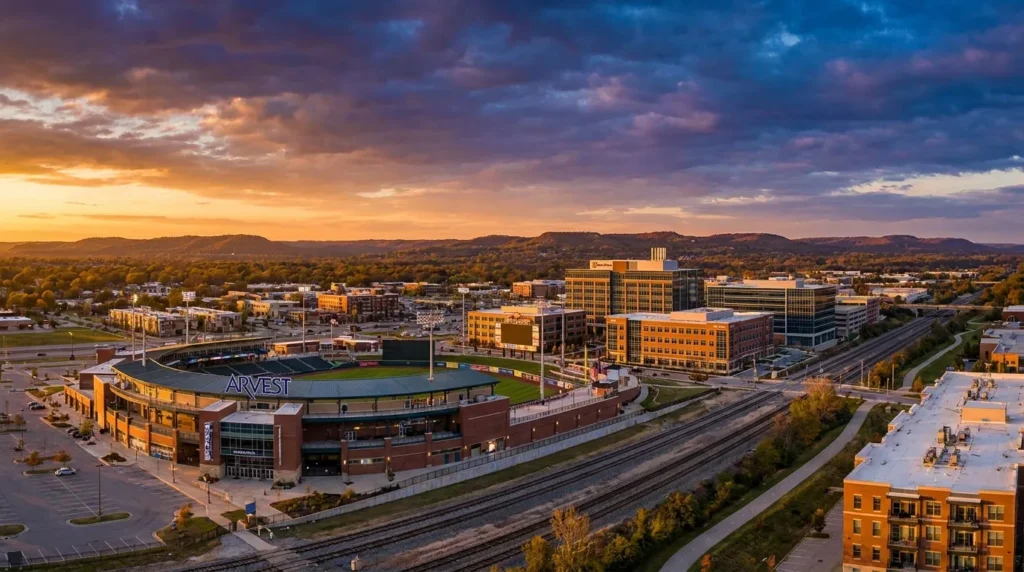
Springdale serves as the industrial and logistics hub of Northwest Arkansas. The Shiloh Museum of Ozark History provides essential context for understanding the region's settlement, and the Jones Center offers an Olympic pool, gymnasium, skating rink, and tennis courts. Arvest Ballpark is home to the Northwest Arkansas Naturals, a Double-A baseball affiliate of the Kansas City Royals.

The Razorback Greenway, spanning over 37 miles of trail, runs through Springdale connecting Fayetteville to Bentonville and Rogers, making it a daily resource for runners, cyclists, and bike commuters. For outdoor recreation, Hobbs State Park and Lake Fayetteville are nearby, and Crystal Bridges Museum in Bentonville draws frequent cultural visitors.

The events calendar includes the Tontitown Grape Festival, Ozark Mountain Music Festival, and Marshallese and Hispanic festivals that reflect the city's diversity. In October, the Crepuscular Tower music festival draws regional audiences.

  1. 1["Shiloh Museum of Ozark History"
  2. 2"Arts Center of the Ozarks"
  3. 3"Arvest Ballpark"
  4. 4"Jones Center"
  5. 5"Tyson Foods World Headquarters area"
  6. 6"Razorback Greenway"
Nightlife4.0 / 10
Parks & green spaces
  • ["Murphy Park"
  • "Luther George Park"
  • "Lake Fayetteville (nearby)"
  • "Tyson Park"
  • "Spring Creek Park"
  • +1 more

Latest posts

Posts about Arkansas

Coverage and updates related to this destination.

Showing content from Arkansas, as there is no specific data for Springdale yet.