Visto n' Visa
Blog
Notícias e artigos
Destinations
Careers
Immigrants

Want to live and work in Pine Bluff?

Personalized immigration plan with eligible visas, costs, and next steps for your goal!

If you are not eligible, you will know exactly why and what to do to improve your approval chances.

Save up to 12 hours in meetings

No pointless assessments.

Save up to 90%

Save money on vague or unfocused consultations

Avoid Fraud and Mistakes

One mistake can cost you your visa

Total Impartiality

Zero commercial bias

Decide with peace of mind

No toxic urgency

Fast and Accurate

Answers in minutes, no guesswork

Pine Bluff Population: Predominantly African American, Delta Heritage

Approximately 75% African American, one of the highest proportions among mid-sized U.S. cities. The Hispanic community has seen limited growth. Median age is high.

Pine Bluff has a predominantly African American population, with roughly 75% identifying as Black, one of the highest proportions among mid-sized cities in the United States. This demographic makeup is a legacy of the Delta's cotton economy, which relied on Black labor since before the Civil War. The white population is a minority, and the Hispanic community has grown little compared to northwestern Arkansas.

English is the primary language, with a strong rural Southern vernacular. Spanish is less prevalent than in other Arkansas cities. The Brazilian community is virtually nonexistent in Pine Bluff. The median age is higher than in other cities in the state, reflecting the departure of young people seeking employment in larger centers.

Religiously, historic African American churches predominate: Missionary Baptist, AME (African Methodist Episcopal), Church of God in Christ (COGIC), and some Pentecostal congregations. Catholicism is a minority. The city has a strong cultural identity tied to gospel music, Delta blues, and the African American community.

Languages spoken
  • English
  • Spanish (small community)
  • African American Vernacular English (AAVE)
Main religions
  • African American Christian (Baptist, AME)
  • Pentecostal Christian (COGIC)
  • Baptist Christian
  • Methodist Christian
  • Catholic (small)

Cost of Living in Pine Bluff: Among the Lowest in the United States

Rent and housing cost a fraction of what they do in large cities. Wages are proportionally lower, but for those with external income, expenses are quite manageable.

Pine Bluff is one of the most affordable cities to live in in the United States. Renting a two- or three-bedroom house can cost between USD 500 and USD 800 per month, with apartments priced even lower. Homes for purchase are extremely inexpensive by American standards, with modest properties available at prices that in other regions would only cover a down payment.

Walmart, Kroger, and Edwards Food Giant supermarkets cover everyday needs. Eating out is affordable: a meal at a casual restaurant runs USD 8 to USD 14. There is a strong supply of soul food (traditional African American Southern cuisine), barbecue, and fried catfish. Ethnic restaurants are few, with some Mexican and Chinese options available.

Arkansas has a state income tax (up to 4.4%) and a local sales tax of around 9.5%. Gasoline and electricity are inexpensive. Employer-sponsored health insurance is the norm, but the supply of jobs with good benefits is limited. For retirees or remote workers with external income, the overall cost of living is quite comfortable.

Pine Bluff

Housing in Pine Bluff: Affordable Homes and Historic Properties

Single-family homes dominate, with very low prices. There are historic properties downtown and newer developments to the northwest.

Pine Bluff offers very affordable housing by American standards. Single-family homes dominate, with prices ranging from very low in older neighborhoods to moderate in newer developments. Neighborhoods such as Country Club Heights, Belair, and the northwest part of the city have newer, well-maintained homes with relatively better-rated schools.

Downtown has historic properties in antebellum, bungalow, and Victorian styles, some in poor condition and others restored. Those looking for restoration projects will find opportunities, though bank financing can be complicated for very old properties. Areas such as the east and south of the city have simpler homes and lower prices.

Renting generally requires a credit score, proof of income, and an application fee. Those arriving without an American credit history often need a co-signer or a larger deposit. Zillow and Realtor.com cover most listings, and local agencies such as Howard Realty serve the market.

Recommended neighborhoods
  • Country Club Heights (newer homes, relatively good schools)
  • Belair (established residential area)
  • Northwest Pine Bluff (more recent developments)
  • Historic downtown (Victorian homes, renovation projects)
  • White Hall (neighboring city, better services)

Job Market in Pine Bluff: Manufacturing, Healthcare, Federal Government, and Paper

Facilities such as Evergreen Packaging (paper), the Pine Bluff Arsenal (federal government), hospitals, and UAPB are the main sources of employment.

Pine Bluff has a contracting industrial economy, but with key pillars still in place. Evergreen Packaging (paper and packaging) and Tyson Foods (local plant) employ hundreds on the factory floor. The Pine Bluff Arsenal, a federal military installation specializing in chemical weapons, is a major employer. Healthcare is a stable sector, anchored by Jefferson Regional Medical Center.

The University of Arkansas at Pine Bluff (UAPB), one of the state's HBCUs (Historically Black Colleges and Universities), employs hundreds in teaching, research, and administration. The Saracen Casino Resort, opened in 2020 by the Quapaw Nation, created jobs in hospitality, gaming, and services. Municipal government and public schools round out the picture.

Average wages are lower than in other Arkansas cities, reflecting the local economy in transition. Openings in construction, agriculture (surrounding farms), and services are accessible for those just starting out. English is required for most positions. The city offers incentives to attract new industries and startups, though practical results remain modest.

Dominant sectors
  • Manufacturing (paper, Evergreen Packaging)
  • Federal government (Pine Bluff Arsenal)
  • Regional healthcare
  • Higher education (UAPB)
  • Agriculture (Delta)
  • +2 more
Major employers
  • Pine Bluff Arsenal (federal government)
  • Jefferson Regional Medical Center
  • Evergreen Packaging
  • University of Arkansas at Pine Bluff (UAPB)
  • Tyson Foods (local plant)
  • +2 more

Education in Pine Bluff: UAPB as the Historic Educational Anchor

Public school district with chronic challenges. Some private options. UAPB is a historic HBCU, and UALR is one hour away in Little Rock.

The Pine Bluff School District serves most children in the city, but faces chronic funding and performance challenges. Families seek alternatives at private schools (Pine Bluff Lighthouse Academy, Watson Chapel Academy) or in neighboring districts such as White Hall, which has a better reputation. Children of those with valid visas are entitled to free public education.

The University of Arkansas at Pine Bluff (UAPB) is one of the state's oldest HBCUs, founded in 1873. It has strong programs in agriculture, biology, criminology, and business. It is a central institution for the African American community of the South and features a beautiful, tree-lined campus. The Golden Lions football team has a tradition in the SWAC (Southwestern Athletic Conference).

For other university options, UALR and UAMS in Little Rock are one hour away. Southeast Arkansas College (SEARK), in Pine Bluff, offers technical programs and associate degrees. Tuition at UAPB for international students runs roughly USD 13,000 to USD 16,000 per year, among the lowest in the United States. Scholarships and financial aid are widely available for eligible students.

Notable universities
  • University of Arkansas at Pine Bluff (UAPB, historic HBCU)
  • Southeast Arkansas College (SEARK)
  • University of Arkansas at Little Rock (UA Little Rock, 1 hour away)

Healthcare in Pine Bluff: Jefferson Regional as the Main Hospital

Jefferson Regional Medical Center serves the southeastern Arkansas region. For complex cases, Little Rock is one hour away.

Jefferson Regional Medical Center is the main hospital in Pine Bluff and southeastern Arkansas, with an emergency room, maternity ward, cardiology, and several specialties. For more complex cases, such as rare cancers, transplants, and pediatric neurology, patients travel to UAMS, CHI St. Vincent, or Arkansas Children's Hospital in Little Rock.

Urgent care is easy to find along Olive Street and Cherry Street. Community health clinics serving lower-income residents also operate on a sliding-scale fee basis. Access to specialists in some areas may require travel to Little Rock, particularly for rheumatology and endocrinology.

As throughout the United States, the system is private and depends on health insurance. Without coverage, a standard office visit costs USD 80 to USD 200, and an emergency room visit can exceed USD 1,500. Employer-sponsored health insurance is the norm. For lower-income residents, Medicaid (Arkansas Works) and FQHC (Federally Qualified Health Center) clinics meet a significant share of demand.

Healthcare index55.0 / 100
  • Life expectancyyears at birth
    78.4yrs
  • Doctors per 1kpracticing physicians
    3.7
  • Health spendper capita, per year
    $13,473
  • Public systemoverall quality rating
    Fair

Safety in Pine Bluff: High Crime Rates for the Population Size

The city has some of the highest crime rates for its size. Neighborhoods vary greatly. White Hall and northwestern neighborhoods are calmer.

Pine Bluff has violent crime rates among the highest in the United States for a city of its size. This is a problem rooted in decades of economic contraction, concentrated poverty, and the difficulty of maintaining adequate police staffing. Some areas downtown and in the east require significant caution, especially at night.

Neighborhoods such as Country Club Heights, Belair, and the northwest area are considerably safer, with a normal residential character. White Hall, a neighboring city, is considered much safer and attracts families who work in Pine Bluff but prefer to live there. Property crime (burglary, theft) is very common throughout the city.

As in all of Arkansas, tornadoes can occur between March and May, and flooding from the Arkansas River affects low-lying areas. The city has warning sirens. For those researching where to live, reviewing neighborhood crime maps carefully before signing a lease is advisable, or considering White Hall and Watson Chapel as nearby alternatives.

5.8
Homicides per 100k
per year
Safety index
22.0
Crime index
78.0
Safer neighborhoods
  • South Pine Bluff (Hardin)
  • White Hall (nearby suburb)
  • Pine Bluff Country Club area
  • Restored downtown near Main Street
  • Trinity area
  • Belair
Areas to avoid
  • Central areas with abandoned buildings after dark
  • Stretches of Olive Street late at night
  • Neighborhoods near 6th Avenue after dark
  • Industrial zones along Highway 65

Transportation in Pine Bluff: Car-Dependent City with Easy Access to Little Rock

A car is the norm. Highway 65 reaches Little Rock in one hour. The LIT airport in Little Rock serves the region. No efficient bus service.

Pine Bluff is a car-dependent city with no efficient public transit. Highway 65 and Highway 79 are the main arteries, connecting the city to Little Rock (one hour north) and other Delta towns. Internal distances within Pine Bluff are short, with 10 to 15 minutes sufficient to cross the city. Parking is abundant and free almost everywhere.

For travelers, Clinton National Airport (LIT) in Little Rock is about 1 hour and 10 minutes away and offers direct flights to Dallas, Atlanta, Charlotte, Chicago, Houston, and Denver. For international flights, connections through Dallas or Atlanta cover most destinations. Grider Field is Pine Bluff's local airport, but it serves primarily private aviation and cargo.

Cycling is practically unfeasible for daily commuting. Bike lanes are absent, and the heat and humidity make the option unattractive. The Amtrak station (Texas Eagle) in Little Rock is the nearest intercity rail option. Intercity bus service (Greyhound) still serves the city, but with reduced frequency.

18 min
Avg commute
32
Walkability
Airports
  • PBF — Pine Bluff Regional Airport (Grider Field)

What the Climate Is Like in Pine Bluff

Pine Bluff has a humid subtropical climate, with very long, hot, and muggy summers, short mild winters with occasional frost, and rainfall distributed fairly evenly throughout the year.

Summer is long, running from May through September, with highs between 90°F and 95°F and very high humidity. The heat index exceeds 102°F in July, with frequent afternoon thunderstorms. Air conditioning runs nearly continuously indoors, in vehicles, and in any enclosed space.

Winter is short, from December through February, with highs between 52°F and 57°F and lows between 30°F and 37°F. Snowfall is infrequent, and occasional ice storms can bring down power lines. A mid-weight coat is sufficient for most days.

The area lies within Tornado Alley, and spring brings a real tornado risk in March, April, and May. Annual rainfall exceeds 54 inches. For residents, a reliable air conditioning system, functional heating, and a designated tornado shelter are practical essentials.

Sunny days / year219 days
Avg high (°F)
  • 55°J
  • 56°F
  • 66°M
  • 72°A
  • 82°M
  • 89°J
  • 92°J
  • 91°A
  • 88°S
  • 76°O
  • 63°N
  • 59°D
Avg low (°F)
  • 38°J
  • 38°F
  • 47°M
  • 53°A
  • 63°M
  • 71°J
  • 75°J
  • 74°A
  • 69°S
  • 57°O
  • 45°N
  • 42°D
Rainfall (")
  • 6"J
  • 6"F
  • 7"M
  • 6"A
  • 5"M
  • 4"J
  • 4"J
  • 3"A
  • 2"S
  • 5"O
  • 4"N
  • 5"D

Culture in Pine Bluff: Delta Blues, Gospel, and African American Tradition

A city with a strong Delta musical tradition. Blues, gospel, and soul food are part of the local identity. UAPB and Saracen Casino enliven the cultural calendar.

Pine Bluff lies on the Delta blues trail, with historic regional musicians performing at local clubs. Gospel music is a central part of life in African American churches. The Arkansas Entertainers Hall of Fame, downtown, honors musicians from the state including Johnny Cash, Glen Campbell, and the Cate Brothers. UAPB bands perform at games and parades.

The local cuisine is distinctly Southern, with strong soul food traditions: fried chicken, ribs, collard greens, cornbread, fried catfish, and sweet potato pie. Local restaurants such as Buster's Place and barbecue joints carry on that tradition. Murals on Main, a series of murals throughout downtown, depicts the city's history.

The Saracen Casino Resort, opened in 2020 by the Quapaw Nation, transformed the entertainment calendar with shows, restaurants, and gaming. Events such as the King Cotton Holiday Classic (basketball) and UAPB Golden Lions football games bring the community together. The White Hall Octoberfest and other regional festivals draw visitors from the surrounding area.

Pine Bluff

What to See and Do While Living in Pine Bluff

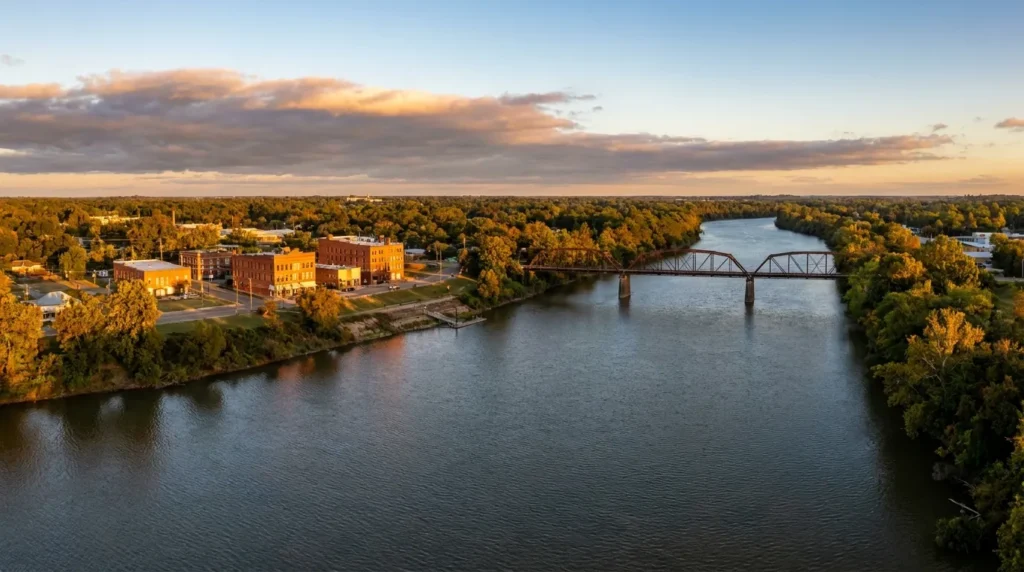
Pine Bluff is a historic Delta city in Arkansas, shaped by the cotton era, blues music, and a strong connection to the HBCU University of Arkansas at Pine Bluff.

The Arkansas Entertainers Hall of Fame, located downtown, honors musicians and artists born in the state, from Johnny Cash to Maya Angelou. The Pine Bluff/Jefferson County Historical Museum occupies the former Union Station and covers the city's cotton and railroad economy. The Saracen Casino Resort, opened in 2020 by the Quapaw Nation, has become the region's largest entertainment destination.

The Arts and Science Center for Southeast Arkansas showcases regional art and features a children's theater. The Delta Rivers Nature Center, operated by the Arkansas Game and Fish Commission, is a free stop with an aquarium and nature trail. Bayou Bartholomew, the longest navigable bayou in the world, offers bass fishing and canoeing.

The Pine Bluff Convention Center Plaza hosts the King Cotton Holiday Classic, a national high school basketball tournament. The University of Arkansas at Pine Bluff (UAPB) brings cultural programming at Lion's Den Football Field and Vesper Hall.

  1. 1["Arkansas Railroad Museum"
  2. 2"Arts and Science Center for Southeast Arkansas"
  3. 3"Pine Bluff\/Jefferson County Historical Museum"
  4. 4"Saracen Casino Resort"
  5. 5"Delta Rivers Nature Center"
  6. 6"Band Museum"
Nightlife3.0 / 10
Parks & green spaces
  • ["Regional Park"
  • "Delta Rivers Nature Center grounds"
  • "Saracen Lake (nearby)"
  • "Lake Pine Bluff"
  • "Martin Park"
  • +1 more

Latest posts

Posts about Arkansas

Coverage and updates related to this destination.

Showing content from Arkansas, as there is no specific data for Pine Bluff yet.