Visto n' Visa
Blog
Notícias e artigos
Destinations
Careers
Immigrants

Want to live and work in North Little Rock?

Personalized immigration plan with eligible visas, costs, and next steps for your goal!

If you are not eligible, you will know exactly why and what to do to improve your approval chances.

Save up to 12 hours in meetings

No pointless assessments.

Save up to 90%

Save money on vague or unfocused consultations

Avoid Fraud and Mistakes

One mistake can cost you your visa

Total Impartiality

Zero commercial bias

Decide with peace of mind

No toxic urgency

Fast and Accurate

Answers in minutes, no guesswork

North Little Rock Population: Racial Breakdown Similar to the Capital

A nearly even mix of white and African American residents, with a growing Hispanic community. Median age is higher than in college towns.

North Little Rock's population is divided in proportions similar to Little Rock: roughly half non-Hispanic white and nearly 40% African American, with a growing Hispanic community (primarily Mexican, Salvadoran, and Honduran). There is also a small Vietnamese community established since the 1970s, with restaurants and temples.

English is the primary language. Spanish has expanded in neighborhoods on the east side of the city and near JFK Boulevard. The Brazilian community is small, connected mainly to professionals working in hospitals and companies in Little Rock. No identifiable Brazilian cluster exists, but online groups connect people across both cities.

Religiously, NLR is part of the Bible Belt: Baptists, Methodists, Pentecostals, and African American churches predominate. The Catholic community has grown alongside the Hispanic population. Spanish-language evangelical churches and historic African American congregations such as Mount Pleasant Baptist Church are also present. The city has a more working-class profile than parts of Little Rock.

Languages spoken
  • English
  • Spanish
  • Vietnamese (historic community)
  • Portuguese (small)
  • Marshallese (regional, small)
Main religions
  • Baptist Christian
  • African American Christian (AME, COGIC, Baptist)
  • Methodist Christian
  • Catholic (growing)
  • Pentecostal Christian

Cost of Living in North Little Rock: Low, Generally Cheaper Than Little Rock

Rent and home prices tend to run somewhat lower than across the river. Food and gas follow regional patterns. Good value for those working in Little Rock.

NLR is generally cheaper than Little Rock for housing. A one-bedroom apartment rents for between USD 700 and USD 1,000 per month, compared to USD 800 to USD 1,200 on the other side. Homes for purchase are priced well below the national average, with neighborhoods such as Park Hill and Lakewood offering older homes at a significant discount.

Walmart, Kroger, Edwards Food Giant, and Aldi cover everyday grocery needs. Dining out is affordable: a meal at a casual restaurant runs USD 10 to USD 18. Argenta offers more upscale options, including bistros and farm-to-table spots. Park Hill and the McCain Boulevard corridor are home to fast food and chain restaurants.

Arkansas levies a state income tax (up to 4.4%) and a local sales tax of around 9%. Gas and electricity are inexpensive. Employer-sponsored health insurance is the norm. For families working in Little Rock who want to reduce housing costs, NLR is a common choice, with a 15 to 20-minute commute across the bridges.

84Cost index (US = 100)16% below US average
CategorySingleCoupleFamily (2 + 2)
iHousing$1,098$1,267$1,605
iFood$321$642$1,165
iTransport$422$718$929
iHealthcare$236$473$887
iChildcare$1,538
iOther$718$1,292$1,816
Monthly total$2,795$4,392$7,940

Source: U.S. BLS Consumer Expenditure Survey 2023 + BEA Regional Price Parities 2023 · Estimates in USD, monthly.

Housing in North Little Rock: Historic Homes in Park Hill and Lakewood

Park Hill and Lakewood feature older homes on tree-lined streets. Argenta has lofts and renovated houses. New neighborhoods are expanding to the north.

Park Hill is the most sought-after historic neighborhood, with homes from the 1920s to the 1940s on streets lined with sycamores and oaks. Brick construction, front porches, and backyards are standard. Lakewood, to the north, is another established middle-class neighborhood with homes surrounding man-made lakes (the Lakewood Lakes) and Burns Park nearby.

The Argenta Arts District, in the revitalized downtown, offers modern lofts in older buildings, some restored houses, and new low-rise condominiums. It suits young professionals who want to walk to bars and restaurants. New neighborhoods are expanding northward toward Sherwood (a neighboring city), with modern homes in planned subdivisions.

Areas such as the east side of the city (near JFK Boulevard) and parts of Levy offer lower-priced homes, though the quality of public services varies. Renting typically requires a credit check, income of three times the monthly rent, and an application fee. Zillow, Apartments.com, and Crye-Leike Real Estate (a local firm) are useful starting points for the search.

Recommended neighborhoods
  • Park Hill (historic homes, tree-lined streets)
  • Lakewood (lakes, Burns Park nearby)
  • Argenta Arts District (revitalized downtown, lofts)
  • Indian Hills (north, modern homes)
  • Sherwood (neighboring city, good schools)
  • +1 more

Job Market in North Little Rock: Industry, Logistics, and Healthcare

Industry, logistics (near the port and rail yard), Baptist Health-NLR, and jobs across the bridge in Little Rock are the main sources of employment.

North Little Rock developed historically as a railroad and industrial city. Manufacturing remains significant, with facilities such as a nearby Caterpillar plant, alongside a strong logistics sector supported by the Port of Little Rock and the Union Pacific Jenks Yard rail facility. Openings in driving, forklift operation, maintenance, and supply chain are consistently available.

Baptist Health-North Little Rock Medical Center is a major local healthcare employer. Retail is prominent along McCain Boulevard, JFK Boulevard, and Camp Robinson. A large share of residents commute to Little Rock for positions in hospitals, government offices, and companies such as Dillard's, Stephens Inc., and UAMS.

Average salaries for skilled professionals range from USD 50,000 to USD 75,000, in line with the cost of living in central Arkansas. Entry-level positions in construction, hospitality, and retail are readily available. English is required for most administrative roles, with some bilingual opportunities in retail and service industries.

Dominant sectors
  • Logistics and transportation (port, railroad)
  • Manufacturing
  • Regional healthcare
  • Retail and commerce
  • Government (Camp Robinson, ANG)
  • +2 more
Major employers
  • Baptist Health-North Little Rock
  • Union Pacific Railroad (Jenks Yard)
  • Camp Joseph T. Robinson (National Guard)
  • Caterpillar (nearby, North Little Rock)
  • Verizon (regional call center)
  • +2 more

Education in North Little Rock: Mixed Public District and Access to Little Rock Universities

Public district quality varies by neighborhood. For higher education, UA Little Rock, UAMS, and UCA (in Conway) serve the region.

The North Little Rock School District serves most children in the city. Quality varies by neighborhood, with schools in Lakewood and Park Hill generally rated higher than those on the east side. Children of residents holding valid visas are entitled to free public education. Some families opt for private schools (St. Edward Mercy, Catholic High in Little Rock) or charter options.

For higher education, the region offers the University of Arkansas at Little Rock (UA Little Rock), with strong programs in law (Bowen School of Law), computer engineering, and business. The University of Arkansas for Medical Sciences (UAMS), also in Little Rock, is the regional reference in medicine. The University of Central Arkansas (UCA), in Conway, is about 40 minutes away.

Philander Smith College and Arkansas Baptist College in Little Rock are historically Black colleges and universities (HBCUs) that serve students from NLR. Pulaski Technical College has a campus in NLR offering technical programs and associate degrees. Tuition for international students at UA Little Rock runs approximately USD 18,000 to USD 24,000 per year.

Notable universities
  • University of Arkansas at Little Rock (UA Little Rock)
  • University of Arkansas for Medical Sciences (UAMS, Little Rock)
  • Philander Smith College (HBCU, Little Rock)
  • Arkansas Baptist College (HBCU)
  • Pulaski Technical College (campus in NLR)

Healthcare in North Little Rock: Baptist Health-NLR and Easy Access to UAMS Across the River

Baptist Health-NLR is the local hospital. For complex cases, UAMS, Arkansas Children's, and CHI St. Vincent are 15 minutes away in Little Rock.

Baptist Health-North Little Rock Medical Center is the city's main hospital, offering emergency care, maternity services, and multiple specialties. For more complex cases, UAMS, Arkansas Children's Hospital, CHI St. Vincent Infirmary, and the Veterans Administration Medical Center in Little Rock are 15 minutes away across the river.

Urgent care centers are easy to find along JFK Boulevard, McCain Boulevard, and Camp Robinson Road. Private clinics, dentists, and ophthalmologists are available throughout the city. Telemedicine services (Teladoc, Maple, and similar platforms) cover a large share of routine visits, a practical option for those without a regular primary care physician.

As throughout the United States, the healthcare system is private and dependent on insurance coverage. Without coverage, a standard visit costs USD 100 to USD 250, and an emergency room visit can exceed USD 1,500. Employer-sponsored health insurance is the standard arrangement. Many NLR residents use hospitals in Little Rock given the proximity, particularly for specialty care.

Healthcare index60.0 / 100
  • Life expectancyyears at birth
    78.4yrs
  • Doctors per 1kpracticing physicians
    3.7
  • Health spendper capita, per year
    $13,473
  • Public systemoverall quality rating
    Fair

Safety in North Little Rock: Contrast Between Quiet Neighborhoods and Higher-Crime Areas

Like Little Rock, NLR has significant variation by neighborhood. Park Hill, Lakewood, and Indian Hills are quiet. Some eastern and central areas require more awareness.

North Little Rock has crime rates above the national average, concentrated in specific areas, primarily East NLR and stretches near JFK Boulevard. Established neighborhoods such as Park Hill, Lakewood, Indian Hills, and the area around Burns Park are considered safe. Argenta, in ongoing revitalization, is regarded as safe with active evening foot traffic.

Property crime (car break-ins, catalytic converter theft, package theft) is the most common everyday concern. Ring cameras and home alarm systems are standard in residential neighborhoods. The local police department (NLRPD) maintains patrols in neighborhoods and near schools. Bar disturbances and impaired driving are the most frequent weekend incidents.

As throughout Arkansas, tornadoes can occur between March and May. NLR has warning sirens and shelter protocols in place. Homes generally have an interior room that serves as a refuge, and some have dedicated safe rooms. New arrivals are encouraged to download the National Weather Service app and learn the difference between a tornado watch and a tornado warning before the first spring season.

5.8
Homicides per 100k
per year
Safety index
36.0
Crime index
64.0
Safer neighborhoods
  • Park Hill
  • Argenta historic district
  • Lakewood
  • Indian Hills
  • Lakeview
  • Amboy
Areas to avoid
  • Stretches of Pike Avenue late at night
  • East Broadway after dark
  • Areas near I-40 north of downtown

Transportation in North Little Rock: Bridges to Little Rock and the Metro Streetcar

The city is connected to Little Rock by bridges and the METRO Streetcar. Clinton Airport (LIT) is 15 minutes away. The car is the default mode of travel.

North Little Rock is car-dependent, though it has straightforward connections to Little Rock. The I-30 bridge, Broadway Bridge, Main Street Bridge, and Junction Bridge (pedestrian) all cross the Arkansas River. The crossing takes 5 to 15 minutes depending on the time of day and bridge chosen. The METRO Streetcar connects Argenta to Little Rock via the Main Street Bridge, a scenic and functional transit option.

Rock Region Metro operates local bus routes covering the main corridors. Cycling is practical on some stretches with dedicated infrastructure, particularly the Arkansas River Trail (more than 80 km / 50 miles around the river on both sides) and the Big Dam Bridge, a well-known pedestrian and cycling span connecting the two banks. It is one of the most scenic features of the metropolitan area.

Clinton National Airport (LIT) is 15 minutes away via I-440, with nonstop flights to Dallas, Atlanta, Charlotte, Chicago, Denver, Houston, and Washington. International travel requires a connection in Dallas or Atlanta. The Amtrak station (Texas Eagle) is in Little Rock, with daily service to Chicago and San Antonio.

20 min
Avg commute
35
Walkability
Airports
  • LIT — Bill and Hillary Clinton National Airport
  • ORK — North Little Rock Municipal Airport
  • International airport
  • Bike infrastructure

What the Climate Is Like Living in North Little Rock

North Little Rock has a humid subtropical climate, with long, muggy summers, short winters with lows near freezing, and rainfall distributed fairly evenly throughout the year.

Summer runs long, from May through September, with highs between 88°F and 93°F and elevated humidity. The heat index often exceeds 100°F in July, with frequent afternoon thunderstorms. Air conditioning runs nearly continuously indoors and in vehicles.

Winter is short, from December through February, with highs between 50°F and 57°F and lows between 28°F and 36°F. Snowfall occurs a few times per season, and occasional ice storms can cause power outages. Central heating sees limited use overall.

The region sits within Tornado Alley, and spring brings a real tornado risk in March, April, and May. Annual rainfall exceeds 51 inches. Autumn is the most comfortable season. For those planning to live here, reliable air conditioning, functional heating, and an identified shelter for tornadoes are all practical necessities.

Sunny days / year219 days
Avg high (°F)
  • 53°J
  • 55°F
  • 64°M
  • 71°A
  • 80°M
  • 88°J
  • 91°J
  • 91°A
  • 87°S
  • 74°O
  • 62°N
  • 57°D
Avg low (°F)
  • 36°J
  • 36°F
  • 45°M
  • 51°A
  • 61°M
  • 69°J
  • 74°J
  • 73°A
  • 68°S
  • 56°O
  • 43°N
  • 40°D
Rainfall (")
  • 5"J
  • 5"F
  • 6"M
  • 6"A
  • 5"M
  • 4"J
  • 3"J
  • 3"A
  • 2"S
  • 4"O
  • 3"N
  • 4"D

Culture in North Little Rock: Argenta, Burns Park, and Railroad Heritage

The city features a revitalized arts district, a vast urban park, and an identity rooted in railroad history. Minor league baseball is popular.

The Argenta Arts District is NLR's cultural heart. Venues such as the ARgenta Community Theater, restaurants including Cregeen's Irish Pub, Mugs Cafe, and Reno's Argenta Cafe, and a seasonal farmers market define downtown life. Events like the Argenta Plaza Pop-Up and the Third Friday Art Walk keep the area active throughout the year.

Burns Park, one of the largest municipal parks in the United States, features a golf course, soccer fields, a small zoo, mountain bike trails, picnic areas, and a historic carousel. It is a go-to family destination on weekends. Dickey-Stephens Park, on the riverbank, hosts the Arkansas Travelers, a Double-A MLB affiliate of the Seattle Mariners.

The railroad heritage is visible at the Old Mill (a replica of the mill featured in the opening of Gone with the Wind, located in Lakewood) and at Junction Bridge, a former railroad span converted into a pedestrian walkway. The cuisine is Southern: barbecue, burgers, and catfish, with a Vietnamese influence at longstanding restaurants such as Lily's Dim Sum Then Some and Saigon Cuisine.

North Little Rock

What Life in North Little Rock, Arkansas Offers

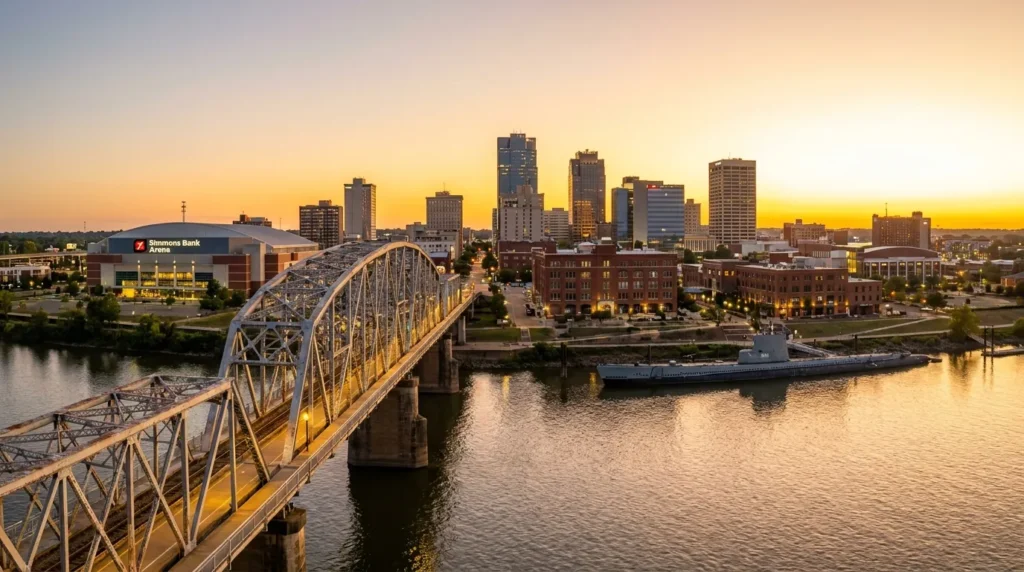
Twin city to Little Rock, separated by the Arkansas River, with the Argenta Arts District, the USS Razorback submarine, and an extensive network of riverfront parks.

The cultural heart of North Little Rock is the Argenta Arts District, centered along Main Street, featuring the Argenta Community Theater, galleries, restaurants, and the Argenta Farmers Market on Saturdays. The area has been revitalized over the past 15 years and has become a destination for younger residents across the metropolitan region.

The Arkansas Inland Maritime Museum, situated along the Arkansas River, houses the submarine USS Razorback, which served in both World War II and the Vietnam War, and is open for tours. The Old Mill in Lakewood is a replica historic gristmill that appeared in the opening sequence of Gone with the Wind and remains a classic backdrop for graduation photos.

The Big Dam Bridge, a 1.3 km pedestrian and cyclist-only span over the Arkansas River, connects the two cities and serves as the centerpiece of the 22 km Arkansas River Trail. Burns Park, one of the largest municipal parks in the United States, offers golf courses, trails, camping areas, and Burns Park Funland for children. Dickey-Stephens Park is home to the AA-affiliated Arkansas Travelers baseball team.

  1. 1["USS Razorback Submarine (Arkansas Inland Maritime Museum)"
  2. 2"Dickey-Stephens Park"
  3. 3"Argenta Arts District"
  4. 4"Old Mill (featured in Gone with the Wind)"
  5. 5"Burns Park"
  6. 6"Big Dam Bridge"
Nightlife4.0 / 10
Parks & green spaces
  • ["Burns Park"
  • "North Shore Riverwalk"
  • "Lakewood Park"
  • "Emerald Park"
  • "Cook's Landing Park"
  • +1 more

Latest posts

Posts about Arkansas

Coverage and updates related to this destination.

Showing content from Arkansas, as there is no specific data for North Little Rock yet.