Visto n' Visa
Blog
Notícias e artigos
Destinations
Careers
Immigrants

Want to live and work in Jonesboro?

Personalized immigration plan with eligible visas, costs, and next steps for your goal!

If you are not eligible, you will know exactly why and what to do to improve your approval chances.

Save up to 12 hours in meetings

No pointless assessments.

Save up to 90%

Save money on vague or unfocused consultations

Avoid Fraud and Mistakes

One mistake can cost you your visa

Total Impartiality

Zero commercial bias

Decide with peace of mind

No toxic urgency

Fast and Accurate

Answers in minutes, no guesswork

Jonesboro's Population: White majority with growing African American and Hispanic communities

A non-Hispanic White majority, with an African American population of around 20% and growing Hispanic and Asian communities over recent decades.

Jonesboro has a predominantly non-Hispanic White population (roughly two-thirds), with African Americans representing approximately 20%, and a growing Hispanic community, primarily of Mexican and Central American origin. There is also a smaller Asian community (Vietnamese, Chinese, Indian), largely connected to the university or hospital.

English is the primary language. Spanish is increasingly heard in grocery stores, churches, and some schools. The Brazilian presence is small, linked to professors and researchers at Arkansas State University or medical professionals. No identifiable Brazilian cluster exists in the city.

Religiously, Jonesboro is part of the Bible Belt, where Southern Baptists, Methodists, Pentecostals, and African American churches predominate. Catholicism has grown alongside the Hispanic community. There is also a historic synagogue (Temple Israel) and several Spanish-language evangelical congregations. The city leans more conservative than the northwestern part of the state.

Languages spoken
  • English
  • Spanish
  • Vietnamese (small community)
  • Indian (small Hindi/Telugu community)
  • Portuguese (small community)
Main religions
  • Christian, Baptist (predominant)
  • Christian, Methodist
  • Christian, Pentecostal
  • Christian, African American (AME, COGIC)
  • Catholic (growing with Hispanic population)
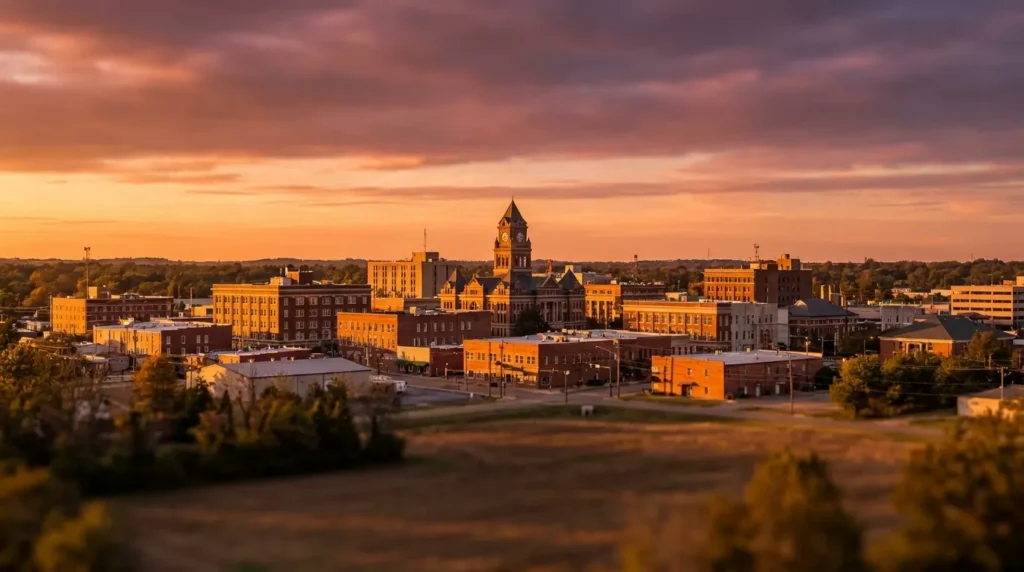
Cost of Living in Jonesboro: Very Low, Among the Most Affordable in the U.S.

Rent, housing, and food costs fall well below the national average. Wages are also lower, but families generally find the balance favorable.

Jonesboro is one of the most affordable cities to live in the United States. A one-bedroom apartment rents for between USD 600 and USD 900 per month, depending on the neighborhood. Homes for purchase are priced well below the national average, with mid-sized properties in established neighborhoods within reach for middle-class families.

Walmart, Kroger, Aldi, and Harps cover everyday grocery needs. Dining out is affordable, with meals at casual restaurants running USD 10 to USD 16, with a strong presence of barbecue, fast food, and some Mexican and Asian options. The Mall at Turtle Creek serves as the regional shopping center.

Arkansas has a state income tax (up to 4.4% as of 2024) and local sales tax of approximately 8.5% to 9%. Gasoline and electricity are inexpensive. Nearly everyone owns a car, and auto insurance is cheaper than in larger cities. Health insurance is typically provided through an employer. For families, total living costs are manageable on a modest income.

84Cost index (US = 100)16% below US average
CategorySingleCoupleFamily (2 + 2)
iHousing$1,098$1,267$1,605
iFood$321$642$1,165
iTransport$422$718$929
iHealthcare$236$473$887
iChildcare$1,538
iOther$718$1,292$1,816
Monthly total$2,795$4,392$7,940

Source: U.S. BLS Consumer Expenditure Survey 2023 + BEA Regional Price Parities 2023 · Estimates in USD, monthly.

Housing in Jonesboro: Single-Family Homes at Low Prices

Single-family homes with garages and yards predominate. Apartments are more common near the university and in newer developments to the west.

Like most mid-sized cities in the American South, Jonesboro is dominated by single-family homes. Traditional neighborhoods near downtown feature older brick and wood homes, tree-lined streets, and spacious yards. Sage Meadows and neighborhoods to the west of the city have newer subdivisions with modern three-to-four-bedroom homes at prices affordable by American standards.

Arkansas State University students tend to rent in apartment complexes near campus, such as Pinewood Crossing, The District at Jonesboro, and University Pointe. Caraway Road and Highland Drive are home to most of these developments. Established families tend to live in central neighborhoods and to the south, near well-regarded schools.

Renting typically requires a credit score, documented income of at least three times the monthly rent, and an application fee. Those arriving without a U.S. credit history often need a co-signer or a larger security deposit. Zillow, Apartments.com, and Realtor.com are the most widely used platforms, and some local real estate agencies assist newcomers.

Recommended neighborhoods
  • Sage Meadows (new subdivision, west side)
  • Valley View (well-regarded schools)
  • Hilltop (downtown, historic homes)
  • Caraway Road (near the university)
  • Brookland (neighboring town, homes with lots)
  • +1 more

Job Market in Jonesboro: Healthcare, University, and Industry

St. Bernards hospital, NEA Baptist, Arkansas State University, and manufacturers such as Nestlé and Hytrol drive employment. Agriculture and logistics also play significant roles.

The city's largest employer is the healthcare sector, with St. Bernards Medical Center and NEA Baptist Memorial Hospital employing thousands in medicine, nursing, technical, and administrative roles. Arkansas State University is the second-largest employer, with faculty, researchers, athletics staff (Red Wolves), and administrative services.

Jonesboro carries significant industrial weight. Nestlé operates one of its largest U.S. facilities in the city, producing Hot Pockets and Lean Cuisine. Hytrol (conveyor systems), Frito-Lay, and Riceland Foods (a rice cooperative based in Stuttgart with regional operations) also provide employment. Construction and logistics serve the region's growth.

Average salaries for skilled professionals range from USD 50,000 to USD 75,000, below major cities but in line with the local cost of living. Healthcare positions are the most consistently available. English is required for most administrative roles, with some opportunities for Spanish speakers on the factory floor.

Dominant sectors
  • Healthcare and hospitals
  • Higher education (Arkansas State University)
  • Food processing (Nestlé)
  • Manufacturing (Hytrol)
  • Agriculture (rice, soybeans, cotton)
  • +2 more
Major employers
  • St. Bernards Medical Center
  • NEA Baptist Memorial Hospital
  • Arkansas State University
  • Nestlé (Hot Pockets)
  • Hytrol Conveyor
  • +2 more

Education in Jonesboro: A Solid Public School District and Arkansas State University as the Anchor

Public schools vary by neighborhood. Valley View and Westside are well-regarded. Arkansas State University is the region's flagship institution.

Jonesboro Public Schools is the main district, with Valley View and Westside (in neighboring districts) among the highest-rated. Children of visa holders are entitled to free public education. There are also Christian private schools (Ridgefield Christian School) and charter schools such as the Academies at Jonesboro High School, which offers STEM and medical programs.

Arkansas State University, in Jonesboro, is the second-largest public university in the state. It has strong programs in agriculture, communication (College of Media and Communication), nursing, physical therapy, and business. The campus is large, with around 13,000 students, and attracts international students, many from India, Nigeria, and China. It has a campus in Querétaro, Mexico, an uncommon partnership.

For technical programs, Arkansas State University-Newport and ASU Mid-South offer associate degrees. International tuition at Arkansas State ranges from approximately USD 17,000 to USD 19,000 per year, among the lowest in the U.S. for public universities. Those pursuing medicine or law typically go to UAMS or Bowen Law in Little Rock, or to Memphis.

Notable universities
  • Arkansas State University (A-State)
  • Arkansas State University Newport
  • Williams Baptist University (Walnut Ridge, nearby)
  • Crowley's Ridge College (Paragould)

Healthcare in Jonesboro: The Primary Medical Hub of Northeastern Arkansas

The city is the medical reference point for the region. St. Bernards and NEA Baptist serve thousands and offer nearly full specialty coverage.

Jonesboro is the healthcare center of northeastern Arkansas. St. Bernards Medical Center, founded by a Catholic religious order in 1900, is the largest hospital, offering emergency care, maternity, oncology, and cardiac surgery. NEA Baptist Memorial Hospital, part of the Memphis-based Baptist Memorial network, is the second major facility, with a strong focus on cardiology and orthopedics.

For highly complex cases (transplants, severe trauma), patients are referred to Memphis (Methodist University Hospital, Le Bonheur Children's) or Little Rock (UAMS). Urgent care clinics are readily available along Caraway Road and Highland Drive. Community clinics and Mid-South Health Systems provide mental health services.

As throughout the U.S., the system is private and insurance-dependent. Without coverage, a standard visit costs between USD 100 and USD 200. Employer-provided health insurance is the norm. Arkansas State requires insurance for international students. Some services offer interpreters for Spanish speakers, but bilingual care is not as widely available as in larger cities.

Healthcare index58.0 / 100
  • Life expectancyyears at birth
    78.4yrs
  • Doctors per 1kpracticing physicians
    3.7
  • Health spendper capita, per year
    $13,473
  • Public systemoverall quality rating
    Fair

Safety in Jonesboro: Reasonable, with Typical Mid-Sized City Challenges

Violent crime is moderate, with property crime being more common. Newer western neighborhoods are quite safe; some central areas warrant attention.

Jonesboro has moderate crime rates by American standards. Violent crime is lower than in Little Rock but present. Property crime (theft, car break-ins, catalytic converter theft) is most common. Neighborhoods such as Sage Meadows, Valley View, and the newer subdivisions to the west are quite safe. Some parts of downtown and East Jonesboro warrant more caution, especially at night.

The police department (JPD) is well-trained, with visible patrols near Arkansas State's campus and the Mall at Turtle Creek. Typical college-town disturbances (alcohol-related incidents, bar fights) occur on weekends. Drunk driving is a persistent issue, and police conduct frequent checkpoints.

As throughout Arkansas, tornadoes can occur in spring. Jonesboro has warning sirens and well-established shelter protocols. In 1973, the city was devastated by an F4 tornado, and residents take weather alerts seriously. Newcomers should download the National Weather Service app and identify the safest interior room in their home.

5.8
Homicides per 100k
per year
Safety index
52.0
Crime index
48.0
Safer neighborhoods
  • Sage Meadows
  • Ridge Pointe
  • Valley View
  • Downtown near Arkansas State University
  • Greensborough Village
  • Hilltop
Areas to avoid
  • Sections of Nettleton Avenue late at night
  • Industrial areas north of downtown
  • West Jonesboro near railroad tracks after dark

Transportation in Jonesboro: A Car-Dependent City with a Limited Regional Airport

A car is practically essential. The local airport offers limited flights. Memphis, with its international airport, is 90 minutes away.

Jonesboro is a car-dependent city. The road network is straightforward, with Highway 63 and Highway 49 as the main corridors. Internal distances are short, with cross-city drives taking 15 to 20 minutes. Parking is abundant and inexpensive throughout the city. The Jonesboro Economical Transit System (JET) operates bus routes, but coverage is limited.

Jonesboro Municipal Airport (JBR) offers limited commercial flights, primarily to Dallas via SkyWest/American. Most flights depart from Memphis (MEM), a 90-minute drive away. Memphis offers direct flights to numerous U.S. cities and some international destinations (Cancun, Toronto), with broader international connections through Dallas, Atlanta, or Charlotte.

For those working at Nestlé, Hytrol, or hospitals, driving is the norm. Positions are available for those commuting from neighboring communities such as Brookland, Bono, or Paragould. Cycling is viable on some stretches of the city, but cycling infrastructure is limited. There is no active passenger rail service in the region.

17 min
Avg commute
28
Walkability
Airports
  • JBR, Jonesboro Municipal Airport
  • Bike infrastructure

What the climate is like living in Jonesboro

Jonesboro has a humid subtropical climate, with long, hot, and muggy summers, short winters with lows near freezing, and rainfall distributed fairly evenly throughout the year.

Summer runs long, from May through September, with highs between 88°F and 93°F and high humidity. Heat index values exceed 100°F in July, and afternoon thunderstorms are routine. Air conditioning runs nearly continuously indoors and in vehicles.

Winter is short, from December through February, with highs between 48°F and 54°F and lows between 27°F and 34°F. Snow falls a few times per season, and ice storms can leave the area without power for days. Central heating sees real use, though for a limited period.

The region sits in Tornado Alley, and spring brings genuine tornado risk in March, April, and May. Annual rainfall exceeds 51 inches. For residents, reliable air conditioning, functional heating, a backup generator, and an identified tornado shelter are practical necessities.

Sunny days / year215 days
Avg high (°F)
  • 50°J
  • 52°F
  • 62°M
  • 69°A
  • 79°M
  • 87°J
  • 91°J
  • 89°A
  • 84°S
  • 72°O
  • 60°N
  • 55°D
Avg low (°F)
  • 34°J
  • 34°F
  • 44°M
  • 51°A
  • 61°M
  • 69°J
  • 74°J
  • 72°A
  • 67°S
  • 55°O
  • 42°N
  • 39°D
Rainfall (")
  • 6"J
  • 6"F
  • 6"M
  • 5"A
  • 5"M
  • 4"J
  • 4"J
  • 4"A
  • 2"S
  • 5"O
  • 3"N
  • 3"D

Culture in Jonesboro: University Life, Sports, and Delta Tradition

Life revolves around the Arkansas State Red Wolves, the Mall at Turtle Creek, and Southern Delta culture. Music, church, and college football define the calendar.

Jonesboro's culture blends university life with the Southern Delta tradition. The Arkansas State Red Wolves play at Centennial Bank Stadium, drawing crowds from across the region each fall. College athletics define many Saturdays on campus, with tailgates and gatherings. The Foundation of Arts and the Forum Theater offer live theater and music downtown.

The cuisine is distinctly Southern, featuring rib and brisket barbecue, fried catfish, ribs, and biscuits with gravy. Restaurants such as Demo's Cantina, Skinny J's, and Native Brewing Company are part of the local routine. There are also solid Mexican and some Asian options, reflecting the growth of immigrant communities.

The calendar includes the NEA District Fair in September (a regional fair with livestock, rodeo, and concerts), the JoBoro Festival in the fall, and university events. The Delta region has a strong blues and gospel tradition, and Jonesboro is near Helena (home of the King Biscuit festival) and Memphis. Hunting and fishing are popular in the surrounding area, with destinations such as Crowley's Ridge State Park and the St. Francis River.

Jonesboro

Attractions in Jonesboro, regional hub of Northeast Arkansas

Jonesboro revolves around the Arkansas State University campus, the Forum Theater in the historic downtown, and Crowley's Ridge State Park, with daily life anchored in college sports and municipal parks.

Arkansas State University, with Centennial Bank Stadium and First National Bank Arena, shapes much of the city's calendar. Red Wolves football and basketball games fill hotels and restaurants on weekends. Near campus, the Bradbury Art Museum and Fowler Center offer visual arts and performing arts programming open to the public.

Downtown, Main Street has reclaimed historic buildings and hosts the Forum Theater (built 1925, restored), restaurants, and cafes. The Downtown Jonesboro Alliance organizes Concerts on the Square and Jonesboro Pridefest. The Jonesboro Municipal Center consolidates city services, and the Northeast Arkansas Regional Library serves as a community hub.

For outdoor recreation, Crowley's Ridge State Park, 30 minutes away, is a destination for trails cutting through the only significant geographical elevation in the Delta. Within the city, Craighead Forest Park offers a lake, trails, and camping. Joe Mack Campbell Park focuses on youth sports. Each October, the NEA District Fair in Jonesboro is the largest fair in northeast Arkansas.

  1. 1["Arkansas State University Museum"
  2. 2"Craighead Forest Park"
  3. 3"Forum Theater"
  4. 4"Foundation of Arts"
  5. 5"Arkansas State University campus"
  6. 6"Downtown Jonesboro historic district"
Nightlife4.0 / 10
Parks & green spaces
  • ["Craighead Forest Park"
  • "Joe Mack Campbell Park"
  • "Allen Park"
  • "Miracle League Park"
  • "Earl Bell Community Center grounds"
  • +1 more

Latest posts

Posts about Arkansas

Coverage and updates related to this destination.

Showing content from Arkansas, as there is no specific data for Jonesboro yet.