Visto n' Visa
Blog
Notícias e artigos
Destinations
Careers
Immigrants

Want to live and work in Hot Springs?

Personalized immigration plan with eligible visas, costs, and next steps for your goal!

If you are not eligible, you will know exactly why and what to do to improve your approval chances.

Save up to 12 hours in meetings

No pointless assessments.

Save up to 90%

Save money on vague or unfocused consultations

Avoid Fraud and Mistakes

One mistake can cost you your visa

Total Impartiality

Zero commercial bias

Decide with peace of mind

No toxic urgency

Fast and Accurate

Answers in minutes, no guesswork

Hot Springs population: white majority, with growing numbers of retirees and tourists

Primarily non-Hispanic white, with an African American community, a Hispanic population, and a significant share of retirees drawn by the resort atmosphere.

Hot Springs has a predominantly non-Hispanic white population (around 70%), with an African American community representing approximately 15% and a growing Hispanic population (Mexican and Central American). There is a notable share of retirees, drawn by the mild climate, low cost of living, and small-town atmosphere with resort-level amenities.

English is the primary language, with Spanish increasingly present in grocery stores and restaurants. A small community tied primarily to healthcare professionals and the Oaklawn Racing Casino Resort also exists. No identifiable cluster is present locally, but online groups based in Little Rock and northwest Arkansas provide community support.

Religiously, Baptists, Methodists, Pentecostals, and Catholics predominate. Spanish-language evangelical churches are also present. The city has a more moderate and tourist-oriented profile than other rural parts of Arkansas, with residents arriving from outside the state in search of retirement or self-employment in hospitality.

Languages spoken
  • English
  • Spanish
  • Portuguese (small community)
  • Vietnamese (small)
Main religions
  • Baptist Christian
  • Methodist Christian
  • Pentecostal Christian
  • Catholic
  • Various evangelical Christian

Cost of living in Hot Springs: low, attractive for retirees

Rent, housing, and food are below the American average. Wages are also low, but for retirees or remote workers the equation is favorable.

Hot Springs is one of the more affordable cities to live in the United States. A one-bedroom apartment rents for between USD 700 and USD 1,000 per month. Homes for purchase are priced well below the national average, with newer properties available in neighborhoods such as Hot Springs Village (the largest gated retirement community in the country) and along the shores of Lake Hamilton.

Grocery stores including Walmart, Kroger, Aldi, and Harps cover the basics. Dining out is reasonably affordable: a meal at a casual restaurant runs USD 12 to USD 20. There is a solid range of barbecue, fried catfish, Italian, Asian, and some gourmet options aimed at tourists along the historic downtown (Central Avenue).

Arkansas has a state income tax (up to 4.4%) and a local sales tax of around 9.5%. Gasoline and electricity are inexpensive. Employer-provided health insurance is the standard for those who work. For retirees with Social Security income or remote workers, the cost of living is quite manageable, which is why Hot Springs frequently appears in rankings of the best cities for retirement.

Hot Springs

Housing in Hot Springs: lakeside homes and the Hot Springs Village community

Homes near Lake Hamilton and Lake Ouachita are popular. Hot Springs Village, a gated retirement community, is a national reference.

Hot Springs offers diverse housing options. Homes around Lake Hamilton, with water access and private docks, are highly sought after, especially by retirees. Lake Ouachita, larger and more natural, has properties along less developed shorelines. Neighborhoods such as Park Avenue, Whittington Avenue, and the western part of the city offer traditional homes on tree-lined streets.

Hot Springs Village, 30 minutes from downtown, is one of the largest gated retirement communities in the United States, with 11 golf courses, 11 lakes, 26,000 residents, and full infrastructure including a medical center, grocery stores, and restaurants. Homes there are a popular choice for those seeking security, activities, and a permanent resort atmosphere.

The historic downtown (Central Avenue and adjacent streets) features Victorian buildings, some converted into lofts and bed-and-breakfasts. Areas such as the eastern part of the city have more affordable homes. Renting typically requires a credit score, proof of income at three times the monthly rent, and an application fee. Zillow and Realtor.com are the most widely used platforms, with local agencies such as Coldwell Banker RPM serving the market.

Recommended neighborhoods
  • Lake Hamilton (waterfront homes, retirees)
  • Hot Springs Village (gated retirement community)
  • Park Avenue (established residential)
  • Central Avenue downtown (lofts in historic buildings)
  • Lakeside (homes near Lakeside school)
  • +1 more

Job market in Hot Springs: tourism, healthcare, gaming, and hospitality

Oaklawn Racing Casino, CHI St. Vincent and National Park Medical Center hospitals, hotels, and tourist restaurants are the main employers. Wages are modest.

Hot Springs's economy revolves around tourism and entertainment. Oaklawn Racing Casino Resort, with its historic thoroughbred racetrack and full casino, is the city's largest employer, with positions in dealing, hotel operations, security, food service, and administration. The racing season (January through April) drives seasonal employment.

Healthcare is a stable sector, with CHI St. Vincent Hot Springs and National Park Medical Center as the leading hospitals. Levi Hospital, part of the CHI network, rounds out the offering. Historic hotels such as the Arlington and Embassy Suites, along with hundreds of restaurants and tourist shops downtown, provide hospitality employment.

Average wages are low, reflecting the hospitality and service economy. Positions in construction, hospitality, and customer service are accessible for those starting out. English is required for most roles, with some bilingual opportunities in hospitality. The large retiree population also sustains demand for home care and elder-care employment.

Dominant sectors
  • Tourism and hospitality
  • Gaming (Oaklawn Racing Casino)
  • Regional healthcare
  • Restaurants and tourist retail
  • Elder care and home assistance
  • +2 more
Major employers
  • Oaklawn Racing Casino Resort
  • CHI St. Vincent Hot Springs
  • National Park Medical Center
  • Levi Hospital
  • Hot Springs Village (gated community)
  • +2 more

Education in Hot Springs: multiple public districts and National Park College

Several districts serve the area. Lakeside and Lake Hamilton are well regarded. National Park College offers technical programs and associate degrees.

Hot Springs and its surroundings are served by several school districts. Hot Springs School District covers the urban core, with Lakeside School District, Lake Hamilton School District, Cutter-Morning Star, and Fountain Lake serving the surrounding areas. Lakeside and Lake Hamilton tend to receive higher ratings than the central district. Children of holders of a valid visa are entitled to free public school enrollment.

Private schools include Cutter Morning Star Christian Academy and Saint John's Catholic School. For higher education, National Park College in Hot Springs offers technical programs, associate degrees, and transfer partnerships for bachelor's degrees. Programs in nursing, hospitality, and health technology are in demand.

For a full university experience, UALR and UAMS in Little Rock are 1 hour away, and Henderson State University in Arkadelphia is 30 minutes. The University of Arkansas in Fayetteville is 4 hours away. Tuition at National Park College is low, around USD 5,000 to USD 7,000 per year for in-state students and USD 8,000 to USD 10,000 for international students.

Notable universities
  • National Park College (Hot Springs)
  • Henderson State University (Arkadelphia, 30 min)
  • Ouachita Baptist University (Arkadelphia, 30 min)
  • University of Arkansas at Little Rock (1 hour)

Healthcare in Hot Springs: solid regional hospitals for the city's size

CHI St. Vincent Hot Springs and National Park Medical Center serve the region. For complex cases, Little Rock is 1 hour away.

The main hospitals in Hot Springs are CHI St. Vincent Hot Springs and National Park Medical Center, offering emergency care, maternity, cardiology, orthopedics, and various specialties. Levi Hospital, part of the CHI network, focuses on rehabilitation. For complex cases such as rare cancers, transplants, and pediatric neurology, patients travel to Little Rock.

Urgent care clinics are easy to find along Central Avenue and Highway 7. There is also a solid supply of private medical offices, physical therapy clinics (driven by demand from the retiree population), dentists, and ophthalmologists. Telemedicine has grown significantly and covers a large share of routine consultations, a convenience for residents in outlying areas such as Hot Springs Village.

As throughout the United States, the system is private and dependent on health insurance. Retirees are covered by Medicare from age 65, which makes the city attractive to that demographic. Without coverage, a standard consultation costs USD 100 to USD 250. Employer-provided health insurance is the norm for those who work. Visitors and those arriving on a short-term basis should carry travel insurance.

Healthcare index58.0 / 100
  • Life expectancyyears at birth
    78.4yrs
  • Doctors per 1kpracticing physicians
    3.7
  • Health spendper capita, per year
    $13,473
  • Public systemoverall quality rating
    Fair

Safety in Hot Springs: reasonably safe, with typical tourist precautions

The city is safe in most areas. The tourist center sees typical petty theft. Neighborhoods such as Hot Springs Village and Lake Hamilton are very quiet.

Hot Springs is considered reasonably safe by American standards. Violent crime is moderate, and most incidents in the statistics involve theft, vehicle break-ins, and property crime, frequently in tourist parking areas. Residential neighborhoods such as Hot Springs Village, Lake Hamilton, and Park Avenue are very quiet. The historic downtown and certain areas warrant more attention at night.

The local police department (HSPD) patrols tourist areas including the national park, Bathhouse Row, Central Avenue, and the Oaklawn Casino. Disorderly conduct in bars, excessive alcohol, and drunk driving are the most common incidents, particularly on race weekends at the track. Pickpocketing in tourist crowds warrants the same attention as in any visitor-oriented city.

As throughout Arkansas, tornadoes can occur between March and May, although the area is less vulnerable than the Delta region. The city has warning sirens. Wildfires are an occasional concern in the Ouachita Mountains, and residents in more remote areas should have an evacuation plan. Arrivals are advised to download the National Weather Service app.

5.8
Homicides per 100k
per year
Safety index
46.0
Crime index
54.0
Safer neighborhoods
  • Hot Springs Village
  • Lake Hamilton area
  • Park Avenue district
  • Whittington Park area
  • Country Club Estates
  • Bathhouse Row historic district
Areas to avoid
  • Stretches of Malvern Avenue after dark
  • Areas near Higdon Ferry Road late at night
  • Isolated parking lots of older motels

Transportation in Hot Springs: car-dependent city with a small airport

A car is the norm. Highway 70 reaches Little Rock in 1 hour. Memorial Field Airport has limited flights; LIT in Little Rock serves most travelers.

Hot Springs is a car-dependent city with no robust public transit. Highway 70 and Highway 270 connect the city to Little Rock (1 hour east) and Texarkana (2 hours west). Highway 7 heads north through the Ouachita Mountains. Internal distances are short, with 10 to 15 minutes sufficient to cross the city. Parking is easy to find.

Memorial Field Airport (HOT) serves private aviation and a limited number of commercial flights. Most flights depart from Clinton National Airport (LIT) in Little Rock, 1 hour away, with direct connections to Dallas, Atlanta, Charlotte, Chicago, Houston, and Denver. For international travel, a connection through Dallas suffices. Hot Springs Intracity Transit provides local bus service with modest coverage.

Cycling works on certain routes, particularly on trails within Hot Springs National Park and dedicated paths. Northwoods Trails, with 80 km of mountain biking trails, is 10 minutes from downtown. For daily life, however, a car remains the standard. No active passenger rail service exists in the area.

18 min
Avg commute
36
Walkability
Airports
  • HOT — Memorial Field Airport
  • Bike infrastructure

What the climate is like living in Hot Springs

Hot Springs has a humid subtropical climate in the Ouachitas, with long, hot summers, short winters with lows near freezing, and rainfall spread fairly evenly throughout the year.

Summer runs long, from May through September, with highs between 88°F and 93°F and high humidity. Heat index values exceed 100°F in July, and afternoon thunderstorms are common. Air conditioning runs nearly continuously indoors and in vehicles.

Winter is short and relatively mild, from December through February, with highs between 50°F and 55°F and lows between 28°F and 36°F. Snowfall is infrequent, with annual accumulations around 4 inches. A mid-weight coat and functional heating are sufficient.

The area sits within Tornado Alley, and spring brings real tornado risk in March, April, and May. Annual rainfall exceeds 55 inches. Fall and spring are the most comfortable seasons. For long-term residents, reliable air conditioning, basic heating, and an identified tornado shelter are practical necessities.

Sunny days / year218 days
Avg high (°F)
  • 53°J
  • 55°F
  • 65°M
  • 70°A
  • 79°M
  • 88°J
  • 91°J
  • 91°A
  • 87°S
  • 74°O
  • 62°N
  • 57°D
Avg low (°F)
  • 36°J
  • 37°F
  • 45°M
  • 51°A
  • 61°M
  • 69°J
  • 74°J
  • 73°A
  • 68°S
  • 56°O
  • 44°N
  • 41°D
Rainfall (")
  • 6"J
  • 6"F
  • 7"M
  • 6"A
  • 5"M
  • 4"J
  • 4"J
  • 3"A
  • 3"S
  • 4"O
  • 3"N
  • 4"D

Culture of Hot Springs: spas, horse racing, art, and Prohibition-era gangsters

The city has a historic bathhouse row, the Oaklawn racetrack, art and history museums, and a Prohibition-era gangster legacy. The documentary film festival is a regional highlight.

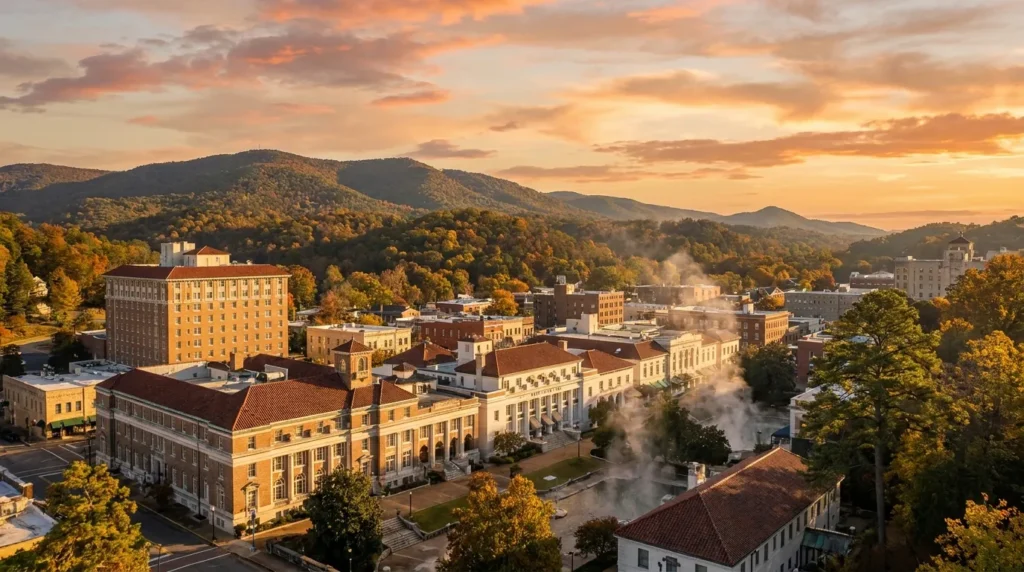
Bathhouse Row, inside Hot Springs National Park, is the cultural heart of the city. The eight historic bathhouses (Buckstaff, Quapaw, Fordyce, and others) evoke the elegant spa era of the early 20th century. Some still offer thermal baths today. Hot Springs National Park is the smallest national park in the United States and the only one embedded within an urban center.

Oaklawn Racing Casino Resort holds a thoroughbred horse racing season from January through April, with the Arkansas Derby as the marquee event. The Prohibition-era gangster history (Al Capone is said to have stayed at the Arlington Hotel) is part of local lore, documented at the Gangster Museum of America. Events such as the Hot Springs Documentary Film Festival are regional highlights.

The dining scene offers solid variety for the city's size: Italian at Belle Arti, fried catfish at McClard's Bar-B-Q (a regional institution since 1928), Southern comfort food, Asian, and Mexican cuisine. Art galleries along Central Avenue, particularly during the monthly Gallery Walk, form another cultural pillar. The nearby lakes for water skiing, bass fishing, and trout fishing are central to outdoor life.

Hot Springs

What to do in Hot Springs, Arkansas's spa city

A small city in the Ouachita Mountains built around natural thermal springs, featuring a unique urban national park, a historic racetrack, and Bathhouse Row, designated a National Historic Landmark.

The centerpiece is Hot Springs National Park, the only national park located within an urban downtown. Bathhouse Row, along Central Avenue, lines up eight early-20th-century thermal bathhouses, with the Buckstaff and Quapaw still in operation and the Fordyce converted into a visitor center.

The Mid-America Science Museum, the Arkansas Alligator Farm and Petting Zoo, and Garvan Woodland Gardens round out family outings. Racing enthusiasts head to Oaklawn Racing Casino Resort, the region's premier racetrack, with a season running January through May.

For outdoor recreation, Lake Hamilton and Lake Ouachita offer boating and fishing. Hot Springs Mountain Tower provides a panoramic view of the region, while the Hot Springs Mountain Trail and Sunset Trail are the most popular day hikes among local residents.

  1. 1["Hot Springs National Park"
  2. 2"Bathhouse Row (Buckstaff and Quapaw in operation)"
  3. 3"Hot Springs Mountain Tower"
  4. 4"Oaklawn Racing Casino Resort"
  5. 5"Magic Springs Theme and Water Park"
  6. 6"Garvan Woodland Gardens"
Nightlife5.0 / 10
Parks & green spaces
  • ["Hot Springs National Park"
  • "Garvan Woodland Gardens"
  • "Lake Catherine State Park"
  • "Lake Ouachita State Park"
  • "Whittington Park"
  • +1 more

Latest posts

Posts about Arkansas

Coverage and updates related to this destination.

Showing content from Arkansas, as there is no specific data for Hot Springs yet.