Visto n' Visa
Blog
Notícias e artigos
Destinations
Careers
Immigrants

Want to live and work in Fayetteville?

Personalized immigration plan with eligible visas, costs, and next steps for your goal!

If you are not eligible, you will know exactly why and what to do to improve your approval chances.

Save up to 12 hours in meetings

No pointless assessments.

Save up to 90%

Save money on vague or unfocused consultations

Avoid Fraud and Mistakes

One mistake can cost you your visa

Total Impartiality

Zero commercial bias

Decide with peace of mind

No toxic urgency

Fast and Accurate

Answers in minutes, no guesswork

Fayetteville's population: young, majority white, with growing Hispanic and Marshallese communities

The population is predominantly non-Hispanic white, with a strong presence of students and transferred professionals. Hispanic and Marshallese communities have grown through employment in Springdale.

Fayetteville's population is predominantly non-Hispanic white, with a significant Hispanic presence (Mexican and Central American) and Marshallese residents from the Marshall Islands. The Marshallese community is concentrated mainly in nearby Springdale but also present in Fayetteville. The median age is low because of the University of Arkansas student population.

English is the primary language, with Spanish widely used in grocery stores, churches, and schools. Marshallese is spoken in some public schools in the region. The Brazilian community in Northwest Arkansas is small but present, connected mainly to university researchers and suppliers at the Walmart and Tyson headquarters. There is no Portuguese-language grocery store or church in the city, though community groups exist in Bentonville.

Religiously, the region is part of the Bible Belt: Baptists, Methodists, and Pentecostals predominate. Catholics are also present and growing with the Hispanic community, alongside an Orthodox church and small Buddhist temples. The city has a more liberal and diverse profile than other parts of Arkansas, driven by the university.

Languages spoken
  • English
  • Spanish
  • Marshallese (metropolitan area)
  • Vietnamese (small community)
  • Portuguese (small Brazilian community)
Main religions
  • Baptist Christian
  • Methodist Christian
  • Pentecostal Christian
  • Catholic (growing with Hispanic community)
  • Non-religious (high among university students)
Cost of living in Fayetteville: low, but rising with the northwest Arkansas boom

Rent and home prices remain accessible by American standards, but costs have climbed in recent years due to growth driven by Walmart and Tyson.

Fayetteville is affordable by American standards, though significantly more expensive than a decade ago. A one-bedroom apartment rents for between USD 900 and USD 1,300 near campus or downtown, with higher prices in newer developments. Homes for purchase vary widely: smaller properties in East Fayetteville remain reasonably priced, while Mount Sequoyah and Wilson Park command higher values.

Grocery stores including Walmart, Aldi, Harps, and Whole Foods cover everyday needs. The Fayetteville Farmers' Market, held downtown, is one of the largest in the South, with local vendors every Saturday in spring and summer. Dining out is affordable: a meal at a casual restaurant runs USD 12 to USD 18, with a strong selection of Mexican, Asian, and barbecue options.

Arkansas imposes a state income tax (up to 4.4% in 2024) and sales tax totaling approximately 9.75% within the city. Gasoline is inexpensive, as is electricity. Health insurance is typically provided through an employer. Those working at Walmart, Tyson, or JB Hunt headquarters generally receive full benefit packages.

84Cost index (US = 100)16% below US average
CategorySingleCoupleFamily (2 + 2)
iHousing$1,098$1,267$1,605
iFood$321$642$1,165
iTransport$422$718$929
iHealthcare$236$473$887
iChildcare$1,538
iOther$718$1,292$1,816
Monthly total$2,795$4,392$7,940

Source: U.S. BLS Consumer Expenditure Survey 2023 + BEA Regional Price Parities 2023 · Estimates in USD, monthly.

Housing in Fayetteville: hillside homes and apartments near campus

Students rent apartments near the university. Families look for homes in neighborhoods such as Mount Sequoyah, Wilson Park, and the southern part of the city.

University of Arkansas students tend to cluster in apartments near campus, along Dickson Street, Maple Street, and in complexes such as The District at Campus West and The Cardinal. These options typically include pools, fitness centers, and campus bus service at the door.

For families, neighborhoods such as Wilson Park, Mount Sequoyah (with views over the city), and Old Town feature traditional brick and wood homes, tree-lined streets, and yards. South Fayetteville and neighborhoods like Walker Park blend older homes with developing areas. The Fayetteville Public Schools district is highly rated, which supports both rental and purchase prices.

Further south, near Greenland and West Fork, larger lots and more affordable homes are available. Springdale and Farmington are worth considering for those working at Tyson. Rental applications generally require a credit score, income verification, and an application fee. Zillow, Apartments.com, and the local UATenants resource help students find housing.

Recommended neighborhoods
  • Wilson Park (families, park, near downtown)
  • Mount Sequoyah (views, historic homes)
  • Old Town (downtown, walkable)
  • South Fayetteville (quiet streets, smaller homes)
  • East Fayetteville (better prices)
  • +2 more

Job market in Fayetteville: university, retail, transportation, and technology

The University of Arkansas and suppliers for the Walmart, Tyson, and JB Hunt headquarters drive employment. Technology and regional healthcare also play significant roles.

The University of Arkansas is the city's largest employer, with more than 15,000 people working in faculty positions, research, athletics, and services. Positions are consistently available in teaching, research, IT, library services, maintenance, and administration. The Washington Regional Medical Center health system rounds out healthcare employment.

More significant for the broader Fayetteville area is the Northwest Arkansas metropolitan region. The Walmart headquarters in Bentonville, Tyson Foods in Springdale, and JB Hunt in Lowell have created a large ecosystem of suppliers, marketing agencies, consultancies, and technology offices. Many professionals choose to live in Fayetteville for its university character and commute 20 to 40 minutes to work.

Average salaries for qualified professionals range from USD 60,000 to USD 95,000, with senior positions at Walmart Tech and Tyson IT reaching USD 130,000 or more. High-growth sectors include data science (supported by the Walmart Innovation campus), engineering, and supply chain. Remote work is also common among those relocated from other regions.

Dominant sectors
  • University and research
  • Retail (Walmart ecosystem)
  • Food processing (Tyson)
  • Transportation and logistics (JB Hunt)
  • Technology and data
  • +2 more
Major employers
  • University of Arkansas (main campus)
  • Walmart (headquarters in nearby Bentonville)
  • Tyson Foods (headquarters in Springdale)
  • JB Hunt Transport (Lowell)
  • Washington Regional Medical Center
  • +2 more

Education in Fayetteville: a strong public school district and the University of Arkansas as its engine

Fayetteville public schools are highly rated. The state flagship university is home to programs in business, engineering, agriculture, and architecture.

The Fayetteville Public Schools district is considered one of the best in Arkansas, with Fayetteville High School ranking well in state evaluations. Children of valid visa holders are entitled to free public schooling. Private options include The New School and Haas Hall Academy (a charter school), among the top charter schools in the state.

The University of Arkansas, founded in 1871, is the state flagship. It has well-regarded programs in engineering, agriculture, architecture, computer science, and the Sam M. Walton College of Business, endowed by the Walton family. The J. William Fulbright College of Arts and Sciences is the largest college on campus. Approximately 32,000 students are enrolled, including thousands of international students.

Northwest Arkansas Community College, in Bentonville, offers technical and associate degree programs. The region also includes John Brown University in Siloam Springs, a well-regarded private Christian college. Tuition at the University of Arkansas for international students is approximately USD 27,000 to USD 30,000 per year, below most large public universities.

Notable universities
  • University of Arkansas (Fayetteville)
  • Sam M. Walton College of Business
  • Fay Jones School of Architecture and Design
  • Northwest Arkansas Community College (Bentonville)
  • John Brown University (Siloam Springs)

Healthcare in Fayetteville: solid regional hospitals and university clinics

The city has a regional hospital and multiple clinics. Complex cases are referred to UAMS in Little Rock or to Tulsa.

The primary hospital is Washington Regional Medical Center, with an emergency department, maternity ward, and specialized clinics. Together with Mercy Hospital Northwest Arkansas in Rogers, it serves the region. The Veterans Health Care System of the Ozarks serves veterans. The university maintains student health services at the Pat Walker Health Center.

For complex cases such as rare cancers, transplants, or specialized pediatric surgery, patients are typically referred to UAMS in Little Rock or to Tulsa, Oklahoma. Urgent care clinics are easy to find, particularly along Joyce Boulevard and College Avenue. Dental, vision, and physical therapy coverage generally comes through private insurance plans.

As throughout the United States, the healthcare system is private and insurance-dependent. Without coverage, office visits cost USD 150 to USD 300, and an emergency room visit can exceed USD 1,500. International students are required to carry insurance through the university, and those employed at Walmart, Tyson, or the University of Arkansas typically receive employer-sponsored plans.

Healthcare index60.0 / 100
  • Life expectancyyears at birth
    78.4yrs
  • Doctors per 1kpracticing physicians
    3.7
  • Health spendper capita, per year
    $13,473
  • Public systemoverall quality rating
    Fair

Safety in Fayetteville: calm, with typical university city concerns

The city is considered safe. Main concerns include alcohol-related incidents on Dickson Street, bicycle theft, and car break-ins in parking lots.

Fayetteville is considered one of the safest cities in Arkansas and ranks well in national quality-of-life surveys. Violent crime is rare, and residents walk at night in the downtown and traditional neighborhoods without significant concern. The Fayetteville Police Department (FPD) and the University of Arkansas Police Department (UAPD) patrol the campus area.

The main issues are typical of a university city: disorder on game nights, alcohol-related incidents on Dickson Street, occasional bar altercations, and impaired driving. Bicycle theft on campus and car break-ins in parking lots also occur. Bikes should be secured with a U-lock, and valuables should not be left visible in vehicles.

On football Saturdays, the city fills up and traffic becomes difficult near the stadium. Those not attending games are advised to avoid stadium-adjacent streets. As in much of the South, tornadoes can occur in spring; the city has warning sirens, and most homes have an interior room designated as a storm shelter.

5.8
Homicides per 100k
per year
Safety index
64.0
Crime index
36.0
Safer neighborhoods
  • Wilson Park
  • Mount Sequoyah
  • Historic downtown around the Square
  • South Fayetteville (Walker Park)
  • East Fayetteville
  • Markham Hill
Areas to avoid
  • Sections of Highway 71B late at night
  • Isolated areas of College Avenue after dark
  • Parking lots near bars on weekends

Transportation in Fayetteville: walkable downtown, but car-dependent beyond it

Downtown and campus are walkable. Elsewhere, a car is essential. University bus service and the regional XNA airport in Highfill round out the options.

Downtown Fayetteville and the University of Arkansas campus are walkable, with Dickson Street, the square, and Wilson Park all in close proximity. Students typically walk or bike within this area. The city has invested in cycling infrastructure, and the Razorback Greenway, a 37-mile paved path connecting Fayetteville to Bentonville, is a regional landmark.

Beyond the core, a car is essentially required. Interstate 49 runs through the metropolitan area, linking Fayetteville to Springdale, Rogers, and Bentonville in 30 to 40 minutes. The Razorback Transit system provides free bus service focused on the campus area, and Ozark Regional Transit covers some urban routes, though service remains limited.

Northwest Arkansas Regional Airport (XNA), in Highfill, about 30 minutes from Fayetteville, offers direct flights to Dallas, Atlanta, Chicago, Denver, Houston, Los Angeles, New York, and other U.S. cities. Seasonal and limited international flights are available. For most international travel, a connection through Dallas or Atlanta is the standard option.

19 min
Avg commute
38
Walkability
Airports
  • XNA — Northwest Arkansas National Airport
  • International airport
  • Bike infrastructure

What the climate is like living in Fayetteville

Fayetteville has a humid subtropical climate in the Ozarks, with hot and humid summers, short cold winters with light snow, and four well-defined seasons.

Summer runs long, from May through September, with highs between 86°F and 91°F and high humidity. Heat index readings can exceed 99°F in July, and afternoon thunderstorms are common. Air conditioning runs nearly continuously indoors and in vehicles.

Winter is short but requires real heating, from December through February, with highs between 45°F and 50°F and lows between 23°F and 30°F. Snow falls on several days each season, with typical accumulations around 8 inches. A mid-weight coat, central heating, and caution on icy roads are part of the routine.

The area sits within Tornado Alley, and spring brings a real risk of tornadoes in March, April, and May. Annual rainfall exceeds 47 inches. Fall and spring are the most comfortable seasons. For those living here, reliable air conditioning, functional heating, and a identified tornado shelter are practical necessities.

Sunny days / year220 days
Avg high (°F)
  • 48°J
  • 51°F
  • 61°M
  • 67°A
  • 75°M
  • 85°J
  • 90°J
  • 88°A
  • 84°S
  • 70°O
  • 59°N
  • 53°D
Avg low (°F)
  • 32°J
  • 31°F
  • 42°M
  • 48°A
  • 58°M
  • 66°J
  • 71°J
  • 70°A
  • 65°S
  • 53°O
  • 41°N
  • 37°D
Rainfall (")
  • 4"J
  • 3"F
  • 5"M
  • 5"A
  • 6"M
  • 4"J
  • 3"J
  • 5"A
  • 3"S
  • 6"O
  • 3"N
  • 3"D

Culture in Fayetteville: Razorbacks, Dickson Street, and outdoor life in the Ozarks

A city defined by college football, live music, farm-to-table dining, and trails in the Ozark mountains.

Fayetteville's cultural identity centers on the Razorbacks. On fall Saturdays, Donald W. Reynolds Razorback Stadium draws more than 75,000 fans to SEC football games. The Wooo Pig Sooie call can be heard across the city. Baseball and basketball also attract strong followings.

Dickson Street anchors the nightlife, with venues such as George's Majestic Lounge (live music since 1927) and JJ's Live. The farm-to-table movement is well established, with restaurants including Hugo's, Tusk and Trotter, and Bordinos serving locally sourced menus. The Fayetteville Farmers' Market is a Saturday institution.

Outdoor life is a major draw. Trails at Mount Sequoyah, Lake Fayetteville, and in the Ozarks (Devil's Den State Park, about 30 minutes away) are part of everyday routines. Mountain biking in the region has grown substantially through investment from Bentonville, and Fayetteville is a stop on the international trail circuit. Events such as Bikes, Blues & BBQ in the fall draw motorcycle enthusiasts from across the country.

Fayetteville

Fayetteville in northwest Arkansas: university life, trails, and live music

A college town in northwest Arkansas anchored by the University of Arkansas, with an active cultural scene, nationally recognized mountain biking, and proximity to Bentonville and Crystal Bridges.

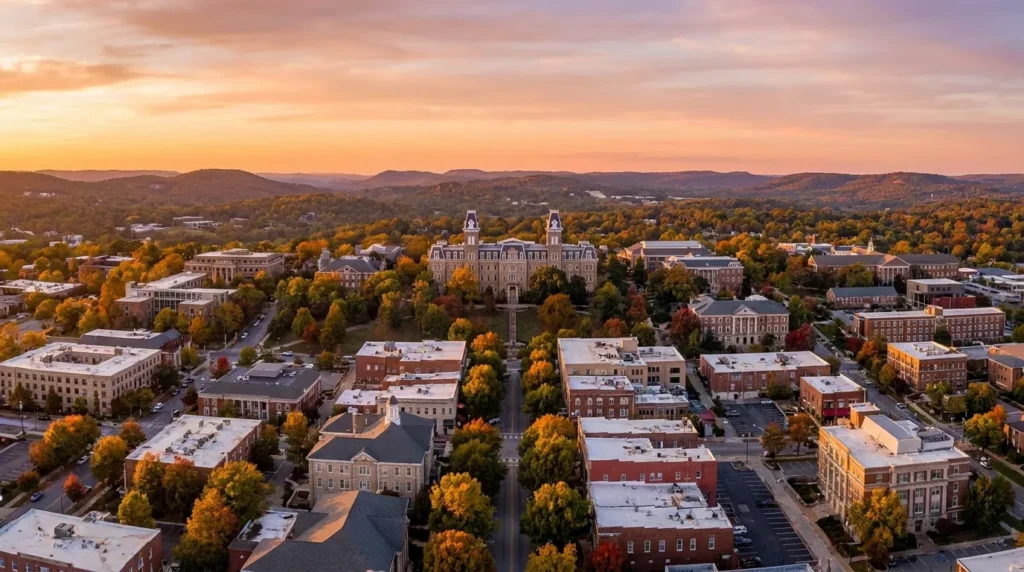
Fayetteville is the largest city in northwest Arkansas and revolves around the University of Arkansas, whose hilltop campus dominates the downtown skyline. Daily life unfolds along Dickson Street, a corridor of bars, restaurants, and the historic Walton Arts Center, as well as around Fayetteville Square, home to a well-known Saturday farmers market. The feel is that of a mid-size city that grew quickly, with neighborhoods like Wilson Park, Mount Sequoyah, and East Fayetteville.

The outdoor scene is strong. The region is part of OZ Trails, a network that has established northwest Arkansas as one of the premier mountain biking destinations in the United States. Mount Kessler, Centennial Park, and Lake Fayetteville offer cross-country, downhill, and pump track riding. The Razorback Greenway, a 36-mile paved trail, connects Fayetteville to Bella Vista through Springdale, Rogers, and Bentonville.

The city has a solid live music scene, with festivals including Fayetteville Roots and Block Street Block Party. The Crystal Bridges Museum of American Art in Bentonville is about 45 minutes away. Eureka Springs, a Victorian-style town in the Ozarks, makes for a good weekend trip. For larger wilderness, Buffalo National River and Devil's Den State Park are within day-trip distance.

  1. 1["University of Arkansas (historic campus)"
  2. 2"Fayetteville Square and Farmers Market"
  3. 3"Walton Arts Center"
  4. 4"Crystal Bridges Museum (nearby
  5. 5Bentonville)"
  6. 6"Dickson Street"
Nightlife6.0 / 10
Parks & green spaces
  • ["Wilson Park"
  • "Lake Fayetteville Park"
  • "Mount Sequoyah"
  • "Gulley Park"
  • "Mount Kessler Regional Park"
  • +1 more

Latest posts

Posts about Arkansas

Coverage and updates related to this destination.

Showing content from Arkansas, as there is no specific data for Fayetteville yet.