Visto n' Visa
Blog
Notícias e artigos
Destinations
Careers
Immigrants

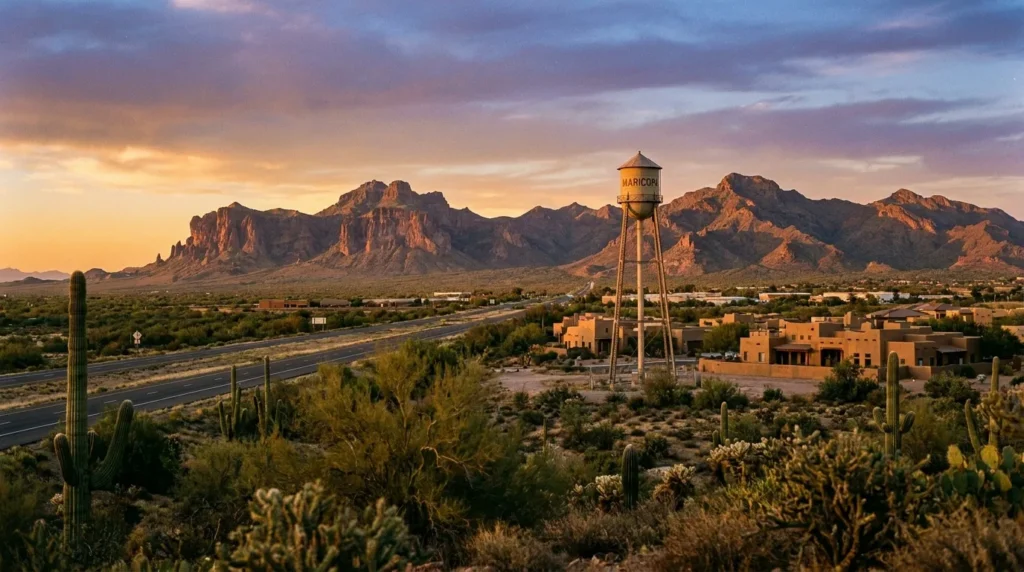
Want to live and work in Maricopa?

Personalized immigration plan with eligible visas, costs, and next steps for your goal!

If you are not eligible, you will know exactly why and what to do to improve your approval chances.

Save up to 12 hours in meetings

No pointless assessments.

Save up to 90%

Save money on vague or unfocused consultations

Avoid Fraud and Mistakes

One mistake can cost you your visa

Total Impartiality

Zero commercial bias

Decide with peace of mind

No toxic urgency

Fast and Accurate

Answers in minutes, no guesswork

Who lives in Maricopa: young families, a growing mix of backgrounds, and newcomers from outside Arizona

The population is young, with many families with school-age children, and includes a broad mix of origins. A large share of residents arrived from other U.S. states drawn by affordable home prices.

The dominant profile in Maricopa is families in their 30s and 40s with school-age children. The median age falls below the Arizona average, and the share of young adults is higher than in older nearby cities such as Casa Grande. Military veterans also appear in significant numbers because of proximity to regional bases.

The composition is mixed: non-Hispanic white residents make up the majority, but the Hispanic population is growing quickly and already exceeds one-third of all residents. There is also a notable African American presence, an Indigenous community tied to the adjacent Ak-Chin reservation, and a growing number of Asian families arriving from the greater Phoenix metro area.

Most new residents come from outside Arizona. California, Illinois, Washington, and Michigan rank among the most common states of origin. Many people arrive looking for a less expensive home than they could find in Phoenix, Tempe, or Mesa, and end up staying because of the schools and a quieter pace of life.

Languages spoken
  • English
  • Spanish
  • O'odham
Main religions
  • Protestant Christianity
  • Catholicism
  • Mormon (LDS)
  • No religion

Cost of living in Maricopa: more affordable housing than Phoenix, with energy bills peaking in summer

Maricopa is one of the most affordable options for living near Phoenix. The big monthly expense is air conditioning from June through September, which can double or triple the electricity bill.

Compared to Chandler, Gilbert, or Scottsdale, Maricopa offers single-story homes with three or four bedrooms at considerably lower prices. Rental rates for a family home are typically well below what similar properties cost in equivalent metro-area neighborhoods. Buying is also more accessible, and the inventory of new construction is large because builders continue opening new subdivisions.

The expense that surprises newly arrived residents is the summer electricity bill. From June through September, keeping a home at a comfortable temperature with central air conditioning can multiply the bill three or four times compared to milder months. Water is not cheap either, since everything in the desert depends on irrigation and pumping infrastructure.

Groceries, gasoline, and services are close to the Arizona average. The city applies no sales tax on basic food items, and the overall state tax burden is moderate. Residents who commute to Phoenix spend significantly on fuel and vehicle wear, so the savings from housing often disappear in the daily commute.

96Cost index (US = 100)4% below US average
CategorySingleCoupleFamily (2 + 2)
iHousing$1,252$1,445$1,830
iFood$366$732$1,329
iTransport$482$819$1,059
iHealthcare$270$540$1,011
iChildcare$1,752
iOther$819$1,474$2,070
Monthly total$3,189$5,010$9,051

Source: U.S. BLS Consumer Expenditure Survey 2023 + BEA Regional Price Parities 2023 · Estimates in USD, monthly.

Where to live in Maricopa: planned communities and single-story homes spread across the desert

The housing supply is dominated by master-planned communities with single-story homes, two-car garages, and shared amenities. Nearly everything was built within the last 15 years.

Most homes in Maricopa sit inside master-planned communities, meaning gated or semi-gated subdivisions with HOA rules, community pools, and internal parks. Rancho El Dorado, Province (for residents 55 and older), Glennwilde, Senita, Cobblestone Farms, and Tortosa are among the best-known areas. Homes are typically single-story with Spanish-style tile roofs, three to five bedrooms, and fenced backyards.

The apartment market is small and still developing. Those looking to rent generally find a family home through Zillow, Trulia, or directly from owners. Some communities have HOA restrictions on exterior paint colors, landscaping, and even street parking for trucks, so reviewing the HOA rules before signing is important.

The practical pattern: the closer to SR-347 and the businesses along John Wayne Parkway, the more convenience and less quiet; the deeper into the subdivisions, the more peace and the greater distance from everything. Newly arrived residents tend to prefer Rancho El Dorado or Glennwilde for their practicality.

Recommended neighborhoods
  • Rancho El Dorado
  • Glennwilde
  • Senita
  • Cobblestone Farms
  • Tortosa
  • +2 more

Job market in Maricopa: employment is in Phoenix, and the car is part of the job

Most residents work outside the city, primarily in the greater Phoenix metro area. Within Maricopa, retail, education, basic healthcare, and construction dominate.

Maricopa is still more of a bedroom community than an employment hub. Most working-age residents take SR-347 early in the morning toward Chandler, Tempe, Phoenix, or Casa Grande. The average commute exceeds 40 minutes, and on days when SR-347 sees an accident it can become an ordeal. Remote workers have adapted particularly well to city life here.

Within the city, jobs are concentrated in grocery stores, schools, clinics, department stores, fast food, and construction. Harrah's Ak-Chin Casino, on Ak-Chin Nation land just to the north, is one of the largest direct employers in the area. K-12 education also employs a significant number of people because of the rapid growth of local schools.

For skilled professionals, the greater Phoenix market as a whole makes more sense to target: technology in Chandler, semiconductor manufacturing around TSMC and Intel to the north, healthcare at regional hospitals, and logistics along the I-10 corridor. Maricopa works as an affordable base for living, not as a primary career location.

Dominant sectors
  • Retail
  • K-12 Education
  • Basic Healthcare
  • Construction
  • Casino and Hospitality
  • +1 more
Major employers
  • Maricopa Unified School District
  • Harrah's Ak-Chin Casino & Resort
  • Walmart
  • Fry's Food Stores
  • Banner Health
  • +1 more

Education in Maricopa: new schools and higher education in Phoenix

The K-12 system grew rapidly to keep pace with incoming families. For higher education, the greater Phoenix area is the primary reference.

The Maricopa Unified School District serves most children in the city, with new schools built over the past 15 years. Charter schools such as Sequoia Pathway Academy and Heritage Academy offer alternatives to the traditional public system. Quality varies between campuses, and it is common for families to choose a neighborhood with a specific assigned public school in mind.

For community college, the regional reference is Central Arizona College, with a Maricopa campus offering technical programs, basic nursing training, and transfer pathways to universities. Those seeking four-year degrees look to Arizona State University in Tempe and the University of Arizona in Tucson, both one to two hours away by car.

Vocational programs and ESL (English as a Second Language) courses for adult immigrants are offered by Central Arizona College and community organizations throughout the greater Phoenix metro area. Local public libraries also run reading clubs, basic English classes, and homework support for children.

Notable universities
  • Central Arizona College - Maricopa Campus
  • Arizona State University (Tempe, regional)
  • University of Arizona (Tucson, regional)
  • Grand Canyon University (Phoenix, regional)

Healthcare in Maricopa: primary care locally, with major hospitals in the Phoenix metro area

The city has clinics, basic urgent care, and pharmacies, but major hospitals are in the greater Phoenix area. Health insurance is essential.

In the United States, healthcare operates through private insurance or public programs for specific groups (Medicare, Medicaid/AHCCCS, veterans programs). For newly arrived immigrants, the most common path is private insurance through an employer or through the healthcare.gov marketplace. Without coverage, a single emergency room visit can cost thousands of dollars.

Maricopa has primary care clinics, urgent care facilities (walk-in appointments for non-emergency cases), pediatric care, dental offices, and pharmacies such as CVS and Walgreens. For more complex procedures, surgeries, childbirth, and specialist care, the typical referral is to Chandler Regional Medical Center, Banner Casa Grande Medical Center, or larger hospitals in Phoenix.

Sun Life Family Health Center serves residents on a sliding-scale fee based on income, which helps those who do not yet have insurance. In a serious emergency, calling 911 guarantees care regardless of coverage, though a bill may arrive afterward. For immigrants, keeping contacts for community health centers in the region is advisable.

Maricopa

Safety in Maricopa: calm bedroom community, with heightened caution on the highway

Maricopa is considered one of the safest cities in Pinal County for violent crime. The greater risks are collisions on SR-347 and opportunistic theft from yards and garages.

The family-oriented bedroom-community profile helps keep violent crime rates below the Arizona average. Residential neighborhoods typically see light foot traffic, active neighbor watch, and video doorbells, and the Maricopa Police Department maintains a relatively close relationship with residents through community events.

The most common incidents are petty thefts: packages left at the door, items taken from open garages, tools in unfenced yards, and car break-ins in commercial parking lots. Opportunistic crime follows the standard American suburban pattern. Closing the garage, retrieving deliveries promptly, and keeping vehicles locked and empty are the basic precautions.

The most significant real risk for Maricopa residents is the road. SR-347 concentrates serious accidents, especially during peak hours and at night, including head-on collisions and pedestrian incidents. Safe following distances, caution when passing, and awareness during dust storms (haboobs) are essential.

Safer neighborhoods
  • Rancho El Dorado
  • Glennwilde
  • Province
  • Cobblestone Farms
  • Homestead
Areas to avoid
  • Isolated stretches of SR-347 at night
  • Unlit desert areas on the western outskirts

Getting around Maricopa: complete car dependency and one highway that carries everything

Without a personal vehicle, daily life in Maricopa becomes very difficult. SR-347 is the main artery, and the nearest international airport is Sky Harbor in Phoenix.

Maricopa was designed for the automobile. Distances between home, grocery stores, schools, and workplaces are too large to walk comfortably, sidewalks exist but do not connect all areas, and public transit is minimal. There is a local shuttle service called COMET for short trips within the city, but it does not replace a personal vehicle.

SR-347, also known as John Wayne Parkway, connects Maricopa to Chandler and the rest of the greater Phoenix metro area. It is practically the only practical northern route and runs as a two-lane road for much of its length, with traffic lights and speed-monitored stretches. To the south it connects with I-8 near Casa Grande, opening a route toward San Diego.

The most relevant international airport is Phoenix Sky Harbor (PHX), about an hour's drive away, with flights throughout the United States and numerous international connections. Mesa Gateway (AZA) is the secondary option, oriented more toward low-cost carriers. Maricopa has an Amtrak station (Sunset Limited and Texas Eagle) with infrequent service, more symbolic than practical.

Airports
  • PHX - Phoenix Sky Harbor International (~60 km)
  • AZA - Phoenix-Mesa Gateway (~80 km)

Climate

Maricopa

Culture in Maricopa: slingshot festival, rodeo traditions, and Ak-Chin roots

Cultural life is young, family-oriented, and blends Arizona rural tradition with the Ak-Chin Indigenous heritage next door. Outdoor community events dominate.

Maricopa is still building its cultural identity. As a very new city, it has no established museums or arts scene comparable to Tucson or Phoenix. The scene is more community-driven, centered on parks, schools, and the Copper Sky Multigenerational Complex, which hosts fairs, small concerts, and sports activities.

The heritage of the Ak-Chin Indian Community carries significant weight in the surrounding area: the Ak-Chin Him-Dak Eco-Museum, on the neighboring territory, documents the history of the O'odham and Pee-Posh peoples through everyday objects. Annual celebrations such as Stagecoach Days recall the city's past as a stagecoach stop between Tucson and Yuma, and the Salsa Festival in nearby Casa Grande draws visitors from across the region.

The food follows Southwest American patterns: authentic Mexican food at taquerias along SR-347, American barbecue smoked low and slow, the Sonoran hot dog (a bacon-wrapped frankfurter with origins in Sonora, Mexico), and fry bread from the Ak-Chin people at community events. At home, cultural life revolves largely around backyards, barbecues, and pools during the warmer months.

Notable dishes
  • Sonoran hot dog
  • Carne asada tacos
  • Ak-Chin/O'odham fry bread
  • Chimichanga
  • Sonora-style carne
Annual events
  • Stagecoach Days
  • Salsa Festival (regional, Casa Grande)
  • Great American Fourth of July
  • Merry Copa Holiday Celebration
  • Ak-Chin Masik Tas Festival

What to do in Maricopa: parks, a casino nearby, and the desert right outside

Not a tourist destination, but it has well-maintained parks, a large casino next door, and easy access to trails and attractions throughout greater Phoenix.

Within the city, the highlight is Copper Sky Regional Park, featuring an artificial lake, walking trails, sports courts, a splash pad for children, and a multigenerational center with an indoor pool and fitness facility. It is the hub of outdoor life in the city, especially during the milder seasons from October through April.

Just to the north, inside the Ak-Chin reservation, sits Harrah's Ak-Chin Casino and Resort, with a casino, hotel, live entertainment, and restaurants. The Ak-Chin Southern Dunes Golf Club is one of the most acclaimed golf courses in Arizona and draws players from across the greater Phoenix metro area.

By car, Phoenix, Scottsdale, and Chandler are within an hour, along with the OdySea Aquarium in Scottsdale, the Desert Botanical Garden, and Camelback Mountain. A bit farther out, Sedona, Saguaro National Park near Tucson, and even the Grand Canyon are within reasonable range for an extended weekend trip.

  1. 1Copper Sky Regional Park
  2. 2Harrah's Ak-Chin Casino & Resort
  3. 3Ak-Chin Him-Dak Eco-Museum
  4. 4Ak-Chin Southern Dunes Golf Club
  5. 5Pacana Park
  6. 6UltraStar Multi-tainment Center
Parks & green spaces
  • Copper Sky Regional Park
  • Pacana Park
  • Rancho El Dorado Park
  • Maricopa Palms Park
  • Santa Rosa Springs Park

Immigrant communities in Maricopa: strong Hispanic presence and diversity drawn by neighboring Phoenix

The most visible immigrant presence is Mexican and Central American, alongside the influence of the adjacent Ak-Chin Nation. Other nationalities appear in smaller numbers, connected to the greater Phoenix area.

Most immigrants in Maricopa come from Mexico, with a presence also from Guatemala, El Salvador, Honduras, and Colombia. Many families arrived through family reunification, work opportunities in construction, Pinal County agriculture, and services. Spanish-language life takes place at taquerias, grocery stores such as El Super in neighboring cities, and churches offering bilingual services.

There are also smaller communities of Filipinos, Indians, Vietnamese, Chinese, and Africans, generally connected to the technology and healthcare hub of greater Phoenix. Military families also bring immigrants who arrived through American spouses serving in the region. The Ak-Chin Nation, an Indigenous community, maintains a strong cultural presence in the immediate vicinity.

All consulates are located in Phoenix, not in Maricopa. For document emergencies, the most common path is driving to the metro area. Regional organizations such as Chicanos Por La Causa, Catholic Charities, IRC Phoenix, and the ACLU of Arizona offer legal, social, and health support for immigrants of various backgrounds.

9,000
Foreign-born residents
estimated
Top countries of origin
  • Mexico
  • Guatemala
  • El Salvador
  • Philippines
  • India
  • Honduras
  • Vietnam
  • Colombia
Foreign consulates
  • Mexican Consulate General in Phoenix
  • Guatemalan Consulate General in Phoenix
  • El Salvador Consulate in Phoenix
  • Honorary Brazilian Consulate in Phoenix
  • Honorary Canadian Consulate in Phoenix
Community organizations
  • Chicanos Por La Causa
  • Catholic Charities Community Services (Arizona)
  • International Rescue Committee Phoenix
  • Sun Life Family Health Center
  • ACLU of Arizona

Latest posts

Posts about Arizona

Coverage and updates related to this destination.

Showing content from Arizona, as there is no specific data for Maricopa yet.