Visto n' Visa
Blog
Notícias e artigos
Destinations
Careers
Immigrants

Want to live and work in Casas Adobes?

Personalized immigration plan with eligible visas, costs, and next steps for your goal!

If you are not eligible, you will know exactly why and what to do to improve your approval chances.

Save up to 12 hours in meetings

No pointless assessments.

Save up to 90%

Save money on vague or unfocused consultations

Avoid Fraud and Mistakes

One mistake can cost you your visa

Total Impartiality

Zero commercial bias

Decide with peace of mind

No toxic urgency

Fast and Accurate

Answers in minutes, no guesswork

Population profile: families, retirees, and a historic Hispanic mix

Around 70,000 residents, with a strong presence of middle-class families, an established Hispanic community, and a growing number of retirees relocating from northern U.S. states.

The population is around 70,000 people, spread across low-density neighborhoods. The composition reflects the history of the American Southwest: a non-Hispanic white majority, a Hispanic community with Mexican roots spanning several generations, and smaller minorities of Asian, Native American, and African American descent. English-Spanish bilingualism is common in commerce.

The age profile is older than the national average. Many residents are retirees who came from cold states such as Minnesota, Illinois, and Michigan in search of the dry, sunny climate. They share the community with young families drawn by the Amphitheater school district and real estate prices more accessible than those in Phoenix or Scottsdale.

The predominant religion is Christian, with a strong Catholic presence tied to the Hispanic heritage and Protestant representation across various denominations. There are also Jewish congregations, Latter-day Saints communities, and small Buddhist and Muslim communities serving the broader Tucson metropolitan area.

Languages spoken
  • English
  • Spanish
Main religions
  • Catholicism
  • Protestantism
  • Mormonism
  • Judaism
  • No religion

Moderate cost of living by western U.S. standards

More affordable than Phoenix, Scottsdale, and most coastal cities, with accessible housing, high energy costs in summer, and grocery prices in line with the national average.

The cost of living in Casas Adobes is below the average for major cities in the western United States. Renting a three-bedroom home tends to be considerably less expensive than in Phoenix or Denver, and homeownership remains viable for middle-class families, especially compared to California and Colorado.

The largest variable expense is electricity in summer. Air conditioning runs almost continuously from May through September, and utility bills can triple during the hottest months. Water is also a significant cost, as maintaining any green garden in a desert climate requires constant irrigation.

Groceries, casual restaurants, and gasoline are close to the Arizona average. Budget-conscious residents shop at chains such as Fry's, Safeway, and Walmart, and take advantage of Mexican markets for fruits, vegetables, and meats at lower prices. Private health insurance is expensive, as it is throughout the country.

96Cost index (US = 100)4% below US average
CategorySingleCoupleFamily (2 + 2)
iHousing$1,252$1,445$1,830
iFood$366$732$1,329
iTransport$482$819$1,059
iHealthcare$270$540$1,011
iChildcare$1,752
iOther$819$1,474$2,070
Monthly total$3,189$5,010$9,051

Source: U.S. BLS Consumer Expenditure Survey 2023 + BEA Regional Price Parities 2023 · Estimates in USD, monthly.

Single-story adobe homes, retirement communities, and family neighborhoods

Southwestern-style single-story homes with yards and garages predominate. There are also modern apartment complexes and gated communities oriented toward residents 55 and older.

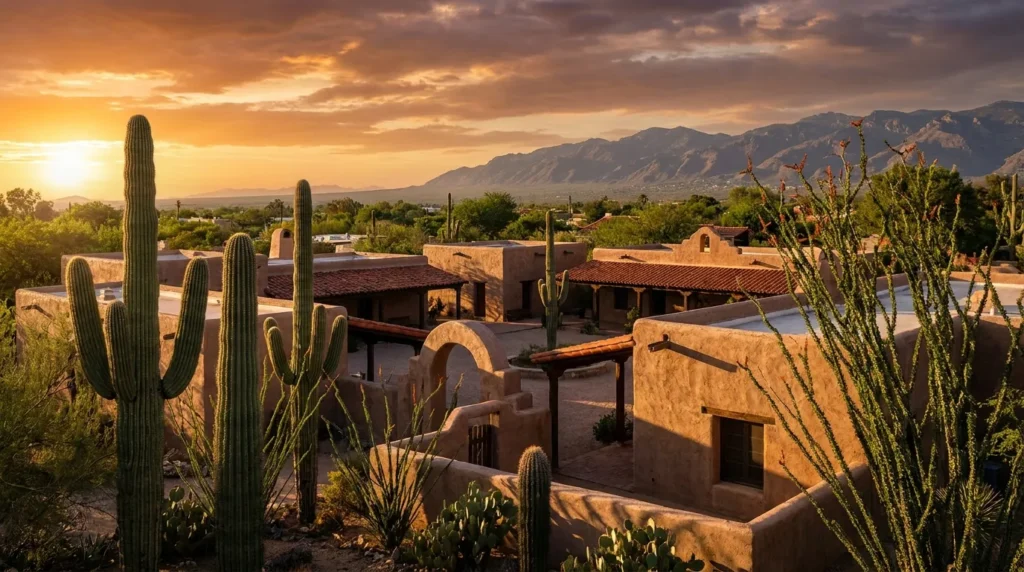
The housing stock is dominated by single-story southwestern-style homes, with sand-colored stucco walls, low roofs, rock gardens, and cacti. Most were built between the 1970s and 1990s, with a backyard, two-car garage, and occasional pool. Lot sizes are generous by American standards.

Those who prefer renting will find modern apartments near La Encantada and Foothills Mall, with shared gym and pool facilities. There are also many single-story condominiums for the 55+ market, with lawn maintenance included, popular among retirees who come to spend the winter away from the cold.

Traditional neighborhoods run along River Road, Ina Road, and Oracle Road. Areas closer to the Santa Catalina Mountains, known as Catalina Foothills, feature more expensive homes with views, though they technically form a separate neighboring CDP. Buying is more common than renting among long-term residents.

Recommended neighborhoods
  • Casas Adobes Plaza
  • La Cholla Corridor
  • Oracle Foothills
  • Wilshire Heights
  • Northwest Tucson

Jobs in healthcare, retail, and services tied to Tucson

The local job market is concentrated in healthcare, education, retail, and services. Major employers are located in Tucson, a short drive away via Oracle Road.

Casas Adobes itself has no major industrial base. Most residents commute to Tucson by car via Oracle Road, La Cholla, or Ina. The largest employing sectors are healthcare, with hospitals and clinics spread across the metropolitan area, and retail, with shopping centers and commerce along the main avenues.

The University of Arizona in Tucson drives employment in education, research, and related services. There is also a strong military and aerospace presence in the region, with Davis-Monthan Air Force Base and companies such as Raytheon Missiles and Defense employing engineers, technicians, and administrative staff in the southern part of the city.

Tourism and hospitality carry weight in winter, when the region receives snowbirds. Small businesses, restaurants, and services catering to retirees (caregivers, physical therapy, landscaping) also support part of the local Casas Adobes economy.

Dominant sectors
  • Healthcare
  • Education
  • Retail
  • Defense and aerospace
  • Tourism and hospitality
Major employers
  • University of Arizona
  • Tucson Medical Center
  • Banner University Medical Center
  • Raytheon Missiles & Defense
  • Davis-Monthan Air Force Base
  • +1 more

Amphitheater schools and a recognized research university in Tucson

Served by the Amphitheater Public Schools district, with well-rated schools, and a short drive from the University of Arizona campus, one of the country's leading research universities.

Children in Casas Adobes attend Amphitheater Public Schools, which is generally well-rated compared to other districts in Pima County. Charter schools, Catholic schools, and some secular private schools also serve northwest Tucson, with options for international curriculum and Montessori programs.

For higher education, the reference is the University of Arizona, a few kilometers to the south, considered one of the largest public research universities in the United States, with strengths in astronomy, planetary sciences, medicine, and Hispanic studies. Pima Community College offers technical programs and the first two years of a bachelor's degree at a significantly lower cost.

The university's presence influences commerce, culture, and the rental market across the entire metropolitan area. International students are found in all neighborhoods, and there are housing, transportation, and translation services specifically oriented toward that community.

Notable universities
  • University of Arizona
  • Pima Community College
  • Arizona State University (partner campus in Phoenix, about 2 hours away)

Strong hospital network centered in Tucson, with expensive private insurance

High-quality healthcare at nearby hospitals such as Northwest Medical Center and TMC. As throughout the country, access depends on costly private insurance or Medicaid/Medicare.

The healthcare network in northwest Tucson is solid. Northwest Medical Center, in Casas Adobes, is the primary local hospital, with an emergency room, maternity ward, and various specialties. Tucson Medical Center and Banner University Medical Center are a few minutes away and offer tertiary care, transplants, oncology, and trauma centers.

As in the rest of the United States, access depends almost entirely on health insurance. Those arriving as immigrants need to quickly understand the differences between HMOs, PPOs, and high-deductible plans. Retirees typically use Medicare, and low-income families may qualify for AHCCCS, Arizona's Medicaid program.

There is a good supply of family practices, specialty clinics, dentists, and ophthalmologists. For newly arrived immigrants without coverage, low-cost community clinics exist throughout the metropolitan area, such as El Rio Health, which offers services in Spanish and income-adjusted fees.

Safety above the Tucson average, with some localized precautions

Quiet residential neighborhoods with crime rates below downtown Tucson. As in any American suburb, there are occasional car break-ins and sporadic burglaries.

Casas Adobes is considered one of the quieter areas in the Tucson metropolitan area. Violent crime is rare in residential neighborhoods, and the sense of security is high, especially compared to parts of downtown and south Tucson, which historically record higher rates.

The most common issues are theft from unlocked vehicles, occasional break-ins, and some vandalism. The basic recommendation is to avoid leaving bags, laptops, or packages visible in the car and to use a home alarm, which is standard practice in northwest Tucson.

Patrol services are provided by the Pima County Sheriff's Department, as the area is unincorporated. Emergency response is considered efficient. Those walking at night in commercial areas along Oracle and Ina generally report no problems, but as in any American city, awareness is always advisable.

Safer neighborhoods
  • Oracle Foothills
  • Casas Adobes Plaza
  • La Cholla Corridor
  • Wilshire Heights
Areas to avoid
  • Isolated stretches along Miracle Mile at night
  • Industrial areas near I-10 outside business hours

Car-dependent living with a nearby airport and limited public transit

Almost everything requires a car. Sun Tran bus lines serve the area, but frequency is low. Tucson International Airport is about 30 minutes away.

Life in Casas Adobes is organized around the automobile. The avenues are wide, with multiple lanes and abundant parking at all commercial establishments. Distances appear short on a map but translate to ten or fifteen minutes by car, and those living here without a vehicle face a considerably harder daily routine.

The Sun Tran bus system serves the area with routes along the main avenues, but frequency is low outside peak hours and connections to downtown Tucson are slow. There is no metro. The Sun Link streetcar operates only in downtown Tucson and on the University of Arizona campus.

Tucson International Airport (TUS) is about 30 to 40 minutes away by car, with direct flights to major U.S. hubs and some Mexican cities. For larger international flights, many residents drive to Phoenix Sky Harbor, about two hours away via I-10.

Airports
  • TUS — Tucson International Airport
  • PHX — Phoenix Sky Harbor International (about 2 hours by car)
  • International airport
  • Bike infrastructure

Sonoran Desert culture with Mexican heritage and the American Southwest

Cultural life is shared with Tucson: a strong mix of Mexican traditions, music festivals, and internationally recognized Sonoran cuisine.

The cultural identity of the region is clearly rooted in the American Southwest with deep Mexican influences. Casas Adobes shares with Tucson a pride in Sonoran cuisine, recognized by UNESCO as a City of Gastronomy, featuring dishes such as the chimichanga, carne seca, carne asada tacos, and the traditional Sonoran hot dog wrapped in bacon.

Festivals mark the calendar. The Tucson Festival of Books brings together authors and readers on the university campus in March. The Tucson Gem, Mineral and Fossil Showcase, held in February, transforms the city into the largest minerals and fossils event in the world. The All Souls Procession in November blends Day of the Dead traditions with contemporary art.

Art galleries, craft markets, and live music are common throughout the area. There is also a strong outdoor lifestyle culture: hiking in the mountains, birdwatching, cycling in winter, and backyard barbecues. There are no UNESCO World Heritage Sites in Casas Adobes proper.

Notable dishes
  • Sonoran hot dog
  • Chimichanga
  • Carne seca
  • Carne asada tacos
  • Tamales
  • +1 more
Annual events
  • Tucson Festival of Books
  • Tucson Gem, Mineral & Fossil Showcase
  • All Souls Procession
  • Fiesta de los Vaqueros (Tucson Rodeo)
  • Tucson Meet Yourself

Desert, mountains, and Tucson's cultural centers just next door

The combination of Santa Catalina desert scenery, nearby national parks, and Tucson's cultural scene offers plenty to do on weekends.

The region's greatest attraction is nature. The Santa Catalina Mountains, with Sabino Canyon and Catalina State Park, are a short drive away and offer trails, seasonal waterfalls, overlooks, and scenic roads up to Mount Lemmon, where temperatures drop twenty degrees and skiing is possible in winter.

Saguaro National Park, split into two sections east and west of Tucson, protects forests of giant saguaro cacti, the symbol of Arizona. The Arizona-Sonora Desert Museum, part zoo, part botanical garden, and part natural history museum, is one of the most recommended visits in the region.

In Tucson there is the historic downtown, Mission San Xavier del Bac (a gem of colonial Baroque architecture), the historic Barrio Viejo district with colorful homes, and Fourth Avenue, with independent shops, restaurants, and bars. La Encantada and Tucson Mall cover shopping and cinema closer to home.

  1. 1Sabino Canyon
  2. 2Catalina State Park
  3. 3Mount Lemmon
  4. 4Saguaro National Park
  5. 5Arizona-Sonora Desert Museum
  6. 6Mission San Xavier del Bac
Parks & green spaces
  • Catalina State Park
  • Sabino Canyon Recreation Area
  • Christopher Columbus Park
  • Tohono Chul Park
  • Brandi Fenton Memorial Park

Established Hispanic community and a growing flow of diverse immigrants

A strong presence of multi-generational Mexican-origin families, alongside smaller communities from across Latin America, Asia, and Europe, drawn by the climate and cost of living.

The most visible immigrant community has Mexican roots, with families who have been in the region for generations alongside more recent arrivals. Spanish is heard in supermarkets, banks, and schools, and Mexican culture blends into daily life through food, music, religious celebrations, and architecture.

In addition, Casas Adobes receives smaller numbers of immigrants from other parts of Latin America (Colombia, Venezuela, Argentina, Brazil), Southeast Asia (Philippines, Vietnam), India, China, and Eastern Europe. Canadian retirees spend the winter in area condominiums and form their own community between November and April.

Support for newcomers comes primarily from organizations based in Tucson, offering services in multiple languages, including housing assistance, English as a second language, immigration legal aid, and school integration. Community life tends to revolve around churches, temples, and cultural associations.

10,000
Foreign-born residents
estimated
Top countries of origin
  • Mexico
  • Philippines
  • Canada
  • China
  • India
  • Colombia
  • Venezuela
  • Vietnam
Foreign consulates
  • Mexican Consulate in Tucson
  • Mexican Consulate General in Nogales, Arizona
  • Nearest additional consulates in Phoenix (Guatemala, El Salvador, Ecuador)
Community organizations
  • Catholic Community Services of Southern Arizona
  • International Rescue Committee (Tucson)
  • Refugee Focus / Lutheran Social Services of the Southwest
  • Pima Community College Refugee Education Program
  • El Rio Health

Latest posts

Posts about Arizona

Coverage and updates related to this destination.

Showing content from Arizona, as there is no specific data for Casas Adobes yet.