Visto n' Visa
Blog
Notícias e artigos
Destinations
Careers
Immigrants

Want to live and work in Sitka?

Personalized immigration plan with eligible visas, costs, and next steps for your goal!

If you are not eligible, you will know exactly why and what to do to improve your approval chances.

Save up to 12 hours in meetings

No pointless assessments.

Save up to 90%

Save money on vague or unfocused consultations

Avoid Fraud and Mistakes

One mistake can cost you your visa

Total Impartiality

Zero commercial bias

Decide with peace of mind

No toxic urgency

Fast and Accurate

Answers in minutes, no guesswork

Small island city with a strong Tlingit presence and mixed origins

Sitka has about 8,500 residents, with a population split among European descendants, the Native Tlingit people, and Filipino, Hispanic, and Asian minorities tied to fishing and the public sector.

The population is small and fairly stable, with a slight decline over recent decades. About one in five residents identifies as Alaska Native, mostly Tlingit, which makes Sitka one of the cities with the most visible Indigenous presence in the state. The Sitka Tribe of Alaska is an active part of political and cultural life.

The Filipino community is the second largest foreign-origin group, with roots in decades of migration tied to the fishing industry. There are also residents of Hispanic, Japanese, Korean, and Russian or Scandinavian descent whose families stayed after the 19th century. Religious diversity reflects this mix, with Orthodox Christians, Catholics, Protestants, and Tlingit spiritual traditions coexisting.

The age profile skews older, with a strong presence of families and retirees and fewer young adults. Many leave to study elsewhere and few return. The public school system, the tribal hospital, and the Coast Guard are the main employers sustaining the city's demographic base.

Languages spoken
  • English
  • Tlingit (Lingit)
  • Tagalog
  • Spanish
  • Russian
Main religions
  • Protestant Christianity
  • Russian Orthodoxy
  • Roman Catholicism
  • Traditional Tlingit spirituality
  • No religion

High cost of living, driven by isolation and freight logistics

Living in Sitka costs significantly more than the US average, with food, fuel, and housing well above national levels because of shipping and air transport.

Almost everything consumed in Sitka arrives by barge or plane, and it shows in the price. Groceries are expensive, especially fruits, vegetables, and dairy. Longtime residents learn to buy in bulk when sales come up, freeze fish caught in the summer, and use community gardens to supplement.

Fuel is more expensive than on the mainland, but distances inside the city are short. Heating in winter is a significant expense, with most homes using fuel oil or wood. Electricity comes largely from local hydroelectric power, which helps keep the bill manageable.

Wages in the public sector, healthcare, and fishing tend to be adjusted for Alaska's cost of living, and resident Alaskans receive the annual Permanent Fund Dividend. Even so, middle-income families feel the squeeze, and it is common to stack jobs, combining seasonal work with a main income.

Sitka

Tight market, wooden homes, and limited supply due to geography

Housing supply in Sitka is constrained by the lack of flat land and demand from seasonal workers, with high rental and purchase prices compared to the city's size.

Sitka grows squeezed between mountains and the sea, so there is not much room to expand. Most homes are wooden, two stories, with a basement and central heating. The oldest buildings sit in the historic downtown near Lincoln Street, while newer ones spread across residential neighborhoods to the north and along Halibut Point Road.

Finding a rental can be difficult, especially in May and September, when fishing and tourism workers arrive or leave. Short-term rentals and Airbnbs have further reduced supply for residents. Buying a property takes patience, and mortgages can be more conservative because of the remote location.

Newcomers often start in shared rooms, employer dorms, or small apartments near downtown. Families that settle in look for homes with a yard, covered garage, and proximity to schools, usually in Indian River, Jamestown Bay, or along Halibut Point Road.

Recommended neighborhoods
  • Downtown Sitka
  • Indian River
  • Jamestown Bay
  • Halibut Point Road
  • Cascade Creek

Economy anchored in fishing, healthcare, government, and cruise tourism

Jobs in Sitka concentrate in commercial fishing, the tribal hospital, public schools, the municipal government, the Coast Guard, and the tourism sector, with strong summer seasonality.

Commercial fishing, especially for salmon, halibut, and black cod, is the backbone of the economy, with a fleet based at the harbor and processors such as Sitka Sound Seafoods and Seafood Producers Cooperative. Many residents combine seasons at sea with another job on land throughout the year.

The second major hub is healthcare and the public sector. The SouthEast Alaska Regional Health Consortium runs the Mt. Edgecumbe Medical Center, with the integrated Sitka Community Hospital. The Coast Guard has an important local base, and municipal and state government employ hundreds in schools, parks, and services.

Tourism has grown substantially with cruise ship arrivals from May to September, generating jobs in shops, restaurants, boat tours, and wildlife viewing. Outside the season the city slows considerably, and tourism workers have to plan their annual income around that cycle.

Dominant sectors
  • Commercial fishing
  • Healthcare
  • Government and defense
  • Tourism and hospitality
  • Education
Major employers
  • SouthEast Alaska Regional Health Consortium (SEARHC)
  • Sitka School District
  • City and Borough of Sitka
  • United States Coast Guard Air Station Sitka
  • Sitka Sound Seafoods
  • +2 more

Small public schools, a state boarding school, and a modest university campus

Sitka's school system serves about 1,200 students in small schools, and the city is home to Mt. Edgecumbe High School, a state boarding school for rural Alaska students.

The Sitka School District runs schools from early childhood through high school, with small classes and teachers who often stay in town for many years. Sitka High School is the main high school, complemented by Pacific High School, which serves students with alternative needs.

One distinctive feature is Mt. Edgecumbe High School, a public state boarding school that takes Indigenous and rural students from across the region, with an emphasis on sciences, Native culture, and pre-college programs. This boarding school brings additional diversity to the city's youth.

In higher education, the University of Alaska Southeast Sitka Campus offers technical programs, teacher training, and distance learning. The former Sheldon Jackson College campus, closed in 2007, now houses the Sitka Fine Arts Camp and cultural activities year-round.

Notable universities
  • University of Alaska Southeast — Sitka Campus
  • Outer Coast (institution in development)
  • Sheldon Jackson Campus (cultural use)

Regional tribal hospital serves all of southeast Alaska

Sitka concentrates healthcare services for the entire southeast Alaska region at Mt. Edgecumbe Medical Center, run by the SEARHC tribal consortium, with primary, specialty, and emergency care.

The main healthcare facility is Mt. Edgecumbe Medical Center, a regional hospital run by the SouthEast Alaska Regional Health Consortium. It serves patients from the city and neighboring communities who arrive by plane or boat, with an emergency room, maternity, surgery, and multiple specialties.

The system integrates primary care in community clinics, mental health, dentistry, and specific programs aimed at Native populations. Telemedicine services also connect residents of remote villages with specialists in Sitka, Juneau, Anchorage, and Seattle.

High-complexity cases are usually transferred to Anchorage or Seattle by medical flight, which makes health insurance with strong air transport coverage an important item. For urgent emergencies, the local Coast Guard also takes part in sea rescues and operations in isolated areas.

Sitka

Generally safe city, with low violent crime rates

Sitka has crime rates below the Alaska and US averages, with most incidents tied to alcohol, domestic violence, and minor thefts in central areas.

The overall feel in Sitka is that of a small, safe town where neighbors know each other and children ride bikes without much supervision. Violent crime is rare, and most police activity involves domestic violence, problematic alcohol use, and opportunistic thefts from boats and vehicles at the harbor.

The historic downtown and northern residential neighborhoods are considered quiet. Areas near bars on Lincoln Street can get rowdier on weekend nights, especially during fishing season, when seasonal workers add to the foot traffic. Common sense usually handles it.

Natural hazards deserve more attention than crime: heavy rain, landslides, strong winds, and occasional earthquakes and tsunami alerts are part of the calendar. The city has marked evacuation routes and frequent community drills, and new residents should get familiar with them within their first month.

Safer neighborhoods
  • Indian River
  • Jamestown Bay
  • Halibut Point Road
  • Cascade Creek
  • Historic downtown
Areas to avoid
  • Isolated unmarked forest areas at night
  • Commercial piers after hours during fishing season

No roads out, daily life moves by car, boat, and plane

Sitka is reachable only by plane or ferry, and within the city most travel happens by car, with a few bus routes, summer cycling, and boats for remote areas.

No road connects Sitka to other Alaska cities or the mainland. Rocky Gutierrez Airport (SIT) handles daily Alaska Airlines flights to Juneau, Seattle, and other southeast stops. The Alaska Marine Highway System runs ferries linking the city to Juneau, Petersburg, Ketchikan, and Bellingham, with long voyages and only a few weekly departures.

Inside the city, the road network is short, running about twenty kilometers from north to south. The car is the dominant mode, but the short distances mean many people bike in the summer and walk to work. The RIDE Sitka bus line provides basic public transit during the day.

People who live on nearby islands or in isolated cabins rely on small boats for daily travel. Floatplanes from Harris Air and other operators connect Sitka to remote communities. In winter, fog and bad weather often cancel flights, so important dates call for several days of buffer.

Airports
  • SIT — Sitka Rocky Gutierrez Airport
  • Bike infrastructure

Climate

Sitka

Tlingit heritage, Russian legacy, and a lively arts scene for its size

Sitka has a surprisingly dense cultural life, with music festivals, Tlingit totem poles, preserved Russian architecture, and a calendar full of community events all year long.

The city has three cultural layers that coexist day to day. Tlingit culture appears in the totem poles at Sitka National Historical Park, in performances at the Sheet'ka Kwaan Naa Kahidi clan house, and in language and art programs run by the Sitka Tribe of Alaska. The Russian heritage survives in St. Michael's Cathedral, the Russian Bishop's House, and many local surnames.

The cultural calendar features the Sitka Summer Music Festival, a chamber music landmark in Alaska, and Sitka WhaleFest, which blends marine science and art. Sitka Fine Arts Camp, based on the former Sheldon Jackson campus, draws young people from across the state for a summer of art, theater, and dance.

Local cuisine revolves around the sea. Fresh salmon, halibut, king crab, and salmon roe are staples, alongside traditional Tlingit foods such as herring eggs and fry bread. Downtown cafes and bars, like Highliner Coffee and the Bayview Pub, serve as gathering spots.

Notable dishes
  • Grilled and smoked salmon
  • Fresh halibut
  • Alaska king crab soup
  • Salmon roe (subject to Tlingit tradition)
  • Herring eggs on seaweed
  • +2 more
Annual events
  • Sitka Summer Music Festival
  • Sitka WhaleFest
  • Alaska Day Festival
  • Sitka Seafood Festival
  • Sitka Herring Festival
  • +1 more

Totem poles, a volcano, whale watching, and rainforest trails

Sitka offers a rare set of small-scale attractions, including trails through Sitka National Historical Park, whale and bear watching, Tlingit totem poles, and Mount Edgecumbe volcano in the background.

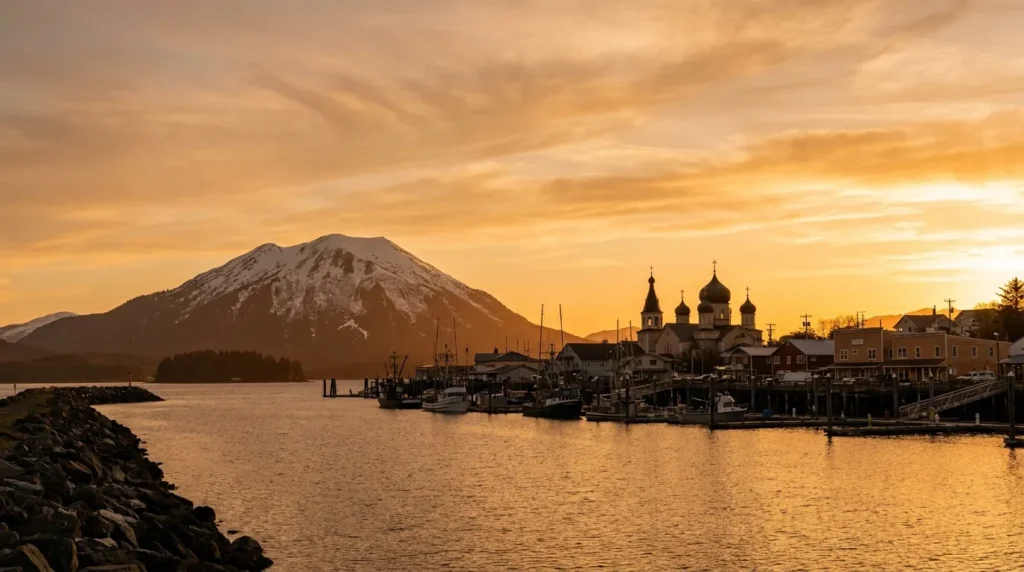
Sitka National Historical Park, with its collection of Tlingit totem poles along a seaside trail, is the postcard image. Nearby are the Sitka Sound Science Center, with an aquarium and salmon hatchery, and the Alaska Raptor Center, a bird of prey hospital open to visitors. Downtown, St. Michael's Cathedral impresses with its gilded interior.

The natural surroundings are as important as the buildings. Mount Edgecumbe volcano, with its symmetrical cone, dominates the horizon. Trails such as Indian River, Mosquito Cove, Gavan Hill, and Harbor Mountain offer hikes with views of the bay and the forest. At sea, tours from the harbor go out to spot whales, sea otters, and sea lions.

For rainy days, the Sheldon Jackson Museum holds one of the best collections of Alaska Native art, and the Sitka Maritime Heritage Society tells the city's fishing and naval history. Cafes, independent bookstores, and the historic Pioneer Bar round out the local itinerary.

  1. 1Sitka National Historical Park
  2. 2St. Michael's Cathedral
  3. 3Alaska Raptor Center
  4. 4Sitka Sound Science Center
  5. 5Sheldon Jackson Museum
  6. 6Russian Bishop's House
Parks & green spaces
  • Sitka National Historical Park
  • Totem Square
  • Crescent Harbor Park
  • Whale Park
  • Starrigavan Recreation Area
  • +1 more

Small communities, with a historic Filipino presence and a flow of seasonal workers

Sitka has a small immigrant community, but with historic Filipino roots tied to fishing, plus Mexicans, Salvadorans, and Eastern Europeans who arrive mainly for seasonal work.

The most established foreign community in Sitka is Filipino, with families that put down roots in the early 20th century, when salmon cannery workers began arriving. Today entire generations have been born in the city, with a strong presence in healthcare, retail, and Catholic parish life.

During fishing and tourism season, the city takes in temporary workers from various origins, including Mexicans, Salvadorans, Ukrainians, Russians, and young people on J-1 visas from Eastern Europe. Many stay only a few months, but some end up settling and starting families.

Because the city is small and isolated, there are no distinct ethnic neighborhoods, and integration happens naturally through schools, churches, and the workplace. Local organizations help newcomers with translation and guidance on healthcare and housing, though on a much smaller scale than in larger cities.

600
Foreign-born residents
estimated
Top countries of origin
  • Philippines
  • Mexico
  • Canada
  • Russia
  • El Salvador
  • Ukraine
  • South Korea
  • Vietnam
Foreign consulates
  • Consulate General of the Philippines in Seattle (jurisdiction)
  • Consulate General of Mexico in Seattle (jurisdiction)
  • Consulate General of Canada in Seattle (jurisdiction)
  • Consulate General of Russia (service via Houston)
  • Consulate General of Japan in Anchorage
Community organizations
  • Sitka Tribe of Alaska
  • Filipino American Association of Sitka
  • Catholic Community Service Southeast Alaska
  • Sitkans Against Family Violence (SAFV)
  • Sitka Public Library — multilingual programs
  • SEARHC Community Health

Latest posts

Posts about Alaska

Coverage and updates related to this destination.

Showing content from Alaska, as there is no specific data for Sitka yet.