Visto n' Visa
Blog
Notícias e artigos
Destinations
Careers
Immigrants

Want to live and work in Juneau?

Personalized immigration plan with eligible visas, costs, and next steps for your goal!

If you are not eligible, you will know exactly why and what to do to improve your approval chances.

Save up to 12 hours in meetings

No pointless assessments.

Save up to 90%

Save money on vague or unfocused consultations

Avoid Fraud and Mistakes

One mistake can cost you your visa

Total Impartiality

Zero commercial bias

Decide with peace of mind

No toxic urgency

Fast and Accurate

Answers in minutes, no guesswork

Juneau's population: a mix of Tlingit natives, government workers, and Filipinos

Tlingit and Haida communities have a strong historical presence. State workers, fishing professionals, and the Filipino community make up the rest.

Juneau has the highest concentration of state government workers in Alaska, as the capital. This draws people from across the state for years or even decades at a time. The Tlingit Native community is a fundamental part of local identity, with the Sealaska Heritage Institute promoting the language and art of the people.

The Filipino community is large and well-established, historically linked to the seafood processing industry, and accounts for a significant share of the population. There are also Haida and Tsimshian residents, descendants of Norwegians with a fishing heritage, and people who relocated from the Lower 48 in search of nature.

The Hispanic community is small but present, with some grocery stores and Mexican restaurants. The average educational level is high, driven by the weight of the public sector workforce and relatively strong income levels.

Languages spoken
  • English
  • Tagalog (Filipino)
  • Tlingit
  • Spanish
  • Cantonese
  • +1 more
Main religions
  • Unaffiliated
  • Protestant Christian (Lutheran, Presbyterian)
  • Catholic
  • Russian Orthodox (historically present among Tlingit)
  • Traditional indigenous spirituality

Cost of living in Juneau: high due to isolation and reliance on shipping

Everything arrives by boat or plane, making food and goods expensive. Rent is high due to limited supply. No state income tax.

Juneau is expensive even by Alaska standards. Since everything is shipped in from Seattle or Anchorage, groceries, electronics, and clothing carry prices inflated by freight costs. Fruits and dairy are noticeably more expensive than in the rest of the United States, and the availability of fresh produce varies with ferry schedules.

Rent is the largest expense. The city has limited land between the ocean and the mountains, with few new developments. One- or two-bedroom apartments in Downtown or Mendenhall Valley typically rent above the national average. Buying a home is difficult, with limited inventory and high prices.

As in all of Alaska, there is no state income tax. Juneau, however, collects a local sales tax. Residents receive the annual Permanent Fund Dividend. Electricity is hydroelectric and cheaper than in many parts of the state.

Juneau

Housing in Juneau: wooden homes on hillsides and condos downtown

Hillside homes with ocean views are a defining feature. Apartments are concentrated in Downtown and Mendenhall Valley. Overall supply is limited.

Juneau has a constrained geography. Downtown is squeezed between Mount Roberts and the Gastineau Channel, and many homes are small, historic, and perched on steep hillsides with stunning views. Mendenhall Valley, about 15 kilometers from downtown, is where most families live, with homes on larger, flatter lots.

Other neighborhoods include Douglas (on the island of the same name, connected by a bridge), Lemon Creek, and Auke Bay. Auke Bay is near the University of Alaska Southeast (UAS) and has a more residential character. Douglas is older, with charming homes and a close-knit community.

The rental market is tight. Workers relocating to Juneau need to search well in advance, especially during the legislative session (January to April), when legislators and staff rent properties on a short-term basis. Zillow, Craigslist, and the Juneau Empire newspaper are common sources.

Recommended neighborhoods
  • Mendenhall Valley (family-friendly, good schools, more space)
  • Downtown Juneau (urban life, historic hillside homes)
  • Douglas (across the bridge, close-knit community)
  • Auke Bay (near UAS, residential character)
  • Lemon Creek (more central, convenient)
  • +1 more

Job market in Juneau: state government, tourism, and fishing

As the capital, state and federal government are the largest employers. Cruise tourism and fishing round out the economy.

State government is the economic core of Juneau. State agencies, the legislature, the judiciary, and various departments are spread throughout Downtown, employing thousands. Federal positions tied to the USFS (Tongass National Forest), the Coast Guard, and NOAA are also significant.

Cruise tourism surges in summer. Between May and September, ships from Holland America, Princess, Norwegian, and Carnival dock nearly every day, bringing thousands of visitors at a time. This creates seasonal jobs in souvenir shops, whale-watching tours, glacier flights, and restaurants. Many seasonal workers come from the Lower 48 or from abroad.

Commercial fishing (salmon, halibut, crab) employs crews and processing workers, with the industry spread across Auke Bay and smaller ports. Bartlett Regional Hospital, the University of Alaska Southeast (UAS), and the school district round out the list of stable major employers.

Dominant sectors
  • State government (Alaska's capital)
  • Cruise tourism
  • Commercial fishing and processing
  • Higher education
  • Healthcare
  • +1 more
Major employers
  • State of Alaska (government)
  • Bartlett Regional Hospital
  • University of Alaska Southeast (UAS)
  • Juneau School District
  • Sealaska Corporation
  • +2 more

Education in Juneau: public schools and a university focused on Southeast Alaska

The Juneau School District serves children, with well-regarded schools. UAS is the regional public university, with programs tied to Southeast Alaska.

Resident children have access to the Juneau School District, which operates schools including Thunder Mountain High School and Juneau-Douglas High School Yadaa.At Kalé. Schools are well regarded within the American context, with Tlingit and French immersion programs available at some campuses.

The University of Alaska Southeast (UAS) has its main campus in Juneau (Auke Bay) and serves the entire Southeast region. Programs include marine biology, Northwest Coast arts, public administration, education, and nursing. The university is small (around 2,000 students), which allows for close contact with faculty.

For technical training, UAS Career Education and partnerships with the fishing industry offer short-term certificate programs. Tuition for state residents is significantly lower than for out-of-state or international students. Those coming to study on an F-1 visa need the U.S. student visa issued before arrival.

Notable universities
  • University of Alaska Southeast (UAS)
  • UAS Career Education Center

Healthcare in Juneau: a regional hospital and Native care through SEARHC

Bartlett Regional is the main hospital. SEARHC serves members of Southeast Alaska tribes. Complex cases are transferred to Seattle.

The American healthcare system applies here: private, employer-insurance-based, with Medicaid (DenaliCare) and marketplace options. State workers typically have reasonable coverage. Those relocating without insurance need to arrange temporary coverage until a new plan takes effect.

Bartlett Regional Hospital is the primary facility, offering emergency care, maternity services, and some specialties. For complex procedures, patients are generally transferred to Anchorage or Seattle, via commercial flight or Medevac. The SouthEast Alaska Regional Health Consortium (SEARHC) provides care to tribal members through clinics and a hospital in Sitka.

Mental health is a genuine concern, with Juneau facing elevated rates of seasonal depression, alcohol dependence, and suicide, issues common in regions with long, overcast winters. Telemedicine services have expanded in response to the geographic isolation.

Healthcare index60.0 / 100
  • Life expectancyyears at birth
    78.4yrs
  • Doctors per 1kpracticing physicians
    3.7
  • Health spendper capita, per year
    $13,473
  • Public systemoverall quality rating
    Fair

Safety in Juneau: generally quiet, with weather and nature as the main hazards

A quiet capital with low crime rates. The greater risks come from the wet climate, trail conditions, bears, and slippery roads.

Juneau is safe by American standards. Violent crime is rare, and most incidents involve petty theft, bar fights downtown during the cruise season, and domestic violence. Walking at night in most neighborhoods is generally safe.

The real risks are natural. Trails regularly have black and brown bears, and bear spray is standard equipment. Constant rain makes roads slippery and contributes to accidents. Avalanches can affect trails in winter, and some hillside homes face landslide risk during heavy rainfall.

The Gastineau Channel and the cold Pacific waters are dangerous for swimming or accidental immersion. Tides shift quickly and can strand people on small islets. The Coast Guard maintains a local base precisely because of the volume of maritime rescues throughout Southeast Alaska.

5.8
Homicides per 100k
per year
Safety index
55.0
Crime index
45.0
Safer neighborhoods
  • Downtown Juneau
  • Mendenhall Valley
  • Auke Bay
  • Douglas
  • Lemon Creek (residential area)
Areas to avoid
  • Industrial areas near the port at night
  • Isolated trail sections near downtown at night

Transportation in Juneau: a capital with no road out, but with an airport and ferry

No road connects the city to the outside. Departure is only by plane or ferry. Within the city, Capital Transit buses provide reasonable coverage.

Juneau has an unusual characteristic: no road connects it to any other city in Alaska or to the contiguous United States. The only ways to leave are by plane through Juneau International Airport (JNU) or by ferry via the Alaska Marine Highway (routes to Sitka, Ketchikan, Skagway, Haines, and Bellingham, Washington).

Within the city, Capital Transit operates buses connecting Downtown to Mendenhall Valley, Douglas, and Auke Bay. Cycling works in summer, but constant rain limits everyday use. Most families own at least one car, even though distances within the city are short.

Juneau International Airport (JNU) has daily flights to Anchorage and Seattle on Alaska Airlines, along with smaller flights to Sitka, Ketchikan, and neighboring communities. For short regional trips, helicopters and floatplanes serve routes to glaciers, islands, and remote lodges.

17 min
Avg commute
36
Walkability
Airports
  • JNU — Juneau International Airport
  • International airport
  • Bike infrastructure

What the Climate Is Like Living in Juneau

Juneau has a subarctic oceanic climate, very humid, with cool and rainy summers, long snowy winters, frequent overcast skies, and limited sunshine throughout the year.

Summer is short and mild, with highs between 16°C and 20°C from June to August. Rain is consistent even in summer, and overcast skies are the norm on most days. This is the season for boat trips, whale watching, and hiking through the temperate rainforests that surround the city.

Winter runs from November to March, with lows between -5°C and 1°C. Snowfall is substantial, roughly 2 meters accumulated per year, but temperatures rarely drop to extremes due to the moderating influence of the ocean. The persistent challenge is the rain: Juneau receives more than 1,500 mm of precipitation annually, and December offers fewer than seven hours of daylight.

For residents, constant humidity, a daily waterproof jacket, and adjusting to limited winter light are part of everyday life. Rain boots, a sturdy rain jacket, and well-insulated windows are essential. Air conditioning is unnecessary nearly year-round.

Sunny days / year86 days
Avg high (°F)
  • 31°J
  • 31°F
  • 37°M
  • 43°A
  • 54°M
  • 63°J
  • 66°J
  • 64°A
  • 58°S
  • 47°O
  • 37°N
  • 32°D
Avg low (°F)
  • 25°J
  • 24°F
  • 28°M
  • 33°A
  • 40°M
  • 50°J
  • 55°J
  • 54°A
  • 48°S
  • 39°O
  • 30°N
  • 26°D
Rainfall (")
  • 13"J
  • 10"F
  • 8"M
  • 8"A
  • 7"M
  • 8"J
  • 9"J
  • 14"A
  • 17"S
  • 17"O
  • 14"N
  • 14"D

Culture in Juneau: Tlingit art, humpback whales, and a small-town feel

Strong Tlingit presence in local art and politics. Outdoor life, music festivals, and a tradition of public service define the city.

Juneau's culture carries the feel of a small town that also serves as a capital. People run into each other at the post office and the grocery store. Tlingit art appears on totem poles, at the Sealaska Heritage Institute, in the Walter Soboleff Building, and at annual festivals such as Celebration, the world's largest pan-Tlingit gathering, held every two years.

The food scene centers on local seafood: king salmon, halibut, king crab, sea urchin. Restaurants like Tracy's King Crab Shack (at the harbor) and Salt are local staples. The Alaskan Brewing Company is a cornerstone of the city's identity.

In terms of nature, humpback whales are spotted nearly every summer in Stephens Passage, and sightings of Steller sea lions and bald eagles are routine. Trails like the Mount Roberts Trail and the Perseverance Trail begin from the city center. The Alaska Folk Festival in April and Juneau Jazz & Classics in May anchor the cultural calendar.

Juneau

Alaska's Capital Among Glaciers and Fjords

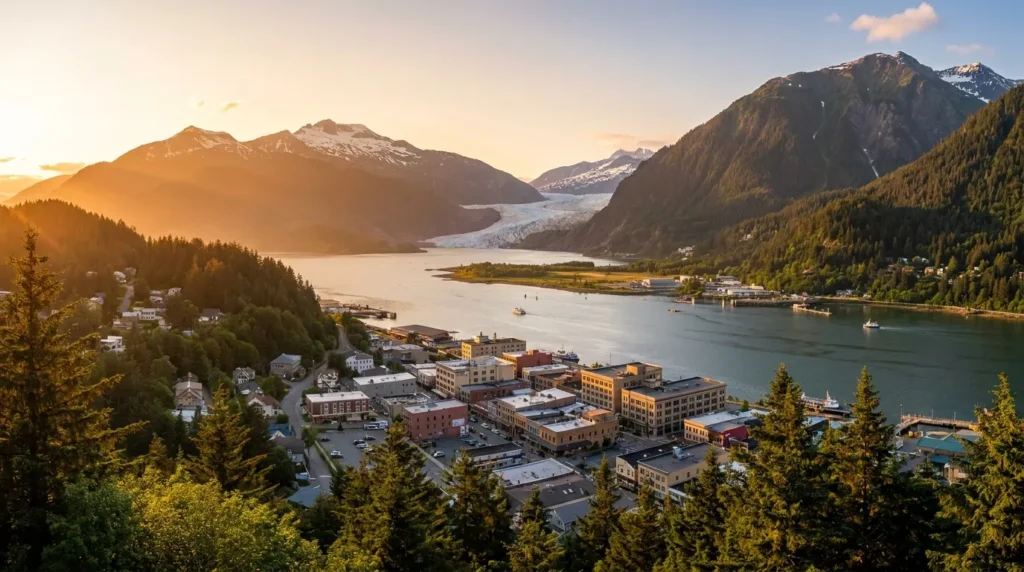
Juneau is the capital of Alaska, accessible only by boat or plane, featuring Mendenhall Glacier, the Mount Roberts Tramway, whale watching opportunities, and a strong Tlingit cultural presence.

Juneau is one of the few American capitals with no road access, nestled between the ocean and the Coast Mountains. Mendenhall Glacier, just a few miles from downtown, is a landmark and a constant destination for hikers, with the Mendenhall Glacier Visitor Center, trails to Nugget Falls, and overlooks along the West Glacier Trail.

The Mount Roberts Tramway rises directly from the harbor to alpine trails, and the historic downtown is home to the Alaska State Museum, the Russian Orthodox Saint Nicholas Church, and the Sealaska Heritage Institute, a central institution for Tlingit, Haida, and Tsimshian culture. In summer, humpback whale watching in Auke Bay and Stephens Passage is a common activity.

The annual calendar includes the Alaska Folk Festival in spring, the biennial Celebration gathering of Indigenous peoples hosted by the Sealaska Heritage Institute, and Juneau Jazz & Classics. In winter, Eaglecrest Ski Area on Douglas Island serves local skiers, and events such as the Juneau Public Market bring the community together.

  1. 1["Mendenhall Glacier"
  2. 2"Mount Roberts Tramway"
  3. 3"Alaska State Museum"
  4. 4"Last Chance Mining Museum"
  5. 5"Macaulay Salmon Hatchery"
  6. 6"Glacier Gardens Rainforest Adventure"
Nightlife4.0 / 10
Parks & green spaces
  • ["Tongass National Forest"
  • "Mendenhall Glacier Recreation Area"
  • "Eagle Beach State Recreation Area"
  • "Mount Roberts Trail"
  • "Perseverance Trail"
  • +1 more

Latest posts

Posts about Alaska

Coverage and updates related to this destination.

Showing content from Alaska, as there is no specific data for Juneau yet.