Visto n' Visa
Blog
Notícias e artigos
Destinations
Careers
Immigrants

Want to live and work in Fairbanks?

Personalized immigration plan with eligible visas, costs, and next steps for your goal!

If you are not eligible, you will know exactly why and what to do to improve your approval chances.

Save up to 12 hours in meetings

No pointless assessments.

Save up to 90%

Save money on vague or unfocused consultations

Avoid Fraud and Mistakes

One mistake can cost you your visa

Total Impartiality

Zero commercial bias

Decide with peace of mind

No toxic urgency

Fast and Accurate

Answers in minutes, no guesswork

Fairbanks population: military families, university students, and Athabascan Native communities

A mix of military families, UAF students, the traditional Athabascan community, and workers tied to the oil industry.

Fairbanks has a distinctive composition. A large portion of the population is active-duty military or veterans, connected to Fort Wainwright (Army) and Eielson Air Force Base (Air Force), located just to the south. This brings families from across the United States who typically stay for a few years before rotating to other bases.

The University of Alaska Fairbanks (UAF) is the largest in the state and attracts students, professors, and Arctic researchers from around the world. The Asian community, particularly Korean, has grown alongside aurora tourism and the military base presence. The Athabascan (interior Native) community maintains a strong historical presence, with satellite villages surrounding the city.

International residents are relatively few and often connected to seasonal work or family ties to the military. English is essential for daily life. The overall educational level is high, shaped by the university's influence, with conversations about permafrost and geophysics common even in coffee shops.

Languages spoken
  • English
  • Spanish
  • Korean
  • Tagalog (Filipino)
  • Athabascan (Gwich'in, Koyukon)
  • +2 more
Main religions
  • Non-religious (high rate in the interior)
  • Protestant Christian
  • Catholic
  • Russian Orthodox (historical presence)
  • Mormon (LDS)

Cost of living in Fairbanks: elevated by freight costs, offset by no state income tax

Heating and fuel are major expenses in winter. Food is expensive due to freight. No state income or sales tax applies.

Living in Fairbanks costs more than in most of the contiguous United States, but is cheaper than Anchorage in many categories. Rent is reasonable: a 2- or 3-bedroom house can be found at prices competitive with Midwestern cities, especially outside the central area.

The major expense is energy. Heating a home in winter consumes heating oil or electricity and can cost several hundred dollars per month when temperatures remain at -30 degrees Celsius for weeks at a time. Gasoline is also expensive, and driving long distances to grocery stores is a normal part of the routine.

As throughout Alaska, there is no state income tax or state-level sales tax. Fairbanks (borough) rates are low. Anyone who resides in the state for a full calendar year receives the Permanent Fund Dividend, a payment drawn from the oil fund. This offsets some of the added cost of living so far from major population centers.

Fairbanks

Housing in Fairbanks: log cabins and cold-adapted homes

Wood-frame homes with heated basements and insulated garages are the norm. Neighborhoods range from rustic cabins to condominiums near UAF.

In Fairbanks, wood-frame construction is standard. Buildings feature heated basements, reinforced insulation, double or triple-pane windows, and heated garages, which are essential for starting a vehicle in winter. Central neighborhoods such as Hamilton Acres and Lemeta mix older homes with some multi-family buildings.

More desirable neighborhoods cluster around the University area (College, Goldstream) and the southern zone (Chena Ridge), where large homes overlook the valley. Those seeking a frontier cabin lifestyle look for lots in Two Rivers or Goldstream Valley, where some properties still rely on water delivery trucks rather than a public water system.

Rental options include whole houses, apartments, and dry cabins (cabins without plumbing, which are cheaper and popular among students). Landlords require proof of income and references. Summer is the peak rental season, as many residents move between university semesters.

Recommended neighborhoods
  • College (near UAF, students and faculty)
  • Goldstream Valley (cabins, more rural)
  • Chena Ridge (large homes, valley views)
  • Hamilton Acres (central, convenient)
  • Aurora (residential, nearby schools)
  • +2 more

Job market in Fairbanks: military, university, and mining

Fort Wainwright and Eielson Air Force Base are the dominant employers. UAF, gold mining, and aurora tourism round out the local economy.

The U.S. Army at Fort Wainwright and the Air Force at Eielson Air Force Base are the largest direct and indirect employers in the area. They generate civilian jobs in maintenance, supply, healthcare, and administration, while also driving commerce and services through the military family population.

The University of Alaska Fairbanks employs hundreds of researchers, professors, and technicians, with a strong focus on Arctic studies, climatology, geophysics, and biology. Permafrost and aurora borealis research puts Fairbanks on the global scientific map.

Gold mining remains significant: Fort Knox Gold Mine, east of the city, is one of the largest in the United States. Oil from the Trans-Alaska Pipeline, which passes through the area, generates seasonal employment. Aurora borealis tourism surges between September and March, with hotels, night tours, and onsen-style facilities hiring intensively during peak season.

Dominant sectors
  • Military (Fort Wainwright and Eielson Air Force Base)
  • University and Arctic research
  • Gold mining
  • Oil and pipeline
  • Tourism (aurora borealis)
  • +2 more
Major employers
  • Fort Wainwright (U.S. Army)
  • Eielson Air Force Base
  • University of Alaska Fairbanks (UAF)
  • Fort Knox Gold Mine
  • Fairbanks Memorial Hospital
  • +2 more

Education in Fairbanks: public schools and a research-focused university

The Fairbanks North Star Borough School District serves children. UAF is the leading public university and a global reference in Arctic studies.

Resident children have access to schools in the Fairbanks North Star Borough School District. The highest-rated schools tend to be near UAF and in West Valley. Specialized programs are available in Russian language, technical education, and outdoor learning.

The University of Alaska Fairbanks (UAF) is the flagship institution. Founded in 1917, it is the oldest university in the state and a world reference in geophysics, Arctic climatology, permafrost biology, mining, and engineering. The Geophysical Institute operates the HAARP radar and conducts aurora borealis research. Tuition for state residents is significantly lower than for out-of-state or international students.

The Career and Technical College offers practical training in welding, diesel mechanics, nursing, aviation, and skilled trades. For those arriving on a student visa, the F-1 student visa is the standard pathway, and UAF accepts international students across several programs.

Notable universities
  • University of Alaska Fairbanks (UAF)
  • UAF Community and Technical College
  • Charter College (Fairbanks campus)

Healthcare in Fairbanks: regional hospital and Tanana Chiefs for Native communities

Fairbanks Memorial is the main hospital, serving residents and patients from interior villages. Tanana Chiefs Conference serves Native communities.

The system follows the standard American model: private, based on employer-sponsored insurance, Medicaid (DenaliCare), or marketplace plans. Military personnel and veterans use the military and VA system. As throughout Alaska, employer-sponsored coverage often has a waiting period of up to three months, making temporary insurance important when starting a new job.

Fairbanks Memorial Hospital is the main medical center for the state's interior, offering emergency care, maternity services, cardiology, and oncology. The Tanana Chiefs Conference operates the Chief Andrew Isaac Health Center, which serves Native communities throughout the interior, including members traveling from remote villages.

For highly complex cases, patients are transferred to Anchorage or Seattle. Mental health and substance abuse treatment are receiving growing attention, as Fairbanks contends with elevated rates of suicide and alcoholism, challenges affecting Alaska as a whole, particularly in Native communities and during the dark winter months.

Healthcare index60.0 / 100
  • Life expectancyyears at birth
    78.4yrs
  • Doctors per 1kpracticing physicians
    3.7
  • Health spendper capita, per year
    $13,473
  • Public systemoverall quality rating
    Fair

Safety in Fairbanks: generally calm, with precautions for winter conditions and wildlife

A quiet city by American standards, with concerns related to extreme cold, bears in summer, and some more vulnerable neighborhoods.

Fairbanks has crime rates typical of a small American city. Residential neighborhoods such as College, Aurora, and Chena Ridge are quiet. Downtown and some areas around Cushman Street see more incidents of harassment and theft, particularly at night.

The greatest real risk is the climate. In January, with temperatures at -40 degrees, a non-starting vehicle or losing one's way can be fatal within minutes. Cars carry emergency jumper cables, extra clothing is kept on hand, and leaving home without guaranteed heating is not advisable. Electric block heaters prevent engines from freezing overnight.

Wildlife is part of daily life. Moose frequent residential yards and can become aggressive if they feel threatened, especially females with calves in spring. Black and brown bears appear on trails in summer, and bear spray is considered basic equipment. Wolves and lynx are rare but present in the surrounding area. Local police and Fish and Wildlife provide clear guidelines for safe coexistence.

5.8
Homicides per 100k
per year
Safety index
36.0
Crime index
64.0
Safer neighborhoods
  • Goldstream Valley
  • University West (near UAF)
  • Farmers Loop
  • Chena Ridge
  • Steele Creek
Areas to avoid
  • South Cushman corridor at night
  • Industrial areas along Van Horn Road
  • Isolated stretches near the Chena River after dark

Transportation in Fairbanks: a car is essential, flights connect to the rest of Alaska

Nearly everyone owns a car. Local buses exist but with limited coverage. FAI airport links to the rest of the state and to Anchorage.

In Fairbanks, owning a car is not a luxury but a necessity. Extreme cold makes waiting for a bus painful, and the distances between home, work, and grocery stores are considerable. Cars equipped with an outlet for an engine block heater are standard. Parking is easy and inexpensive and is rarely a challenge.

The MACS Transit system offers bus routes connecting downtown, UAF, hospitals, and the mall. It serves students and those without a car more than it does typical daily commuters. Bicycles appear only in summer, and even then caution is warranted due to traffic and road dust.

Fairbanks International Airport (FAI) has daily flights to Anchorage, Seattle, and some seasonal destinations. It also serves as a base for bush planes (small aircraft) connecting Fairbanks to Arctic villages such as Bettles, Coldfoot, and Anaktuvuk Pass. The Dalton Highway, which extends to the Arctic Ocean, begins just north of the city.

18 min
Avg commute
32
Walkability
Airports
  • FAI — Fairbanks International Airport
  • International airport
  • Bike infrastructure

What the climate is like living in Fairbanks

Fairbanks has a classic subarctic climate, with brief summers of moderate warmth and nearly continuous daylight, and long, brutal winters with temperatures frequently below -30°C.

Summer runs from June through August and is surprisingly warm for the latitude. Highs reach 77°F (25°C), with cool nights. In June, the sun stays above the horizon for nearly 22 hours, and the city operates at an intense pace of festivals, hiking, and fishing on the Tanana and Chena rivers.

Winter dominates the calendar from October through April. Regular lows fall between -18°F and -36°F (-28°C to -38°C), with extreme episodes below -49°F (-45°C). Snow covers the ground for months, and in December there are fewer than four hours of daylight. Northern lights are common. Continuous heating, double-pane windows, and vehicles fitted with block heaters are standard practice.

For those planning to live here, expect extreme temperatures, heavy heating bills, and only a few months suitable for gardening. Technical cold-weather clothing, a heated garage, and adjustment to low winter light make a significant difference. Air conditioning is rarely needed.

Sunny days / year130 days
Avg high (°F)
  • J
  • 11°F
  • 27°M
  • 40°A
  • 61°M
  • 71°J
  • 73°J
  • 65°A
  • 55°S
  • 37°O
  • 18°N
  • D
Avg low (°F)
  • -6°J
  • -3°F
  • 10°M
  • 20°A
  • 39°M
  • 51°J
  • 55°J
  • 50°A
  • 39°S
  • 26°O
  • N
  • -5°D
Rainfall (")
  • 1"J
  • 1"F
  • 1"M
  • 1"A
  • 1"M
  • 2"J
  • 3"J
  • 4"A
  • 2"S
  • 2"O
  • 1"N
  • 2"D

Culture in Fairbanks: northern lights, dog mushing, and frontier spirit

A city of long winters, with strong dog mushing traditions, hot spring soaks at Chena Hot Springs, and celebration of the summer solstice.

Fairbanks carries a frontier-city identity. Winter defines everything: residents commute to work in the dark, eat lunch in the dark, and return home in the dark between December and January. In return, the northern lights are often visible from the backyard. Homes commonly have saunas, wood-burning fireplaces, and food stores stocked for blizzards or supply disruptions.

The regional sport is dog mushing. The Yukon Quest, one of the world's most demanding sled dog races, departs from Fairbanks in February on alternating years with Whitehorse. Ice fishing, cross-country skiing, snowmachining, and hunting are regular parts of the calendar. In summer everything reverses: fishing around the clock, canoeing on the Chena River, and outdoor festivals.

Local cuisine centers on what is hunted and fished: moose, caribou, king salmon, and northern pike. Pubs such as Silver Gulch (the northernmost brewery in the United States) and restaurants like Lavelle's Bistro are local staples. The onsen at Chena Hot Springs Resort, inspired by Japanese hot baths, have become a notable tourism draw. The Midnight Sun Festival in June, celebrated under a sun that never sets, is the largest event of the year.

Fairbanks

Fairbanks in Alaska's interior, northern lights, hot springs, and university

An interior Alaska city, the unofficial capital of the northern lights, with a strong public university, surrounding hot springs, and a gateway to the Arctic Circle.

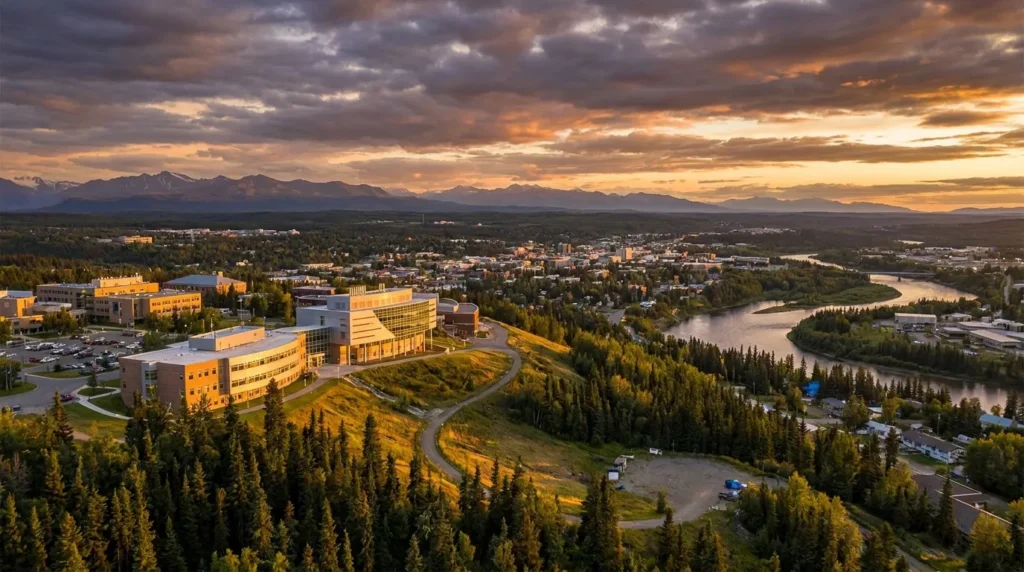
Fairbanks sits in Alaska's interior, far from the ocean, at the confluence of the Chena and Tanana rivers. It is the state's second-largest city and serves as the gateway to the American Arctic. Residents grow accustomed to extreme winters with lows that can drop past forty below zero, and luminous summers in which the sun barely sets. The main neighborhoods surround downtown, College, and North Pole, the neighboring community.

The University of Alaska Fairbanks is the largest employer and home to the Museum of the North, which brings together Indigenous art, geology, and natural history. Pioneer Park, formerly Alaskaland, preserves log cabins and small museums. For aurora viewing, overlooks such as Cleary Summit and Murphy Dome are about thirty minutes from downtown. Chena Hot Springs Resort, 60 miles out, combines outdoor thermal pools, a sled-dog kennel, and the well-known Aurora Ice Museum.

The annual calendar revolves around events such as the World Ice Art Championships in February, the Yukon Quest sled-dog race, and the Midnight Sun Baseball Game in June, played without artificial lighting. Common day trips include Denali National Park to the south and the Dalton Highway heading toward the Arctic, with stops at the Arctic Circle and Coldfoot.

  1. 1["Museum of the North (University of Alaska Fairbanks)"
  2. 2"Pioneer Park"
  3. 3"Chena Hot Springs Resort"
  4. 4"Aurora Ice Museum"
  5. 5"Morris Thompson Cultural and Visitors Center"
  6. 6"Riverboat Discovery"
Nightlife4.0 / 10
Parks & green spaces
  • ["Creamer's Field Migratory Waterfowl Refuge"
  • "Pioneer Park"
  • "Chena River State Recreation Area"
  • "Birch Hill Recreation Area"
  • "Wedgewood Wildlife Sanctuary"
  • +1 more

Latest posts

Posts about Alaska

Coverage and updates related to this destination.

Showing content from Alaska, as there is no specific data for Fairbanks yet.